

- Open Access
Photonic Restricted Boltzmann Machine for Content Generation Tasks
Phys. Rev. X 16, 011071 – Published 31 March, 2026
DOI: https://doi.org/10.1103/k6f7-gtr7
Abstract
The restricted Boltzmann machine (RBM) is a neural network based on the Ising model, well known for its ability to learn probability distributions and stochastically generate new content. However, the high computational cost of Gibbs sampling in content generation tasks imposes significant bottlenecks on electronic implementations. Here, we propose a photonic restricted Boltzmann machine (PRBM) that leverages photonic computing to accelerate Gibbs sampling, enabling efficient content generation. By introducing an efficient encoding method, the PRBM eliminates the need for computationally intensive matrix decomposition and reduces the computational complexity of a single dot product in Gibbs sampling from to . Moreover, with the advantage of photonic computation of non–von Neumann computing architecture, we physically encode the model parameters onto the phases of different wavelength light fields on a spatial light modulator, substantially enhancing computation efficiency for large-scale RBMs. We experimentally validate the photonic-accelerated Gibbs sampling by simulating a two-dimensional Ising model, where the observed phase transition temperature closely matches the theoretical predictions. Beyond physics-inspired tasks, the PRBM demonstrates strong performance in generating and restoring diverse content, including images and temporal sequences. The scalability and reduced training cost of the PRBM framework underscore its potential as a promising pathway for advancing photonic computing in generative artificial intelligence.
Physics Subject Headings (PhySH)
Popular Summary
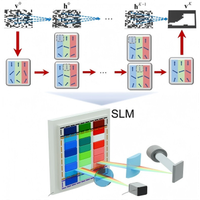
The high computational cost and enormous resource demands in implementing Gibbs sampling with restricted Boltzmann machines in traditional electronic computing impose significant bottlenecks on the continuous advancement of generative artificial-intelligence systems. We develop a photonic restricted Boltzmann machine that accelerates generative tasks by encoding neural network parameters onto the phases of different wavelength light fields on a spatial light modulator. By leveraging a non–von Neumann photonic computing architecture, we eliminate data-transfer bottlenecks between memory and processors and reduce the computational complexity of Gibbs sampling processes. Furthermore, our system naturally avoids backpropagation-based training and successfully generates diverse content including fashion images and piano melodies. We anticipate that the scalability and reduced training costs of this framework will offer a promising pathway toward more efficient and sustainable applications in generative artificial intelligence.
Article Text
Supplemental Material
References (77)
- P. Smolensky, Chapter 6: Information processing in dynamical systems: Foundations of harmony theory, in Parallel Distributed Processing: Explorations in the Microstructure of Cognition: Foundations, edited by D. E. Rumelhart and J. L. McClelland (MIT Press, 1986), pp. 194–281.
- G. E. Hinton, Training products of experts by minimizing contrastive divergence, Neural Comput. 14, 1771 (2002).
- R. Salakhutdinov and G. Hinton, Deep Boltzmann machines, in Artificial Intelligence and Statistics (PMLR, Florida, USA, 2009), pp. 448–455.
- G. E. Hinton and R. R. Salakhutdinov, Reducing the dimensionality of data with neural networks, Science 313, 504 (2006).
- M. N. Bojnordi and E. Ipek, Memristive Boltzmann machine: A hardware accelerator for combinatorial optimization and deep learning, in Proceedings of the 2016 IEEE International Symposium on High Performance Computer Architecture (HPCA) (IEEE, New York, 2016), pp. 1–13.
- I. Goodfellow, Y. Bengio, and A. Courville, Deep Learning (MIT Press, 2016).
- H. Larochelle and Y. Bengio, Classification using discriminative restricted Boltzmann machines, in Proceedings of the 25th International Conference on Machine Learning (ACM, Helsinki, Finland, 2008), pp. 536–543.
- J. Fernandez de Cossio Diaz, S. Cocco, and R. Monasson, Disentangling representations in restricted Boltzmann machines without adversaries, Phys. Rev. X 13, 021003 (2023).
- S. Patel, P. Canoza, and S. Salahuddin, Logically synthesized and hardware-accelerated restricted Boltzmann machines for combinatorial optimization and integer factorization, Nat. Electron. 5, 92 (2022).
- X. Li, C. Wan, R. Zhang, M. Zhao, S. Xiong, D. Kong, X. Luo, B. He, S. Liu, J. Xia et al., Restricted Boltzmann machines implemented by spin–orbit torque magnetic tunnel junctions, Nano Lett. 24, 5420 (2024).
- N. Boulanger-Lewandowski, Y. Bengio, and P. Vincent, Modeling temporal dependencies in high-dimensional sequences: application to polyphonic music generation and transcription, in Proceedings of the 29th International Conference on Machine Learning (Omnipress, Edinburgh, UK, 2012), pp. 1881–1888.
- D. Koller and N. Friedman, Probabilistic Graphical Models: Principles and Techniques (MIT Press, Cambridge, MA, 2009).
- C. Andrieu, N. De Freitas, A. Doucet, and M. I. Jordan, An introduction to MCMC for machine learning, Mach. Learn. 50, 5 (2003).
- D. H. Ackley, G. E. Hinton, and T. J. Sejnowski, A learning algorithm for Boltzmann machines, Cogn. Sci. 9, 147 (1985).
- P. M. Long and R. Servedio, Restricted Boltzmann machines are hard to approximately evaluate or simulate, in Proceedings of the 27th International Conference on Machine Learning (ICML-10) (Citeseer, 2010), pp. 703–710.
- S. Niazi, S. Chowdhury, N. A. Aadit, M. Mohseni, Y. Qin, and K. Y. Camsari, Training deep Boltzmann networks with sparse Ising machines, Nat. Electron. 7, 610 (2024).
- G. Wetzstein, A. Ozcan, S. Gigan, S. Fan, D. Englund, M. Soljačić, C. Denz, D. A. B. Miller, and D. Psaltis, Inference in artificial intelligence with deep optics and photonics, Nature (London) 588, 39 (2020).
- P. L. McMahon, The physics of optical computing, Nat. Rev. Phys. 5, 717 (2023).
- M. Matuszewski, A. Prystupiuk, and A. Opala, Role of all-optical neural networks, Phys. Rev. Appl. 21, 014028 (2024).
- R. Hamerly, L. Bernstein, A. Sludds, M. Soljačić, and D. Englund, Large-scale optical neural networks based on photoelectric multiplication, Phys. Rev. X 9, 021032 (2019).
- P. L. McMahon, A. Marandi, Y. Haribara, R. Hamerly, C. Langrock, S. Tamate, T. Inagaki, H. Takesue, S. Utsunomiya, K. Aihara et al., A fully programmable 100-spin coherent Ising machine with all-to-all connections, Science 354, 614 (2016).
- T. Inagaki, Y. Haribara, K. Igarashi, T. Sonobe, S. Tamate, T. Honjo, A. Marandi, P. L. McMahon, T. Umeki, K. Enbutsu et al., A coherent Ising machine for 2000-node optimization problems, Science 354, 603 (2016).
- T. Inagaki, K. Inaba, R. Hamerly, K. Inoue, Y. Yamamoto, and H. Takesue, Large-scale Ising spin network based on degenerate optical parametric oscillators, Nat. Photonics 10, 415 (2016).
- F. Böhm, G. Verschaffelt, and G. Van der Sande, A poor man’s coherent Ising machine based on opto-electronic feedback systems for solving optimization problems, Nat. Commun. 10, 1 (2019).
- A. Marandi, Z. Wang, K. Takata, R. L. Byer, and Y. Yamamoto, Network of time-multiplexed optical parametric oscillators as a coherent Ising machine, Nat. Photonics 8, 937 (2014).
- S. Utsunomiya, K. Takata, and Y. Yamamoto, Mapping of Ising models onto injection-locked laser systems, Opt. Express 19, 18091 (2011).
- M. Babaeian, D. T. Nguyen, V. Demir, M. Akbulut, P.-A. Blanche, Y. Kaneda, S. Guha, M. A. Neifeld, and N. Peyghambarian, A single shot coherent Ising machine based on a network of injection-locked multicore fiber lasers, Nat. Commun. 10, 1 (2019).
- C. Tradonsky, I. Gershenzon, V. Pal, R. Chriki, A. A. Friesem, O. Raz, and N. Davidson, Rapid laser solver for the phase retrieval problem, Sci. Adv. 5, eaax4530 (2019).
- M. Parto, W. Hayenga, A. Marandi, D. N. Christodoulides, and M. Khajavikhan, Realizing spin Hamiltonians in nanoscale active photonic lattices, Nat. Mater. 19, 725 (2020).
- M. Honari-Latifpour and M.-A. Miri, Mapping the XY Hamiltonian onto a network of coupled lasers, Phys. Rev. Res. 2, 043335 (2020).
- K. P. Kalinin, A. Amo, J. Bloch, and N. G. Berloff, Polaritonic XY-Ising machine, Nanophotonics 9, 4127 (2020).
- N. G. Berloff, M. Silva, K. Kalinin, A. Askitopoulos, J. D. Töpfer, P. Cilibrizzi, W. Langbein, and P. G. Lagoudakis, Realizing the classical XY Hamiltonian in polariton simulators, Nat. Mater. 16, 1120 (2017).
- K. P. Kalinin and N. G. Berloff, Simulating Ising and n-state planar Potts models and external fields with nonequilibrium condensates, Phys. Rev. Lett. 121, 235302 (2018).
- W. Verstraelen and Timothy C. Liew, Optical resonators constitute a universal spin simulator, Phys. Rev. B 111, 014307 (2025).
- K. Kim, M.-S. Chang, S. Korenblit, R. Islam, E. E. Edwards, J. K. Freericks, G.-D. Lin, L.-M. Duan, and C. Monroe, Quantum simulation of frustrated Ising spins with trapped ions, Nature (London) 465, 590 (2010).
- J. Struck, M. Weinberg, C. Ölschläger, P. Windpassinger, J. Simonet, K. Sengstock, R. Höppner, P. Hauke, A. Eckardt, M. Lewenstein et al., Engineering Ising-XY spin-models in a triangular lattice using tunable artificial gauge fields, Nat. Phys. 9, 738 (2013).
- M. Vretenar, B. Kassenberg, S. Bissesar, C. Toebes, and J. Klaers, Controllable Josephson junction for photon Bose-Einstein condensates, Phys. Rev. Res. 3, 023167 (2021).
- F. Cai, S. Kumar, T. Van Vaerenbergh, X. Sheng, R. Liu, C. Li, Z. Liu, M. Foltin, S. Yu, Q. Xia, J. J. Yang, R. Beausoleil, W. D. Lu, and J. P. Strachan, Power-efficient combinatorial optimization using intrinsic noise in memristor Hopfield neural networks, Nat. Electron. 3, 409 (2020).
- M. W. Johnson, M. H. S. Amin, S. Gildert, T. Lanting, F. Hamze, N. Dickson, R. Harris, A. J. Berkley, J. Johansson, P. Bunyk et al., Quantum annealing with manufactured spins, Nature (London) 473, 194 (2011).
- S. Boixo, T. F. Rønnow, S. V. Isakov, Z. Wang, D. Wecker, D. A. Lidar, J. M. Martinis, and M. Troyer, Evidence for quantum annealing with more than one hundred qubits, Nat. Phys. 10, 218 (2014).
- A. D. King, J. Carrasquilla, J. Raymond, I. Ozfidan, E. Andriyash, A. Berkley, M. Reis, T. Lanting, R. Harris, F. Altomare et al., Observation of topological phenomena in a programmable lattice of 1,800 qubits, Nature (London) 560, 456 (2018).
- C. Roques-Carmes, Y. Shen, C. Zanoci, M. Prabhu, F. Atieh, L. Jing, T. Dubček, C. Mao, M. R. Johnson, V. Čeperić et al., Heuristic recurrent algorithms for photonic Ising machines, Nat. Commun. 11, 249 (2020).
- M. Prabhu, C. Roques-Carmes, Y. Shen, N. Harris, L. Jing, J. Carolan, R. Hamerly, T. Baehr-Jones, M. Hochberg, V. Čeperić et al., Accelerating recurrent Ising machines in photonic integrated circuits, Optica 7, 551 (2020).
- Y. Shen, N. C. Harris, S. Skirlo, M. Prabhu, T. Baehr-Jones, M. Hochberg, X. Sun, S. Zhao, H. Larochelle, D. Englund et al., Deep learning with coherent nanophotonic circuits, Nat. Photonics 11, 441 (2017).
- K. Wu, J. G. De Abajo, C. Soci, P. P. Shum, and N. I. Zheludev, An optical fiber network oracle for NP-complete problems, Light 3, e147 (2014).
- Y. Okawachi, M. Yu, J. K. Jang, X. Ji, Y. Zhao, B. Y. Kim, M. Lipson, and A. L. Gaeta, Demonstration of chip-based coupled degenerate optical parametric oscillators for realizing a nanophotonic spin-glass, Nat. Commun. 11, 1 (2020).
- S. Hua, E. Divita, S. Yu, B. Peng, C. Roques-Carmes, Z. Su, Z. Chen, Y. Bai, J. Zou, Y. Zhu et al., An integrated large-scale photonic accelerator with ultralow latency, Nature (London) 640, 361 (2025).
- J. Ouyang, S. Liu, Z. Yang, W. Wang, X. Feng, Y. Li, and Y. Huang, 16-channel photonic solver for optimization problems on a silicon chip, Chip 4, 100117 (2025).
- B. Wu, W. Zhang, S. Zhang, H. Zhou, Z. Ruan, M. Li, D. Huang, J. Dong, and X. Zhang, A monolithically integrated optical Ising machine, Nat. Commun. 16, 4296 (2025).
- Z. Yang, C. Li, Y. Ran, Y. Li, X. Feng, K. Cui, F. Liu, H. Sun, W. Zhang, Y. Ye et al., SUANPAN: Scalable photonic linear vector machine, Light 15, 16 (2026).
- Z. Hu, Y. Ren, Y. Meng, T. Wang, Y. Jiang, M. Wei, Y. Xiao, Z. Li, and M. Li, Programmable optoelectronic Ising machine for optimization of real-world problems, Light 15, 6 (2026).
- D. Pierangeli, G. Marcucci, and C. Conti, Large-scale photonic Ising machine by spatial light modulation, Phys. Rev. Lett. 122, 213902 (2019).
- H. Yamashita, K. I. Okubo, S. Shimomura, Y. Ogura, J. Tanida, and H. Suzuki, Low-rank combinatorial optimization and statistical learning by spatial photonic Ising machine, Phys. Rev. Lett. 131, 063801 (2023).
- D. Veraldi, D. Pierangeli, S. Gentilini, M. C. Strinati, J. Sakellariou, J. S. Cummins, A. Kamaletdinov, M. Syed, R. Z. Wang, N. G. Berloff et al., Fully programmable spatial photonic Ising machine by focal plane division, Phys. Rev. Lett. 134, 063802 (2025).
- S. Shimomura, J. Tanida, and Y. Ogura, Parallel spatial photonic Ising machine using spatial multiplexing for accelerating combinatorial optimization, Opt. Lett. 50, 6674 (2025).
- L. Luo, Z. Mi, J. Huang, and Z. Ruan, Wavelength-division multiplexing optical Ising simulator enabling fully programmable spin couplings and external magnetic fields, Sci. Adv. 9, eadg6238 (2023).
- Y. Fang, J. Huang, and Z. Ruan, Experimental observation of phase transitions in spatial photonic Ising machine, Phys. Rev. Lett. 127, 043902 (2021).
- D. Pierangeli, G. Marcucci, D. Brunner, and C. Conti, Noise-enhanced spatial-photonic Ising machine, Nanophotonics 9, 4109 (2020).
- J. Huang, Y. Fang, and Z. Ruan, Antiferromagnetic spatial photonic Ising machine through optoelectronic correlation computing, Commun. Phys. 4, 1 (2021).
- W. Sun, W. Zhang, Y. Liu, Q. Liu, and Z. He, Quadrature photonic spatial Ising machine, Opt. Lett. 47, 1498 (2022).
- S. Kumar, Z. Li, T. Bu, C. Qu, and Y. Huang, Observation of distinct phase transitions in a nonlinear optical Ising machine, Commun. Phys. 6, 31 (2023).
- M. Leonetti, E. Hörmann, L. Leuzzi, G. Parisi, and G. Ruocco, Optical computation of a spin glass dynamics with tunable complexity, Proc. Natl. Acad. Sci. U.S.A. 118, e2015207118 (2021).
- S.-T. Yu, M.-G. He, S. Fang, Y. Deng, and Z.-S. Yuan, Spatial optical simulator for classical statistical models, Phys. Rev. Lett. 133, 237101 (2024).
- F. Böhm, D. Alonso-Urquijo, G. Verschaffelt, and G. Van der Sande, Noise-injected analog Ising machines enable ultrafast statistical sampling and machine learning, Nat. Commun. 13, 5847 (2022).
- L. Onsager, Crystal statistics. I. A two-dimensional model with an order-disorder transition, Phys. Rev. 65, 117 (1944).
- See Supplemental Material at http://link.aps.org/supplemental/10.1103/k6f7-gtr7 for additional details.
- S. Kirkpatrick, C. D. Gelatt Jr, and M. P. Vecchi, Optimization by simulated annealing, Science 220, 671 (1983).
- H. Xiao, K. Rasul, and R. Vollgraf, Fashion-MNIST: A novel image dataset for benchmarking machine learning algorithms, arXiv:1708.07747.
- Y. LeCun, C. Cortes, and C. J. Burges, The MNIST database of handwritten digits, https://yann.lecun.org/exdb/mnist/.
- G. E. Hinton, A practical guide to training restricted Boltzmann machines, in Neural Networks: Tricks of the Trade: Second Edition (Springer, New York, 2012), pp. 599–619.
- Nottingham dataset, https://github.com/jukedeck/nottingham-dataset.git.
- M. Li, J. Ling, Y. He, U. A. Javid, S. Xue, and Q. Lin, Lithium niobate photonic-crystal electro-optic modulator, Nat. Commun. 11, 4123 (2020).
- A. Smolyaninov, A. El Amili, F. Vallini, S. Pappert, and Y. Fainman, Programmable plasmonic phase modulation of free-space wavefronts at gigahertz rates, Nat. Photonics 13, 431 (2019).
- C. L. Panuski, I. Christen, M. Minkov, C. J. Brabec, S. Trajtenberg-Mills, A. D. Griffiths, J. J. McKendry, G. L. Leake, D. J. Coleman, C. Tran et al., A full degree-of-freedom spatiotemporal light modulator, Nat. Photonics 16, 834 (2022).
- A. Momeni, B. Rahmani, B. Scellier, L. G. Wright, P. L. McMahon, C. C. Wanjura, Y. Li, A. Skalli, N. G. Berloff, T. Onodera et al., Training of physical neural networks, Nature (London) 645, 53 (2025).
- J. Kaplan, S. McCandlish, T. Henighan, T. B. Brown, B. Chess, R. Child, S. Gray, A. Radford, J. Wu, and D. Amodei, Scaling laws for neural language models, arXiv:2001.08361.
- https://github.com/loli145/PRBM.

