

- Featured in Physics
- Open Access
Unifying Same- and Different-Material Particle Charging through Stochastic Scaling
Phys. Rev. X 16, 011023 – Published 11 February, 2026
DOI: https://doi.org/10.1103/k45s-g74h
Abstract
Triboelectric charging of insulating particles through contact is critical in diverse physical and engineering processes, from dust storms and volcanic eruptions to industrial powder handling. However, many experiments over the years have consistently revealed counterintuitive charging patterns, including variable impact charge under identical conditions, charge sign reversal with repeated impacts, and bipolar charging of differently sized particles. Existing computational models cannot predict these patterns; they either rely on oversimplified heuristics or require inaccessible detailed surface properties. We present a stochastic scaling model (SSM) for particle charging that unifies same-material (particle-particle) and different-material (particle-wall) charging in a single theoretical framework. The model is grounded in a physics-based stochastic closure by the mean, variance, skewness, and minimum impact charge measured in a highly controlled reference experiment. To test the SSM, we implemented it in an open-source Lagrangian-Eulerian computational fluid dynamics solver. When simulating 300 000 insulating particles transported by turbulent wall-bounded flows, the SSM takes less than 0.01% of the CPU time. By scaling the statistical parameters of the reference impact to each collision, the new model reproduces the complex charging patterns observed in experiments without requiring surface-level first-principles inputs. The SSM offers a physically grounded route to large-scale simulations of electrostatic effects across many fields of particle-laden flows.
Physics Subject Headings (PhySH)
 synopsis

A New Model for Particle Charging
A statistical approach yields a fast, flexible model for how particles in a powder acquire electric charge from each other and their surroundings.
See more in Physics
Popular Summary
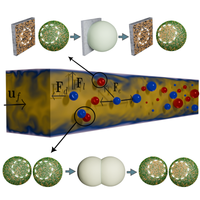
When small particles collide, they can transfer electric charge in a process called triboelectric charging. Triboelectric charging is important in natural events like volcanic eruptions and dust storms, as well as in industrial processes such as handling powder, where it can lead to problems like fouling or even explosions. In most particle flows, particles collide with other particles of the same material and with surrounding surfaces of different materials. Yet existing charging models for large-scale simulations cannot predict both charging types at the same time. We introduce a model that predicts charging for same-material and different-material collisions by unified scaling laws. This model captures the randomness of charge transfer, charge reversal, and size-dependent charging, as observed in experiments. Our model is unique in that it enables realistic simulations of electrostatic effects in natural and industrial particle flows, providing insight into a wide range of problems.
Article Text
References (69)
- C. Cimarelli and K. Genareau, A review of volcanic electrification of the atmosphere and volcanic lightning, J. Volcanol. Geotherm. Res. 422, 107449 (2022).
- A. K. Kamra, Physical sciences: Visual observation of electric sparks on gypsum dunes, Nature (London) 240, 143 (1972).
- T. Shinbrot, K. LaMarche, and B. J. Glasser, Triboelectrification and razorbacks: Geophysical patterns produced in dry grains, Phys. Rev. Lett. 96, 178002 (2006).
- C. M. Hartzell, Dynamics of 2D electrostatic dust levitation at asteroids, Icarus 333, 234 (2019).
- J. Méndez Harper, C. S. McDonald, E. J. Rheingold, L. C. Wehn, R. E. Bumbaugh, E. J. Cope, L. E. Lindberg, J. Pham, Y.-H. Kim, J. Dufek, and C. H. Hendon, Moisture-controlled triboelectrification during coffee grinding, Matter Radiat. Extremes 7, 266 (2024).
- G. E. Klinzing, A review of pneumatic conveying status, advances and projections, Powder Technol. 333, 78 (2018).
- A. Giffin and P. Mehrani, Effect of gas relative humidity on reactor wall fouling generated due to bed electrification in gas-solid fluidized beds, Powder Technol. 235, 368 (2013).
- A. Oshawa, Statistical analysis of fires and explosions attributed to static electricity over the last 50 years in Japanese industry, J. Phys. Conf. Ser. 301, 012033 (2011).
- A. Grayver, Unravelling the electrical conductivity of earth and planets, Surv. Geophys. 45, 187 (2024).
- J. M. Zernhelt, M. Mor, and D. S. Juda, Coffee grinder with static electricity ground, U.S. Patent No. 10,912,418 (2021), https://patents.justia.com/patent/10912418.
- IEC 60079-32-1, Explosive Atmospheres—Part 32-1: Electrostatic Hazards, Technical Specification, 2012, https://webstore.iec.ch/en/publication/651.
- T. Matsuyama, M. Ogu, H. Yamamoto, J. C. M. Marijnissen, and B. Scarlett, Impact charging experiments with single particles of hundred micrometre size, Powder Technol. 135–136, 14 (2003).
- T. Matsuyama and H. Yamamoto, Impact charging of particulate materials, Chem. Eng. Sci. 61, 2230 (2006).
- G. Grosjean and S. Waitukaitis, Single-collision statistics reveal a global mechanism driven by sample history for contact electrification in granular media, Phys. Rev. Lett. 130, 098202 (2023).
- J. Lowell and I. Truscott, Triboelectrification of identical insulators. II. Theory and further experiments, J. Phys. D 19, 1281 (1986).
- P. E. Shaw, C. S. Jex, and W. B. Hardy, Tribo-electricity and friction. II.—Glass and solid elements, Proc. R. Soc. A 118, 97 (1928).
- S. R. Waitukaitis, V. Lee, J. M. Pierson, S. L. Forman, and H. M. Jaeger, Size-dependent same-material tribocharging in insulating grains, Phys. Rev. Lett. 112, 218001 (2014).
- K. M. Forward, D. J. Lacks, and R. M. Sankaran, Charge segregation depends on particle size in triboelectrically charged granular materials, Phys. Rev. Lett. 102, 028001 (2009).
- H. Grosshans, W. Xu, and T. Matsuyama, Simulation of PMMA powder flow electrification using a new charging model based on single-particle experiments, Chem. Eng. Sci. 254, 117623 (2021).
- S. L. Soo, Dynamics of charged suspensions, Topics in Current Aerosol Research (Pergamon Press, New York, 1971), pp. 71–73.
- H. Masuda, T. Komatsu, and K. Iinoya, The static electrification of particles in gas-solids pipe flow, AIChE J. 22, 558 (1976).
- W. John, G. Reischl, and W. Devor, Charge transfer to metal surfaces from bouncing aerosol particles, J. Aerosol Sci. 11, 115 (1980).
- J. C. Laurentie, P. Traoré, and L. Dascalescu, Discrete element modeling of triboelectric charging of insulating materials in vibrated granular beds, J. Electrost. 71, 951 (2013).
- S. Matsusaka, M. Gadhiri, and H. Masuda, Electrification of an elastic sphere by repeated impacts on a metal plate, J. Phys. D 33, 2311 (2000).
- C. Pei, C.-Y. Wu, D. England, S. Byard, H. Berchtold, and M. Adams, Numerical analysis of contact electrification using DEM-CFD, Powder Technol. 248, 34 (2013).
- H. Grosshans and S. Jantač, Recent progress in CFD modeling of powder flow charging during pneumatic conveying, Chem. Eng. J. 455, 140918 (2023).
- S. Matsusaka, H. Maruyama, T. Matsuyama, and M. Ghadiri, Triboelectric charging of powders: A review, Chem. Eng. Sci. 65, 5781 (2010).
- F. Chowdhury, M. Ray, A. Sowinski, P. Mehrani, and A. Passalacqua, A review on modeling approaches for the electrostatic charging of particles, Powder Technol. 389, 104 (2021).
- H. Grosshans and M. V. Papalexandris, Large eddy simulation of triboelectric charging in pneumatic powder transport, Powder Technol. 301, 1008 (2016).
- H. Grosshans and M. V. Papalexandris, Direct numerical simulation of triboelectric charging in a particle-laden turbulent channel flow, J. Fluid Mech. 818, 465 (2017).
- M. Zeybek and H. Grosshans, Eulerian formulation for the triboelectric charging of polydisperse powder flows, Phys. Fluids 33, 63304 (2021).
- M. Ray, F. Chowdhury, A. Sowinski, P. Mehrani, and A. Passalacqua, An Euler-Euler model for mono-dispersed gas-particle flows incorporating electrostatic charging due to particle-wall and particle-particle collisions, Chem. Eng. Sci. 197, 327 (2019).
- M. Ray, F. Chowdhury, A. Sowinski, P. Mehrani, and A. Passalacqua, Eulerian modeling of charge transport in bi-disperse particulate flows due to triboelectrification, Phys. Fluids 32, 023302 (2020).
- H. T. Baytekin, B. Baytekin, J. T. Incorvati, and B. A. Grzybowski, Material transfer and polarity reversal in contact charging, Angew. Chem., Int. Ed. Engl. 51, 4843 (2012).
- D. J. Lacks, N. Duff, and S. K. Kumar, Nonequilibrium accumulation of surface species and triboelectric charging in single component particulate systems, Phys. Rev. Lett. 100, 188305 (2008).
- D. J. Lacks and A. Levandovsky, Effect of particle size distribution on the polarity of triboelectric charging in granular insulator systems, J. Electrost. 65, 107 (2007).
- H. Grosshans and M. V. Papalexandris, A model for the non-uniform contact charging of particles, Powder Technol. 305, 518 (2016).
- X. Liu, J. Kolehmainen, I. Nwogbaga, A. Ozel, and S. Sundaresan, Effect of particle size on tribocharging, Powder Technol. 375, 199 (2020).
- J. Lowell and I. Truscott, Triboelectrification of identical insulators. I. An experimental investigation, J. Phys. D 19, 1273 (1986).
- L. Konopka and J. Kosek, Discrete element modeling of electrostatic charging of polyethylene powder particles, J. Electrost. 87, 150 (2017).
- S. Jantač and H. Grosshans, Suppression and control of bipolar powder charging by turbulence, Phys. Rev. Lett. 132, 054004 (2024).
- M. Apodaca, P. Wesson, K. Bishop, M. Ratner, and B. Grzybowski, Contact electrification between identical materials, Angew. Chem., Int. Ed. 49, 946 (2019).
- H. T. Baytekin, M. Patashisnki, A. Z. Branicki, B. Baytekin, S. Soh, and B. A. Grzybowski, The mosaic of surface charge in contact electrification, Science 33, 308 (2011).
- B. D. Terris, J. E. Stern, D. Rugar, and H. J. Mamin, Contact electrification using force microscopy, Phys. Rev. Lett. 63, 2669 (1989).
- T. A. L. Burgo, T. R. D. Ducati, K. R. Francisco, K. J. Clinckspoor, F. Galembeck, and S. E. Galembeck, Triboelectricity: Macroscopic charge patterns formed by self-arraying ions on polymer surfaces, Langmuir 28, 7407 (2012).
- G. Grosjean and S. Waitukaitis, Asymmetries in triboelectric charging: Generalizing mosaic models to different-material samples and sliding contacts, Phys. Rev. Mater. 7, 065601 (2023).
- Y. Zhang, A. Ozel, and C. M. Hartzell, A macroscopic donor-acceptor-based discrete element model for contact electrification of insulating granular materials, Powder Technol. 431, 119029 (2024).
- S. Jantač, J. Pelcová, J. Sklenářová, M. Drápela, H. Grosshans, and J. Kosek, Triboelectric charging model for particles with rough surfaces, Adv. Powder Technol. 36, 104787 (2025).
- P. M. Ireland, The role of changing contact in sliding triboelectrification, J. Phys. D 41, 025305 (2008).
- P. M. Ireland, Dynamic particle-surface tribocharging: The role of shape and contact mode, J. Electrost. 70, 524 (2012).
- T. Matsuyama, A discussion on maximum charge held by a single particle due to gas discharge limitation, AIP Conf. Proc. 1927, 02001 (2018).
- F. Chowdhury, A. Sowinski, M. Ray, A. Passalacqua, and P. Mehrani, Charge generation and saturation on polymer particles due to single and repeated particle-metal contacts, J. Electrost. 91, 9 (2018).
- W. Xu, S. Jantač, T. Matsuyama, and H. Grosshans, Spatially resolved measurement of the electrostatic charge of turbulent powder flows, Exp. Fluids 65, 1 (2024).
- V. Lee, N. M. James, S. R. Waitukaitis, and H. M. Jaeger, Collisional charging of individual submillimeter particles: Using ultrasonic levitation to initiate and track charge transfer, Phys. Rev. Mater. 2, 035602 (2018).
- D. Carter and C. M. Hartzell, Experimental methodology for measuring in-vacuum granular tribocharging, Rev. Sci. Instrum. 90, 125105 (2019).
- pafix, https://gitlab1.ptb.de/asep/pafix (2021).
- H. Grosshans and M. V. Papalexandris, On the accuracy of the numerical computation of the electrostatic forces between charged particles, Powder Technol. 322, 185 (2017).
- K.-H. Grote and J. Feldhusen, Dubbel (Springer, Wiesbaden, 2007).
- W. Domke, Werkstoffkunde und Werkstoffprüfung (Cornelsen, Berlin, 1986).
- N. Mujica and S. Waitukaitis, Accurate determination of the shapes of granular charge distributions, Phys. Rev. E 107, 034901 (2023).
- J. Haeberle, A. Schella, M. Sperl, M. Schröter, and P. Born, Double origin of stochastic granular tribocharging, Soft Matter 14, 4987 (2018).
- J. C. Sobarzo, F. Pertl, D. M. Balazs, T. Costanzo, M. Sauer, A. Foelske, M. Ostermann, C. M. Pichler, Y. Wang, Y. Nagata, M. Bonn, and S. Waitukaitis, Spontaneous ordering of identical materials into a triboelectric series, Nature (London) 638, 664 (2025).
- G. Ozler, M. Demircioglu, and H. Grosshans, Effect of drag force modelling on the flow of electrically charged particles, Adv. Powder Technol. 34, 103951 (2023).
- H. Grosshans, Influence of weak electrostatic charges and secondary flows on pneumatic powder transport, Can. J. Chem. Eng. 101, 2347 (2022).
- A. Putnam, Integratable form of droplet drag coefficient, ARS J. 31, 1467 (1961).
- P. G. Saffmann, The lift on a small sphere in a slow shear flow, J. Fluid Mech. 22, 385 (1965).
- R. Mei, An approximate expression for the shear lift on a spherical particle at finite Reynolds number, Int. J. Multiphase Flow 18, 145 (1992).
- S. D. Roth, Ray casting for modeling solids, Comput. Graphics Image Process. 18, 109 (1982).
- T. Schroeder, Collision detection using ray casting, Game Dev. 8, 50 (2001).

