

- Open Access
Fluidic Hysterons and Memory in Flow Networks
Phys. Rev. X 16, 041011 – Published 9 October, 2026
DOI: https://doi.org/10.1103/hh4n-pw7w
Abstract
Hysterons provide a minimal description of memory in driven matter: bistable elements with distinct switching thresholds whose collective dynamics generate hysteresis, avalanches, and history-dependent switching. Experimental realizations have so far been dominated by solid-state mechanical systems, where bistability is usually encoded structurally through buckling, snap-through, or geometric incompatibility. Here we realize hysteron physics through a hydrodynamic route. A single elastic fiber anchored in a microfluidic channel becomes bistable through nonlinear elastohydrodynamic feedback: Viscous loading deforms the fiber, deformation reshapes hydraulic resistance, and flow redistribution modifies the loading. This feedback produces a fluidic hysteron whose onset is organized by a cusp catastrophe in geometric control parameters. A parallel bypass channel acts as a geometric load line that reshapes, and can even eliminate, bistability while simultaneously mediating long-ranged hydraulic interactions between fibers. In arrays, varying a single geometric parameter drives a transition from a noninteracting Preisach regime with return-point memory to an interacting regime with configuration-dependent thresholds, mixed-direction switching paths, and projected trajectories that cross the independent-Preisach envelope. These results establish a passive hydrodynamic route to hysteron networks, in which memory emerges from flow-structure feedback and global hydraulic constraints.
Physics Subject Headings (PhySH)
Popular Summary
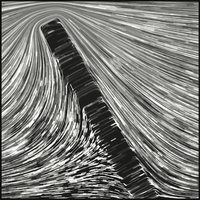
Physical systems, like crumpled sheets or mechanical metamaterials, may respond differently after they are compressed, stretched, or shaken. Hysterons, simple bistable elements that switch at one threshold when the drive is increased and at another when it is decreased, can describe this kind of memory. We show that such memory can arise in a purely fluidic setting. Our elementary unit is a soft elastic fiber anchored inside a microfluidic channel. Viscous forces bend the fiber as fluid flows past, which changes the channel resistance and redirects the flow, changing the force on the fiber. This makes the fiber snap between two stable states. We can tune the bistability of the fiber and the interactions between multiple fibers by adding a parallel bypass channel. In arrays, these interactions produce cascadelike switching events and memory effects that differ from those of independent hysterons. This establishes a passive hydrodynamic route to memory in flow networks and shows that history-dependent behavior can emerge.
Article Text
Supplemental Material
References (63)
- N. C. Keim and P. E. Arratia, Mechanical and microscopic properties of the reversible plastic regime in a 2d jammed material, Phys. Rev. Lett. 112, 028302 (2014).
- K. L. Galloway, E. G. Teich, X. G. Ma, C. Kammer, I. R. Graham, N. C. Keim, C. Reina, D. J. Jerolmack, A. G. Yodh, and P. E. Arratia, Relationships between structure, memory and flow in sheared disordered materials, Nat. Phys. 18, 565 (2022).
- Dor Shohat, Daniel Hexner, and Yoav Lahini, Memory from coupled instabilities in unfolded crumpled sheets, Proc. Natl. Acad. Sci. U.S.A. 119, e2200028119 (2022).
- Chaviva Sirote-Katz, Dor Shohat, Carl Merrigan, Yoav Lahini, Cristiano Nisoli, and Yair Shokef, Emergent disorder and mechanical memory in periodic metamaterials, Nat. Commun. 15, 4008 (2024).
- Joseph D. Paulsen and Nathan C. Keim, Mechanical memories in solids, from disorder to design, Annu. Rev. Condens. Matter Phys. 16, 61 (2025).
- Muhittin Mungan, Eric Clément, Damien Vandembroucq, and Srikanth Sastry, Self-organization, memory, and learning: From driven disordered systems to living matter, Annu. Rev. Condens. Matter Phys. 17, 207 (2026).
- Ferenc Preisach, Über die magnetische nachwirkung, Z. Phys. 94, 277 (1935).
- Nathan C. Keim, Joseph D. Paulsen, Zorana Zeravcic, Srikanth Sastry, and Sidney R. Nagel, Memory formation in matter, Rev. Mod. Phys. 91, 035002 (2019).
- James P. Sethna, Karin Dahmen, Sivan Kartha, James A. Krumhansl, Bruce W. Roberts, and Joel D. Shore, Hysteresis and hierarchies: Dynamics of disorder-driven first-order phase transformations, Phys. Rev. Lett. 70, 3347 (1993).
- Muhittin Mungan and M. Mert Terzi, The structure of state transition graphs in systems with return point memory: I. General theory, Ann. Henri Poincaré 20, 2819 (2019).
- Muhittin Mungan, Srikanth Sastry, Karin Dahmen, and Ido Regev, Networks and hierarchies: How amorphous materials learn to remember, Phys. Rev. Lett. 123, 178002 (2019).
- Hadrien Bense and Martin van Hecke, Complex pathways and memory in compressed corrugated sheets, Proc. Natl. Acad. Sci. U.S.A. 118, e2111436118 (2021).
- Martin van Hecke, Profusion of transition pathways for interacting hysterons, Phys. Rev. E 104, 054608 (2021).
- Nidhi Pashine, Daniel Hexner, Andrea J. Liu, and Sidney R. Nagel, Directed aging, memory, and nature’s greed, Sci. Adv. 5, eaax4215 (2019).
- Tian Chen, Mark Pauly, and Pedro M. Reis, A reprogrammable mechanical metamaterial with stable memory, Nature (London) 589, 386 (2021).
- L. J. Kwakernaak and M. van Hecke, Counting and sequential information processing in mechanical metamaterials, Phys. Rev. Lett. 130, 268204 (2023).
- Jingran Liu, Margot Teunisse, George Korovin, Ivo R. Vermaire, Lishuai Jin, Hadrien Bense, and Martin van Hecke, Controlled pathways and sequential information processing in serially coupled mechanical hysterons, Proc. Natl. Acad. Sci. U.S.A. 121, e2308414121 (2024).
- Joseph D. Paulsen, Mechanical hysterons with tunable interactions of general sign, Nat. Commun. 17, 2799 (2026).
- E. M. Purcell, Life at low Reynolds number, Am. J. Phys. 45, 3 (1977).
- Alex Groisman, Markus Enzelberger, and Stephen R. Quake, Microfluidic memory and control devices, Science 300, 955 (2003).
- Manu Prakash and Neil Gershenfeld, Microfluidic bubble logic, Science 315, 832 (2007).
- Michael J. Fuerstman, Piotr Garstecki, and George M. Whitesides, Coding/decoding and reversibility of droplet trains in microfluidic networks, Science 315, 828 (2007).
- José Alvarado, Jean Comtet, Emmanuel De Langre, and A. E. Hosoi, Nonlinear flow response of soft hair beds, Nat. Phys. 13, 1014 (2017).
- M. Gomez, D. E. Moulton, and D. Vella, Passive control of viscous flow via elastic snap-through, Phys. Rev. Lett. 119, 144502 (2017).
- Ofek Peretz, Anand K. Mishra, Robert F. Shepherd, and Amir D. Gat, Underactuated fluidic control of a continuous multistable membrane, Proc. Natl. Acad. Sci. U.S.A. 117, 5217 (2020).
- Ivan C. Christov, Soft hydraulics: From newtonian to complex fluid flows through compliant conduits, J. Phys. Condens. Matter 34, 063001 (2021).
- H. Garg, P. G. Ledda, J. S. Pedersen, and M. Pezzulla, Passive viscous flow selection via fluid-induced buckling, Phys. Rev. Lett. 133, 084001 (2024).
- Camille Jorge, Amélie Chardac, Alexis Poncet, and Denis Bartolo, Active hydraulics laws from frustration principles, Nat. Phys. 20, 303 (2024).
- K. Park, A. Tixier, A. H. Christensen, S. F. Arnbjerg-Nielsen, M. A. Zwieniecki, and K. H. Jensen, Viscous flow in a soft valve, J. Fluid Mech. 836, R3 (2018).
- A. H. Christensen and K. H. Jensen, Viscous flow in a slit between two elastic plates, Phys. Rev. Fluids 5, 044101 (2020).
- J. F. Louf, J. Knoblauch, and K. H. Jensen, Bending and stretching of soft pores enable passive control of fluid flows, Phys. Rev. Lett. 125, 098101 (2020).
- Keunhwan Park, Aude Tixier, Magnus Paludan, Emil Østergaard, Maciej Zwieniecki, and Kaare H. Jensen, Fluid-structure interactions enable passive flow control in real and biomimetic plants, Phys. Rev. Fluids 6, 123102 (2021).
- Minsoung Rhee and Mark A. Burns, Microfluidic pneumatic logic circuits and digital pneumatic microprocessors for integrated microfluidic systems, Lab Chip 9, 3131 (2009).
- James A. Weaver, Jessica Melin, Don Stark, Stephen R. Quake, and Mark A. Horowitz, Static control logic for microfluidic devices using pressure-gain valves, Nat. Phys. 6, 218 (2010).
- Bobak Mosadegh, Chuan-Hsien Kuo, Yi-Chung Tung, Yu-suke Torisawa, Tommaso Bersano-Begey, Hossein Tavana, and Shuichi Takayama, Integrated elastomeric components for autonomous regulation of sequential and oscillatory flow switching in microfluidic devices, Nat. Phys. 6, 433 (2010).
- Philip N. Duncan, Transon V. Nguyen, and Elliot E. Hui, Pneumatic oscillator circuits for timing and control of integrated microfluidics, Proc. Natl. Acad. Sci. U.S.A. 110, 18104 (2013).
- Siavash Ahrar, Manasi Raje, Irene C. Lee, and Elliot E. Hui, Pneumatic computers for embedded control of microfluidics, Sci. Adv. 9, eadg0201 (2023).
- Margot Teunisse and Martin van Hecke, Transition graphs of interacting hysterons: Structure, design, organization and statistics, R. Soc. Open Sci. 12, 250753 (2025).
- Alejandro Martínez-Calvo, Matthew D. Biviano, Anneline H. Christensen, Eleni Katifori, Kaare H. Jensen, and Miguel Ruiz-García, The fluidic memristor as a collective phenomenon in elastohydrodynamic networks, Nat. Commun. 15, 3121 (2024).
- Lauren E. Altman, Nadia Aguilar, Douglas J. Durian, Miguel Ruiz-Garcia, and Eleni Katifori, Collective behavior and memory states in flow networks with tunable bistability, Nat. Commun. 17, 4782 (2026).
- See Supplemental Material at http://link.aps.org/supplemental/10.1103/hh4n-pw7w for detailed derivation and experimental data, which includes Ref. [42].
- Paul Baconnier, Margot H. Teunisse, and Martin van Hecke, Dynamic self-loops in networks of passive and active binary elements, Phys. Rev. Lett. 135, 207402 (2025).
- P. G. Ledda, H. Garg, V. Østergaard-Clausen, L. K. Rudzki, A. Madary, and M. Pezzulla, Fluid-induced snap-through instability of spherical shells, Phys. Rev. Lett. 135, 234002 (2025).
- Gentian Muhaxheri and Christian D. Santangelo, Bifurcations of inflating balloons and interacting hysterons, Phys. Rev. E 110, 024209 (2024).
- Gentian Muhaxheri, Victoria Antonetti, and Christian D. Santangelo, A catastrophic approach to designing interacting hysterons, New J. Phys. 27, 125004 (2025).
- Tim Poston and Ian Stewart, Catastrophe Theory and its Applications (Pitman Publishing, London, United Kingdom, 1978).
- Steven H Strogatz, Nonlinear Dynamics and Chaos: With Applications to Physics, Biology, Chemistry, and Engineering (Chapman and Hall/CRC, London, 1994).
- M. M. Terzi and M. Mungan, State transition graph of the Preisach model and the role of return-point memory, Phys. Rev. E 102, 012122 (2020).
- Chloe W. Lindeman, Travis R. Jalowiec, and Nathan C. Keim, Generalizing multiple memories from a single drive: The hysteron latch, Sci. Adv. 11, eadr5933 (2025).
- Luigi A. Lugiato, Theory of optical bistability, in Progress in Optics, edited by E. Wolf (North-Holland, Amsterdam, 1984), Vol. 21, pp. 69–216.
- K. Bhattacharyya, D. Zwicker, and K. Alim, Memory formation in adaptive networks, Phys. Rev. Lett. 129, 028101 (2022).
- K. Bhattacharyya, D. Zwicker, and K. Alim, Memory capacity of adaptive flow networks, Phys. Rev. E 107, 034407 (2023).
- Dor Shohat and Martin van Hecke, Geometric control and memory in networks of hysteretic elements, Phys. Rev. Lett. 134, 188201 (2025).
- Axel R. Pries, Michael Höpfner, Ferdinand le Noble, Mark W. Dewhirst, and Timothy W. Secomb, The shunt problem: Control of functional shunting in normal and tumour vasculature, Nat. Rev. Cancer 10, 587 (2010).
- Henrik Ronellenfitsch and Eleni Katifori, Global optimization, local adaptation, and the role of growth in distribution networks, Phys. Rev. Lett. 117, 138301 (2016).
- Atsushi Tero, Seiji Takagi, Tetsu Saigusa, Kentaro Ito, Dan P. Bebber, Mark D. Fricker, Kenji Yumiki, Ryo Kobayashi, and Toshiyuki Nakagaki, Rules for biologically inspired adaptive network design, Science 327, 439 (2010).
- Marcus Roper and Agnese Seminara, Mycofluidics: The fluid mechanics of fungal adaptation, Annu. Rev. Fluid Mech. 51, 511 (2019).
- Mathieu Le Verge-Serandour and Karen Alim, Physarum polycephalum: Smart network adaptation, Annu. Rev. Condens. Matter Phys. 15, 263 (2024).
- Loreto Oyarte Galvez et al., A travelling-wave strategy for plant–fungal trade, Nature (London) 639, 172 (2025).
- Mirna Kramar and Karen Alim, Encoding memory in tube diameter hierarchy of living flow network, Proc. Natl. Acad. Sci. U.S.A. 118, e2007815118 (2021).
- Dhananjay Dendukuri, Shelley S. Gu, Daniel C. Pregibon, T. Alan Hatton, and Patrick S. Doyle, Stop-flow lithography in a microfluidic device, Lab Chip 7, 818 (2007).
- Katrien Stinissen, Franco Nicolas Piñan Basualdo, and Benjamin Gorissen, Interacting parallel fluidic hysterons, Adv. Sci. e76158 (2026).
- 10.5281/zenodo.22711294.

