

- Open Access
Fault-Tolerant Execution of Error-Corrected Quantum Algorithms
Phys. Rev. X 16, 041048 – Published 19 November, 2026
DOI: https://doi.org/10.1103/gnq3-c2df
Abstract
Scaling up quantum algorithms to tackle high-impact problems in science and industry requires quantum error correction and fault tolerance. While progress has been made in experimentally realizing error-corrected primitives, the end-to-end execution of logical quantum algorithms using only fault-tolerant (FT) components has remained out of reach. We demonstrate the FT and error-corrected execution of two quantum algorithms, the quantum approximate optimization algorithm (QAOA) and the Harrow-Hassidim-Lloyd algorithm applied to the Poisson equation, on Quantinuum H2 and Helios trapped-ion quantum processors using the Steane code. For QAOA circuits on five and six logical qubits, we show performance improvements from increasing the number of QAOA layers and the number of gates used to approximate logical rotations, despite increased physical circuit complexity. We further show that QAOA circuits with up to eight logical qubits and nine logical gates perform similarly to unencoded circuits. For the largest QAOA circuits we run, with 12 logical (97 physical) qubits and 2132 physical two-qubit gates, we still observe better-than-random performance. Finally, we show that adding active quantum error correction cycles and increasing the repeat-until-success limit of state-preparation subroutines can improve the performance of a quantum algorithm, thereby demonstrating critical capabilities of scalable FT quantum computation. Our results are enabled by a FT logical -gate implementation with an infidelity of and dynamic circuits with measurement-dependent feedback. Our work demonstrates near-breakeven performance of complex, error-corrected algorithmic quantum circuits using only FT components.
Physics Subject Headings (PhySH)
Popular Summary
Future quantum computers will need error correction to solve hard problems reliably, much as classical computers use error-correcting codes to protect stored data. Crucially, the error-correction process itself must be fault tolerant, designed so that it does not introduce more errors than it prevents. Previous work has tested individual pieces of this machinery. However, combining these pieces to run a complete quantum algorithm had not been demonstrated. We accomplish this on trapped-ion quantum computers, running two algorithms entirely with fault-tolerant, error-corrected components on up to 97 physical qubits. The protected algorithms perform nearly as well as unprotected ones, nearing the “break-even” point where error correction delivers a net benefit. We further demonstrate two capabilities essential for scaling up: actively correcting errors midcomputation and automatically retrying failed steps, both of which improve algorithm performance. These experiments show that today’s quantum hardware is approaching the reliability needed for quantum computation at larger scales.
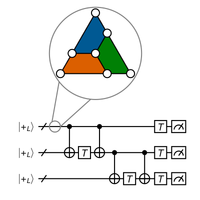
Article Text
References (108)
- R. Acharya, D. A. Abanin, L. Aghababaie-Beni et al., Quantum error correction below the surface code threshold, Nature (London) 638, 920 (2025).
- T. He, W. Lin, R. Wang et al., Experimental quantum error correction below the surface code threshold via all-microwave leakage suppression, Phys. Rev. Lett. 135, 260601 (2025).
- B. W. Reichardt, D. Aasen, R. Chao et al., Demonstration of quantum computation and error correction with a tesseract code, arXiv:2409.04628.
- A. Paetznick, M. P. da Silva, C. Ryan-Anderson et al., Demonstration of logical qubits and repeated error correction with better-than-physical error rates, arXiv:2404.02280.
- J. M. Pino, J. M. Dreiling, C. Figgatt et al., Demonstration of the trapped-ion quantum CCD computer architecture, Nature (London) 592, 209 (2021).
- S. A. Moses, C. H. Baldwin, M. S. Allman et al., A race-track trapped-ion quantum processor, Phys. Rev. X 13, 041052 (2023).
- A. Ransford, M. S. Allman, J. Arkinstall et al., Helios: A 98-qubit trapped-ion quantum computer, arXiv:2511.05465.
- D. Bluvstein, S. J. Evered, A. A. Geim et al., Logical quantum processor based on reconfigurable atom arrays, Nature (London) 626, 58 (2024).
- B. W. Reichardt, A. Paetznick, D. Aasen et al., Fault-tolerant quantum computation with a neutral atom processor, arXiv:2411.11822.
- A. Radnaev, W. Chung, D. Cole et al., Universal neutral-atom quantum computer with individual optical addressing and nondestructive readout, PRX Quantum 6, 030334 (2025).
- D. Bluvstein, A. A. Geim, S. H. Li et al., A fault-tolerant neutral-atom architecture for universal quantum computation, Nature (London) 649, 39 (2025).
- S. Bravyi, D. Poulin, and B. Terhal, Tradeoffs for reliable quantum information storage in 2D systems, Phys. Rev. Lett. 104, 050503 (2010).
- N. Baspin and A. Krishna, Quantifying nonlocality: How outperforming local quantum codes is expensive, Phys. Rev. Lett. 129, 050505 (2022).
- S. Dai and R. Li, Locality vs quantum codes, in Proceedings of the 57th Annual ACM Symposium on Theory of Computing, STOC ’25 (Association for Computing Machinery, New York, USA, 2025), pp. 677–688.
- H. Sayginel, S. Koutsioumpas, M. Webster, A. Rajput, and D. E. Browne, Fault-tolerant logical Clifford gates from code automorphisms, PRX Quantum 6, 030343 (2025).
- M. Cain, C. Zhao, H. Zhou, N. Meister, J. P. Ataides, A. Jaffe, D. Bluvstein, and M. D. Lukin, Correlated decoding of logical algorithms with transversal gates, Phys. Rev. Lett. 133, 240602 (2024).
- H. Zhou, C. Zhao, M. Cain et al., Low-overhead transversal fault tolerance for universal quantum computation, Nature (London) 646, 303 (2025).
- M. Cain, D. Bluvstein, C. Zhao et al., Fast correlated decoding of transversal logical algorithms, arXiv:2505.13587.
- J. P. B. Ataides, A. Gu, S. F. Yelin, and M. D. Lukin, Neural decoders for universal quantum algorithms, PRX Intell. 1, 013008 (2026).
- A. Steane, Multiple-particle interference and quantum error correction, Proc. R. Soc. A 452, 2551 (1996).
- B. W. Reichardt, Fault-tolerant quantum error correction for Steane’s seven-qubit color code with few or no extra qubits, Quantum Sci. Technol. 6, 015007 (2020).
- H. Goto, Minimizing resource overheads for fault-tolerant preparation of encoded states of the Steane code, Sci. Rep. 6, 19578 (2016).
- C. Ryan-Anderson, J. G. Bohnet, K. Lee et al., Realization of real-time fault-tolerant quantum error correction, Phys. Rev. X 11, 041058 (2021).
- L. Postler and S. Heuβen, I. Pogorelov et al., Demonstration of fault-tolerant universal quantum gate operations, Nature (London) 605, 675 (2022).
- S. Dasu, S. Burton, K. Mayer et al., Breaking even with magic: Demonstration of a high-fidelity logical non-Clifford gate, arXiv:2506.14688.
- K. Mayer, C. Ryan-Anderson, N. Brown et al., Benchmarking logical three-qubit quantum Fourier transform encoded in the Steane code on a trapped-ion quantum computer, arXiv:2404.08616.
- K. Yamamoto, Y. Kikuchi, D. Amaro et al., Quantum error-corrected computation of molecular energies, PRX Quantum 7, 020319 (2026).
- W. Dai and D. Berleant, Benchmarking contemporary deep learning hardware and frameworks:A survey of qualitative metrics, in 2019 IEEE First International Conference on Cognitive Machine Intelligence (CogMI) (2019), pp. 148–155, arXiv:1907.03626.
- M. H. Abobeih, Y. Wang, J. Randall et al., Fault-tolerant operation of a logical qubit in a diamond quantum processor, Nature (London) 606, 884 (2022).
- Y. Wang, S. Simsek, T. M. Gatterman et al., Fault-tolerant one-bit addition with the smallest interesting color code, Sci. Adv. 10, eado9024 (2024).
- N. Lacroix, A. Bourassa, F. J. H. Heras et al., Scaling and logic in the color code on a superconducting quantum processor, Nature (London) 645, 614 (2025).
- S. Dasu, M. DeCross, A. Y. Guo et al., Computing with many encoded logical qubits beyond break-even, arXiv:2602.22211.
- K. Yamamoto, S. Duffield, Y. Kikuchi, and D. Munoz Ramo, Demonstrating Bayesian quantum phase estimation with quantum error detection, Phys. Rev. Res. 6, 013221 (2024).
- D. Hangleiter, M. Kalinowski, D. Bluvstein, M. Cain, N. Maskara, X. Gao, A. Kubica, M. D. Lukin, and M. J. Gullans, Fault-tolerant compiling of classically hard IQP circuits on hypercubes, PRX Quantum 6, 020338 (2025).
- E. Farhi, J. Goldstone, and S. Gutmann, A quantum approximate optimization algorithm, arXiv:1411.4028.
- K. Blekos, D. Brand, A. Ceschini et al., A review on quantum approximate optimization algorithm and its variants, Phys. Rep. 1068, 1 (2024).
- A. Boehmer, Binary pulse compression codes, IEEE Trans. Inf. Theory 13, 156 (1967).
- M. Schroeder, Synthesis of low-peak-factor signals and binary sequences with low autocorrelation (Corresp.), IEEE Trans. Inf. Theory 16, 85 (1970).
- A. W. Harrow, A. Hassidim, and S. Lloyd, Quantum algorithm for linear systems of equations, Phys. Rev. Lett. 103, 150502 (2009).
- P. Aliferis, D. Gottesman, and J. Preskill, Quantum accuracy threshold for concatenated distance-3 codes, arXiv:quant-ph/0504218.
- D. Gottesman, An introduction to quantum error correction and fault-tolerant quantum computation, arXiv:0904.2557.
- A. R. Calderbank and P. W. Shor, Good quantum error-correcting codes exist, Phys. Rev. A 54, 1098 (1996).
- H. Bombin, An introduction to topological quantum codes, arXiv:1311.0277.
- A. Kubica and M. E. Beverland, Universal transversal gates with color codes: A simplified approach, Phys. Rev. A 91, 032330 (2015).
- C. Chamberland and A. W. Cross, Fault-tolerant magic state preparation with flag qubits, Quantum 3, 143 (2019).
- S. Heußen, L. Postler, M. Rispler, I. Pogorelov, C. D. Marciniak, T. Monz, P. Schindler, and M. Muller, Strategies for a practical advantage of fault-tolerant circuit design in noisy trapped-ion quantum computers, Phys. Rev. A 107, 042422 (2023).
- Y. Ibe, Y. Hirano, Y. Ozu et al., Measurement-based fault-tolerant quantum computation on high-connectivity devices: A resource-efficient approach toward Early FTQC, arXiv:2510.18652.
- C. Ryan-Anderson, Pecos, https://github.com/PECOS-packages/PECOS (2018).
- R. Zen, J. Olle, L. Colmenarez, M. Puviani, M. Muller, and F. Marquardt, Quantum circuit discovery for fault-tolerant logical state preparation with reinforcement learning, Phys. Rev. X 15, 041012 (2025).
- C. Chamberland and M. E. Beverland, Flag fault-tolerant error correction with arbitrary distance codes, Quantum 2, 53 (2018).
- R. Chao and B. W. Reichardt, Flag fault-tolerant error correction for any stabilizer code, PRX Quantum 1, 010302 (2020).
- S. Boulebnane and A. Montanaro, Solving boolean satisfiability problems with the quantum approximate optimization algorithm, PRX Quantum 5, 030348 (2024).
- R. Shaydulin, C. Li, S. Chakrabarti et al., Evidence of scaling advantage for the quantum approximate optimization algorithm on a classically intractable problem, Sci. Adv. 10, eadm6761 (2024).
- S. Boulebnane, A. Khan, M. Liu et al., Evidence that the quantum approximate optimization algorithm optimizes the Sherrington-Kirkpatrick model efficiently in the average case, Phys. Rev. Lett. 136, 240601 (2026).
- A. Apte, S. Boulebnane, Y. Jin et al., Quantum approximate optimization of integer graph problems and surpassing semidefinite programming for Max-k-Cut, arXiv:2602.05956.
- E. Farhi, S. Gutmann, D. Ranard, and B. Villalonga, Lower bounding the MaxCut of high girth 3-regular graphs using the QAOA, arXiv:2503.12789.
- A. Montanaro and L. Zhou, Quantum speedups in solving near-symmetric optimization problems by low-depth QAOA, arXiv:2411.04979.
- S. H. Sureshbabu, D. Herman, R. Shaydulin et al., Parameter setting in quantum approximate optimization of weighted problems, Quantum 8, 1231 (2024).
- E. Farhi, J. Goldstone, S. Gutmann, and L. Zhou, The quantum approximate optimization algorithm and the Sherrington-Kirkpatrick model at infinite size, Quantum 6, 759 (2022).
- J. Wurtz and D. Lykov, Fixed-angle conjectures for the quantum approximate optimization algorithm on regular MaxCut graphs, Phys. Rev. A 104, 052419 (2021).
- Z. He, R. Shaydulin, D. Herman et al., Parameter Setting Heuristics Make the Quantum Approximate Optimization Algorithm Suitable for the Early Fault-Tolerant Era, in Proceedings of the 43rd IEEE/ACM International Conference on Computer-Aided Design, ICCAD ’24 (Association for Computing Machinery, New York, 2025), pp. 1–7.
- Z. He, R. Raymond, R. Shaydulin, and M. Pistoia, Non-variational quantum random access optimization with alternating operator ansatz, Sci. Rep. 15, 29191 (2025).
- M. Golay, Sieves for low autocorrelation binary sequences, IEEE Trans. Inf. Theory 23, 43 (1977).
- Z. Zhang, J. Shen, N. Kumar, and M. Pistoia, New improvements in solving large LABS instances using massively parallelizable memetic Tabu search, arXiv:2504.00987.
- B. Bošković, F. Brglez, and J. Brest, Low-autocorrelation binary sequences: On improved merit factors and runtime predictions to achieve them, Appl. Soft Comput. 56, 262 (2017).
- B. Bošković, F. Brglez, and J. Brest, A GitHub archive for solvers and solutions of the labs problem, https://github.com/borkob/git_labs (2016).
- T. Packebusch and S. Mertens, Low autocorrelation binary sequences, J. Phys. A 49, 165001 (2016).
- Qokit, https://github.com/jpmorganchase/QOKit (2025).
- A. M. Childs, R. Kothari, and R. D. Somma, Quantum algorithm for systems of linear equations with exponentially improved dependence on precision, SIAM J. Comput. 46, 1920 (2017).
- S. Chakraborty, A. Gilyén, and S. Jeffery, The power of block-encoded matrix powers: Improved regression techniques via faster Hamiltonian simulation, Proceedings of the 46th International Colloquium on Automata, Languages, and Programming (ICALP 2019) (2019), 132, 33∶1, arXiv:1804.01973.
- D. An and L. Lin, Quantum linear system solver based on time-optimal adiabatic quantum computing and quantum approximate optimization algorithm, ACM Trans. Quantum Comput. 3, 5:1 (2022).
- Pedro C. Costa, D. An, Y. R. Sanders, Y. Su, R. Babbush, and D. W. Berry, Optimal scaling quantum linear-systems solver via discrete adiabatic theorem, PRX Quantum 3, 040303 (2022).
- A. Montanaro and S. Pallister, Quantum algorithms and the finite element method, Phys. Rev. A 93, 032324 (2016).
- J.-P. Liu, H. Ø. Kolden, H. K. Krovi et al., Efficient quantum algorithm for dissipative nonlinear differential equations, Proc. Natl. Acad. Sci. U.S.A. 118, e2026805118 (2021).
- N. Linden, A. Montanaro, and C. Shao, Quantum vs. classical algorithms for solving the heat equation, Commun. Math. Phys. 395, 601 (2022).
- I. Kerenidis and A. Prakash, Quantum recommendation systems, arXiv:1603.08675.
- R. Babbush, D. W. Berry, R. Kothari, R. D. Somma, and N. Wiebe, Exponential quantum speedup in simulating coupled classical oscillators, Phys. Rev. X 13, 041041 (2023).
- S. Bravyi, R. Manson-Sawko, M. Zayats, and S. Zhuk, Quantum simulation of a noisy classical nonlinear dynamics, arXiv:2507.06198.
- A. Y. Kitaev, Quantum measurements and the Abelian stabilizer problem, arXiv:quant-ph/9511026.
- M. A. Nielsen and I. L. Chuang, Quantum Computation and Quantum Information: 10th Anniversary Edition (Cambridge University Press, Cambridge, England, 2010).
- T. Häner, M. Roetteler, and K. M. Svore, Optimizing quantum circuits for arithmetic, arXiv:1805.12445.
- B. Eastin and E. Knill, Restrictions on transversal encoded quantum gate sets, Phys. Rev. Lett. 102, 110502 (2009).
- T. Hao, A. Xu, and S. Tannu, Reducing T gates with unitary synthesis, arXiv:2503.15843.
- S. Sivarajah, S. Dilkes, A. Cowtan et al., : A retargetable compiler for NISQ devices, Quantum Sci. Technol. 6, 014003 (2020).
- J. Paykin, A. T. Schmitz, M. Ibrahim et al., PCOAST: A Pauli-Based Quantum Circuit Optimization Framework, in 2023 IEEE International Conference on Quantum Computing and Engineering (QCE) (2023), Vol. 01, pp. 715–726.
- A. T. Schmitz, Nicolas P. D. Sawaya, S. Johri, and A. Y. Matsuura, Graph optimization perspective for low-depth Trotter-Suzuki decomposition, Phys. Rev. A 109, 042418 (2024).
- System model h2 emulators—quantinuum systems, https://docs.quantinuum.com/systems/user_guide/emulator_user_guide/emulators/h2_emulators.html (2025).
- J. A. Smolin, J. M. Gambetta, and G. Smith, Efficient method for computing the maximum-likelihood quantum state from measurements with additive Gaussian noise, Phys. Rev. Lett. 108, 070502 (2012).
- C. Piveteau, D. Sutter, S. Bravyi, J. M. Gambetta, and K. Temme, Error mitigation for universal gates on encoded qubits, Phys. Rev. Lett. 127, 200505 (2021).
- A. Ceasura, P. Iyer, J. J. Wallman, and H. Pashayan, Non-exponential behaviour in logical randomized benchmarking, arXiv:2212.05488.
- M. Koch, A. Lawrence, K. Singhal et al., GUPPY: Pythonic quantum-classical programming, in Informal Proceedings of the Fourth International Workshop on Programming Languages for Quantum Computing (PLanQC ’24) (2024), arXiv:2510.12582.
- M. Koch, A. Borgna, C. Roy et al., Imperative quantum programming with ownership and borrowing in Guppy, in Informal Proceedings of the Fifth International Workshop on Programming Languages for Quantum Computing (PLanQC ’25) (2025), arXiv:2510.13082.
- M. A. Nielsen, The entanglement fidelity and quantum error correction, arXiv:quant-ph/9606012.
- T. Hao, J. Sullivan, S. Omanakuttan et al., Compilation pipeline for predicting algorithmic break-even in an early-fault-tolerant surface code architecture, arXiv:2511.20947.
- ONISQ: Optimization with Noisy Intermediate-Scale Quantum devices, https://www.darpa.mil/research/programs/optimization-with-noisy-intermediate-scale-quantum-devices (2019).
- R. Shaydulin and M. Pistoia, Qaoa with , in Proceedings of the 2023 IEEE International Conference on Quantum Computing and Engineering (QCE) (IEEE, New York, 2023), Vol. 01, pp. 1074–1077.
- E. Pelofske, A. Bärtschi, L. Cincio et al., Scaling whole-chip QAOA for higher-order ising spin glass models on heavy-hex graphs, npj Quantum Inf. 10, 109 (2024).
- E. Pelofske, A. Bärtschi, J. Golden, and S. Eidenbenz, High-Round QAOA for MAX k-SAT on Trapped Ion NISQ Devices, in 2023 IEEE International Conference on Quantum Computing and Engineering (QCE), Vol. 01 (2023), pp. 506–517.
- J. A. Montanez-Barrera, K. Michielsen, and D. E. B. Neira, Evaluating the performance of quantum processing units at large width and depth, arXiv:2502.06471.
- T. Lubinski, C. Coffrin, C. McGeoch et al., Optimization applications as quantum performance benchmarks, ACM Trans. Quantum Comput. 5, 18 (2024).
- Z. He, D. Amaro, R. Shaydulin, and M. Pistoia, Performance of quantum approximate optimization with quantum error detection, Commun. Phys. 8, 217 (2025).
- Y. Jin, Z. He, T. Hao et al., Iceberg beyond the tip: Co-compilation of a quantum error detection code and a quantum algorithm, arXiv:2504.21172.
- D. Forlivesi and D. Amaro, Flag at origin: A modular fault-tolerant preparation for CSS codes, arXiv:2508.14200.
- A. Y. Kitaev, Quantum computations: Algorithms and error correction, Russ. Math. Surv. 52, 1191 (1997).
- C. M. Dawson and M. A. Nielsen, The Solovay-Kitaev algorithm, arXiv:quant-ph/0505030.
- M. Horodecki, P. Horodecki, and R. Horodecki, General teleportation channel, singlet fraction, and quasidistillation, Phys. Rev. A 60, 1888 (1999).
- M. A. Nielsen, A simple formula for the average gate fidelity of a quantum dynamical operation, Phys. Lett. A 303, 249 (2002).
- M. Golay, The merit factor of long low autocorrelation binary sequences (Corresp.), IEEE Trans. Inf. Theory 28, 543 (1982).

