

- Open Access
Real-Space Visualization of the Intrinsic Aging in -type Thermoelectrics
Phys. Rev. X 16, 031049 – Published 24 August, 2026
DOI: https://doi.org/10.1103/gl3r-hxtm
Abstract
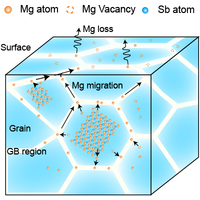
Long-term stability in materials is commonly associated with resistance to external perturbations. Yet metastable defect populations may relax spontaneously even in the absence of environmental stimuli, reshaping macroscopic properties over extended timescales. Here, we show the real-space visualization of intrinsic aging of -type under inert and room-temperature conditions after two-year storage by atomic-scale characterizations. Density-functional-theory calculations and machine-learning molecular dynamics simulations prove that the aging originates from relaxation of a metastable Mg-rich state, in which low vacancy-formation energies and migration barriers enable thermodynamically favorable and kinetically accessible Mg redistribution. Multiscale characterizations further reveal that grain boundaries (GBs) act as fast-diffusion pathways and effective sinks, establishing a hierarchical Mg redistribution process from grain interiors to GBs and surfaces. These results identify intrinsic defect physics as one of the fundamental stability constraints in functional materials and underscore the importance of controlling defect thermodynamics and transport pathways for achieving practically durable materials.
Physics Subject Headings (PhySH)
Popular Summary
Long-term stability in materials is commonly associated with resistance to external perturbations. However, we observed spontaneous degradation of thermoelectric performance in -type stored under inert conditions at room temperature for two years. By combining atomic-scale simulations and advanced characterization techniques, we achieved real-space visualization of this intrinsic aging process, observing the spontaneous relaxation of Mg-rich metastable states. Magnesium atoms continuously detach from the lattice, leaving behind Mg vacancies, and redistribute through rapid diffusion along grain boundaries. Our work highlights that intrinsic aging is also one of the fundamental constraints on the stability of semiconductor materials, shifting the mainstream paradigm of material reliability from environmental adaptability to intrinsic defect kinetics. We expect this physical picture to apply broadly beyond thermoelectrics to many other functional materials.
Article Text
Supplemental Material
References (50)
- J. P. Correa-Baena, M. Saliba, T. Buonassisi, M. Grätzel, A. Abate, W. Tress, and A. Hagfeldt, Promises and challenges of perovskite solar cells, Science 358, 739 (2017).
- J. Mao, Z. H. Liu, J. W. Zhou, H. T. Zhu, Q. Zhang, G. Chen, and Z. F. Ren, Advances in thermoelectrics, Adv. Phys. 67, 69 (2018).
- J. Buha and T. Ohkubo, Natural aging in alloys, Metall. Mater. Trans. A 39a, 2259 (2008).
- M. Werinos, H. Antrekowitsch, T. Ebner, R. Prillhofer, W. A. Curtin, P. J. Uggowitzer, and S. Pogatscher, Design strategy for controlled natural aging in Al-Mg-Si alloys, Acta Mater. 118, 296 (2016).
- C. C. Koch, R. O. Scattergood, K. A. Darling, and J. E. Semones, Stabilization of nanocrystalline grain sizes by solute additions, J. Mater. Sci. 43, 7264 (2008).
- K. Lu, Stabilizing nanostructures in metals using grain, and twin boundary architectures, Nat. Rev. Mater. 1, 16019 (2016).
- H. W. Zhu, S. Teale, M. N. Lintangpradipto, S. Mahesh, B. Chen, M. D. McGehee, E. H. Sargent, and O. M. Bakr, Long-term operating stability in perovskite photovoltaics, Nat. Rev. Mater. 8, 569 (2023).
- F. B. Minussi, E. M. Bertoletti, J. A. Eiras, and E. B. Araújo, Intrinsic aging in mixed-cation lead halide perovskites, Sustain. Energy Fuels 6, 4925 (2022).
- G. J. Snyder and E. S. Toberer, Complex thermoelectric materials, Nat. Mater. 7, 105 (2008).
- Z. H. Liu, Z. T. Guo, A. R. Li, L. Q. Wang, J. H. Sui, and T. Mori, Tellurium-free thermoelectric materials and devices for low-temperature energy harvesting, Nat. Rev. Mater. 1 (2026), 10.1038/s41578-026-00923-5.
- Z. Liu, W. Gao, F. Guo, W. Cai, Q. Zhang, and J. Sui, Challenges for thermoelectric power generation: From a material perspective, Mater. Lab 1, 220003 (2022).
- A. R. Li, C. G. Fu, X. B. Zhao, and T. J. Zhu, High-Performance Thermoelectrics: Progress and perspective, Res. China 1934848 (2020).
- J. Mao, H. T. Zhu, Z. W. Ding, Z. H. Liu, G. A. Gamage, G. Chen, and Z. F. Ren, High thermoelectric cooling performance of n-type -based materials, Science 365, 495 (2019).
- S. Bano, R. Chetty, J. Babu, and T. Mori, -based materials and devices rivaling bismuth telluride for thermoelectric power generation and cooling, Device 2, 100408 (2024).
- P. Zhao et al., Plasticity in single-crystalline thermoelectric material, Nature (London) 631, 777 (2024).
- Z. H. Liu, N. Sato, W. H. Gao, K. Yubuta, N. Kawamoto, M. Mitome, K. Kurashima, Y. Owada, K. Nagase, C.-H. Lee, J. Yi, K. Tsuchiya, and T. Mori, Demonstration of ultrahigh thermoelectric efficiency of in module for low-temperature energy harvesting, Joule 5, 1196 (2021).
- A. R. Li, P. F. Nan, Y. C. Wang, Z. H. Gao, S. Y. Zhang, Z. K. Han, X. B. Zhao, B. H. Ge, C. G. Fu, and T. J. Zhu, Chemical stability and degradation mechanism of thermoelectrics towards room-temperature applications, Acta Mater. 239, 118301 (2022).
- L. R. Jørgensen, J. Zhang, C. B. Zeuthen, and B. B. Iversen, Thermal stability of high performance n-type thermoelectric investigated through powder X-ray diffraction and pair distribution function analysis, J. Mater. Chem. A 6, 17171 (2018).
- S. Ohno, K. Imasato, S. Anand, H. Tamaki, S. D. Kang, P. Gorai, H. K. Sato, E. S. Toberer, T. Kanno, and G. J. Snyder, Phase boundary mapping to obtain n-type -based thermoelectrics, Joule 2, 141 (2018).
- J. Shuai, B. H. Ge, J. Mao, S. W. Song, Y. M. Wang, and Z. F. Ren, Significant role of Mg stoichiometry in designing high thermoelectric performance for Mg3(Sb,Bi)2-based n-type Zintls, J. Am. Chem. Soc. 140, 1910 (2018).
- J. W. Zhang, L. R. Song, and B. B. Iversen, Insights into the design of thermoelectric and its analogs by combining theory and experiment, npj Comput. Mater. 5, 76 (2019).
- See Supplemental Material at http://link.aps.org/supplemental/10.1103/gl3r-hxtm for additional data and Figs. S1–S11.
- X. Y. Dong, J. B. Zhu, Y. K. Zhu, M. Liu, L. J. Xie, N. Qu, Y. F. Jin, X. H. Jiang, F. K. Guo, Z. H. Liu, W. Cai, and J. H. Sui, Understanding of isoelectronic alloying induced energy gap variation for a large enhancement of thermoelectric power factor, Phys. Rev. B 109, 155203 (2024).
- Y. A. Du and N. A. W. Holzwarth, Mechanisms of diffusion in crystalline - and electrolytes from first principles, Phys. Rev. B 76, 174302 (2007).
- X. R. Han, Y. Li, P. Li, X. L. Yan, X. Q. Wu, and B. Huang, A comparable study of defect diffusion and recombination in Si and GaN, J. Appl. Phys. 132, 045701 (2022).
- J. L. Roehl and S. V. Khare, Diffusion of Te vacancy and interstitials of Te, Cl, O, S, P and Sb in CdTe: A density functional theory study, Sol. Energy Mater. Sol. Cells 128, 343 (2014).
- Y. A. Du, S. Sakong, and P. Kratzer, As vacancies, Ga antisites, and Au impurities in zinc blende and wurtzite GaAs nanowire segments from first principles, Phys. Rev. B 87, 075308 (2013).
- H. H. Hu, Y. W. Ju, J. C. Yu, Z. C. Wang, J. Pei, H. C. Thong, J. W. Li, B. W. Cai, F. M. Liu, Z. R. Han, B. Su, H. L. Zhuang, Y. L. Jiang, H. Z. Li, Q. Li, H. J. Zhao, B. P. Zhang, J. Zhu, and J. F. Li, Highly stabilized and efficient thermoelectric copper selenide, Nat. Mater. 23, 527 (2024).
- V. L. Deringer, M. Lumeij, R. P. Stoffel, and R. Dronskowski, Mechanisms of atomic motion through crystalline GeTe, Chem. Mater. 25, 2220 (2013).
- Z. L. Gan, X. L. Lei, W. J. Wu, and S. Y. Zhong, Lithium vacancy migration in : From first principles studies, Comput. Mater. Sci. 184, 109873 (2020).
- D. Sheppard, R. Terrell, and G. Henkelman, Optimization methods for finding minimum energy paths, J. Chem. Phys. 128, 134106 (2008).
- J. J. Kuo, Y. Yu, S. D. Kang, O. Cojocaru-Mirédin, M. Wuttig, and G. J. Snyder, Mg deficiency in grain boundaries of n-type identified by atom probe tomography, Adv. Mater. Interfaces 6, 1900429 (2019).
- T. Luo, J. J. Kuo, K. J. Griffith, K. Imasato, O. Cojocaru-Mirédin, M. Wuttig, B. Gault, Y. Yu, and G. J. Snyder, Nb-mediated grain growth and grain-boundary engineering in -based thermoelectric materials, Adv. Funct. Mater. 31, 2100258 (2021).
- Z. M. Zhang, C. Ming, Q. F. Song, L. Wang, H. B. Chen, J. C. Liao, C. Wang, L. D. Chen, and S. Q. Bai, Grain boundary modulation improved thermal stability of high thermoelectric performance -based compounds, Acta Mater. 287, 120806 (2025).
- A. L. Usler, D. Kemp, A. Bonkowski, and R. A. De Souza, A general expression for the statistical error in a diffusion coefficient obtained from a solid-state molecular-dynamics simulation, J. Comput. Chem. 44, 1347 (2023).
- A. Bonkowski, J. A. Kilner, and R. A. De Souza, Oxygen grain-boundary diffusion in perovskite-oxides probed by molecular-dynamics simulations, RSC Appl. Interfaces 1, 699 (2024).
- M. P. Gomez, D. A. Stevenson, and R. A. Huggins, Self-diffusion of Pb and Te in lead telluride, J. Phys. Chem. Solids 32, 335 (1971).
- F. Landuzzi, L. Pasquini, S. Giusepponi, M. Celino, A. Montone, P. L. Palla, and F. Cleri, Molecular dynamics of ionic self-diffusion at an MgO grain boundary, J. Mater. Sci. 50, 2502 (2015).
- W. W. Li, Y. Ando, E. Minamitani, and S. Watanabe, Study of Li atom diffusion in amorphous with neural network potential, J. Chem. Phys. 147, 214106 (2017).
- J. P. Rino, Y. M. M. Hornos, G. A. Antonio, I. Ebbsjo, R. K. Kalia, and P. Vashishta, Structural and dynamical correlations in —a molecular-dynamics study of superionic and molten phases, J. Chem. Phys. 89, 7542 (1988).
- Z. M. Xu, H. Y. Duan, Z. Dou, M. B. Zheng, Y. X. Lin, Y. H. Xia, H. T. Zhao, and Y. Y. Xia, Machine learning molecular dynamics simulation identifying weakly negative effect of polyanion rotation on Li-ion migration, npj Comput. Mater. 9, 105 (2023).
- J. W. Zhang, L. R. Jorgensen, L. R. Song, and B. B. Iversen, Insight into the strategies for improving the thermal stability of efficient N-type -based thermoelectric materials, ACS Appl. Mater. Interfaces 14, 31024 (2022).
- G. Kresse and J. Furthmuller, Efficiency of ab-initio total energy calculations for metals and semiconductors using a plane-wave basis set, Comput. Mater. Sci. 6, 15 (1996).
- G. Kresse and D. Joubert, From ultrasoft pseudopotentials to the projector augmented-wave method, Phys. Rev. B 59, 1758 (1999).
- J. P. Perdew, K. Burke, and M. Ernzerhof, Generalized gradient approximation made simple, Phys. Rev. Lett. 77, 3865 (1996).
- S. Maintz, V. L. Deringer, A. L. Tchougréeff, and R. Dronskowski, lobster: A tool to extract chemical bonding from plane-wave based DFT, J. Comput. Chem. 37, 1030 (2016).
- D. Sheppard, P. H. Xiao, W. Chemelewski, D. D. Johnson, and G. Henkelman, A generalized solid-state nudged elastic band method, J. Chem. Phys. 136, 074103 (2012).
- Z. Y. Fan et al., GPUMD: A package for constructing accurate machine-learned potentials and performing highly efficient atomistic simulations, J. Chem. Phys. 157, 114801 (2022).
- P. Hirel, atomsk: A tool for manipulating and converting atomic data files, Comput. Phys. Commun. 197, 212 (2015).
- Y. X. Gong et al., Research data for “Real-Space Visualization of the Intrinsic Aging in -type Thermoelectrics”, Zenodo, Version 1, 10.5281/zenodo.21410669 (2015).

