

- Open Access
Real-Time Adaptive Tracking of Fluctuating Relaxation Rates in Superconducting Qubits
Phys. Rev. X 16, 011025 – Published 13 February, 2026
DOI: https://doi.org/10.1103/gk1b-stl3
Abstract
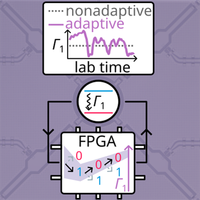
The fidelity of operations on a solid-state quantum processor is fundamentally bounded by environmental decoherence. Characterizing environmental fluctuations is challenging because the acquisition time of nonadaptive experimental protocols limits temporal precision and can average out rapid features of the underlying dynamics. Here, we overcome this temporal-resolution limit by 2 orders of magnitude using a field-programmable gate-array powered classical controller that adaptively and continuously tracks the relaxation-time fluctuations of two fixed-frequency superconducting transmon qubits, which exhibit average relaxation times of approximately 0.17 ms and occasionally exceed 0.5 ms. We report events in which the relaxation time switches by nearly an order of magnitude over timescales of just tens of milliseconds, rather than minutes or hours as previously reported. Our real-time Bayesian estimation protocol estimates relaxation times within a few milliseconds, close to the decoherence timescale itself. Our statistical analysis further suggests that some of these fast fluctuations arise from two-level systems switching at rates up to 10 Hz, 4 orders of magnitude faster than earlier reports. These results redefine the timescales relevant for calibration in superconducting quantum processing units, establish a reference for rapid relaxation-rate characterization in device screening, and improve our understanding of fast relaxation dynamics.
Physics Subject Headings (PhySH)
Popular Summary
Environmental decoherence, often caused by parasitic two-level system (TLS) defects, remains a fundamental bottleneck for the stability and performance of superconducting quantum processors. We developed an adaptive Bayesian protocol for real-time tracking of qubit relaxation rates using a field-programmable gate array powered classical controller. Our approach drastically reduces characterization time by 2 orders of magnitude, estimating relaxation times in just a few milliseconds, close to the intrinsic decoherence timescale itself, and uncovering TLS switching dynamics as fast as 10 Hz, 4 orders of magnitude faster than earlier studies reported. These results provide a scalable tool for high-throughput qubit screening and error mitigation, shifting the paradigm from periodic offline recalibration to continuous, real-time quantum hardware monitoring. This framework establishes a precise foundation for optimizing large-scale quantum processing units against fast environmental fluctuations.
Article Text
Supplemental Material
References (73)
- P. Krantz, M. Kjaergaard, F. Yan, T. P. Orlando, S. Gustavsson, and W. D. Oliver, A quantum engineer’s guide to superconducting qubits, Appl. Phys. Rev. 6, 021318 (2019).
- H.-L. Huang, D. Wu, D. Fan, and X. Zhu, Superconducting quantum computing: A review, Sci. China Inf. Sci. 63, 1 (2020).
- A. Blais, A. L. Grimsmo, S. M. Girvin, and A. Wallraff, Circuit quantum electrodynamics, Rev. Mod. Phys. 93, 025005 (2021).
- Y. Y. Gao, M. A. Rol, S. Touzard, and C. Wang, Practical guide for building superconducting quantum devices, PRX Quantum 2, 040202 (2021).
- S. E. Rasmussen, K. S. Christensen, S. P. Pedersen, L. B. Kristensen, T. Bækkegaard, N. J. S. Loft, and N. T. Zinner, Superconducting circuit companion—an introduction with worked examples, PRX Quantum 2, 040204 (2021).
- E. Campbell, A series of fast-paced advances in quantum error correction, Nat. Rev. Phys. 6, 160 (2024).
- L. Caune, L. Skoric, N. S. Blunt, A. Ruban, J. McDaniel, J. A. Valery, A. D. Patterson, A. V. Gramolin, J. Majaniemi, K. M. Barnes, T. Bialas, O. Buğdayc𝚤, O. Crawford, G. P. Gehér, H. Krovi et al., Demonstrating real-time and low-latency quantum error correction with superconducting qubits, arXiv:2410.05202.
- Google Quantum AI and Collaborators, Quantum error correction below the surface code threshold, Nature (London) 638, 920 (2025).
- I. Besedin, M. Kerschbaum, J. Knoll, I. Hesner, L. Bödeker, L. Colmenarez, L. Hofele, N. Lacroix, C. Hellings, F. Swiadek, A. Flasby, M. B. Panah, D. C. Zanuz, M. Müller, and A. Wallraff, Realizing lattice surgery on two distance-three repetition codes with superconducting qubits, arXiv:2501.04612.
- M. Mohseni, A. Scherer, K. G. Johnson, O. Wertheim, M. Otten, N. A. Aadit, K. M. Bresniker, K. Y. Camsari, B. Chapman, S. Chatterjee, G. A. Dagnew, A. Esposito, F. Fahim, M. Fiorentino, A. Khalid et al., How to build a quantum supercomputer: Scaling challenges and opportunities, arXiv:2411.10406.
- D. Gao, D. Fan, C. Zha, J. Bei, G. Cai, J. Cai, S. Cao, F. Chen, J. Chen, K. Chen, X. Chen, X. Chen, Z. Chen, Z. Chen, Z. Chen et al., Establishing a new benchmark in quantum computational advantage with 105-qubit Zuchongzhi 3.0 processor, Phys. Rev. Lett. 134, 090601 (2025).
- Z. Wei, T. He, Y. Ye, D. Wu, Y. Zhang, Y. Zhao, W. Lin, H.-L. Huang, X. Zhu, and J.-W. Pan, Low-overhead defect-adaptive surface code with bandage-like super-stabilizers, npj Quantum Inf. 11, 75 (2025).
- P. J. J. O’Malley, J. Kelly, R. Barends, B. Campbell, Y. Chen, Z. Chen, B. Chiaro, A. Dunsworth, A. G. Fowler, I.-C. Hoi, E. Jeffrey, A. Megrant, J. Mutus, C. Neill, C. Quintana et al., Qubit metrology of ultralow phase noise using randomized benchmarking, Phys. Rev. Appl. 3, 044009 (2015).
- I. Siddiqi, Engineering high-coherence superconducting qubits, Nat. Rev. Mater. 6, 875 (2021).
- C. E. Murray, Material matters in superconducting qubits, Mater. Sci. Eng. 146, 100646 (2021).
- C. R. H. McRae, G. M. Stiehl, H. Wang, S.-X. Lin, S. A. Caldwell, D. P. Pappas, J. Mutus, and J. Combes, Reproducible coherence characterization of superconducting quantum devices, Appl. Phys. Lett. 119, 100501 (2021).
- J. H. Béjanin, C. T. Earnest, A. S. Sharafeldin, and M. Mariantoni, Interacting defects generate stochastic fluctuations in superconducting qubits, Phys. Rev. B 104, 094106 (2021).
- M. Carroll, S. Rosenblatt, P. Jurcevic, I. Lauer, and A. Kandala, Dynamics of superconducting qubit relaxation times, npj Quantum Inf. 8, 132 (2022).
- T. Thorbeck, A. Eddins, I. Lauer, D. T. McClure, and M. Carroll, Two-level-system dynamics in a superconducting qubit due to background ionizing radiation, PRX Quantum 4, 020356 (2023).
- D. Colao Zanuz, Q. Ficheux, L. Michaud, A. Orekhov, K. Hanke, A. Flasby, M. Bahrami Panah, G. J. Norris, M. Kerschbaum, A. Remm, F. Swiadek, C. Hellings, S. Lazăr, C. Scarato, N. Lacroix, S. Krinner, C. Eichler, A. Wallraff, and J. C. Besse, Mitigating losses of superconducting qubits strongly coupled to defect modes, Phys. Rev. Appl. 23, 044054 (2025).
- Y. Kim, L. C. Govia, A. Dane, E. v. d. Berg, D. M. Zajac, B. Mitchell, Y. Liu, K. Balakrishnan, G. Keefe, A. Stabile et al., Error mitigation with stabilized noise in superconducting quantum processors, Nat. Commun. 16, 8439 (2025).
- S. Weeden, D. C. Harrison, S. Patel, M. Snyder, E. J. Blackwell, G. Spahn, S. Abdullah, Y. Takeda, B. L. T. Plourde, J. M. Martinis, and R. McDermott, Statistics of strongly coupled defects in superconducting qubits, arXiv:2506.00193.
- L. Chen, K.-H. Lee, C.-H. Liu, B. Marinelli, R. K. Naik, Z. Kang, N. Goss, H. Kim, D. I. Santiago, and I. Siddiqi, Scalable and site-specific frequency tuning of two-level system defects in superconducting qubit arrays, arXiv:2503.04702.
- C. Müller, J. H. Cole, and J. Lisenfeld, Towards understanding two-level-systems in amorphous solids: Insights from quantum circuits, Rep. Prog. Phys. 82, 124501 (2019).
- Y. Shalibo, Y. Rofe, D. Shwa, F. Zeides, M. Neeley, J. M. Martinis, and N. Katz, Lifetime and coherence of two-level defects in a Josephson junction, Phys. Rev. Lett. 105, 177001 (2010).
- P. V. Klimov, J. Kelly, Z. Chen, M. Neeley, A. Megrant, B. Burkett, R. Barends, K. Arya, B. Chiaro, Y. Chen, A. Dunsworth, A. Fowler, B. Foxen, C. Gidney, M. Giustina, R. Graff et al., Fluctuations of energy-relaxation times in superconducting qubits, Phys. Rev. Lett. 121, 090502 (2018).
- S. Schlör, J. Lisenfeld, C. Müller, A. Bilmes, A. Schneider, D. P. Pappas, A. V. Ustinov, and M. Weides, Correlating decoherence in transmon qubits: Low frequency noise by single fluctuators, Phys. Rev. Lett. 123, 190502 (2019).
- C. Müller, J. Lisenfeld, A. Shnirman, and S. Poletto, Interacting two-level defects as sources of fluctuating high-frequency noise in superconducting circuits, Phys. Rev. B 92, 035442 (2015).
- J. J. Burnett, A. Bengtsson, M. Scigliuzzo, D. Niepce, M. Kudra, P. Delsing, and J. Bylander, Decoherence benchmarking of superconducting qubits, npj Quantum Inf. 5, 132 (2019).
- C. E. Granade, C. Ferrie, N. Wiebe, and D. G. Cory, Robust online Hamiltonian learning, New J. Phys. 14, 103013 (2012).
- V. Gebhart, R. Santagati, A. A. Gentile, E. M. Gauger, D. Craig, N. Ares, L. Banchi, F. Marquardt, L. Pezzè, and C. Bonato, Learning quantum systems, Nat. Rev. Phys. 5, 141 (2023).
- M. Spiecker, P. Paluch, N. Gosling, N. Drucker, S. Matityahu, D. Gusenkova, S. Günzler, D. Rieger, I. Takmakov, F. Valenti et al., Two-level system hyperpolarization using a quantum Szilard engine, Nat. Phys. 19, 1320 (2023).
- K. Reuer, J. Landgraf, T. Fösel, J. O’Sullivan, L. Beltrán, A. Akin, G. J. Norris, A. Remm, M. Kerschbaum, J.-C. Besse et al., Realizing a deep reinforcement learning agent for real-time quantum feedback, Nat. Commun. 14, 7138 (2023).
- M. J. Arshad, C. Bekker, B. Haylock, K. Skrzypczak, D. White, B. Griffiths, J. Gore, G. W. Morley, P. Salter, J. Smith, I. Zohar, A. Finkler, Y. Altmann, E. M. Gauger, and C. Bonato, Real-time adaptive estimation of decoherence timescales for a single qubit, Phys. Rev. Appl. 21, 024026 (2024).
- F. Berritta, T. Rasmussen, J. A. Krzywda, J. van der Heijden, F. Fedele, S. Fallahi, G. C. Gardner, M. J. Manfra, E. van Nieuwenburg, J. Danon, A. Chatterjee, and F. Kuemmeth, Real-time two-axis control of a spin qubit, Nat. Commun. 15, 1676 (2024).
- N. Dumoulin Stuyck, A. E. Seedhouse, S. Serrano, T. Tanttu, W. Gilbert, J. Y. Huang, F. Hudson, K. M. Itoh, A. Laucht, W. H. Lim, C. H. Yang, A. Saraiva, and A. S. Dzurak, Silicon spin qubit noise characterization using real-time feedback protocols and wavelet analysis, Appl. Phys. Lett. 124, 114003 (2024).
- N. R. Vora, Y. Xu, A. Hashim, N. Fruitwala, H. N. Nguyen, H. Liao, J. Balewski, A. Rajagopala, K. Nowrouzi, Q. Ji et al., ML-powered FPGA-based real-time quantum state discrimination enabling mid-circuit measurements, arXiv:2406.18807.
- F. Berritta, J. A. Krzywda, J. Benestad, J. van der Heijden, F. Fedele, S. Fallahi, G. C. Gardner, M. J. Manfra, E. van Nieuwenburg, J. Danon, A. Chatterjee, and F. Kuemmeth, Physics-informed tracking of qubit fluctuations, Phys. Rev. Appl. 22, 014033 (2024).
- J. Park, H. Jang, H. Sohn, J. Yun, Y. Song, B. Kang, L. E. A. Stehouwer, D. D. Esposti, G. Scappucci, and D. Kim, Passive and active suppression of transduced noise in silicon spin qubits, Nat. Commun. 16, 78 (2025).
- F. Berritta, J. Benestad, L. Pahl, M. Mathews, J. A. Krzywda, R. Assouly, Y. Sung, D. K. Kim, B. M. Niedzielski, K. Serniak, M. E. Schwartz, J. L. Yoder, A. Chatterjee, J. A. Grover, J. Danon, W. D. Oliver, and F. Kuemmeth, Efficient qubit calibration by binary-search Hamiltonian tracking, PRX Quantum 6, 030335 (2025).
- C. M. Van Vliet and P. H. Handel, A new transform theorem for stochastic processes with special application to counting statistics, Physica (Amsterdam) 113A, 261 (1982).
- R. C. Kurchin, Using Bayesian parameter estimation to learn more from data without black boxes, Nat. Rev. Phys. 6, 152 (2024).
- C. W. Warren, J. Fernández-Pendás, S. Ahmed, T. Abad, A. Bengtsson, J. Biznárová, K. Debnath, X. Gu, C. Križan, A. Osman, A. Fadavi Roudsari, P. Delsing, G. Johansson, A. Frisk Kockum, G. Tancredi, and J. Bylander, Extensive characterization and implementation of a family of three-qubit gates at the coherence limit, npj Quantum Inf. 9, 44 (2023).
- See Supplemental Material at http://link.aps.org/supplemental/10.1103/gk1b-stl3 for the experimental setup, additional examples of decay-rate estimation for both qubits, and theoretical details on the optimal waiting time based on binomial statistics and on the decay-rate estimation using gamma distributions. The Supplemental Material includes Refs. [45,46].
- S. Gustavsson, F. Yan, G. Catelani, J. Bylander, A. Kamal, J. Birenbaum, D. Hover, D. Rosenberg, G. Samach, A. P. Sears et al., Suppressing relaxation in superconducting qubits by quasiparticle pumping, Science 354, 1573 (2016).
- F. Leveraro, Novel techniques for fast and precise estimation of qubit decay rates, Master’s thesis, University of Copenhagen (2024).
- D. Ristè, C. C. Bultink, K. W. Lehnert, and L. DiCarlo, Feedback control of a solid-state qubit using high-fidelity projective measurement, Phys. Rev. Lett. 109, 240502 (2012).
Our model assumes that an exponential decay well approximates a relaxation time experiment. However, this assumption breaks down in the presence of strong coupling between the qubit and a TLS, which induces oscillations in the excited-state return probability. If the oscillation frequency is known, the protocol can be easily adapted by sampling at the maxima (or minima) of these oscillations. Otherwise, the model must be extended for multiparameter Bayesian estimation [34, 49]. Such strong coupling regimes have not been observed in and during our experiments.
- M. Valeri, V. Cimini, S. Piacentini, F. Ceccarelli, E. Polino, F. Hoch, G. Bizzarri, G. Corrielli, N. Spagnolo, R. Osellame et al., Experimental multiparameter quantum metrology in adaptive regime, Phys. Rev. Res. 5, 013138 (2023).
- C. Ferrie, C. E. Granade, and D. G. Cory, How to best sample a periodic probability distribution, or on the accuracy of Hamiltonian finding strategies, Quantum Inf. Process. 12, 611 (2013).
A gamma distribution models the statistics of the sum of independent decay processes, where the random variable represents the total decay time. In that sense, it is naturally related to decay dynamics. However, in our case, we measure the state rather than the actual decay time . As a result, the relevant statistics are binomial rather than the exponential distribution typically associated with lifetime studies. Therefore, the appearance of the gamma distribution in this work is not due to physical origins, but rather because it closely resembles the true posterior.
Thus for adaptive methods, the Shannon information is rarely used in practice, as it tends to be computationally intractable.
For , we have and (see Supplemental Material [44] for the case , ).
We perform a numerical approximation of the Kullback-Leibler divergence () to estimate how much the posterior distribution differs from our gamma-distribution approximation. The largest deviation occurs for the worst-case outcome together with a small prior shape parameter, typically . In this regime the posterior is strongly skewed, and the approximation error reaches a maximum of roughly at intermediate ratios . The accuracy improves systematically with increasing . For example, at the peak divergence drops below 0.006, and for it falls below 0.001 across the entire range of . See Supplemental Material [44] for further details on the validity of the approximation, also with respect to a normal distribution.
- J. Benestad, J. Krzywda, E. van Nieuwenburg, and J. Danon, Efficient adaptive Bayesian estimation of a slowly fluctuating overhauser field gradient, SciPost Phys. 17, 014 (2024).
Because of the numerical precision of the controller, the actual ratio between and varies by approximately 10% in the vast majority of probe cycles.
Each probe cycle includes a readout period, followed by an approximately wait time to allow the resonator to cool down and fully deplete any residual photons from the readout pulse. Each Bayesian update takes . The controller is programmed to start with an initial gamma distribution prior with . With this in mind, the adaptive waiting time in each cycle is set to (see Supplemental Material [44] for a motivation of the choice ), where is the estimator for after cycle .
- S. M. Meißner, A. Seiler, J. Lisenfeld, A. V. Ustinov, and G. Weiss, Probing individual tunneling fluctuators with coherently controlled tunneling systems, Phys. Rev. B 97, 180505(R) (2018).
Here , , . Considering also that the nonadaptive is linearly stepped up to , the average idle time from the point of view of the adaptive scheme is , mostly covered by the average . The adaptive waiting time in each cycle is then set to (see Supplemental Material [44]).
- F. Ye, A. Ellaboudy, D. Albrecht, R. Vudatha, N. T. Jacobson, and J. M. Nichol, Characterization of individual charge fluctuators in Si/SiGe quantum dots, Phys. Rev. B 110, 235305 (2024).
, , and .
- M. Bal, A. A. Murthy, S. Zhu, F. Crisa, X. You, Z. Huang, T. Roy, J. Lee, D. v. Zanten, R. Pilipenko et al., Systematic improvements in transmon qubit coherence enabled by niobium surface encapsulation, npj Quantum Inf. 10, 43 (2024).
- S. Kono, J. Pan, M. Chegnizadeh, X. Wang, A. Youssefi, M. Scigliuzzo, and T. J. Kippenberg, Mechanically induced correlated errors on superconducting qubits with relaxation times exceeding 0.4 ms, Nat. Commun. 15, 3950 (2024).
- M. Tuokkola, Y. Sunada, H. Kivijärvi, J. Albanese, L. Grönberg, J.-P. Kaikkonen, V. Vesterinen, J. Govenius, and M. Möttönen, Methods to achieve near-millisecond energy relaxation and dephasing times for a superconducting transmon qubit, Nat. Commun. 16, 5421 (2025).
- A. Dane, K. Balakrishnan, B. Wacaser, L.-W. Hung, H. J. Mamin, D. Rugar, R. M. Shelby, C. Murray, K. Rodbell, and J. Sleight, Performance stabilization of high-coherence superconducting qubits, arXiv:2503.12514.
- J. Lisenfeld, A. Bilmes, A. Megrant, R. Barends, J. Kelly, P. Klimov, G. Weiss, J. M. Martinis, and A. V. Ustinov, Electric field spectroscopy of material defects in transmon qubits, npj Quantum Inf. 5, 105 (2019).
- A. Bilmes, A. Megrant, P. Klimov, G. Weiss, J. M. Martinis, A. V. Ustinov, and J. Lisenfeld, Resolving the positions of defects in superconducting quantum bits, Sci. Rep. 10, 3090 (2020).
- G. J. Grabovskij, T. Peichl, J. Lisenfeld, G. Weiss, and A. V. Ustinov, Strain tuning of individual atomic tunneling systems detected by a superconducting qubit, Science 338, 232 (2012).
- J. M. Martinis, Saving superconducting quantum processors from decay and correlated errors generated by gamma and cosmic rays, npj Quantum Inf. 7, 90 (2021).
- P. M. Harrington, M. Li, M. Hays, W. Van De Pontseele, D. Mayer, H. D. Pinckney, F. Contipelli, M. Gingras, B. M. Niedzielski, H. Stickler et al., Synchronous detection of cosmic rays and correlated errors in superconducting qubit arrays, Nat. Commun. 16, 6428 (2025).
- A. Sergeevich, A. Chandran, J. Combes, S. D. Bartlett, and H. M. Wiseman, Characterization of a qubit Hamiltonian using adaptive measurements in a fixed basis, Phys. Rev. A 84, 052315 (2011).
- P. Cappellaro, Spin-bath narrowing with adaptive parameter estimation, Phys. Rev. A 85, 030301(R) (2012).
- F. Berritta, J. Benestad, J.Krzywda, O. Krause, M. A. M. Nielsen, S. Krøjer, C. Warren, E. Rehnman, A. Nylander, I. Ahmad, A. Osman, J. Biznárová, M. Rommel, A. Fadavi Roudsari, J. Bylander, G. Tancredi, J. Danon, J. Hastrup, F. Kuemmeth, and M. Kjaergaard, Dataset underlying the manuscript: Real-time adaptive tracking of fluctuating relaxation rates in superconducting qubits [Data set], Zenodo (2026), 10.5281/zenodo.17345142.

