

- Open Access
Particle View of Many-Body Electronic Structure with Neural Network Wave Function
Phys. Rev. X 16, 031048 – Published 24 August, 2026
DOI: https://doi.org/10.1103/g6v2-grnl
Abstract
In the study of electronic structure, the wave function view dominates the current research landscape and forms the theoretical foundation of modern quantum mechanics. In contrast, valence bond (VB) theory represents chemical bonds as shared electron pairs and can provide an intuitive, particle-based insight into chemical bonding. In this work, using a newly developed periodic dynamic Voronoi Metropolis sampling (PDVMS) method, we project classical many-body electronic configurations from the neural network wave function and apply VB theory to construct a complementary particle-view paradigm. The powerful neural network wave function can achieve near-exact ab initio solutions for the ground state of both molecular and solid systems. It allows us to definitively characterize the ground state of benzene by reassessing the competition between its two VB structures. Extending PDVMS to solids, we also predict a spin-staggered VB structure in graphene, which explains emergent magnetic properties in graphene-based nanostructures. Furthermore, this particle view provides insight into the optimization process of the neural network wave function itself. Our work thus introduces a framework for analyzing many-body electronic structure in molecules and solids, opening new avenues for investigating this complex problem and its associated exotic phenomena.
Physics Subject Headings (PhySH)
Popular Summary
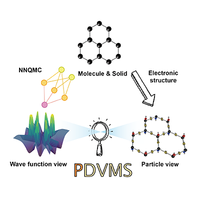
Quantum mechanics can predict electron behavior, but the concept of the wave function is challenging for humans to interpret. The mathematical complexity obscures the intuitive, particle-based picture of chemical bonds used in chemistry. We introduce a framework that translates the complex quantum wave function into a clear, classical picture of electron positions. We combine a neural network that calculates a near-exact ground-state wave function with a recently developed method called periodic dynamic Voronoi Metropolis sampling that we extended to periodic solids. This combination pins down the locations of electrons from the wave function’s probability cloud. We applied this framework to benzene and graphene. We found graphene’s ground state features a “spin-staggered” structure, in contrast to the expected network of alternating single and double bonds, providing an intuitive explanation for the emergent magnetic properties observed in similar nanostructures. Our framework provides a complementary lens to visualize and understand the complex electronic choreography ties to exotic phenomena in molecules and solids.
Article Text
Supplemental Material
References (58)
- J. J. Thomson, Cathode rays, Philos. Mag. 44, 293 (1897).
- R. A. Millikan, The isolation of an ion, a precision measurement of its charge, and the correction of Stokes’s law, Science 32, 436 (1910).
- N. Bohr, On the constitution of atoms and molecules, Philos. Mag. 26, 1 (1913).
- W. Gerlach and O. Stern, Der experimentelle Nachweis der Richtungsquantelung im Magnetfeld, Z. Phys. 9, 349 (1922).
- A. Einstein, Über einen die Erzeugung und Verwandlung des Lichtes betreffenden heuristischen Gesichtspunkt, Ann. Phys. (Berlin) 322, 132 (1905).
- A. H. Compton, A quantum theory of the scattering of x-rays by light elements, Phys. Rev. 21, 483 (1923).
- L. de Broglie, Recherches sur la théorie des quanta, Ann. Phys. (Berlin) 10, 22 (1925).
- E. Schrödinger, An undulatory theory of the mechanics of atoms and molecules, Phys. Rev. 28, 1049 (1926).
- R. J. Bartlett and J. F. Stanton, Applications of post-Hartree-Fock Methods: A tutorial, Rev. Comput. Chem. 5, 65 (1994).
- W. Koch and M. C. Holthausen, A Chemist’s Guide to Density Functional Theory (John Wiley & Sons, New York, 2015).
- C. J. Cramer, Essentials of Computational Chemistry: Theories and Models (John Wiley & Sons, New York, 2013).
- J. Han, L. Zhang, and W. E, Solving many-electron Schrödinger equation using deep neural networks, J. Comput. Phys. 399, 108929 (2019).
- D. Pfau, J. S. Spencer, A. G. D. G. Matthews, and W. M. C. Foulkes, Ab initio solution of the many-electron Schrödinger equation with deep neural networks, Phys. Rev. Res. 2, 033429 (2020).
- J. S. Spencer, D. Pfau, A. Botev, and W. M. C. Foulkes, Better, faster fermionic neural networks, arXiv:2011.07125.
- J. Hermann, Z. Schätzle, and F. Noé, Deep-neural-network solution of the electronic Schrödinger equation, Nat. Chem. 12, 891 (2020).
- I. von Glehn, J. S. Spencer, and D. Pfau, A self-attention ansatz for ab-initio quantum chemistry, arXiv:2211.13672.
- W. Ren, W. Fu, X. Wu, and J. Chen, Towards the ground state of molecules via diffusion Monte Carlo on neural networks, Nat. Commun. 14, 1860 (2023).
- X. Li, Z. Li, and J. Chen, Ab initio calculation of real solids via neural network ansatz, Nat. Commun. 13, 7895 (2022).
- R. Li, H. Ye, D. Jiang, X. Wen, C. Wang, Z. Li, X. Li, D. He, J. Chen, W. Ren, and L. Wang, A computational framework for neural network-based variational Monte Carlo with forward Laplacian, Nat. Mach. Intell. 6, 209 (2024).
- M. Iqbal, N. Tantivasadakarn, R. Verresen, S. L. Campbell, J. M. Dreiling, C. Figgatt, J. P. Gaebler, J. Johansen, M. Mills, S. A. Moses et al., Non-Abelian topological order and anyons on a trapped-ion processor, Nature (London) 626, 505 (2024).
- P. Liu, H. Li, Z. Zhou, and Y. Pei, Topological acoustic tweezer and pseudo-spin states of acoustic topological insulators, Appl. Phys. Lett. 120, 222202 (2022).
- B. Wang, Z. Che, C. Cheng, C. Tong, L. Shi, Y. Shen, K. Y. Bliokh, and J. Zi, Topological water-wave structures manipulating particles, Nature (London) 638, 394 (2025).
- G. N. Lewis, The atom and the molecule, J. Am. Chem. Soc. 38, 762 (1916).
- L. Pauling, The nature of the chemical bond—1992, J. Chem. Educ. 69, 519 (1992).
- J. Gerratt, D. L. Cooper, P. B. Karadakov, and M. Raimondi, Modern valence bond theory, Chem. Soc. Rev. 26, 87 (1997).
- P. W. Anderson, G. Baskaran, Z. Zou, and T. Hsu, Resonating–valence-bond theory of phase transitions and superconductivity in -based compounds, Phys. Rev. Lett. 58, 2790 (1987).
- R. Moessner and S. L. Sondhi, Three-dimensional resonating-valence-bond liquids and their excitations, Phys. Rev. B 68, 184512 (2003).
- Y. Liu, T. J. Frankcombe, and T. W. Schmidt, Chemical bonding motifs from a tiling of the many-electron wavefunction, Phys. Chem. Chem. Phys. 18, 13385 (2016).
- Y. Liu, P. Kilby, T. J. Frankcombe, and T. W. Schmidt, The electronic structure of benzene from a tiling of the correlated 126-dimensional wavefunction, Nat. Commun. 11, 1210 (2020).
- Y. Liu, P. Kilby, T. J. Frankcombe, and T. W. Schmidt, Calculating curly arrows from ab initio wavefunctions, Nat. Commun. 9, 1436 (2018).
- Y. Liu, T. J. Frankcombe, and T. W. Schmidt, Energetics of covalent bonding from wave function tiles, J. Am. Chem. Soc. 147, 12917 (2025).
- See Supplemental Material at http://link.aps.org/supplemental/10.1103/g6v2-grnl for computational details of PDVMS, neural network hyperparameters, additional visualizations, and further analyses of structural preferences and convergence, which includes Ref. [33].
- H. W. Kuhn, The Hungarian method for the assignment problem, Naval Res. Logist. 2, 83 (1955).
- D. M. Ceperley, Fermion nodes, J. Stat. Phys. 63, 1237 (1991).
- L. Bai and D. Breen, Calculating center of mass in an unbounded 2D environment, J. Graph. Tools 13, 53 (2008).
- A. Kekulé, Sur la constitution des substances aromatiques, Bull. Soc. Chim. Paris 3, 98 (1865), https://gallica.bnf.fr/ark:/12148/bpt6k281952v/f102.image.
- A. Kekulé, Untersuchungen über aromatische Verbindungen, Justus Liebigs Annalen der Chemie 137, 129 (1866).
- L. Pauling and G. W. Wheland, The nature of the chemical bond. V. The quantum-mechanical calculation of the resonance energy of benzene and naphthalene and the hydrocarbon free radicals, J. Chem. Phys. 1, 362 (1933).
- E. Hückel, Quantentheoretische Beiträge zum Benzolproblem I. Die Elektronenkonfiguration des Benzols und verwandter Verbindungen, Z. Phys. 70, 204 (1931).
- J. W. Linnett, Valence-bond structures: A new proposal, Nature (London) 187, 859 (1960).
- S. K. Tiwari, S. Sahoo, N. Wang, and A. Huczko, Graphene research and their outputs: Status and prospect, J. Sci. Adv. Mater. Dev. 5, 10 (2020).
- Y. Cao, V. Fatemi, S. Fang, K. Watanabe, T. Taniguchi, E. Kaxiras, and P. Jarillo-Herrero, Unconventional superconductivity in magic-angle graphene superlattices, Nature (London) 556, 43 (2018).
- H. Lv, Y. Yao, M. Yuan, G. Chen, Y. Wang, L. Rao, S. Li, U. I. Kara, R. L. Dupont, C. Zhang et al., Functional nanoporous graphene superlattice, Nat. Commun. 15, 1295 (2024).
- V. Georgakilas, J. N. Tiwari, K. C. Kemp, J. A. Perman, A. B. Bourlinos, K. S. Kim, and R. Zboril, Noncovalent functionalization of graphene and graphene oxide for energy materials, biosensing, catalytic, and biomedical applications, Chem. Rev. 116, 5464 (2016).
- D. Malko, C. Neiss, F. Viñes, and A. Görling, Competition for graphene: Graphynes with direction-dependent Dirac cones, Phys. Rev. Lett. 108, 086804 (2012).
- P. Tiamduangtawan and K. Saenboonruang, Environmental-friendly synthesis of reduced graphene oxide (rGO) using gamma irradiation, J. Phys. Conf. Ser. 1285, 012034 (2019).
- H. González-Herrero, J. M. Gómez-Rodríguez, P. Mallet, M. Moaied, J. J. Palacios, C. Salgado, M. M. Ugeda, J.-Y. Veuillen, F. Yndurain, and I. Brihuega, Atomic-scale control of graphene magnetism by using hydrogen atoms, Science 352, 437 (2016).
- G. Z. Magda, X. Jin, I. Hagymási, P. Vancsó, Z. Osváth, P. Nemes-Incze, C. Hwang, L. P. Biró, and L. Tapasztó, Room-temperature magnetic order on zigzag edges of narrow graphene nanoribbons, Nature (London) 514, 608 (2014).
- M. Terrones, A. R. Botello-Méndez, J. Campos-Delgado, F. López-Urías, Y. I. Vega-Cantú, F. J. Rodríguez-Macías, A. L. Elías, E. Muñoz-Sandoval, A. G. Cano-Márquez, J.-C. Charlier et al., Graphene and graphite nanoribbons: Morphology, properties, synthesis, defects and applications, Nano Today 5, 351 (2010).
- J. O. Sofo, A. S. Chaudhari, and G. D. Barber, Graphane: A two-dimensional hydrocarbon, Phys. Rev. B 75, 153401 (2007).
- M. Pumera and C. H. A. Wong, Graphane and hydrogenated graphene, Chem. Soc. Rev. 42, 5987 (2013).
- O. V. Yazyev, Emergence of magnetism in graphene materials and nanostructures, Rep. Prog. Phys. 73, 056501 (2010).
- Z. Li, S. Li, Y. Xu, and N. Tang, Recent advances in magnetism of graphene from 0D to 2D, Chem. Commun. 59, 6286 (2023).
- J. Hong, E. Bekyarova, P. Liang, W. A. de Heer, R. C. Haddon, and S. Khizroev, Room-temperature magnetic ordering in functionalized graphene, Sci. Rep. 2, 624 (2012).
- P. Wilhelm, T. C. Lang, and A. M. Läuchli, Interplay of fractional Chern insulator and charge density wave phases in twisted bilayer graphene, Phys. Rev. B 103, 125406 (2021).
- A. L. Sharpe, E. J. Fox, A. W. Barnard, J. Finney, K. Watanabe, T. Taniguchi, M. A. Kastner, and D. Goldhaber-Gordon, Emergent ferromagnetism near three-quarters filling in twisted bilayer graphene, Science 365, 605 (2019).
- M. Serlin, C. L. Tschirhart, H. Polshyn, Y. Zhang, J. Zhu, K. Watanabe, T. Taniguchi, L. Balents, and A. F. Young, Intrinsic quantized anomalous Hall effect in a moiré heterostructure, Science 367, 900 (2020).
- Z. Wang, W. Fu, Z. Li, W. Ren, and J. Chen, Periodic Dynamic Voronoi Metropolis Sampling (PDVMS), GitHub repository, https://github.com/TheChenGroup/Periodic-Dynamic-Voronoi-Metropolis-Sampling (2025).

