

- Open Access
Dissipating Quartets of Excitations in a Superconducting Circuit
Phys. Rev. X 16, 011032 – Published 23 February, 2026
DOI: https://doi.org/10.1103/bjpc-8xcf
Abstract
Over the past decade, autonomous stabilization of bosonic qubits has emerged as a promising approach for hardware-efficient protection of quantum information. However, applying these techniques to more complex encodings than the Schrödinger cat code requires exquisite control of high-order wave mixing processes. The challenge is to enable specific multiphotonic dissipation channels while avoiding unintended nonlinear interactions. In this work, we leverage a genuine six-wave mixing process enabled by a near Kerr-free Josephson element to enforce dissipation of quartets of excitations in a high-impedance superconducting resonator. Owing to residual nonlinearities stemming from stray inductances in our circuit, this dissipation channel is only effective when the resonator holds a specific number of photons. Applying it to the fourth excited state of the resonator, we show an order-of-magnitude enhancement of the state decay rate while only marginally impacting the relaxation and coherence of lower-energy states. Given that stray inductances could be strongly reduced through simple modifications in circuit design and that our methods can be adapted to activate even higher-order dissipation channels, these results pave the way toward the dynamical stabilization of four-component Schrödinger cat qubits and even more complex bosonic qubits.
Physics Subject Headings (PhySH)
Popular Summary
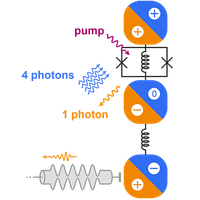
Qubits encoded in oscillators can be stabilized through tailored interactions with a cold environment. A repetition code of two-legged cat qubits stabilized in this way was recently operated below threshold, demonstrating their potential for hardware-efficient error correction. More advanced bosonic qubits, such as four-legged cat qubits, promise even greater hardware efficiency and error resilience. However, stabilizing these advanced qubits requires higher-order multiphotonic interactions with the environment, posing a significant experimental challenge. In this work, we demonstrate a four-to-one photon exchange between a superconducting resonator and a cold environment, an essential step for stabilizing four-legged cat qubits. While residual nonlinearities in the circuit currently prevent the stabilization of a full-fledged cat state, these effects are well understood and can be mitigated with straightforward circuit design improvements.
Article Text
References (87)
- M. A. Nielsen and I. L. Chuang, Quantum Computation and Quantum Information (Cambridge University Press, Cambridge, England, 2010).
- D. Gottesman, Stabilizer Codes and Quantum Error Correction (California Institute of Technology, Pasadena, 1997).
- M. Wolinsky and H. J. Carmichael, Quantum noise in the parametric oscillator: From squeezed states to coherent-state superpositions, Phys. Rev. Lett. 60, 1836 (1988).
- P. Zanardi and M. Rasetti, Noiseless quantum codes, Phys. Rev. Lett. 79, 3306 (1997).
- D. A. Lidar, I. L. Chuang, and K. B. Whaley, Decoherence-free subspaces for quantum computation, Phys. Rev. Lett. 81, 2594 (1998).
- J. P. Barnes and W. S. Warren, Automatic quantum error correction, Phys. Rev. Lett. 85, 856 (2000).
- M. Sarovar and G. J. Milburn, Continuous quantum error correction by cooling, Phys. Rev. A 72, 012306 (2005).
- F. Ticozzi and L. Viola, Quantum Markovian subsystems: Invariance, attractivity, and control, IEEE Trans. Autom. Control 53, 2048 (2008).
- F. Pastawski, L. Clemente, and J. I. Cirac, Quantum memories based on engineered dissipation, Phys. Rev. A 83, 012304 (2011).
- M. Mirrahimi, Z. Leghtas, V. V. Albert, S. Touzard, R. J. Schoelkopf, L. Jiang, and M. H. Devoret, Dynamically protected cat-qubits: A new paradigm for universal quantum computation, New J. Phys. 16, 045014 (2014).
- J. Cohen and M. Mirrahimi, Dissipation-induced continuous quantum error correction for superconducting circuits, Phys. Rev. A 90, 062344 (2014).
- V. V. Albert, B. Bradlyn, M. Fraas, and L. Jiang, Geometry and response of Lindbladians, Phys. Rev. X 6, 041031 (2016).
- E. Kapit, Hardware-efficient and fully autonomous quantum error correction in superconducting circuits, Phys. Rev. Lett. 116, 150501 (2016).
- E. Kapit, The upside of noise: Engineered dissipation as a resource in superconducting circuits, Quantum Sci. Technol. 2, 033002 (2017).
- F. Reiter, A. S. Sørensen, P. Zoller, and C. Muschik, Dissipative quantum error correction and application to quantum sensing with trapped ions, Nat. Commun. 8, 1822 (2017).
- J.-M. Lihm, K. Noh, and U. R. Fischer, Implementation-independent sufficient condition of the Knill-Laflamme type for the autonomous protection of logical qudits by strong engineered dissipation, Phys. Rev. A 98, 012317 (2018).
- B. Royer, S. Singh, and S. M. Girvin, Stabilization of finite-energy Gottesman-Kitaev-Preskill states, Phys. Rev. Lett. 125, 260509 (2020).
- J. Lebreuilly, K. Noh, C.-H. Wang, S. M. Girvin, and L. Jiang, Autonomous quantum error correction and quantum computation, arXiv:2103.05007.
- B. De Neeve, T.-L. Nguyen, T. Behrle, and J. P. Home, Error correction of a logical grid state qubit by dissipative pumping, Nat. Phys. 18, 296 (2022).
- Q. Xu, G. Zheng, Y.-X. Wang, P. Zoller, A. A. Clerk, and L. Jiang, Autonomous quantum error correction and fault-tolerant quantum computation with squeezed cat qubits, npj Quantum Inf. 9, 78 (2023).
- I. Rojkov, M. Simoni, E. Zapusek, F. Reiter, and J. Home, Stabilization of cat-state manifolds using nonlinear reservoir engineering, arXiv:2407.18087.
- V. V. Albert, Bosonic coding: Introduction and use cases, in Quantum Fluids of Light and Matter (IOS Press, 2025), pp. 79–107.
- Z. Leghtas, S. Touzard, I. M. Pop, A. Kou, B. Vlastakis, A. Petrenko, K. M. Sliwa, A. Narla, S. Shankar, M. J. Hatridge et al., Confining the state of light to a quantum manifold by engineered two-photon loss, Science 347, 853 (2015).
- S. Touzard, A. Grimm, Z. Leghtas, S. O. Mundhada, P. Reinhold, C. Axline, M. Reagor, K. Chou, J. Blumoff, K. M. Sliwa et al., Coherent oscillations inside a quantum manifold stabilized by dissipation, Phys. Rev. X 8, 021005 (2018).
- R. Lescanne, M. Villiers, T. Peronnin, A. Sarlette, M. Delbecq, B. Huard, T. Kontos, M. Mirrahimi, and Z. Leghtas, Exponential suppression of bit-flips in a qubit encoded in an oscillator, Nat. Phys. 16, 509 (2020).
- C. Berdou, A. Murani, U. Reglade, W. C. Smith, M. Villiers, J. Palomo, M. Rosticher, A. Denis, P. Morfin, M. Delbecq et al., One hundred second bit-flip time in a two-photon dissipative oscillator, PRX Quantum 4, 020350 (2023).
- U. Réglade, A. Bocquet, R. Gautier, J. Cohen, A. Marquet, E. Albertinale, N. Pankratova, M. Hallén, F. Rautschke, L.-A. Sellem et al., Quantum control of a cat qubit with bit-flip times exceeding ten seconds, Nature (London) 629, 778 (2024).
- A. Marquet, A. Essig, J. Cohen, N. Cottet, A. Murani, E. Albertinale, S. Dupouy, A. Bienfait, T. Peronnin, S. Jezouin et al., Autoparametric resonance extending the bit-flip time of a cat qubit up to 0.3 s, Phys. Rev. X 14, 021019 (2024).
- H. Putterman, K. Noh, C. T. Hann, G. S. MacCabe, S. Aghaeimeibodi, R. N. Patel, M. Lee, W. M. Jones, H. Moradinejad, R. Rodriguez et al., Hardware-efficient quantum error correction via concatenated bosonic qubits, Nature (London) 638, 927 (2025).
- M. Mirrahimi and P. Rouchon, Dynamics and Control of Open Quantum Systems, Lecture Notes (2015).
- R. Robin, P. Rouchon, and L.-A. Sellem, Convergence of bipartite open quantum systems stabilized by reservoir engineering, in Annales Henri Poincaré (Springer, New York, 2024), pp. 1–51.
This hierarchy is needed to adiabatically eliminate the mode from the dynamics, but it does not need to be respected for the cat manifold to be stabilized [31].
- L. Sun, A. Petrenko, Z. Leghtas, B. Vlastakis, G. Kirchmair, K. Sliwa, A. Narla, M. Hatridge, S. Shankar, J. Blumoff et al., Tracking photon jumps with repeated quantum non-demolition parity measurements, Nature (London) 511, 444 (2014).
- N. Ofek, A. Petrenko, R. Heeres, P. Reinhold, Z. Leghtas, B. Vlastakis, Y. Liu, L. Frunzio, S. M. Girvin, L. Jiang et al., Extending the lifetime of a quantum bit with error correction in superconducting circuits, Nature (London) 536, 441 (2016).
- L. Hu, Y. Ma, W. Cai, X. Mu, Y. Xu, W. Wang, Y. Wu, H. Wang, Y. Song, C.-L. Zou et al., Quantum error correction and universal gate set operation on a binomial bosonic logical qubit, Nat. Phys. 15, 503 (2019).
- Z. Ni, S. Li, X. Deng, Y. Cai, L. Zhang, W. Wang, Z.-B. Yang, H. Yu, F. Yan, S. Liu et al., Beating the break-even point with a discrete-variable-encoded logical qubit, Nature (London) 616, 56 (2023).
- J. M. Gertler, B. Baker, J. Li, S. Shirol, J. Koch, and C. Wang, Protecting a bosonic qubit with autonomous quantum error correction, Nature (London) 590, 243 (2021).
- A. L. Grimsmo, J. Combes, and B. Q. Baragiola, Quantum computing with rotation-symmetric bosonic codes, Phys. Rev. X 10, 011058 (2020).
- D. Gottesman, A. Kitaev, and J. Preskill, Encoding a qubit in an oscillator, Phys. Rev. A 64, 012310 (2001).
- S. E. Nigg, H. Paik, B. Vlastakis, G. Kirchmair, S. Shankar, L. Frunzio, M. H. Devoret, R. J. Schoelkopf, and S. M. Girvin, Black-box superconducting circuit quantization, Phys. Rev. Lett. 108, 240502 (2012).
- W. C. Smith, A. Kou, U. Vool, I. M. Pop, L. Frunzio, R. J. Schoelkopf, and M. H. Devoret, Quantization of inductively shunted superconducting circuits, Phys. Rev. B 94, 144507 (2016).
- Z. K. Minev, Z. Leghtas, S. O. Mundhada, L. Christakis, I. M. Pop, and M. H. Devoret, Energy-participation quantization of Josephson circuits, npj Quantum Inf. 7, 131 (2021).
- R. M. Foster, A reactance theorem, Bell Syst. Tech. J. 3, 259 (1924).
The fluxes and that thread the physical circuit loops can be formally allocated to each arm of the squid, such that they are the same fluxes threading the effective circuit loops.
The fluxes and are known up to an integer number of flux quanta and depend on applied currents through an affine transformation. The map is centered at nonzero applied currents, indicating significant flux offsets.
- W. Smith, A. Borgognoni, M. Villiers, E. Roverc’h, J. Palomo, M. Delbecq, T. Kontos, P. Campagne-Ibarcq, B. Douçot, and Z. Leghtas, Spectral signature of high-order photon processes enhanced by cooper-pair pairing, Nat. Commun. 16, 8359 (2025).
The spurious nonlinear term in the circuit Hamiltonian is a small perturbation so that eigenstates have an overlap close to 1 with unperturbed Fock states.
- W. D. Oliver and P. B. Welander, Materials in superconducting quantum bits, MRS Bull. 38, 816 (2013).
- C. Müller, J. H. Cole, and J. Lisenfeld, Towards understanding two-level-systems in amorphous solids: Insights from quantum circuits, Rep. Prog. Phys. 82, 124501 (2019).
Note that, in principle, the memory coherence should not be affected by this drive as the ATS remains at a dynamical sweet spot, in the sense that its susceptibility to magnetic flux drifts averages out over a period of the drive.
- A. Petrescu, M. Malekakhlagh, and H. E. Türeci, Lifetime renormalization of driven weakly anharmonic superconducting qubits. II. The readout problem, Phys. Rev. B 101, 134510 (2020).
- J. Venkatraman, X. Xiao, R. G. Cortiñas, and M. H. Devoret, Nonlinear dissipation in a driven superconducting circuit, Phys. Rev. A 110, 042411 (2024).
- H. Putterman, K. Noh, R. N. Patel, G. A. Peairs, G. S. MacCabe, M. Lee, S. Aghaeimeibodi, C. T. Hann, I. Jarrige, G. Marcaud et al., Preserving phase coherence and linearity in cat qubits with exponential bit-flip suppression, Phys. Rev. X 15, 011070 (2025).
- L. Carde, P. Rouchon, J. Cohen, and A. Petrescu, Flux-pump-induced degradation of t 1 for dissipative cat qubits, Phys. Rev. Appl. 23, 024073 (2025).
- D. Lachance-Quirion, M.-A. Lemonde, J. O. Simoneau, L. St-Jean, P. Lemieux, S. Turcotte, W. Wright, A. Lacroix, J. Fréchette-Viens, R. Shillito et al., Autonomous quantum error correction of Gottesman-Kitaev-Preskill states, Phys. Rev. Lett. 132, 150607 (2024).
- S. O. Mundhada, A. Grimm, J. Venkatraman, Z. K. Minev, S. Touzard, N. E. Frattini, V. V. Sivak, K. Sliwa, P. Reinhold, S. Shankar et al., Experimental implementation of a Raman-assisted eight-wave mixing process, Phys. Rev. Appl. 12, 054051 (2019).
In that work, the auxiliary mode was not designed to dissipate excitations at a sufficiently large rate to turn the interaction into an effective four-photon dissipation channel.
- S. Puri, A. Grimm, P. Campagne-Ibarcq, A. Eickbusch, K. Noh, G. Roberts, L. Jiang, M. Mirrahimi, M. H. Devoret, and S. M. Girvin, Stabilized cat in a driven nonlinear cavity: A fault-tolerant error syndrome detector, Phys. Rev. X 9, 041009 (2019).
- C. Siegele and P. Campagne-Ibarcq, Robust suppression of noise propagation in Gottesman-Kitaev-Preskill error correction, Phys. Rev. A 108, 042427 (2023).
- A. Z. Ding, B. L. Brock, A. Eickbusch, A. Koottandavida, N. E. Frattini, R. G. Cortiñas, V. R. Joshi, S. J. de Graaf, B. J. Chapman, S. Ganjam et al., Quantum control of an oscillator with a Kerr-cat qubit, Nat. Commun. 16, 1 (2025).
- O. Vy, X. Wang, and K. Jacobs, Error-transparent evolution: The ability of multi-body interactions to bypass decoherence, New J. Phys. 15, 053002 (2013).
- S. Rosenblum, P. Reinhold, M. Mirrahimi, L. Jiang, L. Frunzio, and R. J. Schoelkopf, Fault-tolerant detection of a quantum error, Science 361, 266 (2018).
- P. Reinhold, S. Rosenblum, W.-L. Ma, L. Frunzio, L. Jiang, and R. J. Schoelkopf, Error-corrected gates on an encoded qubit, Nat. Phys. 16, 822 (2020).
- W.-L. Ma, M. Zhang, Y. Wong, K. Noh, S. Rosenblum, P. Reinhold, R. J. Schoelkopf, and L. Jiang, Path-independent quantum gates with noisy ancilla, Phys. Rev. Lett. 125, 110503 (2020).
- H. Putterman, J. Iverson, Q. Xu, L. Jiang, O. Painter, F. G. S. L. Brandão, and K. Noh, Stabilizing a bosonic qubit using colored dissipation, Phys. Rev. Lett. 128, 110502 (2022).
Large dissipation rates are desired for fast adiabatic control of the cat state [67] but are not needed to achieve macroscopic bit-flip times [26].
- J. Guillaud and M. Mirrahimi, Repetition cat qubits for fault-tolerant quantum computation, Phys. Rev. X 9, 041053 (2019).
- S. Touzard, A. Kou, N. E. Frattini, V. V. Sivak, S. Puri, A. Grimm, L. Frunzio, S. Shankar, and M. H. Devoret, Gated conditional displacement readout of superconducting qubits, Phys. Rev. Lett. 122, 080502 (2019).
- D. Willsch, D. Rieger, P. Winkel, M. Willsch, C. Dickel, J. Krause, Y. Ando, R. Lescanne, Z. Leghtas, N. T. Bronn et al., Observation of Josephson harmonics in tunnel junctions, Nat. Phys. 20, 815 (2024).
- J. Braumüller, L. Ding, A. P. Vepsäläinen, Y. Sung, M. Kjaergaard, T. Menke, R. Winik, D. Kim, B. M. Niedzielski, A. Melville et al., Characterizing and optimizing qubit coherence based on SQUID geometry, Phys. Rev. Appl. 13, 054079 (2020).
- J. Cohen, W. C. Smith, M. H. Devoret, and M. Mirrahimi, Degeneracy-preserving quantum nondemolition measurement of parity-type observables for cat qubits, Phys. Rev. Lett. 119, 060503 (2017).
- L.-A. Sellem, A. Sarlette, Z. Leghtas, M. Mirrahimi, P. Rouchon, and P. Campagne-Ibarcq, Dissipative protection of a GKP qubit in a high-impedance superconducting circuit driven by a microwave frequency comb, Phys. Rev. X 15, 011011 (2025).
- X. C. Kolesnikow, R. W. Bomantara, A. C. Doherty, and A. L. Grimsmo, Gottesman-Kitaev-Preskill state preparation using periodic driving, Phys. Rev. Lett. 132, 130605 (2024).
- F. Nathan, L. O’Brien, K. Noh, M. H. Matheny, A. L. Grimsmo, L. Jiang, and G. Refael, Self-correcting Gottesman-Kitaev-Preskill qubit and gates in a driven-dissipative circuit, PRX Quantum 6, 030352 (2025).
We considered activating a longitudinal coupling between the memory and buffer by pumping the ATS at , following the strategy presented in Ref. [27]. In practice, this measurement scheme proved hard to tune in our system with significant dispersive interaction between modes, and dispersive measurements were sufficient to achieve the same goal.
- M. Taguchi, D. M. Basko, and Frank W. J. Hekking, Mode engineering with a one-dimensional superconducting metamaterial, Phys. Rev. B 92, 024507 (2015).
This formula holds in the more general case where also varies, albeit after replacing with its average value.
- D. M. Pozar, Microwave Engineering (John Wiley & Sons, New York, 2011).
- N. T. Bronn, Y. Liu, J. B. Hertzberg, A. D. Córcoles, A. A. Houck, J. M. Gambetta, and J. M. Chow, Broadband filters for abatement of spontaneous emission in circuit quantum electrodynamics, Appl. Phys. Lett. 107 (2015).
- L. Planat, A. Ranadive, R. Dassonneville, J. Puertas Martínez, S. Léger, C. Naud, O. Buisson, W. Hasch-Guichard, D. M. Basko, and N. Roch, Photonic-crystal Josephson traveling-wave parametric amplifier, Phys. Rev. X 10, 021021 (2020).
- G. Viola and G. Catelani, Collective modes in the fluxonium qubit, Phys. Rev. B 92, 224511 (2015).
- V. Manucharyan, Superinductance, Ph.D. thesis, 2012.
- X. You, J. A. Sauls, and J. Koch, Circuit quantization in the presence of time-dependent external flux, Phys. Rev. B 99, 174512 (2019).
This term is valid only in the RWA since the modes phase fluctuations can have opposed signs across both inductors; however, the only contributions that survives the RWA do not depend on this sign.
The maximum overlap (defined for two states and as ) is larger than 0.9995 for all .
- J. Gambetta, A. Blais, D. I. Schuster, A. Wallraff, L. Frunzio, J. Majer, M. H. Devoret, S. M. Girvin, and R. J. Schoelkopf, Qubit-photon interactions in a cavity: Measurement-induced dephasing and number splitting, Phys. Rev. A 74, 042318 (2006).
- N. E. Frattini, V. V. Sivak, A. Lingenfelter, S. Shankar, and M. H. Devoret, Optimizing the nonlinearity and dissipation of a SNAIL parametric amplifier for dynamic range, Phys. Rev. Appl. 10, 054020 (2018).

