

- Open Access
Stochastic Ratcheting on a Funneled Energy Landscape Is Necessary for Highly Efficient Contractility of Actomyosin Force Dipoles
Phys. Rev. X 8, 021006 – Published 4 April, 2018
DOI: https://doi.org/10.1103/PhysRevX.8.021006
Abstract
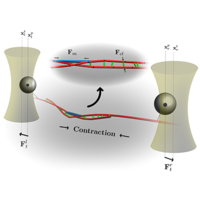
Current understanding of how contractility emerges in disordered actomyosin networks of nonmuscle cells is still largely based on the intuition derived from earlier works on muscle contractility. In addition, in disordered networks, passive cross-linkers have been hypothesized to percolate force chains in the network, hence, establishing large-scale connectivity between local contractile clusters. This view, however, largely overlooks the free energy of cross-linker binding at the microscale, which, even in the absence of active fluctuations, provides a thermodynamic drive towards highly overlapping filamentous states. In this work, we use stochastic simulations and mean-field theory to shed light on the dynamics of a single actomyosin force dipole—a pair of antiparallel actin filaments interacting with active myosin II motors and passive cross-linkers. We first show that while passive cross-linking without motor activity can produce significant contraction between a pair of actin filaments, driven by thermodynamic favorability of cross-linker binding, a sharp onset of kinetic arrest exists at large cross-link binding energies, greatly diminishing the effectiveness of this contractility mechanism. Then, when considering an active force dipole containing nonmuscle myosin II, we find that cross-linkers can also serve as a structural ratchet when the motor dissociates stochastically from the actin filaments, resulting in significant force amplification when both molecules are present. Our results provide predictions of how actomyosin force dipoles behave at the molecular level with respect to filament boundary conditions, passive cross-linking, and motor activity, which can explicitly be tested using an optical trapping experiment.
Physics Subject Headings (PhySH)
Popular Summary
Biological tissues have the amazing ability to generate significant force and respond to mechanical stimuli. In eukaryotic muscle cells, for example, neural activity can signal actomyosin fibers (long threads of proteins) to contract, generating tension from within the cell’s cytoskeleton that leads to muscle contraction. While nonmuscle cells can also produce significant contractile force with analogous sets of protein ingredients, this somehow takes place even in the absence of well-organized cytoskeletal structures that are thought to be key in generating contractility in muscle cells. This raises the question of whether the same chemical and physical principles are responsible for the contractile behavior and overall microscopic dynamics of nonmuscle cells. This question underlies understanding phenomena such as immune cell activation, wound healing, and cancer metastasis. Using theoretical analyses and computer simulations, we provide a novel explanation as to how contractile forces can be generated within general actomyosin networks with disordered architectures.
First, we show that fundamental contractile elements in actomyosin networks, called force dipoles, harness the thermodynamic free energy of an auxiliary cross-linking protein binding, independent of motor processes. Surprisingly, we discover that both energy- and nonenergy-consuming proteins in tandem can greatly amplify forces at a microscopic level because of a structural ratcheting of the motor by cross-linking proteins. Our work explains this synergistic phenomenon and provides scaling laws for how this force generation depends on the thermodynamic properties of the proteins, pointing to a nonequilibrium ratcheting mechanism as an important requirement for significant contractile force generation in nonmuscle actomyosin systems.
Having worked out the fundamental principles behind elementary actomyosin force dipoles, next we study how a large collection of such dipoles form mesoscopic-scale networks, which architecturally remodel themselves and show interesting, novel contractile behaviors at larger scales.
Article Text
References (56)
- B. Alberts, A. Johnson, J. Lewis, M. Raff, K. Roberts, and P. Walter, Molecular Biology of the Cell, 4th ed. (Garland Science, New York, 2002).
- A. Schmidt and M. N. Hall, Signaling to the Actin Cytoskeleton, Annu. Rev. Cell Dev. Biol. 14, 305 (1998).
- V. Vogel and M. Sheetz, Local Force and Geometry Sensing Regulate Cell Functions, Nat. Rev. Mol. Cell Biol. 7, 265 (2006).
- T. Luo, K. Mohan, P. A. Iglesias, and D. N. Robinson, Molecular Mechanisms of Cellular Mechanosensing, Nat. Mater. 12, 1064 (2013).
- A. V. Hill, The Mechanical Eefficiency of Frog’s Muscle, Proc. R. Soc. B 127, 434 (1939).
- T. Duke, Molecular Model of Muscle Contraction, Proc. Natl. Acad. Sci. U.S.A. 96, 2770 (1999).
- A. Vilfan and T. Duke, Instabilities in the Transient Response of Muscle, Biophys. J. 85, 818 (2003).
- N. Billington, A. Wang, J. Mao, R. S. Adelstein, and J. R. Sellers, Characterization of Three Full-Length Human Nonmuscle Myosin II Paralogs, J. Biol. Chem. 288, 33398 (2013).
- G. Salbreux, G. Charras, and E. Paluch, Actin Cortex Mechanics and Cellular Morphogenesis, Trends Cell Biol. 22, 536 (2012).
- R. Levayer and T. Lecuit, Biomechanical Regulation of Contractility: Spatial Control and Dynamics, Trends Cell Biol. 22, 61 (2012).
- L. Blanchoin, R. Boujemaa-Paterski, C. Sykes, and J. Plastino, Actin Dynamics, Architecture, and Mechanics in Cell Motility, Physiol. Rev. 94, 235 (2014).
- M. Lenz, Geometrical Origins of Contractility in Disordered Actomyosin Networks, Phys. Rev. X 4, 041002 (2014).
- M. Lenz, M. L. Gardel, and A. R. Dinner, Requirements for Contractility in Disordered Cytoskeletal Bundles, New J. Phys. 14, 033037 (2012).
- M. P. Murrell and M. L. Gardel, F-Actin Buckling Coordinates Contractility and Severing in a Biomimetic Actomyosin Cortex, Proc. Natl. Acad. Sci. U.S.A. 109, 20820 (2012).
- M. S. e Silva, M. Depken, B. Stuhrmann, M. Korsten, F. C. MacKintosh, and G. H. Koenderink, Active Multistage Coarsening of Actin Networks Driven by Myosin Motors, Proc. Natl. Acad. Sci. U.S.A. 108, 9408 (2011).
- D. B. Oelz, B. Y. Rubinstein, and A. Mogilner, A Combination of Actin Treadmilling and Cross-Linking Drives Contraction of Random Actomyosin Arrays, Biophys. J. 109, 1818 (2015).
- K. Popov, J. Komianos, and G. A. Papoian, MEDYAN: Mechanochemical Simulations of Contraction and Polarity Alignment in Actomyosin Networks, PLoS Comput. Biol. 12, e1004877 (2016).
- P. M. Bendix, G. H. Koenderink, D. Cuvelier, Z. Dogic, B. N. Koeleman, W. M. Brieher, C. M. Field, L. Mahadevan, and D. A. Weitz, A Quantitative Analysis of Contractility in Active Cytoskeletal Protein Networks, Biophys. J. 94, 3126 (2008).
- S. Köhler and A. R. Bausch, Contraction Mechanisms in Composite Active Actin Networks, PLoS One 7, 1 (2012).
- S. Wang and P. G. Wolynes, Active Contractility in Actomyosin Networks, Proc. Natl. Acad. Sci. U.S.A. 109, 6446 (2012).
- J. Alvarado, M. Sheinman, A. Sharma, F. C. MacKintosh, and G. H. Koenderink, Molecular Motors Robustly Drive Active Gels to a Critically Connected State, Nat. Phys. 9, 591 (2013).
- W. Jung, M. P. Murrell, and T. Kim, F-Actin Cross-Linking Enhances the Stability of Force Generation in Disordered Actomyosin Networks, Comput. Part. Mech. 2, 317 (2015).
- H. Ennomani, G. Letort, C. Guérin, J.-L. Martiel, W. Cao, F. Nédélec, E. M. De La Cruz, M. Théry, and L. Blanchoin, Architecture and Connectivity Govern Actin Network Contractility, Curr. Biol. 26, 616 (2016).
- S. Wang and P. G. Wolynes, Communication: Effective Temperature and Glassy Dynamics of Active Matter, J. Chem. Phys. 135, 051101 (2011).
- A. J. Levine and F. C. MacKintosh, The Mechanics and Fluctuation Spectrum of Active Gels, J. Phys. Chem. B 113, 3820 (2009).
- S. Walcott and S. X. Sun, Active Force Generation in Cross-Linked Filament Bundles without Motor Proteins, Phys. Rev. E 82, 050901 (2010).
- Z. Lansky, M. Braun, A. Lüdecke, M. Schlierf, P. R. T. Wolde, M. E. Janson, and S. Diez, Diffusible Crosslinkers Generate Directed Forces in Microtubule Networks, Cell 160, 1159 (2015).
- J. Hermans and B. Lentz, Equilibria and Kinetics of Biological Macromolecules (Wiley, New York, 2014).
- T. D. Pollard, Structure and Polymerization of Acanthamoeba Myosin-II Filaments, J. Cell Biol. 95, 816 (1982).
- S. X. Sun, S. Walcott, and C. W. Wolgemuth, Cytoskeletal Cross-Linking and Bundling in Motor-Independent Contraction, Curr. Biol. 20, R649 (2010).
- D. Johann, D. Goswami, and K. Kruse, Generation of Stable Overlaps between Antiparallel Filaments, Phys. Rev. Lett. 115, 118103 (2015).
- T. Erdmann, P. J. Albert, and U. S. Schwarz, Stochastic Dynamics of Small Ensembles of Non-Processive Molecular Motors: The Parallel Cluster Model, J. Chem. Phys. 139, 175104 (2013).
- S. Stam, J. Alberts, M. L. Gardel, and E. Munro, Isoforms Confer Characteristic Force Generation and Mechanosensation by Myosin II Filaments, Biophys. J. 108, 1997 (2015).
Assuming a critical buckling force for a cross-linked segment of the form , where for an actin filament [35], and the inter-cross-link distance of the actin filament network being [36], which is representative of lamellar actin concentrations of , the estimated critical buckling force for these network segments is 4.3 pN. Assuming ten motor heads of nonmuscle myosin II (isoform A) are available for binding to an actin segment, predictions for force generation of this small ensemble are well below 5 pN due to the stochastic nature of the nonprocessive motor heads [32, 33]. We also confirm this in our force dipole simulations.
- M. Footer, J. Kerssemakers, J. Theriot, and M. Dogterom, Direct Measurement of Force Generation by Actin Filament Polymerization Using an Optical Trap, Proc. Natl. Acad. Sci. U.S.A. 104, 2181 (2007).
- T. T. Falzone, S. Blair, and R. M. Robertson-Anderson, Entangled F-Actin Displays a Unique Crossover to Microscale Nonlinearity Dominated by Entanglement Segment Dynamics, Soft Matter 11, 4418 (2015).
- Y. Lan and G. A. Papoian, The Stochastic Dynamics of Filopodial Growth, Biophys. J. 94, 3839 (2008).
- P. I. Zhuravlev and G. A. Papoian, Molecular Noise of Capping Protein Binding Induces Macroscopic Instability in Filopodial Dynamics. Proc. Natl. Acad. Sci. U.S.A. 106, 11570 (2009).
- L. Hu and G. A. Papoian, Mechano-Chemical Feedbacks Regulate Actin Mesh Growth in Lamellipodial Protrusions, Biophys. J. 98, 1375 (2010).
- L. Hu and G. A. Papoian, Molecular Transport Modulates the Adaptive Response of Branched Actin Networks to an External Force, J. Phys. Chem. B 117, 13388 (2013).
- J. M. Ferrer, H. Lee, J. Chen, B. Pelz, F. Nakamura, R. D. Kamm, and M. J. Lang, Measuring Molecular Rupture Forces between Single Actin Filaments and Actin-Binding Proteins, Proc. Natl. Acad. Sci. U.S.A. 105, 9221 (2008).
- M. Murrell, P. W. Oakes, M. Lenz, and M. L. Gardel, Forcing Cells into Shape: The Mechanics of Actomyosin Contractility, Nat. Rev. Mol. Cell Biol. 16, 486 (2015).
- M. Kovács, K. Thirumurugan, P. J. Knight, and J. R. Sellers, Load-Dependent Mechanism of Nonmuscle Myosin 2. Proc. Natl. Acad. Sci. U.S.A. 104, 9994 (2007).
- B. Guo and W. H. Guilford, Mechanics of Actomyosin Bonds in Different Nucleotide States Are Tuned to Muscle Contraction, Proc. Natl. Acad. Sci. U.S.A. 103, 9844 (2006).
- S. Walcott, D. M. Warshaw, and E. P. Debold, Mechanical Coupling between Myosin Molecules Causes Differences between Ensemble and Single-Molecule Measurements, Biophys. J. 103, 501 (2012).
- C. Veigel, J. E. Molloy, S. Schmitz, and J. Kendrick-Jones, Load-Dependent Kinetics of Force Production by Smooth Muscle Myosin Measured with Optical Tweezers, Nat. Cell Biol. 5, 980 (2003).
- M. F. Norstrom, P. A. Smithback, and R. S. Rock, Unconventional Processive Mechanics of Non-Muscle Myosin IIB, J. Biol. Chem. 285, 26326 (2010).
- D. H. Wachsstock, W. H. Schwartz, and T. D. Pollard, Affinity of Alpha-Actinin for Actin Determines the Structure and Mechanical Properties of Actin Filament Gels, Biophys. J. 65, 205 (1993).
- X. Veigel, C. J. E. Molloy, and J. Kendrick-Jones, Load-Dependent Kinetics of Force Production by Smooth Muscle Myosin Measured with Optical Tweezers, Nat. Cell Biol. 5, 980 (2003).
- A. Ott, M. Magnasco, A. Simon, and A. Libchaber, Persistence of Actin, Macromolecules 48, 1642 (1993).
- M. Kovács, F. Wang, A. Hu, Y. Zhang, and J. R. Sellers, Functional Divergence of Human Cytoplasmic Myosin II. Kinetic Characterization of the Non-Muscle IIA Isoform, J. Biol. Chem. 278, 38132 (2003).
- G. Piazzesi, M. Reconditi, M. Linari, L. Lucii, P. Bianco, E. Brunello, V. Decostre, A. Stewart, D. B. Gore, T. C. Irving, M. Irving, and V. Lombardi, Skeletal Muscle Performance Determined by Modulation of Number of Myosin Motors Rather than Motor Force or Stroke Size, Cell 131, 784 (2007).
- D. T. Gillesple, Exact Stochastic Simulation of Coupled Chemical Reactions, J. Phys. Chem. 93555, 2340 (1977).
- D. T. Gillespie, A General Method for Numerically Simulating the Stochastic Time Evolution of Coupled Chemical Reactions, J. Comput. Phys. 22, 403 (1976).
- Y. Kuramoto, Effects of Diffusion on the Fluctuations in Open Chemical Systems, Prog. Theor. Phys. 52, 711 (1974).
- F. C. MacKintosh, Polymer-Based Models of Cytoskeletal Networks, Cytoskelet. Mech. Model. Meas. Cell Mech. 2006, 152 (2006).

