

- Featured in Physics
- Open Access
Stability, Degeneracy, and Scalability of a 600-Site Cavity Array Microscope
Phys. Rev. X 16, 041009 – Published 8 October, 2026
DOI: https://doi.org/10.1103/9cwp-ppp2
Abstract
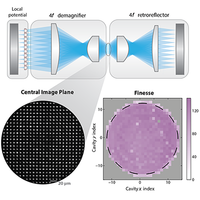
Optical cavities are a foundational technology for controlling light-matter interactions. While interfacing a single cavity to either an atom or ensemble has become a standard tool, the advent of single-atom control in large atomic arrays has spurred interest in a new frontier of “many-cavity QED,” featuring many independent resonators capable of separately addressing individual quantum emitters. In this fast-evolving landscape, the cavity array microscope was recently introduced—employing free space intracavity optics to engineer a two-dimensional array of tightly spaced cavity modes with wavelength-scale waists, ideally suited for interfacing with atom arrays. Here, we realize the next generation of this architecture, achieving hundreds of degenerate cavity modes with improved, uniform finesse, and explore the technical features of the system which will enable further scalability. In particular, we study imperfections, including optical aberrations, field of view constraints, array nondegeneracies, and losses from optical elements. We identify the sensitivity to these various factors and exposit the control knobs and techniques necessary to align and operate the system in a stable manner. Ultimately, we lay out a pathway toward operation with tens of thousands of independent cavities while maintaining compatibility with existing atom arrays, paving the way to myriad applications including highly parallelized remote entanglement generation, fast and nondestructive midcircuit readout, and the implementation of hybrid atom-photon Hamiltonians.
Physics Subject Headings (PhySH)
 synopsis

How To Arrange Hundreds of Atoms Between Two Mirrors
A new device in which more than 600 atoms are manipulated within a single optical cavity could allow for the scaling up of neutral-atom quantum computers.
See more in Physics
Popular Summary
Optical cavities have been used for decades to facilitate strong interactions between quantum emitters and light; however, they typically operate with a single spatial mode, providing just one “interaction site.” In recent years, the development of neutral atom array quantum processors has spurred interest in cavity architectures that independently interface with many quantum emitters in parallel. We address this challenge by developing a scalable cavity array microscope containing over 600 independent optical cavities, achieved by integrating specialized optical elements inside the cavity to generate a two-dimensional grid of tightly focused modes. We further uncover the fundamental mechanisms governing its stability, mutual degeneracy, and scalability, providing a viable pathway toward scaling this architecture to support tens of thousands of high-performance cavities. Our results facilitate expanded opportunities across various disciplines, ranging from highly parallelized remote entanglement generation in quantum networks to spatially resolved biological and chemical sensing.
Article Text
Supplemental Material
References (39)
- H. Walther, B. T. H. Varcoe, B.-G. Englert, and T. Becker, Cavity quantum electrodynamics, Rep. Prog. Phys. 69, 1325 (2006).
- J. L. Reynolds et al., Quantum-optimal nonlinear microscopy with classical light, arXiv:2512.04328.
- L.-M. Needham et al., Label-free detection and profiling of individual solution-phase molecules, Nature (London) 629, 1062 (2024).
- L. Kohler, M. Mader, C. Kern, M. Wegener, and D. Hunger, Tracking Brownian motion in three dimensions and characterization of individual nanoparticles using a fiber-based high-finesse microcavity, Nat. Commun. 12, 6385 (2021).
- B. P. Abbott et al., Observation of gravitational waves from a binary black hole merger, Phys. Rev. Lett. 116, 061102 (2016).
- J. M. Raimond, M. Brune, and S. Haroche, Manipulating quantum entanglement with atoms and photons in a cavity, Rev. Mod. Phys. 73, 565 (2001).
- I. D. Leroux, Schleier-M. H. Smith, and Vuletić, V. Implementation of cavity squeezing of a collective atomic spin, Phys. Rev. Lett. 104, 073602 (2010).
- E. S. Cooper, P. Kunkel, A. Periwal, and M. Schleier-Smith, Graph states of atomic ensembles engineered by photon-mediated entanglement, Nat. Phys. 20, 770 (2024).
- S. W. Ding et al., High finesse buckled microcavities, Optica 13, 313 (2026).
- C. J. Hood, H. J. Kimble, and J. Ye, Characterization of high-finesse mirrors: Loss, phase shifts, and mode structure in an optical cavity, Phys. Rev. A 64, 033804 (2001).
- P. Samutpraphoot, T. P. L. Dordevic, Ocola, H. Bernien, C. Senko, V. Vuletic, and M. D. Lukin, Strong coupling of two individually controlled atoms via a nanophotonic cavity, Phys. Rev. Lett. 124, 063602 (2020).
- D. Hunger et al., A fiber Fabry-Pérot cavity with high finesse, New J. Phys. 12, 065038 (2010).
- T. Juffmann, B. B. Klopfer, T. L. Frankort, P. Haslinger, and M. A. Kasevich, Multi-pass microscopy, Nat. Commun. 7, 12858 (2016).
- M. Jaffe et al., Understanding and suppressing backscatter in optical resonators, Optica 9, 878 (2022).
- D. Shadmany et al., Cavity QED in a high NA resonator, Sci. Adv. 11, eads8171 (2025).
- L. Taneja, D. I. Schuster, and J. Simon, Light-controlled strong coupling of optical cavity modes spaced by 200 thz, Opt. Lett. 50, 5698 (2025).
- F. Orsi, N. R. P. Sauerwein, Bhatt, J. Faltinath, E. Fedotova, N. Reiter, T. Cantat Moltrecht, and J. P. Brantut, Cavity microscope for micrometer-scale control of atom-photon interactions, PRX Quantum 5, 040333 (2024).
- A. Shaw et al., A cavity-array microscope for parallel single-atom interfacing, Nature (London) 46 (2026).
- E. Deist, Y. H. Lu, J. Ho, M. K. Pasha, J. Zeiher, Z. Yan, and D. M. StamperKurn, Mid-circuit cavity measurement in a neutral atom array, Phys. Rev. Lett. 129, 203602 (2022).
- B. Grinkemeyer et al., Error-detected quantum operations with neutral atoms mediated by an optical cavity, Science 387, 1301 (2025).
- B. Hu, J. Sinclair, E. Bytyqi, M. Chong, A. Rudelis, J. Ramette, Z. Vendeiro, and V. Vuletic, Site-selective cavity readout and classical error correction of a 5-bit atomic register, Phys. Rev. Lett. 134, 120801 (2025).
- L. Hartung, M. Seubert, S. Welte, E. Distante, and G. Rempe, A quantum-network register assembled with optical tweezers in an optical cavity, Science 385, 179 (2024).
- Y. Liu, Z. Wang, P. Yang, Q. Wang, Q. Fan, S. Guan, G. Li, P. Zhang, and T. Zhang, Realization of strong coupling between deterministic single-atom arrays and a high-finesse miniature optical cavity, Phys. Rev. Lett. 130, 173601 (2023).
- T. Ðorđević et al., Entanglement transport and a nanophotonic interface for atoms in optical tweezers, Science 373, 1511 (2021).
- J. Sinclair, J. Ramette, B. Grinkemeyer, D. Bluvstein, M. D. Lukin, and V. Vuletic, Fault-tolerant optical interconnects for neutral-atom arrays, Phys. Rev. Res. 7, 013313 (2025).
- M. I. Makin, J. H. Cole, C. Tahan, L. C. Hollenberg, Lloyd, and A. D. Greentree, Quantum phase transitions in photonic cavities with two-level systems, Phys. Rev. A 77, 053819 (2008).
- M. Hartmann, F. Brandao, and M. Plenio, Quantum many-body phenomena in coupled cavity arrays, Laser Photonics Rev. 2, 527 (2008).
- A. D. Greentree, C. Tahan, J. H. Cole, and L. C. L. Hollenberg, Quantum phase transitions of light, Nat. Phys. 2, 856 (2006).
- See Supplemental Material at http://link.aps.org/supplemental/10.1103/9cwp-ppp2 for extended analysis and discussion of aberrations, cavity locking and alignment procedures, and biosensing applications.
- P. L. Ocola, I. Dimitrova, B. Grinkemeyer, E. GuardadoSanchez, T. Dordevic, P. Samutpraphoot, V. Vuletic, and M. D. Lukin, Control and entanglement of individual Rydberg atoms near a nanoscale device, Phys. Rev. Lett. 132, 113601 (2024).
- N.-C. Chiu et al., Continuous operation of a coherent 3,000-qubit system, Nature (London) 646, 1075 (2025).
- R. Lin et al., AI-enabled parallel assembly of thousands of defect-free neutral atom arrays, Phys. Rev. Lett. 135, 060602 (2025).
- H. J. Manetsch et al., A tweezer array with 6,100 highly coherent atomic qubits, Nature (London) 347, 60 (2025).
- A. Sommer and J. Simon, Engineering photonic Floquet Hamiltonians through Fabry–Pérot resonators, New J. Phys. 18, 035008 (2016).
Asphericon 245040-001-03A Corning 7980 asphere with , . Modified from AFL12-10-U-U-355 for 780 nm.
- A. E. Siegman, Lasers (University Science Books, Herndon, VA, 1986).
- H. E. Bennett and J. Porteus, Relation between surface roughness and specular reflectance at normal incidence, J. Opt. Soc. Am. 51, 123 (1961).
- M. Phelps, First contact application and removal procedure, internal LIGO document (2010).
- A. Mokeev, B. Saif, M. D. Lukin, and J. Borregaard, Enhancing optical imaging via quantum computation, PRX Quantum 7, 010318 (2026).

