

- Open Access
Unraveling Non-polymorphic Phase Evolution in Mg-Ag-Sb for Designing Thermally Recoverable Thermoelectrics
Phys. Rev. X 16, 031035 – Published 12 August, 2026
DOI: https://doi.org/10.1103/7nxm-t64f
Abstract
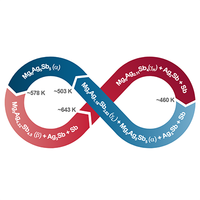
P-type MgAgSb with excellent room-temperature thermoelectric performance holds great promise for cooling and power generation. However, its practical application has been significantly limited by phase transitions, which are long considered a polymorphic transformation where the compositions remain identical but the crystal structures differ. Here we report the non-polymorphic nature of the complex phase transitions in Mg-Ag-Sb during thermal cycling, yielding four compositionally distinct ternary compounds that crystallize in three different structures. During heating, the tetragonal -phase MgAgSb decomposes into the tetragonal -phase , and subsequently into the cubic -phase , with the progressive precipitation of and Sb phases. Upon cooling, the -phase converts to the cubic -phase , accompanied by the phase with substantial and Sb phases. The electron localization function and bonding analysis indicate that the Mg-Ag-Sb compound is characterized by ionic interactions, wherein the Ag-Sb bond is notably weaker compared to the Mg-Sb bond. Molecular dynamics simulations reveal that significant Mg and Ag migration within the Sb sublattices underlies the phase evolution. Surprisingly, the rapid atomic diffusion also enables the restoration of the -phase MgAgSb upon annealing at low temperatures. Successful recovery of the phase can be realized even after 500 thermal cycles between 423–673 K, demonstrating unprecedented thermal recoverability.
Physics Subject Headings (PhySH)
Popular Summary
Thermal degradation, typically occurring through phase transitions or decomposition, is a common failure mechanism that limits material reusability. For high-performance -type MgAgSb thermoelectric material, thermal instability and the difficulty in addressing it, has long constrained operating temperature to below 573 K. This limiting temperature hinders practical deployment. We found that significant performance degradation is driven by non-polymorphic transitions tied to Mg/Ag migration within Sb sublattices, accompanied by the precipitation of and Sb phases. This contrasts with the previous assumption of a polymorphic phase transition, where the composition remains fixed during the structural rearrangement. We found that low-temperature annealing reverses the changes we observed, enabling full recovery of the material’s high performance even after 500 thermal cycles (at 423–673 K). Clarifying the mechanism behind the phase transitions of this material establishes a foundational basis for the design of self-healing thermoelectrics.
Article Text
Supplemental Material
References (67)
- A. F. Ioffe, Semiconductor Thermoelements and Thermoelectric Cooling (Infosearch Limited, London, 1956), 10.1063/1.3060810.
- D. M. Rowe, CRC Handbook of Thermoelectrics (CRC Press, Boca Raton, 1995), 10.1201/9781420049718.
- H. J. Goldsmid, Introduction to Thermoelectricity (Springer, Heidelberg; New York, 2010), 10.1007/978-3-642-00716-3.
- S. Ye et al., Superior electron transport in the single-crystalline TiCoSb-based half-Heuslers, Nat. Commun. 16, 1812 (2025).
- X. Ma et al., Elevating thermoelectric performance in the sub-ambient temperature range for electronic refrigeration, Innovation 6, 100864 (2025).
- L. R. Jørgensen, C. B. Zeuthen, H. Reardon, and B. B. Iversen, Is a realistic candidate for high-temperature thermoelectric applications?, J. Phys. Chem. C 122, 5317 (2018).
- H. Shang, Z. Liang, C. Xu, S. Song, D. Huang, H. Gu, J. Mao, Z. Ren, and F. Ding, N-type with improved thermal stability for thermoelectric power generation, Acta Mater. 201, 572 (2020).
- H. Z. Zhao, J. E. Sui, Z. J. Tang, Y. C. Lan, Q. G. Jie, D. Kraemer, K. N. McEnaney, A. Guloy, G. Chen, and Z. F. Ren, High thermoelectric performance of -based materials, Nano Energy 7, 97 (2014).
- J. Shuai, H. S. Kim, Y. C. Lan, S. Chen, Y. Liu, H. Z. Zhao, J. H. Sui, and Z. F. Ren, Study on thermoelectric performance by Na doping in nanostructured , Nano Energy 11, 640 (2015).
- Z. H. Liu, Y. M. Wang, J. Mao, H. Y. Geng, J. Shuai, Y. X. Wang, R. He, W. Cai, J. H. Sui, and Z. F. Ren, Lithium doping to enhance thermoelectric performance of with weak electron-phonon coupling, Adv. Energy Mater. 6, 11 (2016).
- A. Li, L. Wang, J. Li, and T. Mori, Global softening to manipulate sound velocity for reliable high-performance thermoelectrics, Energy Environ. Sci. 17, 8810 (2024).
- X. Wu, Y. Lin, C. Liu, Y. Wang, H. Li, B. Ge, and W. Liu, A high performance eco-friendly -based thermoelectric power generation device near phase transition temperatures, Energy Environ. Sci. 17, 2879 (2024).
- X. Zhang et al., High-performance -based thermoelectrics with at , Joule 8, 3324 (2024).
- A. Li, L. Wang, J. Li, X. Wu, and T. Mori, Self-optimized contact in air-robust thermoelectric junction towards long-lasting heat harvesting, Nat. Commun. 16, 1502 (2025).
- W. Zuo et al., Atomic-scale interface strengthening unlocks efficient and durable Mg-based thermoelectric devices, Nat. Mater. 24, 735 (2025).
- L. Xie et al., Screening strategy for developing thermoelectric interface materials, Science 382, 921 (2023).
- M. J. Kirkham, A. M. dos Santos, C. J. Rawn, E. Lara-Curzio, J. W. Sharp, and A. J. Thompson, Ab initio determination of crystal structures of the thermoelectric material , Phys. Rev. B 85, 144120 (2012).
- J. L. Mi, P. J. Ying, M. Sist, H. Reardon, P. Zhang, T. Zhu, X. Zhao, and B. B. Iversen, Elaborating the crystal structures of thermoelectric compound: Polymorphs and atomic disorders, Chem. Mater. 29, 6378 (2017).
- Z. Zhang, Y. Zhu, J. Ji, J. Zhang, H. Luo, C. Fu, Q. Li, M. Brod, G. J. Snyder, and Y. Zhang, Ag rearrangement induced metal-insulator phase transition in thermoelectric , Mater. Today Phys. 25, 100702 (2022).
- Z. Liu, H. Geng, J. Mao, J. Shuai, R. He, C. Wang, W. Cai, J. Sui, and Z. Ren, Understanding and manipulating the intrinsic point defect in for higher thermoelectric performance, J. Mater. Chem. A 4, 16834 (2016).
- J. Lei, D. Zhang, W. Guan, Z. Cheng, C. Wang, and Y. Wang, Engineering electrical transport in to realize high performances near room temperature, Phys. Chem. Chem. Phys. 20, 16729 (2018).
- K. Toh, K. Suekuni, K. Hashikuni, H. Nishiate, U. Anazawa, C.-H. Lee, and M. Ohtaki, An effective synthesis route for high-performance thermoelectric material, J. Mater. Sci. 57, 11265 (2022).
- Y. Huang, J. Lei, H. Chen, Z. Zhou, H. Dong, S. Yang, H. Gao, T.-R. Wei, K. Zhao, and X. Shi, Intrinsically high thermoelectric performance in near-room-temperature materials, Acta Mater. 249, 118847 (2023).
- See Supplemental Material at http://link.aps.org/supplemental/10.1103/7nxm-t64f for figures and tables containing supporting characterization, calculation, and experimental results, which includes Figs. S1–S41, Tables S1–S9, and Refs. [17,18,25].
- S. Zhi, X. Ma, S. Ye, Zuoxu Wu, F. Cao, Y. Fu, Q. Zhang, and J. Mao, Significant anharmonic scattering in single-crystalline with site-occupation disorders, Appl. Phys. Rev. 12, 021411 (2025).
- A. L. Bail, Whole powder pattern decomposition methods and applications: A retrospection, Powder Diffr. 20, 316 (2005).
- A. Li, L. Wang, X. Wu, J. Li, X. Wang, G. Wu, Z. Hu, and T. Mori, Semiconductor-metal transition powers high-efficiency thermoelectrics, Sci. Adv. 11, eadx7115 (2025).
- A. Savin, R. Nesper, S. Wengert, and T. F. Fässler, ELF: The electron localization function, Angew. Chem., Int. Ed. Engl. 36, 1808 (1997).
- J. K. Burdett and T. A. McCormick, Electron localization in molecules and solids: The meaning of ELF, J. Phys. Chem. A 102, 6366 (1998).
- K. Koumpouras and J. A. Larsson, Distinguishing between chemical bonding and physical binding using electron localization function (ELF), J. Phys. Condens. Matter 32, 315502 (2020).
- P. C. Müller, C. Ertural, J. Hempelmann, and R. Dronskowski, Crystal orbital bond index: Covalent bond orders in solids, J. Phys. Chem. C 125, 7959 (2021).
- X. Nan, K. Hayashi, Z. Huang, and Y. Miyazaki, Data-driven approach for potential iron-based half-Heusler thermoelectrics with chemical bonding characteristics, Sci. Adv. 11, eadw4514 (2025).
- V. L. Deringer, A. L. Tchougréeff, and R. Dronskowski, Crystal orbital Hamilton population (COHP) analysis as projected from plane-wave basis sets, J. Phys. Chem. A 115, 5461 (2011).
- S. Steinberg and R. Dronskowski, The crystal orbital Hamilton population (COHP) method as a tool to visualize and analyze chemical bonding in intermetallic compounds, Crystals 8, 225 (2018).
- H. Li, J. Lai, Z. Li, and L. Wang, Multi-sites electrocatalysis in high-entropy alloys, Adv. Funct. Mater. 31, 2106715 (2021).
- H. Liu, X. Shi, F. Xu, L. Zhang, W. Zhang, L. Chen, Q. Li, C. Uher, T. Day, and G. J. Snyder, Copper ion liquid-like thermoelectrics, Nat. Mater. 11, 422 (2012).
- H. Liu et al., Ultrahigh thermoelectric performance by electron and phonon critical scattering in , Adv. Mater. 25, 6607 (2013).
- Y. He, T. Day, T. Zhang, H. Liu, X. Shi, L. Chen, and G. J. Snyder, High thermoelectric performance in non-toxic earth-abundant copper sulfide, Adv. Mater. 26, 3974 (2014).
- Y. He, P. Lu, X. Shi, F. Xu, T. Zhang, G. J. Snyder, C. Uher, and L. Chen, Ultrahigh thermoelectric performance in mosaic crystals, Adv. Mater. 27, 3639 (2015).
- M. Ferhat and J. Nagao, Thermoelectric and transport properties of compounds, J. Appl. Phys. 88, 813 (2000).
- S. Chen et al., Unified contact layer and low-temperature transient liquid phase interconnection for high-performance all-Mg-based thermoelectric devices, Natl. Sci. Rev. 12, nwaf227 (2025).
- J. Camut, I. Barber Rodriguez, H. Kamila, A. Cowley, R. Sottong, E. Mueller, and J. de Boor, Insight on the interplay between synthesis conditions and thermoelectric properties of , Mater. 12, 11 (2019).
- I. Rodriguez-Barber, J. Camut, L. Luhmann, A. Cowley, E. Mueller, and J. de Boor, On the influence of AgMg precursor formation on microstructure and thermoelectric properties, J. Alloys Compd. 860, 158384 (2021).
- A. Duparchy, L. Millerand, J. Camut, S. Tumminello, H. Kamila, R. Deshpande, A. Cowley, E. Mueller, and J. De Boor, Establishing synthesis-composition-property relationships for enhanced and reproducible thermoelectric properties of , J. Mater. Chem. A 10, 21716 (2022).
- K. Guo et al., Rational manipulation of Ag vacancies for lattice plainification and superior thermoelectric performance in , Chem. Eng. J. 507, 160515 (2025).
- G. Kresse and J. Furthmuller, Efficiency of ab-initio total energy calculations for metals and semiconductors using a plane-wave basis set, Comput. Mater. Sci. 6, 15 (1996).
- G. Kresse and J. Furthmuller, Efficient iterative schemes for ab-initio total-energy calculations using a plane-wave basis set, Phys. Rev. B 54, 11169 (1996).
- P. E. Blochl, Projector augmented-wave method, Phys. Rev. B 50, 17953 (1994).
- J. P. Perdew, K. Burke, and M. Ernzerhof, Generalized gradient approximation made simple, Phys. Rev. Lett. 77, 3865 (1996).
- A. Zunger, S.-H. Wei, L. G. Ferreira, and J. E. Bernard, Special quasirandom structures, Phys. Rev. Lett. 65, 353 (1990).
- M. Angqvist, W. A. Munoz, J. M. Rahm, E. Fransson, C. Durniak, P. Rozyczko, T. H. Rod, and P. Erhart, ICET-A python library for constructing and sampling alloy cluster expansions, Adv. Theory Simul. 2, 1900015 (2019).
- R. Dronskowski and P. E. Bloechl, Crystal orbital Hamilton populations (COHP): Energy-resolved visualization of chemical bonding in solids based on density-functional calculations, J. Phys. Chem. 97, 8617 (1993).
- S. Maintz, V. L. Deringer, A. L. Tchougréeff, and R. Dronskowski, Analytic projection from plane-wave and PAW wavefunctions and application to chemical-bonding analysis in solids, J. Comput. Chem. 34, 2557 (2013).
- S. Maintz, V. L. Deringer, A. L. Tchougréeff, and R. Dronskowski, lobster: A tool to extract chemical bonding from plane-wave based DFT, J. Comput. Chem. 37, 1030 (2016).
- W. G. Hoover, A. J. C. Ladd, and B. Moran, High-strain-rate plastic flow studied via non-equilibrium molecular dynamics, Phys. Rev. Lett. 48, 1818 (1982).
- D. J. Evans, Computer “experiment” for non-linear thermodynamics of couette flow, J. Chem. Phys. 78, 3297 (1983).
- M. Parrinello and A. Rahman, Crystal structure and pair potentials: A molecular-dynamics study, Phys. Rev. Lett. 45, 1196 (1980).
- M. Parrinello and A. Rahman, Polymorphic transitions in single crystals: A new molecular dynamics method, J. Appl. Phys. 52, 7182 (1981).
- R. Jinnouchi, J. Lahnsteiner, F. Karsai, G. Kresse, and M. Bokdam, Phase transitions of hybrid perovskites simulated by machine-learning force fields trained on the fly with bayesian inference, Phys. Rev. Lett. 122, 225701 (2019).
- R. Jinnouchi, F. Karsai, and G. Kresse, On-the-fly machine learning force field generation: Application to melting points, Phys. Rev. B 100, 014105 (2019).
- R. Jinnouchi, F. Karsai, C. Verdi, R. Asahi, and G. Kresse, Descriptors representing two- and three-body atomic distributions and their effects on the accuracy of machine-learned inter-atomic potentials, J. Chem. Phys. 152, 234102 (2020).
- O. Hellman, I. A. Abrikosov, and S. I. Simak, Lattice dynamics of anharmonic solids from first principles, Phys. Rev. B 84, 180301(R) (2011).
- O. Hellman, P. Steneteg, I. A. Abrikosov, and S. I. Simak, Temperature dependent effective potential method for accurate free energy calculations of solids, Phys. Rev. B 87, 104111 (2013).
- O. Hellman and I. A. Abrikosov, Temperature-dependent effective third-order interatomic force constants from first principles, Phys. Rev. B 88, 144301 (2013).
- F. Knoop et al., TDEP: Temperature dependent effective potentials, J. Open Source Software 9, 6150 (2024).
- S. Nosé, A molecular dynamics method for simulations in the canonical ensemble, Taylor Francis 52, 255 (1984).
- R. Nelson, C. Ertural, J. George, V. L. Deringer, G. Hautier, and R. Dronskowski, lobster: Local orbital projections, atomic charges, and chemical-bonding analysis from projector-augmented-wave-based density-functional theory, J. Comput. Chem. 41, 1931 (2020).

