

- Open Access
Information Thermodynamics of Agents: The Work Capacity of Channels with Memory
Phys. Rev. X 16, 041004 – Published 5 October, 2026
DOI: https://doi.org/10.1103/7nds-tjr8
Abstract
Predicting future observations plays a central role in machine learning, biology, economics, and many other fields. It lies at the heart of organizational principles such as the variational free-energy principle and, based on the second law of thermodynamics, has even been shown to be necessary for reaching the fundamental energetic limits of information processing on a tape. While the usefulness of the predictive paradigm is undisputed, complex adaptive systems that interact with their environment are more than just predictive machines: They have the power to act upon their environment and cause change. In this work, we develop a framework to analyze the thermodynamics of information processing in percept-action loops, a model of agent-environment interaction, allowing us to investigate the thermodynamic implications of actions and percepts on equal footing. To this end, we introduce the concept of work capacity defined as the maximum rate at which an agent can expect to extract work from its environment. Our results reveal that work-efficient agents must balance prediction and forgetting. This highlights a fundamental departure from the thermodynamics of passive observation, suggesting that prediction and energy efficiency may be at odds in active learning systems.
Physics Subject Headings (PhySH)
Popular Summary
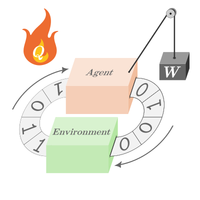
In information thermodynamics, the second-law bound on extractable work yields a predictive principle: For a system that processes a fixed stream of inputs, the better those inputs can be predicted, the more work can be extracted during processing. Biological and artificial agents, however, can act on their environments, so that their future inputs depend on their actions. Predicting these action-dependent inputs can require memory of both past inputs and past actions, and the same second-law bound that underlies the predictive principle implies that retaining past actions carries a fundamental thermodynamic cost. We show that, as a result, maximizing prediction need not maximize work extraction. In some environments, efficient information processing requires balancing prediction against forgetting aspects of past actions. This points toward new thermodynamic design principles for biological and artificial agents.
Article Text
Supplemental Material
References (101)
- P. Lennie, The cost of cortical computation, Curr. Biol. 13, 493 (2003).
- L. Yu and Y. Yu, Energy-efficient neural information processing in individual neurons and neuronal networks, J. Neurosci. Res. 95, 2253 (2017).
- C. P. Kempes, D. Wolpert, Z. Cohen, and J. Pérez-Mercader, The thermodynamic efficiency of computations made in cells across the range of life, Phil. Trans. R. Soc. A 375, 20160343 (2017).
- N. C. Thompson, K. Greenewald, K. Lee, G. F. Manso, The computational limits of deep learning, arXiv:2007.05558.
- J. McDonald, B. Li, N. Frey, D. Tiwari, V. Gadepally, and S. Samsi, Great power, great responsibility: Recommendations for reducing energy for training language models, in Findings of the Association for Computational Linguistics: NAACL 2022, edited by M. Carpuat, M.-C. de Marneffe, and I. V. Meza Ruiz (Association for Computational Linguistics, Stroudsburg, PA, USA, 2022), pp. 1962–1970.
- A. Bérut, A. Arakelyan, A. Petrosyan, S. Ciliberto, R. Dillenschneider, and E. Lutz, Experimental verification of Landauer’s principle linking information and thermodynamics, Nature (London) 483, 187 (2012).
- J. Hong, B. Lambson, S. Dhuey, and J. Bokor, Experimental test of Landauer’s principle in single-bit operations on nanomagnetic memory bits, Sci. Adv. 2, e1501492 (2016).
- J. V. Koski, V. F. Maisi, J. P. Pekola, and D. V. Averin, Experimental realization of a Szilard engine with a single electron, Proc. Natl. Acad. Sci. U.S.A. 111, 13786 (2014).
- G. Paneru, D. Y. Lee, T. Tlusty, and H. K. Pak, Lossless Brownian information engine, Phys. Rev. Lett. 120, 020601 (2018).
- U. Seifert, Stochastic thermodynamics, fluctuation theorems and molecular machines, Rep. Prog. Phys. 75, 126001 (2012).
- J. M. Parrondo, J. M. Horowitz, and T. Sagawa, Thermodynamics of information, Nat. Phys. 11, 131 (2015).
- F. J. Cao and M. Feito, Thermodynamics of feedback controlled systems, Phys. Rev. E 79, 041118 (2009).
- T. Sagawa and M. Ueda, Nonequilibrium thermodynamics of feedback control, Phys. Rev. E 85, 021104 (2012).
- S. Ito and T. Sagawa, Information thermodynamics on causal networks, Phys. Rev. Lett. 111, 180603 (2013).
- J. M. Horowitz and M. Esposito, Thermodynamics with continuous information flow, Phys. Rev. X 4, 031015 (2014).
- D. Hartich, A. C. Barato, and U. Seifert, Stochastic thermodynamics of bipartite systems: Transfer entropy inequalities and a Maxwell’s demon interpretation, J. Stat. Mech. (2014) P02016.
- N. Shiraishi and T. Sagawa, Fluctuation theorem for partially masked nonequilibrium dynamics, Phys. Rev. E 91, 012130 (2015).
- D. Mandal and C. Jarzynski, Work and information processing in a solvable model of Maxwell’s demon, Proc. Natl. Acad. Sci. U.S.A. 109, 11641 (2012).
- D. Mandal, H. T. Quan, and C. Jarzynski, Maxwell’s refrigerator: An exactly solvable model, Phys. Rev. Lett. 111, 030602 (2013).
- A. C. Barato and U. Seifert, An autonomous and reversible Maxwell’s demon, Europhys. Lett. 101, 60001 (2013).
- A. C. Barato and U. Seifert, Unifying three perspectives on information processing in stochastic thermodynamics, Phys. Rev. Lett. 112, 090601 (2014).
- J. Hoppenau and A. Engel, On the energetics of information exchange, Europhys. Lett. 105, 50002 (2014).
- N. Merhav, Sequence complexity and work extraction, J. Stat. Mech. (2015) P06037.
- A. B. Boyd, D. Mandal, and J. P. Crutchfield, Correlation-powered information engines and the thermodynamics of self-correction, Phys. Rev. E 95, 012152 (2017).
- Andrew J. Garner, J. Thompson, V. Vedral, and M. Gu, Thermodynamics of complexity and pattern manipulation, Phys. Rev. E 95, 042140 (2017).
- A. B. Boyd, D. Mandal, and J. P. Crutchfield, Thermodynamics of modularity: Structural costs beyond the Landauer bound, Phys. Rev. X 8, 031036 (2018).
- A. J. Garner, The fundamental thermodynamic bounds on finite models, Chaos 31, 063131 (2021).
- L. He, A. Pradana, J. W. Cheong, and L. Y. Chew, Information processing second law for an information ratchet with finite tape, Phys. Rev. E 105, 054131 (2022).
- A. B. Boyd, J. P. Crutchfield, and M. Gu, Thermodynamic machine learning through maximum work production, New J. Phys. 24, 083040 (2022).
- T. J. Elliott, M. Gu, Andrew J. Garner, and J. Thompson, Quantum adaptive agents with efficient long-term memories, Phys. Rev. X 12, 011007 (2022).
- R. C. Huang, P. M. Riechers, M. Gu, and V. Narasimhachar, Engines for predictive work extraction from memoryful quantum stochastic processes, Quantum 7, 1203 (2023).
- J. Thompson, P. M. Riechers, Andrew J. Garner, T. J. Elliott, and M. Gu, Energetic advantages for quantum agents in online execution of complex strategies, Phys. Rev. Lett. 135, 160402 (2025).
- G. Zambon and G. Adesso, Quantum processes as thermodynamic resources: The role of Non-Markovianity, Phys. Rev. Lett. 134, 200401 (2025).
- Y. Ephraim and N. Merhav, Hidden Markov processes, IEEE Trans. Inf. Theory 48, 1518 (2002).
- R. G. Gallager, Information Theory and Reliable Communication (Wiley, New York, 1968).
- See Supplemental Material at http://link.aps.org/supplemental/10.1103/7nds-tjr8 for mathematical background, detailed derivations and proofs of the main results, and analytical and numerical details of the example, which includes Refs. [37–62].
- R. M. Gray, Probability, Random Processes, and Ergodic Properties (Springer, New York, 2009), Vol. 1.
Note that the labeling convention is such that the value left of the colon in the subscript is included in the sequence, while the value to the right is not.
- T. M. Cover and J. A. Thomas, Elements of Information Theory (Wiley, New York, 2005).
- R. M. Gray, Entropy and Information Theory, first, corrected ed. (Springer Science & Business Media, New York, 2011).
- D. Hankerson, G. A. Harris, and P. D. Johnson Jr, Introduction to Information Theory and Data Compression (CRC Press, Boca Raton, 2003).
- R. W. Yeung, A First Course in Information Theory (Springer US, New York, NY, 2002).
- A. Kolchinsky, A novel approach to the partial information decomposition, Entropy 24, 403 (2022).
- R. W. Yeung, A new outlook on Shannon’s information measures, IEEE Trans. Inf. Theory 37, 466 (1991).
- H. K. Ting, On the amount of information, Theory Probab. Appl. 7, 439 (1962).
- H. C. Tijms, A First Course in Stochastic Models (John Wiley and Sons, Chichester, England, 2003).
- R. G. Gallager, Discrete Stochastic Processes (Springer, New York, 1996).
- R. E. Edwards, Fourier Series: A Modern Introduction Volume 1, 2nd ed. (Springer, New York, NY, 1979).
- J. R. Munkres, Topology: Pearson New International Edition (Pearson Higher Ed, Harlow, England, 2013).
- J. C. Kieffer and M. Rahe, Markov channels are asymptotically mean stationary, SIAM J. Math. Anal. 12, 293 (1981).
- J. Pearl, Bayesian networks: A model of self-activated memory for evidential reasoning, Proceedings of the Annual Meeting of the Cognitive Science Society (Lawrence Erlbaum Associates, Hillsdale, NJ, 1985), 7.
- J. Pearl, Probabilistic Reasoning in Intelligent Systems: Networks of Plausible Inference (Morgan Kaufmann Publishers Inc., San Mateo, CA, 1988).
- T. Verma and J. Pearl, Causal networks: Semantics and expressiveness, in Machine Intelligence and Pattern Recognition, Uncertainty in Artificial Intelligence Vol. 9, edited by R. D. Shachter, T. S. Levitt, L. N. Kanal, and J. F. Lemmer (North-Holland, Amsterdam, Netherlands, 1990), pp. 69–76.
- D. Janzing and B. Schölkopf, Causal inference using the algorithmic Markov condition, IEEE Trans. Inf. Theory 56, 5168 (2010).
- S. Lauritzen, Graphical Models (Clarendon Press, Oxford, 1996).
In fact, can be any sufficient statistic of about but for our purposes, setting is the simplest. This solution was also pointed out in Fig. 13(a) of Ref. [57].
- A. S. Klyubin, D. Polani, and C. L. Nehaniv, Representations of space and time in the maximization of information flow in the perception-action loop, Neural Comput. 19, 2387 (2007).
- R. J. Evans, Graphs for margins of Bayesian networks, Scand. J. Stat. Theory Appl. 43, 625 (2016).
- N. Tishby and D. Polani, Information Theory of Decisions and Actions, in Perception-Action Cycle: Models, Architectures, and Hardware, edited by V. Cutsuridis, A. Hussain, and J. G. Taylor (Springer, New York, 2010), pp. 601–636.
- C. Salge, C. Glackin, and D. Polani, Empowerment–An Introduction, in Guided Self-Organization: Inception, edited by M. Prokopenko (Springer, Berlin, 2014), pp. 67–114.
- N. Ay and K. Zahedi, On the causal structure of the sensorimotor loop, in Guided Self-Organization: Inception (Springer, Berlin, 2014), pp. 261–294.
- J. G. Kemeny and J. L. Snell, Finite Markov Chains (van Nostrand Princeton, NJ, 1960), Vol. 26.
- N. Barnett and J. P. Crutchfield, Computational mechanics of input–output processes: Structured transformations and the epsilon-transducer, J. Stat. Phys. 161, 404 (2015).
- F. Rosas, A. Boyd, and M. Baltieri, AI in a vat: Fundamental limits of efficient world modelling for agent sandboxing and interpretability, arXiv:2504.04608.
- R. B. Ash, Basic Probability Theory (Dover Publications, Mineola, NY, 2008).
- M. Iosifescu, Finite Markov Processes and Their Applications (Dover Publications, Mineola, NY, 2007).
- R. Landauer, Information is physical, Phys. Today 44, 23 (1991).
- S. Deffner and C. Jarzynski, Information processing and the second law of thermodynamics: An inclusive, Hamiltonian approach, Phys. Rev. X 3, 041003 (2013).
- A. Kolchinsky and D. H. Wolpert, Dependence of dissipation on the initial distribution over states, J. Stat. Mech. (2017) 083202.
- N. Shiraishi, K. Funo, and K. Saito, Speed limit for classical stochastic processes, Phys. Rev. Lett. 121, 070601 (2018).
- A. Kolchinsky and D. H. Wolpert, Work, entropy production, and thermodynamics of information under protocol constraints, Phys. Rev. X 11, 041024 (2021).
- D. H. Wolpert, J. Korbel, C. W. Lynn, F. Tasnim, J. A. Grochow, G. Kardeş, J. B. Aimone, V. Balasubramanian, E. De Giuli, D. Doty et al., Is stochastic thermodynamics the key to understanding the energy costs of computation?, Proc. Natl. Acad. Sci. U.S.A. 121, e2321112121 (2024).
An illustrative example of a sequence where the Cesàro limit fails to exist is , where one zero is followed by twice as many ones, followed again by twice as many zeros, and so on. This results in an oscillating arithmetic mean as .
- P. A. Ortega and D. A. Braun, Thermodynamics as a theory of decision-making with information-processing costs, Proc. R. Soc. A 469, 20120683 (2013).
Also referred to as a noiseless channel in communication theory.
- C. E. Shannon, A mathematical theory of communication, Bell Syst. Tech. J. 27, 379 (1948).
If the percept process is a stationary finite-state Markov chain, a closed-form expression for the entropy rate exists [76].
- A. B. Boyd, D. Mandal, and J. P. Crutchfield, Identifying functional thermodynamics in autonomous maxwellian ratchets, New J. Phys. 18, 023049 (2016).
- A. B. Boyd, J. P. Crutchfield, M. Gu, and F. C. Binder, Thermodynamic overfitting and generalization: Energetics of predictive intelligence, New J. Phys. 27, 063901 (2025).
The name stems from the following observation. Let be the probability that the next symbol is 0 given that the current symbol is 0. Then, the value of that maximizes the entropy rate of the golden-mean process equals , the reciprocal of the golden ratio, and the corresponding entropy rate is , the binary logarithm of the golden ratio [81].
- D. Lind and B. Marcus, An Introduction to Symbolic Dynamics and Coding (Cambridge University Press, Cambridge, England, 2021).
- T. Parr, G. Pezzulo, and K. J. Friston, Active Inference: The Free Energy Principle in Mind, Brain, and Behavior (MIT Press, Cambridge, MA, 2022).
- D. T. Larose and C. D. Larose, Data Mining and Predictive Analytics, 2nd ed. (John Wiley & Sons, Hoboken, NJ, 2015).
- J. P. Crutchfield, Between order and chaos, Nat. Phys. 8, 17 (2012).
- S. Boccaletti, C. Grebogi, Y.-C. Lai, H. Mancini, and D. Maza, The control of chaos: Theory and applications, Phys. Rep. 329, 103 (2000).
- T. Lin, Y. Wang, X. Liu, and X. Qiu, A survey of transformers, AI Open 3, 111 (2022).
- M. Navascués and L. P. García-Pintos, Nonthermal quantum channels as a thermodynamical resource, Phys. Rev. Lett. 115, 010405 (2015).
- P. Faist, M. Berta, and F. Brandão, Thermodynamic capacity of quantum processes, Phys. Rev. Lett. 122, 200601 (2019).
- G. Chiribella, G. M. D’Ariano, and P. Perinotti, Theoretical framework for quantum networks, Phys. Rev. A 80, 022339 (2009).
- M. Gu, K. Wiesner, E. Rieper, and V. Vedral, Quantum mechanics can reduce the complexity of classical models, Nat. Commun. 3, 762 (2012).
- V. Dunjko, J. M. Taylor, and H. J. Briegel, Quantum-enhanced machine learning, Phys. Rev. Lett. 117, 130501 (2016).
- C. H. Bennett, The thermodynamics of computation—a review, Int. J. Theor. Phys. 21, 905 (1982).
- S. Ito and T. Sagawa, Maxwell’s demon in biochemical signal transduction with feedback loop, Nat. Commun. 6, 7498 (2015).
- H. Shimazaki, Neurons as an Information-theoretic engine, arXiv:1512.07855.
- T. E. Ouldridge, C. C. Govern, and P. R. ten Wolde, Thermodynamics of computational copying in biochemical systems, Phys. Rev. X 7, 021004 (2017).
- R. A. Brittain, N. S. Jones, and T. E. Ouldridge, Biochemical Szilard engines for memory-limited inference, New J. Phys. 21, 063022 (2019).
- A. J. Tjalma, V. Galstyan, J. Goedhart, L. Slim, N. B. Becker, and P. R. Ten Wolde, Trade-offs between cost and information in cellular prediction, Proc. Natl. Acad. Sci. U.S.A. 120, e2303078120 (2023).
- A. Rupe and J. P. Crutchfield, On principles of emergent organization, Phys. Rep. 1071, 1 (2024).
- K. Friston, Life as we know it, J. R. Soc. Interface 10, 20130475 (2013).
- H. J. Briegel and T. Müller, Projective Simulation in Action: Quantum-Mechanical Perspectives on the Problem of Agency (Springer Nature, Cham, Switzerland, 2025).
- L. J. Fiderer, P. C. Barth, I. D. Smith, and H. J. Briegel, Code for “Information Thermodynamics of Agents: The Work Capacity of Channels with Memory”, Zenodo, 10.5281/zenodo.21905519 (2026).

