

- Open Access
Rare Cage Escapes Drive Relaxation in Deeply Supercooled Liquids
Phys. Rev. X 16, 021061 – Published 26 June, 2026
DOI: https://doi.org/10.1103/7m7x-zxqv
Abstract
The relaxation dynamics of glass-forming liquids shows at a temperature , somewhat above the glass-transition temperature , a crossover, indicating the conjunction of two different dynamical regimes. For temperatures slightly above , experiments and computer simulations have extensively probed this dynamics on the particle level and identified several universal scaling laws that are often compatible with the predictions of ideal mode coupling theory, while for temperatures below , the nature of the relaxation dynamics, and hence the reason for the crossover, has so far remained elusive. Here we use large-scale computer simulations to investigate how in the low-temperature regime the relaxation mechanism differs from the one at higher temperatures. Our analysis reveals unexpected scaling laws that allow us to give a surprisingly simple description of the relaxation dynamics at very low ’s. Space-time correlation functions show that the cage-escape process involves rare but large particle displacements. These displacements give rise to distinctive subdiffusive power laws in the mean squared displacement and the intermediate scattering function, and also rationalize the origin of the universal excess wing found in the dynamic susceptibility. This insight advances our understanding on the dynamics of glass-forming systems at temperatures that are close to the experimental glass transition.
Physics Subject Headings (PhySH)
Popular Summary
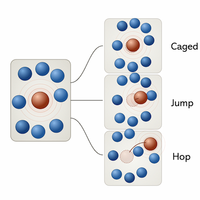
As glass-forming liquids are cooled, the viscosity dramatically increases by up to 15 orders of magnitude. Identifying the microscopic mechanism underlying this viscosity change has proven difficult, resulting in a multitude of competing theoretical approaches. Progress has been hampered by the difficulty to monitor in experiments the dynamics on the molecular level, and of performing numerical simulations at sufficiently low temperatures. Using large-scale computer simulations, we investigated the microscopic dynamics in this challenging temperature regime. We found that at low temperatures the nature of particle motion changes, crossing over from flowlike dynamics to simple hopping motion. Our insight into microscopic behavior should improve our understanding of glass-former dynamics.
Article Text
Supplemental Material
References (102)
- S. S. Schoenholz, E. D. Cubuk, D. M. Sussman, E. Kaxiras, and A. J. Liu, A structural approach to relaxation in glassy liquids, Nat. Phys. 12, 469 (2016).
- T. S. Grigera and G. Parisi, Fast Monte Carlo algorithm for supercooled soft spheres, Phys. Rev. E 63, 045102 (2001).
- A. Ninarello, L. Berthier, and D. Coslovich, Models and algorithms for the next generation of glass transition studies, Phys. Rev. X 7, 021039 (2017).
- B. Kou, Y. Cao, J. Li, C. Xia, Z. Li, H. Dong, A. Zhang, J. Zhang, W. Kob, and Y. Wang, Granular materials flow like complex fluids, Nature (London) 551, 360 (2017).
- L. Berthier and D. R. Reichman, Modern computational studies of the glass transition, Nat. Rev. Phys. 5, 102 (2023).
- Y. Qiu, I. Jang, X. Huang, and A. Yethiraj, Unsupervised learning of structural relaxation in supercooled liquids from short-term fluctuations, Proc. Natl. Acad. Sci. U.S.A. 122, e2427246122 (2025).
- A. Madanchi and L. Simine, Mapping dynamic heterogeneity in supercooled glass-formers, J. Chem. Phys. 164 (2026).
- L. Rovigatti, P. Šulc, I. Z. Reguly, and F. Romano, A comparison between parallelization approaches in molecular dynamics simulations on GPUs, J. Comput. Chem. 36, 1 (2015).
- W. Götze, Complex Dynamics of Glass-Forming Liquids: A Mode-Coupling Theory (Oxford University Press, Oxford, 2008), Vol. 143.
- V. Lubchenko and P. G. Wolynes, Theory of structural glasses and supercooled liquids, Annu. Rev. Phys. Chem. 58, 235 (2007).
- J. Horbach and W. Kob, Relaxation dynamics of a viscous silica melt: The intermediate scattering functions, Phys. Rev. E 64, 041503 (2001).
- J. P. Garrahan and D. Chandler, Coarse-grained microscopic model of glass formers, Proc. Natl. Acad. Sci. U.S.A. 100, 9710 (2003).
- M. Vogel and S. C. Glotzer, Temperature dependence of spatially heterogeneous dynamics in a model of viscous silica, Phys. Rev. E 70, 061504 (2004).
- D. Coslovich and G. Pastore, Dynamics and energy landscape in a tetrahedral network glass-former: Direct comparison with models of fragile liquids, J. Phys. Condens. Matter 21, 285107 (2009).
- H. Z. Cummins, W. M. Du, M. Fuchs, W. Götze, S. Hildebrand, A. Latz, G. Li, and N. J. Tao, Light-scattering spectroscopy of the liquid-glass transition in and in the molecular glass salol: Extended-mode-coupling-theory analysis, Phys. Rev. E 47, 4223 (1993).
- G. Szamel, Mode-coupling theory and beyond: A diagrammatic approach, Prog. Theor. Exp. Phys. 2013, 012J01 (2013).
- L. M. Janssen, Mode-coupling theory of the glass transition: A primer, Front. Phys. 6, 97 (2018).
- W. Gotze and L. Sjogren, Scaling properties in supercooled liquids near the glass transition, J. Phys. C 21, 3407 (1988).
- I. Pihlajamaa and Liesbeth M. C. Janssen, Dissecting mode-coupling theory for supercooled liquids, Phys. Rev. Res. 6, 043319 (2024).
- E. J. Saltzman and K. S. Schweizer, Activated hopping and dynamical fluctuation effects in hard sphere suspensions and fluids, J. Chem. Phys. 125 (2006).
- E. J. Saltzman and K. S. Schweizer, Non-Gaussian effects, space-time decoupling, and mobility bifurcation in glassy hard-sphere fluids and suspensions, Phys. Rev. E 74, 061501 (2006).
- E. J. Saltzman and K. S. Schweizer, Large-amplitude jumps and non-Gaussian dynamics in highly concentrated hard sphere fluids, Phys. Rev. E 77, 051504 (2008).
- E. Flenner and G. Szamel, Dynamic heterogeneities above and below the mode-coupling temperature: Evidence of a dynamic crossover, J. Chem. Phys. 138, 12A523 (2013).
- P. Das and S. Sastry, Crossover in dynamics in the Kob-Andersen binary mixture glass-forming liquid, J. Non-Cryst. Solids 14, 100098 (2022).
- D. Coslovich, M. Ozawa, and W. Kob, Dynamic and thermodynamic crossover scenarios in the Kob-Andersen mixture: Insights from multi-CPU and multi-GPU simulations, Eur. Phys. J. E 41, 1 (2018).
- G. Porpora, F. Rusciano, R. Pastore, and F. Greco, Comparing microscopic and macroscopic dynamics in a paradigmatic model of glass-forming molecular liquid, Int. J. Mol. Sci. 23, 3556 (2022).
- P. Charbonneau, Y. Jin, G. Parisi, and F. Zamponi, Hopping and the Stokes–Einstein relation breakdown in simple glass formers, Proc. Natl. Acad. Sci. U.S.A. 111, 15025 (2014).
- U. R. Pedersen, T. B. Schrøder, and J. C. Dyre, Phase diagram of Kob-Andersen-type binary Lennard-Jones mixtures, Phys. Rev. Lett. 120, 165501 (2018).
- S. Franz, H. Jacquin, G. Parisi, P. Urbani, and F. Zamponi, Quantitative field theory of the glass transition, Proc. Natl. Acad. Sci. U.S.A. 109, 18725 (2012).
- G. Biroli, C. Cammarota, G. Tarjus, and M. Tarzia, Random-field-like criticality in glass-forming liquids, Phys. Rev. Lett. 112, 175701 (2014).
- G. Parisi and F. Zamponi, Mean-field theory of hard sphere glasses and jamming, Rev. Mod. Phys. 82, 789 (2010).
- K. S. Schweizer and E. J. Saltzman, Entropic barriers, activated hopping, and the glass transition in colloidal suspensions, J. Chem. Phys. 119, 1181 (2003).
- S. Sastry, P. G. Debenedetti, and F. H. Stillinger, Signatures of distinct dynamical regimes in the energy landscape of a glass-forming liquid, Nature (London) 393, 554 (1998).
- B. Doliwa and A. Heuer, Hopping in a supercooled Lennard-Jones liquid: Metabasins, waiting time distribution, and diffusion, Phys. Rev. E 67, 030501(R) (2003).
- T. S. Grigera and G. Parisi, Fast Monte Carlo algorithm for supercooled soft spheres, Phys. Rev. E 63, 045102(R) (2001).
- H. Ikeda, F. Zamponi, and A. Ikeda, Mean field theory of the swap Monte Carlo algorithm, J. Chem. Phys. 147 (2017).
- Anshul D. Parmar, M. Ozawa, and L. Berthier, Ultrastable metallic glasses in silico, Phys. Rev. Lett. 125, 085505 (2020).
- L. Ortlieb, T. S. Ingebrigtsen, J. E. Hallett, F. Turci, and C. P. Royall, Probing excitations and cooperatively rearranging regions in deeply supercooled liquids, Nat. Commun. 14, 2621 (2023).
- B. Guiselin, C. Scalliet, and L. Berthier, Microscopic origin of excess wings in relaxation spectra of supercooled liquids, Nat. Phys. 18, 468 (2022).
- F. Ghimenti, L. Berthier, and F. van Wijland, Irreversible Monte Carlo algorithms for hard disk glasses: From event-chain to collective swaps, Phys. Rev. Lett. 133, 028202 (2024).
- L. Berthier, E. Flenner, C. J. Fullerton, C. Scalliet, and M. Singh, Efficient swap algorithms for molecular dynamics simulations of equilibrium supercooled liquids, J. Stat. Mech. (2019) 064004.
- I. Pihlajamaa, Corentin C. L. Laudicina, and Liesbeth M. C. Janssen, Influence of polydispersity on the relaxation mechanisms of glassy liquids, Phys. Rev. Res. 5, 033120 (2023).
- C. Scalliet, B. Guiselin, and L. Berthier, Thirty milliseconds in the life of a supercooled liquid, Phys. Rev. X 12, 041028 (2022).
- L. Berthier, G. Biroli, D. Coslovich, W. Kob, and C. Toninelli, Finite-size effects in the dynamics of glass-forming liquids, Phys. Rev. E 86, 031502 (2012).
- S. Karmakar, C. Dasgupta, and S. Sastry, Growing length and time scales in glass-forming liquids, Proc. Natl. Acad. Sci. U.S.A. 106, 3675 (2009).
- W. Kob and H. C. Andersen, Testing mode-coupling theory for a supercooled binary Lennard-Jones mixture I: The van Hove correlation function, Phys. Rev. E 51, 4626 (1995).
- W. Kob and H. C. Andersen, Testing mode-coupling theory for a supercooled binary Lennard-Jones mixture. II. Intermediate scattering function and dynamic susceptibility, Phys. Rev. E 52, 4134 (1995).
- W. Kob and H. C. Andersen, Scaling behavior in the -relaxation regime of a supercooled Lennard-Jones mixture, Phys. Rev. Lett. 73, 1376 (1994).
- S. Franz, R. Mulet, and G. Parisi, Kob-Andersen model: A nonstandard mechanism for the glassy transition, Phys. Rev. E 65, 021506 (2002).
- T. B. Schrøder and J. C. Dyre, Solid-like mean-square displacement in glass-forming liquids, J. Chem. Phys. 152, 141101 (2020).
- T. Böhmer, F. Pabst, J. P. Gabriel, R. Zeißler, and T. Blochowicz, On the spectral shape of the structural relaxation in supercooled liquids, J. Chem. Phys. 162, 120902 (2025).
- U. K. Nandi, W. Kob, and S. Maitra Bhattacharyya, Connecting real glasses to mean-field models, J. Chem. Phys. 154, 094506 (2021).
- F. Rusciano, R. Pastore, and F. Greco, Fickian non-Gaussian diffusion in glass-forming liquids, Phys. Rev. Lett. 128, 168001 (2022).
- M. Ozawa, W. Kob, A. Ikeda, and K. Miyazaki, Equilibrium phase diagram of a randomly pinned glass-former, Proc. Natl. Acad. Sci. U.S.A. 112, 6914 (2015).
- L. Angelani, R. Di Leonardo, G. Ruocco, A. Scala, and F. Sciortino, Saddles in the energy landscape probed by supercooled liquids, Phys. Rev. Lett. 85, 5356 (2000).
- K. Broderix, K. K. Bhattacharya, A. Cavagna, A. Zippelius, and I. Giardina, Energy landscape of a Lennard-Jones liquid: statistics of stationary points, Phys. Rev. Lett. 85, 5360 (2000).
- D. Coslovich, A. Ninarello, and L. Berthier, A localization transition underlies the mode-coupling crossover of glasses, SciPost Phys. 7, 077 (2019).
- See Supplemental Material at http://link.aps.org/supplemental/10.1103/7m7x-zxqv for additional figures and analyses supporting the results discussed in the main text.
- P. Lunkenheimer, R. Wehn, T. Riegger, and A. Loidl, Excess wing in the dielectric loss of glass formers: Further evidence for a -relaxation, J. Non-Cryst. Solids 307–310, 336 (2002).
- R. Zorn, A wing explained, Nat. Phys. 18, 374 (2022).
- I. Popov, R. Nigmatullin, and A. Khamzin, The origin of the “excess wing” and -relaxation phenomena in glass-forming materials, J. Non-Cryst. Solids 358, 1516 (2012).
- S. Sen and J. Lovi, Trends in the temperature dependence of dynamical heterogeneity in strong and fragile supercooled liquids, J. Non-Cryst. Solids 638, 123060 (2024).
- S. Sengupta, S. Karmakar, C. Dasgupta, and S. Sastry, Breakdown of the Stokes-Einstein relation in two, three, and four dimensions, J. Chem. Phys. 138, 12A548 (2013).
- M. D. Ediger, Spatially heterogeneous dynamics in supercooled liquids, Annu. Rev. Phys. Chem. 51, 99 (2000).
- R. Richert, Heterogeneous dynamics in liquids: Fluctuations in space and time, J. Phys. Condens. Matter 14, R703 (2002).
- L. Berthier, G. Biroli, J.-P. Bouchaud, L. Cipelletti, and W. van Saarloos, Dynamical Heterogeneities in Glasses, Colloids, and Granular Media (Oxford University Press, Oxford, 2011), Vol. 150.
- V. Vaibhav and S. Dutta, Entropic timescales of dynamic heterogeneity in supercooled liquid, Phys. Rev. E 109, L062102 (2024).
- F. Rusciano, R. Pastore, F. Greco, Rusciano et al. Reply:, Phys. Rev. Lett. 131, 119802 (2023).
- F. Caporaletti, S. Capaccioli, D. Bessas, A. I. Chumakov, A. Martinelli, F. Dallari, and G. Monaco, Crossover of quasi-localized dynamics and diffusion in supercooled liquids, Nat. Phys. (2026), 10.1038/s41567-026-03320-5.
- U. Schneider, R. Brand, P. Lunkenheimer, and A. Loidl, Excess wing in the dielectric loss of glass formers: A Johari-Goldstein relaxation?, Phys. Rev. Lett. 84, 5560 (2000).
- C. Gainaru, R. Kahlau, E. A. Rössler, and R. Böhmer, Evolution of excess wing and -process in simple glass formers, J. Chem. Phys. 131, 184510 (2009).
- T. Blochowicz, C. Tschirwitz, S. Benkhof, and E. A. Rössler, Susceptibility functions for slow relaxation processes in supercooled liquids and the search for universal relaxation patterns, J. Chem. Phys. 118, 7544 (2003).
- K. L. Ngai and M. Paluch, Classification of secondary relaxation in glass-formers based on dynamic properties, J. Chem. Phys. 120, 857 (2004).
- K. Shiraishi, H. Mizuno, and A. Ikeda, Johari-Goldstein relaxation in glassy dynamics originates from two-scale energy landscape, Proc. Natl. Acad. Sci. U.S.A. 120, e2215153120 (2023).
- L. Gao, H.-B. Yu, T. B. Schrøder, and J. C. Dyre, Unified percolation scenario for the and processes in simple glass formers, Nat. Phys. 21, 471 (2025).
- C.-S. Lee, H.-Y. Deng, L. Zhang, C. Xiao, B. Li, C.-T. Yip, and C.-H. Lam, Unified picture of structural relaxation, beta relaxation, and excess wing in glass formers, Phys. Rev. E 112, 045422 (2025).
- F. Rusciano, R. Pastore, and F. Greco, Universal evolution of Fickian non-Gaussian diffusion in two-and three-dimensional glass-forming liquids, Int. J. Mol. Sci. 24, 7871 (2023).
- J. M. Miotto, S. Pigolotti, A. V. Chechkin, and S. Roldán-Vargas, Length scales in Brownian yet non-Gaussian dynamics, Phys. Rev. X 11, 031002 (2021).
- P. Chaudhuri, L. Berthier, and W. Kob, Universal nature of particle displacements close to glass and jamming transitions, Phys. Rev. Lett. 99, 060604 (2007).
- R. Pastore, A. Coniglio, and M. Pica Ciamarra, Dynamic phase coexistence in glass-forming liquids, Sci. Rep. 5, 11770 (2015).
- J. Horbach, W. Kob, and K. Binder, Specific heat of amorphous silica within the harmonic approximation, J. Phys. Chem. B 103, 4104 (1999).
- M. Ozawa, A. Ikeda, K. Miyazaki, and W. Kob, Ideal glass states are not purely vibrational: Insight from randomly pinned glasses, Phys. Rev. Lett. 121, 205501 (2018).
- J. Bouchaud, A. Comtet, A. Georges, and P. Le Doussal, Anomalous diffusion in random media of any dimensionality, J. Phys. 48, 1445 (1987).
- M. De Marzio, G. Camisasca, M. Rovere, and P. Gallo, Microscopic origin of the fragile to strong crossover in supercooled water: The role of activated processes, J. Chem. Phys. 146, 084502 (2017).
- N. Gnan, T. B. Schrøder, U. R. Pedersen, N. P. Bailey, and J. C. Dyre, Pressure-energy correlations in liquids. IV. “Isomorphs” in liquid phase diagrams, J. Chem. Phys. 131, 234504 (2009).
- K.-U. Hess, D. Dingwell, and E. Rössler, Parametrization of viscosity-temperature relations of aluminosilicate melts, Chem. Geol. 128, 155 (1996).
- E. Rössler, K.-U. Hess, and V. Novikov, Universal representation of viscosity in glass forming liquids, J. Non-Cryst. Solids 223, 207 (1998).
- E. Rössler and A. Sokolov, The dynamics of strong and fragile glass formers, Chem. Geol. 128, 143 (1996).
- S. Ishino, Y.-C. Hu, and H. Tanaka, Microscopic structural origin of slow dynamics in glass-forming liquids, Nat. Mater. 24, 268 (2025).
- D. Chandler and J. P. Garrahan, Dynamics on the way to forming glass: Bubbles in space-time, Annu. Rev. Phys. Chem. 61, 191 (2010).
- M. R. Hasyim and K. K. Mandadapu, Emergent facilitation and glassy dynamics in supercooled liquids, Proc. Natl. Acad. Sci. U.S.A. 121, e2322592121 (2024).
- R. Pastore, A. Coniglio, and M. Pica Ciamarra, From cage-jump motion to macroscopic diffusion in supercooled liquids, Soft Matter 10, 5724 (2014).
- A. Jiang, J. Shang, X. Liu, Y. Tang, H. K. Kwan, and Y. Zhu, Efficient CSP algorithm with spatio-temporal filtering for motor imagery classification, IEEE Trans. Neural Syst. Rehab. Eng. 28, 1006 (2020).
- J. Helfferich, F. Ziebert, S. Frey, H. Meyer, J. Farago, A. Blumen, and J. Baschnagel, Continuous-time random-walk approach to supercooled liquids. I. Different definitions of particle jumps and their consequences, Phys. Rev. E 89, 042603 (2014).
- M. Pica Ciamarra, W. Ji, and M. Wyart, Local vs. cooperative: Unraveling glass transition mechanisms with SEER, Proc. Natl. Acad. Sci. U.S.A. 121, e2400611121 (2024).
- R. K. Pandit and H. E. Castillo, Simple model for dynamic heterogeneity in glass-forming liquids, Phys. Rev. Lett. 131, 218202 (2023).
- M. Saito, T. Araki, Y. Onodera, K. Ohara, M. Seto, Y. Yoda, and Y. Wakabayashi, Discovery of collective nonjumping motions leading to Johari-Goldstein process of stress relaxation in model ionic glass, Acta Mater. 284, 120536 (2025).
- S. Albert, T. Bauer, M. Michl, G. Biroli, J.-P. Bouchaud, A. Loidl, P. Lunkenheimer, R. Tourbot, C. Wiertel-Gasquet, and F. Ladieu, Fifth-order susceptibility unveils growth of thermodynamic amorphous order in glass-formers, Science 352, 1308 (2016).
- F. H. Stillinger, Supercooled liquids, glass transitions, õand the Kauzmann paradox, J. Chem. Phys. 88, 7818 (1988).
- J.-L. Barrat, E. Del Gado, S. U. Egelhaaf, X. Mao, M. Dijkstra, D. J. Pine, S. K. Kumar, K. Bishop, O. Gang, A. Obermeyer et al., Soft matter roadmap, J. Phys. 7, 012501 (2024).
- S. Plimpton, Fast parallel algorithms for short-range molecular dynamics, J. Comput. Phys. 117, 1 (1995).
- F. Rusciano, R. Pastore, F. Greco, and W. Kob, Rare cage escapes drive relaxation in deeply supercooled liquids, Zenodo, 10.5281/zenodo.20054240 (2026).

