

- Featured in Physics
- Open Access
Unlocking Emergent Resilience in Amorphous Metamaterials via a Physics-Constrained Energy-Based Framework
Phys. Rev. X 16, 031024 – Published 31 July, 2026
DOI: https://doi.org/10.1103/77mh-hflq
Abstract
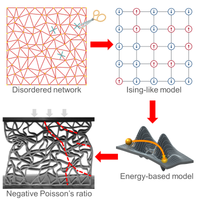
Mechanical metamaterials achieve their extraordinary properties through their intricate architectures. While amorphous designs can minimize directional bias relative to their regular counterparts, their vast configuration space poses a significant challenge for conventional design strategies. Here, we introduce a physics-constrained, energy-based model framework to navigate this complexity with machine learning. We formulate a multiobjective energy function that encodes desired macroscopic properties—specifically, a target negative Poisson ratio and approximate isotropy—into the network’s topology. The design problem is then recasted as finding the ground state of this energy landscape, while operating within a mechanically stable or physics-constrained configuration space. We employ Boltzmann annealing as a physically consistent inference algorithm to identify the optimal low-energy configurations. The structures discovered and fabricated via 3D printing exhibit a highly negative Poisson ratio together with near-equal responses along principal axes (i.e., isotropy along both and axes). Remarkably, these optimized structures also reveal highly desirable emergent properties, including exceptional performance in specific energy absorption, impact resistance, and fracture toughness, significantly outperforming regular lattice counterparts. This work establishes a robust and interpretable machine-learning framework for the design of high-performance amorphous metamaterials.
Physics Subject Headings (PhySH)
 Focus
Focus

Predicted Noncrystalline Structures Have Bonus Properties
Simulations reveal disordered structures that are also surprisingly resistant to impacts and cracks.
See more in Physics
Popular Summary
Materials with extraordinary properties like becoming thinner when compressed are usually designed from ordered patterns, despite the toughest natural materials like bone and spider silk being disordered. Attempting to design disordered materials is difficult due to the large number of arrangements, most of which are either nonfunctional or unstable. We developed a physics-constrained design framework that treats material discovery by finding the lowest-energy state in a physically constrained space. Our method encodes the desired properties into an energy function, then uses statistical physics algorithms to search only the mechanically stable configurations. This creates design rules that allow us to print disordered, auxetic 3D structures with large improvements in properties like energy absorption and fracture resistance. Our framework provides a general tool for designing amorphous materials optimized for thermal, acoustic, or optical functions. By bridging machine learning with fundamental physics, we open a pathway to engineer disorder intentionally rather than avoid it.
Article Text
Supplemental Material
References (85)
- M. Kadic, T. Bückmann, R. Schittny, and M. Wegener, Metamaterials beyond electromagnetism, Rep. Prog. Phys. 76, 126501 (2013).
- Z. Chen, B. Guo, Y. Yang, and C. Cheng, Metamaterials-based enhanced energy harvesting: A review, Physica B 438, 1 (2014).
- M. Moccia, G. Castaldi, S. Savo, Y. Sato, and V. Galdi, Independent manipulation of heat and electrical current via bifunctional metamaterials, Phys. Rev. X 4, 021025 (2014).
- F. Cervera, L. Sanchis, J. V. Sánchez-Pérez, R. Martinez-Sala, C. Rubio, F. Meseguer, C. López, D. Caballero, and J. Sánchez-Dehesa, Refractive acoustic devices for airborne sound, Phys. Rev. Lett. 88, 023902 (2002).
- K. E. Evans and A. Alderson, Auxetic materials: Functional materials and structures from lateral thinking!, Adv. Mater. 12, 617 (2000).
- W. Yang, Z.-M. Li, W. Shi, B.-H. Xie, and M.-B. Yang, Review on auxetic materials, J. Mater. Sci. 39, 3269 (2004).
- M. Kadic, G. W. Milton, M. van Hecke, and M. Wegener, 3D metamaterials, Nat. Rev. Phys. 1, 198 (2019).
- J. M. Ziman, Models of Disorder: The Theoretical Physics of Homogeneously Disordered Systems (Cambridge University Press, Cambridge, England, 1979).
- L. A. Braunstein, S. V. Buldyrev, R. Cohen, S. Havlin, and H. E. Stanley, Optimal paths in disordered complex networks, Phys. Rev. Lett. 91, 168701 (2003).
- M. X. Li, Y. T. Sun, C. Wang, L. W. Hu, S. Sohn, J. Schroers, and Y. H. Liu, Data-driven discovery of a universal indicator for metallic glass forming ability, Nat. Mater. 21, 165 (2022).
- S. Liu, Y. Li, Y. Wang, and Yilin Wu, Emergence of large-scale mechanical spiral waves in bacterial living matter, Nat. Phys. 20, 1015 (2024).
- A. Simonov and A. L. Goodwin, Designing disorder into crystalline materials, Nat. Rev. Chem. 4, 657 (2020).
- X. Shen, C. Fang, Z. Jin, H. Tong, S. Tang, H. Shen, N. Xu, J. Lo, X. Xu, and L. Xu, Achieving adjustable elasticity with non-affine to affine transition, Nat. Mater. 20, 1635 (2021).
- S. Yu, C. W. Qiu, Y. Chong, S. Torquato, and N. Park, Engineered disorder in photonics, Nat. Rev. Mater. 6, 226 (2021).
- J. Berger, H. Wadley, and R. McMeeking, Mechanical metamaterials at the theoretical limit of isotropic elastic stiffness, Nature (London) 543, 533 (2017).
- W. E. Warren and A. M. Kraynik, Foam mechanics: The linear elastic response of two-dimensional spatially periodic cellular materials, Mech. Mater. 6, 27 (1987).
- A. Hansen, E. L. Hinrichsen, and S. Roux, Scale-invariant disorder in fracture and related breakdown phenomena, Phys. Rev. B 43, 665 (1991).
- K. J. Koester, J. W. Ager Iii, and R. O. Ritchie, The true toughness of human cortical bone measured with realistically short cracks, Nat. Mater. 7, 672 (2008).
- E. Aarts and J. Korst, Simulated Annealing and Boltzmann Machines: A Stochastic Approach to Combinatorial Optimization and Neural Computing (Wiley, Hoboken, 1989).
- D. Pierangeli, G. Marcucci, and C. Conti, Large-scale photonic Ising machine by spatial light modulation, Phys. Rev. Lett. 122, 213902 (2019).
- J. S. Cummins, H. Salman, and N. G. Berloff, Ising Hamiltonian minimization: Gain-based computing with manifold reduction of soft spins vs quantum annealing, Phys. Rev. Res. 7, 013150 (2025).
- D. R. Reid, N. Pashine, J. M. Wozniak, H. M. Jaeger, A. J. Liu, S. R. Nagel, and J. J. de Pablo, Auxetic metamaterials from disordered networks, Proc. Natl. Acad. Sci. U.S.A. 115, E1384 (2018).
- Z. Jin, C. Fang, X. Shen, and L. Xu, Designing amorphous networks with adjustable Poisson ratio from a simple triangular lattice, Phys. Rev. Appl. 18, 054052 (2022).
- R. Lakes, Foam structures with a negative Poisson’s ratio, Science 235, 1038 (1987).
- N. Chan and K. Evans, Microscopic examination of the microstructure and deformation of conventional and auxetic foams, J. Mater. Sci. 32, 5725 (1997).
- G. N. Greaves, A. L. Greer, R. S. Lakes, and T. Rouxel, Poisson’s ratio and modern materials, Nat. Mater. 10, 823 (2011).
- M. J. Mirzaali, H. Pahlavani, and A. Zadpoor, Auxeticity and stiffness of random networks: Lessons for the rational design of 3D printed mechanical metamaterials, Appl. Phys. Lett. 115, 3 (2019).
- S. Shan, S. H. Kang, Z. Zhao, L. Fang, and K. Bertoldi, Design of planar isotropic negative Poisson’s ratio structures, Extreme Mech. Lett. 4, 96 (2015).
- X. Xue, C. Lin, F. Wu, Z. Li, and J. Liao, Lattice structures with negative Poisson’s ratio: A review, Mater. Today Commun. 34, 105132 (2023).
- J. Dagdelem, J. Montoya, M. De Jong, and K. Persson, Computational prediction of new auxetic materials, Nat. Commun. 8, 323 (2017).
- L. J. Gibson, M. F. Ashby, G. Schajer, and C. Robertson, The mechanics of two-dimensional cellular materials, Proc. R. Soc. A 382, 25 (1982).
- J. N. Grima and K. E. Evans, Auxetic behavior from rotating squares, J. Mater. Sci. Lett. 19, 1563 (2000).
- R. Gatt, D. Attard, P. S. Farrugia, K. M. Azzopardi, L. Mizzi, J. P. Brincat, and J. N. Grima, A realistic generic model for anti-tetrachiral systems, Phys. Status Solidi B 250, 2012 (2013).
- D. Prall and R. Lakes, Properties of a chiral honeycomb with a Poisson’s ratio of–1, Int. J. Mech. Sci. 39, 305 (1997).
- T. Bückmann, N. Stenger, M. Kadic, J. Kaschke, A. Frölich, T. Kennerknecht, C. Eberl, M. Thiel, and M. Wegener, Tailored 3D mechanical metamaterials made by dip-in direct-laser-writing optical lithography, Adv. Mater. 24, 2710 (2012).
- J. N. Grima, P. S. Farrugia, R. Gatt, and D. Attard, On the auxetic properties of rotating rhombi and parallelograms: A preliminary investigation, Phys. Status Solidi B 245, 521 (2007).
- A. Li, Y. Lei, Y. Bai, and H. Wang, Improved lightweight corrugated network design to auxetic perforated metamaterial, Int. J. Mech. Sci. 243, 108040 (2023).
- F. Burla, Y. Mulla, B. E. Vos, A. Aufderhorst-Roberts, and G. H. Koenderink, From mechanical resilience to active material properties in biopolymer networks, Nat. Rev. Phys. 1, 249 (2019).
- X. Zheng, H. Lee, T. H. Weisgraber, M. Shusteff, J. DeOtte, E. B. Duoss, J. D. Kuntz, M. M. Biener, Q. Ge, J. A. Jackson, S. O. Kucheyev, N. X. Fang, and C. M. Spadaccini, Ultralight, ultrastiff mechanical metamaterials, Science 344, 1373 (2014).
- T. Tancogne-Dejean, A. B. Spierings, and D. Mohr, Additively-manufactured metallic micro-lattice materials for high specific energy absorption under static and dynamic loading, Acta Mater. 116, 14 (2016).
- Y. Wang, K. Wu, X. Zhang, X. Li, Y. Wang, and H. Gao, Superior fracture resistance and topology-induced intrinsic toughening mechanism in 3D shell-based lattice metamaterials, Sci. Adv. 10, eadq2664 (2024).
- R. P. Bohara, S. Linforth, T. Nguyen, A. Ghazlan, and T. Ngo, Novel lightweight high-energy absorbing auxetic structures guided by topology optimization, Int. J. Mech. Sci. 211, 106793 (2021).
- A. Chardac, L. A. Hoffmann, Y. Poupart, L. Giomi, and D. Bartolo, Topology-driven ordering of flocking matter, Phys. Rev. X 11, 031069 (2021).
- See Supplemental Material at http://link.aps.org/supplemental/10.1103/77mh-hflq for the derivation of the theoretical EBM model and details of the materials and experiments, which includes Refs. [45–58].
- D. R. Reid, N. Pashine, A. S. Bowen, S. R. Nagel, and J. J. de Pablo, Ideal isotropic auxetic networks from random networks, Soft Matter 15, 8084 (2019).
- N. W. Tschoegl, W. G. Knauss, and I. Emri, Poisson’s ratio in linear viscoelasticity-a critical review, Mech. Time-Depend. Mater. 6, 3 (2002).
- H. Jin, Y. Bu, J. Li, J. Liu, X. Fen, L. Dai, J. Wang, J. Lu, and S. Wang, Strong graphene 3D assemblies with high elastic recovery and hardness, Adv. Mater. 30, 1707424 (2018).
- M. Zhang, Q. Yu, Z. Liu, J. Zhang, G. Tan, D. Jiao, W. Zhu, S. Li, Z. Zhang, and R. O. Ritchie, 3D printed Mg-NiTi interpenetrating-phase composites with high strength, damping capacity, and energy absorption efficiency, Sci. Adv. 6, eaba5581 (2020).
- J. Harrigan, S. Reid, and C. Peng, Inertia effects in impact energy absorbing materials and structures, Int. J. Impact Eng. 22, 955 (1999).
- J. Y. Lee, J. An, and C. Chua, Fundamentals and applications of 3D printing for novel materials, Appl. Mater. Today 7, 120 (2017).
- N. Shahrubudin, T. Lee, and R. Ramlan, An overview on 3D printing technology: Technological, materials, and applications, Proc. Manuf. 35, 1286 (2019).
- S. Desai, R. Sonawane, and A. More, Thermoplastic polyurethane for three-dimensional printing applications: A review, Polym. Adv. Technol. 34, 2061 (2023).
- M. Farid, W. Wu, G. Li, A. Zheng, and Y. Zhao, Superior tensile properties of FDM 3D-printed TPU/E-TPU layered structure, J. Mater. Res. 39, 2051 (2024).
- H. Ye, Q. Liu, J. Cheng, H. Li, B. Jian, R. Wang, Z. Sun, Y. Lu, and Q. Ge, Multimaterial 3D printed self-locking thick-panel origami metamaterials, Nat. Commun. 14, 1607 (2023).
- L. Ren, Q. Wu, J. Li, Y. He, Y. Zhang, X. Zhou, S. Wu, Q. Liu, and B. Li, 4D printing of customizable and reconfigurable mechanical metamaterials, Int. J. Mech. Sci. 270, 109112 (2024).
- Y. Liu, C. Zhao, C. Xu, and J. Ren, Shape recovery effect and energy absorption of reusable honeycomb structures, Compos. Struct. 352, 118708 (2025).
- S. Zhang, Y. Zhang, X. Zhang, C. Yu, K. Xu, J. Qin, G. Zhang, and X. Shi, 3D-printed thermoplastic polyurethane/polyvinylidene fluoride gradient stiffness and hierarchical cellular structures with tailored energy absorption behavior, Addit. Manuf. 83, 104062 (2024).
- https://www.esun3d.com/uploads/eSUN_eTPU-95A-Filament_TDS_V4.0.pdf.
- R. Milkus and A. Zaccone, Local inversion-symmetry breaking controls the boson peak in glasses and crystals, Phys. Rev. B 93, 094204 (2016).
- J. Paulose, A. S. Meeussen, and V. Vitelli, Selective buckling via states of self-stress in topological metamaterials, Proc. Natl. Acad. Sci. U.S.A. 112, 7639 (2015).
- E. Heiml, A. Hössinger-Kalteis, and Z. Major, Experimental characterization of 3D printed cellular structures, Mater. Today Proc. 62, 2528 (2022).
- S. R. Bates, I. R. Farrow, and R. S. Trask, 3D printed polyurethane honeycombs for repeated tailored energy absorption, Mater. Des. 112, 172 (2016).
- Y. Wu, J. Hermes, L. Verbelen, and L. Yang, Impact energy absorption ability of thermoplastic polyurethane (TPU) cellular structures fabricated via powder bed fusion, 30th Solid Freeform Fabrication Symposium Proceedings (University of Texas, Austin, TX, 2019).
- S. Zhang, Q. Gao, Y. Zhang, X. Sheng, Z. Miao, J. Qin, G. Zhang, and X. Shi, 3D printing thermoplastic polyurethane hierarchical cellular foam with outstanding energy absorption capability, Addit. Manuf. 76, 103770 (2023).
- C. Ge, L. Priyadarshini, D. Cormier, L. Pan, and J. Tuber, A preliminary study of cushion properties of a 3D printed thermoplastic polyurethane Kelvin foam, Packag. Technol. Sci. 31, 361 (2018).
- T. Schaedler, C. Ro, A. Sorensen, Z. Eckel, S. Yang, W. Carter, and A. Jacobsen, Designing metallic microlattices for energy absorber applications, Adv. Eng. Mater. 16, 276 (2014).
- S. Li, Y. Hou, J. Huang, J. Shi, and L. Meng, Exploring the enhanced energy-absorption performance of hybrid polyurethane (PU)-foam-filled lattice metamaterials, Int. J. Impact Eng. 193, 105058 (2024).
- R. Hamzehei, J. Kadkhodapour, A. P. Anaraki, Saeed Rezaei a, S. Dariushi b, and A. M. Rezadoust, Octagonal auxetic metamaterials with hyperelastic properties for large compressive deformation, Int. J. Mech. Sci. 145, 96 (2018).
- D. Mistry, S. D. Connell, S. Mickthwaite, P. B. Morgan, J. H. Clamp, and H. F. Gleeson, Coincident molecular auxeticity and negative order parameter in a liquid crystal elastomer, Nat. Commun. 9, 5095 (2018).
- M. Avalle, G. Belingardi, and R. Montanini, Characterization of polymeric structural foams under compressive impact loading by means of energy-absorption diagram, Int. J. Impact Eng. 25, 455 (2001).
- Q. M. Li, I. Magkiriadis, and J. J. Harrigan, Compressive strain at the onset of densification of cellular solids, J. Cell. Plast. 42, 371 (2006).
- M. Zaiser and S. Zapperi, Disordered mechanical metamaterials, Nat. Rev. Phys. 5, 679 (2023).
- Y. Lin, Q. Yu, J. Pan, F. Duan, R. O. Ritchie, and Y. Li, On the impact toughness of gradient-structured metals, Acta Mater. 193, 125 (2020).
- Z. Gao, X. Zhang, Y. Wu, M. S. Pham, Y. Lu, C. Xia, H. Wang, and H. Wang, Damage-programmable design of metamaterials achieving crack-resisting mechanisms seen in nature, Nat. Commun. 15, 7373 (2024).
- L. R. Meza, A. J. Zelhofer, N. Clarke, A. J. Mateos, D. M. Kochmann, and J. R. Greer, Resilient 3D hierarchical architected metamaterials, Proc. Natl. Acad. Sci. U.S.A. 112, 11502 (2015).
- K. J. Koester, J. W. Ager III, and R. O. Ritchie, The true toughness of human cortical bone measured with realistically short cracks, Nat. Mater. 7, 672 (2008).
- J. J. Lewandowski, M. Shazly, and A. S. Nouri, Intrinsic and extrinsic toughening of metallic glasses, Scr. Mater. 54, 337 (2006).
- G. Duan, K. De Blauwe, M. L. Lind, J. P. Schramm, and W. L. Johnson, Compositional dependence of thermal, elastic, and mechanical properties in Cu–Zr–Ag bulk metallic glasses, Scr. Mater. 58, 159 (2008).
- J. B. Choi and R. S. Lakes, Non-linear properties of polymer cellular materials with a negative Poisson’s ratio, J. Mater. Sci. 27, 4678 (1992).
- P. Tandaiya, U. Ramamurty, G. Ravichandran, and R. Narasimhan, Effect of Poisson’s ratio on crack tip fields and fracture behavior of metallic glasses, Acta Mater. 56, 6077 (2008).
- J. B. Choi and R. S. Lakes, Fracture toughness of re-entrant foam materials with a negative Poisson’s ratio: Experiment and analysis, Int. J. Fract. 80, 73 (1996).
- R. Hamzehei, M. Bodaghi, and N. Wu, 3D-printed highly stretchable curvy sandwich metamaterials with superior fracture resistance and energy absorption, Int. J. Solids Struct. 286, 112570 (2024).
- Z. Song, K. Wu, Z. Wang, L. He, and Y. Ni, Fracture mechanics of bi-material lattice metamaterials, J. Mech. Phys. Solids 192, 105835 (2024).
- Z. Meng, P. Lei, B. Hou, B. Liu, and Y. Wang, Dual-bond fracture metamaterials with full-field extrinsic toughening, Nat. Commun. 16, 6891 (2025).
- Z. Wang, K. Wu, J. Ding, J. Jin, Y. Zhou, M. Li, Y. Yao, L. He, Z. Song, and Y. Ni, Strut-buckling transformation enabling anomalous density-scaling toughening law in ultralight lattice metamaterials, Adv. Mater. 37, 2419635 (2025).

