

- Featured in Physics
- Open Access
Super-resonance: Breaking the Bandwidth Limit of Resonant Modes and Its Application to Flow Control
Phys. Rev. X 16, 021045 – Published 28 May, 2026
DOI: https://doi.org/10.1103/766t-tqsy
Abstract
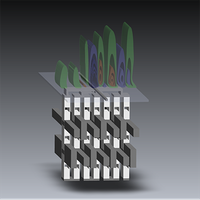
We report the discovery of super-resonance—a new regime of resonant behavior in which a mode’s out-of-phase response persists far beyond its classical bandwidth. This effect emerges from a coiled phononic structure composed of a locally resonant elastic metamaterial and architected to support multiple internal energy pathways. These pathways converge at an effectively single spatial location, enabling extended modal dominance and significantly broadening the frequency range over which a resonant phase is sustained. We demonstrate by direct numerical simulations the implications of this mechanism in the context of flow instability control, where current approaches are inherently constrained by the characteristically narrow spectral bandwidth of conventional resonances. Using a super-resonant phononic subsurface structure interfacing with a channel flow, we show passive simultaneous suppression of four unstable flow perturbations across a frequency range more than 5 times wider than that is attainable with a standard resonance in an equivalent uncoiled structure. By enabling broadband control of flow instabilities, super-resonance overcomes a long-standing limitation in laminar flow control strategies. More broadly, it introduces a powerful new tool for phase-engineered wave-matter interaction. The ability to preserve out-of-phase modal response across wide spectral ranges establishes a fundamental advance in the physics of resonance, with far-reaching implications for suppressing fully developed turbulent flows and beyond.
Physics Subject Headings (PhySH)
 synopsis

Coiled Phononic Structure Super-Resonates
Computer simulations show how a structure placed underneath a surface suppresses turbulence in a fluid flow across the surface at a wide range of frequencies.
See more in Physics
Popular Summary
The conventional understanding of resonance comes with intrinsic bandwidth limitations. We introduce the concept of super-resonance, which is a fundamentally new regime of resonant behavior that overcomes this traditional limitation. We enabled a single resonant mode to effectively sustain an out-of-phase response across a frequency range far broader than that of conventional resonance, challenging this long-standing constraint in resonance physics. We demonstrate the concept in the context of laminar-to-turbulent flow transition—a central problem affecting air, sea, and land vehicles and many other systems. Current approaches do not provide broadband control of flow instabilities, which limit the ability to delay transition under realistic conditions. Our approach integrates phononics, fluid dynamics, metamaterials, and machine learning to show how super-resonance enables broadband stabilization of these instabilities. In addition to delaying transition, this opens a pathway to ultimately suppress fully developed turbulence—with far-reaching implications for energy efficiency and vehicle performance.
Article Text
Supplemental Material
References (79)
- J.-L. Lagrange, Mécanique Analytique (Chez la Veuve Desaint, Paris, 1788).
- M. Born, W. Heisenberg, and P. Jordan, Zur quantenmechanik II, Z. Phys. 35, 557 (1926).
- P. A. M. Dirac, The quantum theory of the emission and absorption of radiation, Proc. R. Soc. A 114, 243 (1927).
- R. P. Feynman, R. B. Leighton, and M. Sands, The Feynman Lectures on Physics, Vol. 3: Quantum Mechanics (Addison-Wesley, Reading, MA, 1965), see Chap. 2 for harmonic oscillator in quantum mechanics.
- N. W. Ashcroft and N. D. Mermin, Solid State Physics (Saunders College, Philadelphia, 1976).
- M. Gad-el Hak, A. Pollard, and J.-P. Bonnet, Flow Control: Fundamentals and Practices (Springer Science & Business Media, New York, 2003), Vol. 53.
- J. Tiainen, A. Grönman, A. Jaatinen-Värri, and J. Backman, Flow control methods and their applicability in low-Reynolds-number centrifugal compressors—A review, Int. J. Turbomach. Propul. Power 3, 2 (2017).
- M. V. Morkovin, On the many faces of transition, in Viscous Drag Reduction: Proceedings of the Symposium on Viscous Drag Reduction held at the LTV Research Center, Dallas, TX, 1968 (Springer, New York, 1969), pp. 1–31.
- H. Schlichting and K. Gersten, Boundary-Layer Theory (Springer, New York, 2016).
- R. W. Milling, Tollmien–Schlichting wave cancellation, Phys. Fluids 24, 979 (1981).
- H. Liepmann, G. Brown, and D. Nosenchuck, Control of laminar-instability waves using a new technique, J. Fluid Mech. 118, 187 (1982).
- H. Liepmann and D. Nosenchuck, Active control of laminar-turbulent transition, J. Fluid Mech. 118, 201 (1982).
- A. S. Thomas, The control of boundary-layer transition using a wave-superposition principle, J. Fluid Mech. 137, 233 (1983).
- R. D. Joslin, R. A. Nicolaides, G. Erlebacher, M. Y. Hussaini, and M. D. Gunzburger, Active control of boundary-layer instabilities: Use of sensors and spectral controller, AIAA J. 33, 1521 (1995).
- S. Grundmann and C. Tropea, Active cancellation of artificially introduced Tollmien-Schlichting waves using plasma actuators, Exp. Fluids 44, 795 (2008).
- M. Amitay, B. A. Tuna, and H. Dell’Orso, Identification and mitigation of T-S waves using localized dynamic surface modification, Phys. Fluids 28, 064103 (2016).
- H. H. Hu and H. H. Bau, Feedback control to delay or advance linear loss of stability in planar poiseuille flow, Proc. R. Soc. A 447, 299 (1994).
- T. R. Bewley and S. Liu, Optimal and robust control and estimation of linear paths to transition, J. Fluid Mech. 365, 305 (1998).
- M. I. Hussein, S. Biringen, O. R. Bilal, and A. Kucala, Flow stabilization by subsurface phonons, Proc. R. Soc. A 471, 20140928 (2015).
- B. L. Davis, A. S. Tomchek, E. A. Flores, L. Liu, and M. I. Hussein, Analysis of periodicity termination in phononic crystals, in Proceedings of the ASME International Mechanical Engineering Congress and Exposition Conference (IMECE 2011), Denver, Colorado (The American Society of Mechanical Engineers, New York, NY, 2011), Vol. 8, pp. 973–977.
- H. B. Al Ba’ba’a, C. L. Willey, V. W. Chen, A. T. Juhl, and M. Nouh, Theory of truncation resonances in continuum rod-based phononic crystals with generally asymmetric unit cells, Adv. Theor. Simul. 6, 2200700 (2023).
- Matheus I. Rosa, B. L. Davis, L. Liu, M. Ruzzene, and M. I. Hussein, Material vs. structure: Topological origins of band-gap truncation resonances in periodic structures, Phys. Rev. Mater. 7, 124201 (2023).
- P. A. Deymier, Acoustic Metamaterials and Phononic Crystals (Springer Science & Business Media, New York, 2013), Vol. 173.
- M. I. Hussein, M. J. Leamy, and M. Ruzzene, Dynamics of phononic materials and structures: Historical origins, recent progress, and future outlook, Appl. Mech. Rev. 66, 040802 (2014).
- A. S. Phani and M. I. Hussein, Introduction to lattice materials, in Dynamics of Lattice Materials (John Wiley & Sons, Ltd, New York, 2017), Chap. 1, pp. 1–17.
- Y. Jin, Y. Pennec, B. Bonello, H. Honarvar, L. Dobrzynski, B. Djafari-Rouhani, and M. I. Hussein, Physics of surface vibrational resonances: Pillared phononic crystals, metamaterials, and metasurfaces, Rep. Prog. Phys. 84, 086502 (2021).
- C. J. Barnes, C. L. Willey, K. Rosenberg, A. Medina, and A. T. Juhl, Initial computational investigation toward passive transition delay using a phononic subsurface, in Proceedings of the AIAA SciTech 2021 Forum (American Institute of Aeronautics and Astronautics, Reston, VA, 2021), p. 1454.
- A. Kianfar and M. I. Hussein, Phononic-subsurface flow stabilization by subwavelength locally resonant metamaterials, New J. Phys. 25, 053021 (2023).
- T. Michelis, A. Putranto, and M. Kotsonis, Attenuation of Tollmien-Schlichting waves using resonating surface-embedded phononic crystals, Phys. Fluids 35, 044101 (2023).
- R. Schmidt, H. Yousef, I. Roy, C. Scalo, and M. Nouh, Perturbation energy extraction from a fluid via a subsurface acoustic diode with sustained downstream attenuation, J. Appl. Phys. 137, 054901 (2025).
- A. Kianfar and M. I. Hussein, Local flow control by phononic subsurfaces over extended spatial domains, J. Appl. Phys. 134, 094701 (2023).
- C. L. Willey, C. J. Barnes, V. W. Chen, K. Rosenberg, A. Medina, and A. T. Juhl, Multi-input multi-output phononic subsurfaces for passive boundary layer transition delay, J. Fluids Struct. 121, 103936 (2023).
- M. I. Hussein, D. Roca, A. R. Harris, and A. Kianfar, Scatterless interference: Delay of laminar-to-turbulent flow transition by a lattice of subsurface phonons, Proc. R. Soc. A 482, 20250771 (2026).
- C. W. Klauss, V. Russo, M. I. Hussein, and C. Brehm, Exploration of phononic subsurfaces for hypersonic boundary layer disturbance reduction, in Proceedings of the AIAA Aviation Forum and ASCEND 2025, Las Vegas, Nevada (American Institute of Aeronautics and Astronautics, Reston, VA, 2025), p. 3455.
- D. D. Wiberg, S. Park, V. Ramakrishnan, T. Saxton-Fox, K. H. Matlack, and P. J. Ansell, One-way coupling of surface vibration and kármán vortex street instability, in Proceedings of the AIAA Aviation Forum and ASCEND 2025, Ref. [34], p. 3252.
- T. Michelis, C. De Koning, and M. Kotsonis, On the interaction of Tollmien-Schlichting waves with a wall-embedded Helmholtz resonator, Phys. Fluids 35, 034104 (2023).
- R. Zhao, C. Wen, Y. Zhou, G. Tu, and J. Lei, Review of acoustic metasurfaces for hypersonic boundary layer stabilization, Prog. Aerosp. Sci. 130, 100808 (2022).
A band gap truncation resonance may exhibit a modestly broader out-of-phase bandwidth than a standard structural resonance—particularly when the band gap is wide [28]. Yet it remains fundamentally a conventional resonance subject to the same narrow-band limitations described above.
These instability bands depend on the Reynolds number Re and can be predicted a priori through linear stability analysis [27, 40, 41].
- G. B. Schubauer and H. K. Skramstad, Laminar boundary-layer oscillations and stability of laminar flow, J. Aeronaut. Sci. 14, 69 (1947).
- L. M. Mack, Boundary-layer linear stability theory, in AGARD Special Course on Stability and Transition of Laminar Flow, AGARD Report (1984), Vol. 709.
- I. Tolstoy, Superresonant systems of scatterers. I, J. Acoust. Soc. Am. 80, 282 (1986).
- J. A. Gordon and R. W. Ziolkowski, The design and simulated performance of a coated nano-particle laser, Opt. Express 15, 2622 (2007).
- M. V. Rybin, K. L. Koshelev, Z. F. Sadrieva, K. B. Samusev, A. A. Bogdanov, M. F. Limonov, and Y. S. Kivshar, High- supercavity modes in subwavelength dielectric resonators, Phys. Rev. Lett. 119, 243901 (2017).
- Z. Wang, B. Luk’yanchuk, L. Yue, B. Yan, J. Monks, R. Dhama, O. V. Minin, I. V. Minin, S. Huang, and A. A. Fedyanin, High order Fano resonances and giant magnetic fields in dielectric microspheres, Sci. Rep. 9, 20293 (2019).
The width of a resonant peak may be broadened by adding dissipation, but at the expense of the response amplitude.
- C. L. Willey, V. W. Chen, D. Roca, A. Kianfar, M. I. Hussein, and A. T. Juhl, Coiled phononic crystal with periodic rotational locking: Subwavelength Bragg band gaps, Phys. Rev. Appl. 18, 014035 (2022).
Future work may follow the same methodology for air or other fluids.
- W. M. F. Orr, The stability or instability of the steady motions of a perfect liquid and of a viscous liquid. Part II: A viscous liquid, Proc. R. Irish Acad. A 27, 69 (1907), https://www.jstor.org/stable/20490591.
- A. Sommerfeld, Ein beitrag zur hydrodynamischen erklärung der turbulenten flüssigkeitsbewegungen, in Proceedings of the Fourth International Congress of Mathematicians, Vol. III (Teubner, Leipzig, 1909), pp. 116–124, presented at the International Congress of Mathematicians, Rome, 1908.
- G. Danabasoglu, S. Biringen, and C. L. Streett, Spatial simulation of instability control by periodic suction blowing, Phys. Fluids A 3, 2138 (1991).
- E. Saiki, S. Biringen, G. Danabasoglu, and C. Streett, Spatial simulation of secondary instability in plane channel flow: Comparison of K- and H-type disturbances, J. Fluid Mech. 253, 485 (1993).
- A. Kucala and S. Biringen, Spatial simulation of channel flow instability and control, J. Fluid Mech. 738, 105 (2014).
- M. J. Lighthill, On displacement thickness, J. Fluid Mech. 4, 383 (1958).
- N. L. Sankar, J. B. Malone, and Y. Tassa, An implicit conservative algorithm for steady and unsteady three-dimensional transonic potential flows, in Proceedings of the 1981 AIAA, Palo Alto, California (American Institute of Aeronautics and Astronautics, Reston, VA, 1981).
- M. V. Morkovin, On roughness-induced transition: Facts, views, and speculations, in Instability and Transition: Materials of the workshop held May 15-June 9, 1989 in Hampton, VA, Volume 1 (Springer, New York, 1990), pp. 281–295.
- G. Sal-Anglada, D. Yago, J. Cante, J. Oliver, and D. Roca, Optimal design of multiresonant layered acoustic metamaterials (MLAM) via a homogenization approach, Engineering structures 293, 116555 (2023).
- D. Yago, G. Sal-Anglada, D. Roca, J. Cante, and J. Oliver, Machine learning in solid mechanics: Application to acoustic metamaterial design, Int. J. Numer. Methods Eng. 125, e7476 (2024).
It should be noted that without the described multiple structural connectivity to the flow, the coiled PSub would yield an identical FRF as its uncoiled counterpart—considering only the (1,1) transfer function. The purpose of the coiling is primarily to enable the geometric convergence of the multiple junctions to a specific “point” representing a narrow flow-PSub interface region that is smaller than the relevant instability wavelengths in the flow.
- See Supplemental Material http://link.aps.org/supplemental/10.1103/766t-tqsy for a video displaying a time evolution of the multiple-mode wave packet as well the resulting change in the total perturbation kinetic energy compared to the uncontrolled rigid-wall case.
- N. Kasagi, Y. Hasegawa, K. Fukagata, and K. Iwamoto, Control of turbulent transport: Less friction and more heat transfer, J. Heat Transf. 134, 031009 (2012).
- A. Kianfar and P. L. Johnson, Moment of momentum integral analysis of turbulent boundary layers with pressure gradient, J. Fluid Mech. 1002, A29 (2025).
- K. Fukagata, K. Iwamoto, and N. Kasagi, Contribution of Reynolds stress distribution to the skin friction in wall-bounded flows, Phys. Fluids 14, L73 (2002).
- G. Ma, M. Xiao, and C. T. Chan, Topological phases in acoustic and mechanical systems, Nat. Rev. Phys. 1, 281 (2019).
- W. Zhu, W. Deng, Y. Liu, J. Lu, H.-X. Wang, Z.-K. Lin, X. Huang, J.-H. Jiang, and Z. Liu, Topological phononic metamaterials, Rep. Prog. Phys. 86, 106501 (2023).
- X. Wang, R. Dong, Y. Li, and Y. Jing, Non-local and non-Hermitian acoustic metasurfaces, Rep. Prog. Phys. 86, 116501 (2023).
- Y. Chen, R. Fleury, P. Seppecher, G. Hu, and M. Wegener, Nonlocal metamaterials and metasurfaces, Nat. Rev. Phys. 7, 299 (2025).
- G. U. Patil and K. H. Matlack, Review of exploiting nonlinearity in phononic materials to enable nonlinear wave responses, Acta Mech. 233, 1 (2022).
- M. D. Fronk, L. Fang, P. Packo, and M. J. Leamy, Elastic wave propagation in weakly nonlinear media and metamaterials: A review of recent developments, Nonlinear Dyn. 111, 10709 (2023).
- Y. Jin, L. He, Z. Wen, B. Mortazavi, H. Guo, D. Torrent, B. Djafari-Rouhani, T. Rabczuk, X. Zhuang, and Y. Li, Intelligent on-demand design of phononic metamaterials, Nanophotonics 11, 439 (2022).
- J. Chen, J. Huang, M. An, P. Hu, Y. Xie, J. Wu, and Y. Chen, Application of machine learning on the design of acoustic metamaterials and phonon crystals: A review, Smart Mater. Struct. 33, 073001 (2024).
- F. Avallone et al., Metamaterials and fluid flows, Metamaterials and fluid flows, Nat. Commun. 17, 4144 (2026).
- M. I. Hussein, G. M. Hulbert, and R. A. Scott, Dispersive elastodynamics of 1D banded materials and structures: Analysis, J. Sound Vib. 289, 779 (2006).
- N. M. Newmark, A method of computation for structural dynamics, J. Eng. Mech. Div. 85, 67 (1959).
- C. Farhat and M. Lesoinne, Two effcient staggered algorithms for the serial and parallel solution of three-dimensional nonlinear transient aeroelastic problems, Comput. Methods Appl. Mech. Eng. 182, 499 (2000).
- L. Prandtl, Bemerkungen über die entstehung der turbulenz, ZAMM-J. Appl. Math. Mech./Z. Angew. Math. Mech. 1, 431 (1921).
- C. Cossu and L. Brandt, On Tollmien-Schlichting-like waves in streaky boundary layers, Eur. J. Mech. B 23, 815 (2004).
- A. Bannier, E. Garnier, and P. Sagaut, Riblet flow model based on an extended FIK identity, Flow Turbul. Combust. 95, 351 (2015).
- S. B. Pope and S. B. Pope, Turbulent Flows (Cambridge University Press, Cambridge, England, 2000).

