

- Open Access
Semidefinite Block-Matrix Relaxations for Computing Quantum Correlations
Phys. Rev. X 16, 031050 – Published 25 August, 2026
DOI: https://doi.org/10.1103/6rh2-s3y2
Abstract
Bounding the correlations predicted by quantum theory is an important challenge in quantum information science. Today’s leading approach is semidefinite programming relaxations, but existing methods still cannot account for many relevant types of constraints. Here, we propose a general semidefinite relaxation methodology that can incorporate a breadth of constraints needed in various quantum correlation problems, thereby generalising the seminal Navascués-Pironio-Acín hierarchy. It yields useful results at reasonable computational cost. We showcase the methodology and its features by using it to address five different quantum information problems. These are (i) entanglement witnessing from imperfect measurement devices, (ii) certifying measurements from fidelity-constrained sources, (iii) computing dimensionality in genuine multiparticle entangled states, (iv) benchmarking dimensionality for state preparation devices, and (v) finding uncertainty relations for nearly anticommuting observables. These applications reflect both the usefulness and versatility of the methodology, as well as its potential for broader relevance in the field.
Physics Subject Headings (PhySH)
Popular Summary
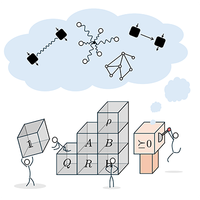
Understanding which statistical results are forbidden in quantum theory is important for the development of quantum science and technology. However, such calculations are almost always very difficult. This work introduces a flexible computer-based method that gives simplified approximate solutions. The method works for a host of different experimental scenarios encountered in modern quantum information science. For instance, it can deal with the detection of complex forms of entanglement, verify the dimension of a quantum system, or benchmark quantum features in measurement devices. It provides a general and unifying practical framework, with the potential to serve as a tool for addressing a variety of different problems in the field.
Article Text
References (75)
- A. Tavakoli, A. Pozas-Kerstjens, P. Brown, and M. Araújo, Semidefinite programming relaxations for quantum correlations, Rev. Mod. Phys. 96, 045006 (2024).
- A. C. Doherty, P. A. Parrilo, and F. M. Spedalieri, Complete family of separability criteria, Phys. Rev. A 69, 022308 (2004).
- A. Acín, T. Fritz, A. Leverrier, and A. B. Sainz, A combinatorial approach to nonlocality and contextuality, Commun. Math. Phys. 334, 533 (2015).
- M. F. Pusey, Negativity and steering: A stronger peres conjecture, Phys. Rev. A 88, 032313 (2013).
- M. Navascués and T. Vértesi, Bounding the set of finite dimensional quantum correlations, Phys. Rev. Lett. 115, 020501 (2015).
- T. H. Yang, T. Vértesi, J.-D. Bancal, V. Scarani, and M. Navascués, Robust and versatile black-box certification of quantum devices, Phys. Rev. Lett. 113, 040401 (2014).
- A. Pozas-Kerstjens, R. Rabelo, L. Rudnicki, R. Chaves, D. Cavalcanti, M. Navascués, and A. Acín, Bounding the sets of classical and quantum correlations in networks, Phys. Rev. Lett. 123, 140503 (2019).
- E. Wolfe, A. Pozas-Kerstjens, M. Grinberg, D. Rosset, A. Acín, and M. Navascués, Quantum inflation: A general approach to quantum causal compatibility, Phys. Rev. X 11, 021043 (2021).
- A. Tavakoli, J. Pauwels, E. Woodhead, and S. Pironio, Correlations in entanglement-assisted prepare-and-measure scenarios, PRX Quantum 2, 040357 (2021).
- P. Brown, H. Fawzi, and O. Fawzi, Device-independent lower bounds on the conditional von Neumann entropy, Quantum 8, 1445 (2024).
- S. Pironio, M. Navascués, and A. Acín, Convergent relaxations of polynomial optimization problems with noncommuting variables, SIAM J. Optim. 20, 2157 (2010).
- M. Navascués, S. Pironio, and A. Acín, Bounding the set of quantum correlations, Phys. Rev. Lett. 98, 010401 (2007).
- M. Navascués, S. Pironio, and A. Acín, A convergent hierarchy of semidefinite programs characterizing the set of quantum correlations, New J. Phys. 10, 073013 (2008).
- O. Gühne and G. Tóth, Entanglement detection, Phys. Rep. 474, 1 (2009).
- H. Cao, S. Morelli, L. A. Rozema, C. Zhang, A. Tavakoli, and P. Walther, Genuine multipartite entanglement detection with imperfect measurements: Concept and experiment, Phys. Rev. Lett. 133, 150201 (2024).
- D. Rosset, R. Ferretti-Schöbitz, J.-D. Bancal, N. Gisin, and Y.-C. Liang, Imperfect measurement settings: Implications for quantum state tomography and entanglement witnesses, Phys. Rev. A 86, 062325 (2012).
- S. Morelli, H. Yamasaki, M. Huber, and A. Tavakoli, Entanglement detection with imprecise measurements, Phys. Rev. Lett. 128, 250501 (2022).
- A. Tavakoli, Quantum steering with imprecise measurements, Phys. Rev. Lett. 132, 070204 (2024).
- H. Fawzi, The set of separable states has no finite semidefinite representation except in dimension , arXiv:1905.02575.
- A. Peres, Separability criterion for density matrices, Phys. Rev. Lett. 77, 1413 (1996).
- C. Spengler, M. Huber, S. Brierley, T. Adaktylos, and B. C. Hiesmayr, Entanglement detection via mutually unbiased bases, Phys. Rev. A 86, 022311 (2012).
- O. Gühne, E. Haapasalo, T. Kraft, J.-P. Pellonpää, and R. Uola, Colloquium: Incompatible measurements in quantum information science, Rev. Mod. Phys. 95, 011003 (2023).
- A. Tavakoli, J. Kaniewski, T. Vértesi, D. Rosset, and N. Brunner, Self-testing quantum states and measurements in the prepare-and-measure scenario, Phys. Rev. A 98, 062307 (2018).
- M. Farkas and J. Kaniewski, Self-testing mutually unbiased bases in the prepare-and-measure scenario, Phys. Rev. A 99, 032316 (2019).
- C. Carmeli, T. Heinosaari, and A. Toigo, Quantum random access codes and incompatibility of measurements, Europhys. Lett. 130, 50001 (2020).
- M. Navascués, K. F. Pál, T. Vértesi, and M. Araújo, Self-testing in prepare-and-measure scenarios and a robust version of Wigner’s theorem, Phys. Rev. Lett. 131, 250802 (2023).
- J. Pauwels, S. Pironio, E. Woodhead, and A. Tavakoli, Almost qudits in the prepare-and-measure scenario, Phys. Rev. Lett. 129, 250504 (2022).
- A. Tavakoli, Semi-device-independent framework based on restricted distrust in prepare-and-measure experiments, Phys. Rev. Lett. 126, 210503 (2021).
- A. Tavakoli, E. Z. Cruzeiro, R. Uola, and A. A. Abbott, Bounding and simulating contextual correlations in quantum theory, PRX Quantum 2, 020334 (2021).
- A. Chaturvedi, M. Farkas, and V. J. Wright, Characterising and bounding the set of quantum behaviours in contextuality scenarios, Quantum 5, 484 (2021).
- A. Tavakoli, E. Zambrini Cruzeiro, E. Woodhead, and S. Pironio, Informationally restricted correlations: A general framework for classical and quantum systems, Quantum 6, 620 (2022).
- J. M. Renes, R. Blume-Kohout, A. J. Scott, and C. M. Caves, Symmetric informationally complete quantum measurements, J. Math. Phys. (N.Y.) 45, 2171 (2004).
- J. Pauwels, S. Pironio, and A. Tavakoli, Information capacity of quantum communication under natural physical assumptions, Quantum 9, 1637 (2025).
- L. Gurvits, Classical deterministic complexity of edmonds’ problem and quantum entanglement, in Proceedings of the Thirty-Fifth Annual ACM Symposium on Theory of Computing, STOC ’03 (Association for Computing Machinery, New York, USA, 2003), p. 10–19.
- S. Gharibian, Strong np-hardness of the quantum separability problem, Quantum Inf. Comput. 10, 343 (2010).
- B. M. Terhal and P. Horodecki, Schmidt number for density matrices, Phys. Rev. A 61, 040301(R) (2000).
- M. Huber and J. I. de Vicente, Structure of multidimensional entanglement in multipartite systems, Phys. Rev. Lett. 110, 030501 (2013).
- G. Cobucci and A. Tavakoli, Detecting the dimensionality of genuine multiparticle entanglement, Sci. Adv. 10, eadq4467 (2024).
- M. Weilenmann, B. Dive, D. Trillo, E. A. Aguilar, and M. Navascués, Entanglement detection beyond measuring fidelities, Phys. Rev. Lett. 124, 200502 (2020).
- M. Erhard, M. Malik, M. Krenn, and A. Zeilinger, Experimental Greenberger-Horne-Zeilinger entanglement beyond qubits, Nat. Photonics 12, 759 (2018).
- A. Cervera-Lierta, M. Krenn, A. Aspuru-Guzik, and A. Galda, Experimental high-dimensional Greenberger-Horne-Zeilinger entanglement with superconducting transmon qutrits, Phys. Rev. Appl. 17, 024062 (2022).
- J. Bao et al., Very-large-scale integrated quantum graph photonics, Nat. Photonics 17, 573 (2023).
- X.-M. Hu, C.-X. Huang, N. d’Alessandro, G. Cobucci, C. Zhang, Y. Guo, Y.-F. Huang, C.-F. Li, G.-C. Guo, X. Gao, M. Huber, A. Tavakoli, and B.-H. Liu, Observation of genuine high-dimensional multi-partite non-locality in entangled photon states, Nat. Commun. 16, 5017 (2025).
- M. Malik, M. Erhard, M. Huber, M. Krenn, R. Fickler, and A. Zeilinger, Multi-photon entanglement in high dimensions, Nat. Photonics 10, 248 (2016).
- R. H. Dicke, Coherence in spontaneous radiation processes, Phys. Rev. 93, 99 (1954).
- T.-C. Wei and P. M. Goldbart, Geometric measure of entanglement and applications to bipartite and multipartite quantum states, Phys. Rev. A 68, 042307 (2003).
- M. Hayashi, D. Markham, M. Murao, M. Owari, and S. Virmani, Entanglement of multiparty-stabilizer, symmetric, and antisymmetric states, Phys. Rev. A 77, 012104 (2008).
- A. Tavakoli, D. Rosset, and M.-O. Renou, Enabling computation of correlation bounds for finite-dimensional quantum systems via symmetrization, Phys. Rev. Lett. 122, 070501 (2019).
- R. Gallego, N. Brunner, C. Hadley, and A. Acín, Device-independent tests of classical and quantum dimensions, Phys. Rev. Lett. 105, 230501 (2010).
- J. Ahrens, P. Badziag, A. Cabello, and M. Bourennane, Experimental device-independent tests of classical and quantum dimensions, Nat. Phys. 8, 592 (2012).
- M. Hendrych, R. Gallego, M. Mičuda, N. Brunner, A. Acín, and J. P. Torres, Experimental estimation of the dimension of classical and quantum systems, Nat. Phys. 8, 588 (2012).
- M. Ringbauer, T. R. Bromley, M. Cianciaruso, L. Lami, W. Y. Sarah Lau, G. Adesso, A. G. White, A. Fedrizzi, and M. Piani, Certification and quantification of multilevel quantum coherence, Phys. Rev. X 8, 041007 (2018).
- A. Bernal, G. Cobucci, M. J. Renner, and A. Tavakoli, Absolute dimensionality of quantum ensembles, Phys. Rev. Lett. 133, 240203 (2024).
- P. J. Coles, M. Berta, M. Tomamichel, and S. Wehner, Entropic uncertainty relations and their applications, Rev. Mod. Phys. 89, 015002 (2017).
- G. Tóth and O. Gühne, Entanglement detection in the stabilizer formalism, Phys. Rev. A 72, 022340 (2005).
- K. Hansenne, Z.-P. Xu, T. Kraft, and O. Gühne, Symmetries in quantum networks lead to no-go theorems for entanglement distribution and to verification techniques, Nat. Commun. 13, 496 (2022).
- S. Wehner and A. Winter, Higher entropic uncertainty relations for anti-commuting observables, J. Math. Phys. (N.Y.) 49, 062105 (2008).
- S. Niekamp, M. Kleinmann, and O. Gühne, Entropic uncertainty relations and the stabilizer formalism, J. Math. Phys. (N.Y.) 53, 012202 (2012).
- P. Kurzyński, T. Paterek, R. Ramanathan, W. Laskowski, and D. Kaszlikowski, Correlation complementarity yields bell monogamy relations, Phys. Rev. Lett. 106, 180402 (2011).
- C. de Gois, K. Hansenne, and O. Gühne, Uncertainty relations from graph theory, Phys. Rev. A 107, 062211 (2023).
- M. B. Morán and F. Huber, Uncertainty relations from state polynomial optimization, Phys. Rev. Lett. 132, 200202 (2024).
- G. Cobucci and A. Tavakoli, Detecting the dimensionality of genuine multiparticle entanglement, Sci. Adv. 10, 10.1126/sciadv.adq4467 (2024).
- M. Navascués, A. Feix, M. Araújo, and T. Vértesi, Characterizing finite-dimensional quantum behavior, Phys. Rev. A 92, 042117 (2015).
- M. Navascués, G. de la Torre, and T. Vértesi, Characterization of quantum correlations with local dimension constraints and its device-independent applications, Phys. Rev. X 4, 011011 (2014).
- H. H. Jee, C. Sparaciari, O. Fawzi, and M. Berta, Quasi-Polynomial Time Algorithms for Free Quantum Games in Bounded Dimension, in 48th International Colloquium on Automata, Languages, and Programming (ICALP 2021), Leibniz International Proceedings in Informatics (LIPIcs) Vol. 198, edited by N. Bansal, E. Merelli, and J. Worrell (Schloss Dagstuhl—Leibniz-Zentrum für Informatik, Dagstuhl, Germany, 2021), pp. 82:1–82:20.
- H. M. Wiseman, S. J. Jones, and A. C. Doherty, Steering, entanglement, nonlocality, and the einstein-podolsky-rosen paradox, Phys. Rev. Lett. 98, 140402 (2007).
- D. Cavalcanti and P. Skrzypczyk, Quantum steering: A review with focus on semidefinite programming, Rep. Prog. Phys. 80, 024001 (2016).
- S. Designolle, V. Srivastav, R. Uola, N. H. Valencia, W. McCutcheon, M. Malik, and N. Brunner, Genuine high-dimensional quantum steering, Phys. Rev. Lett. 126, 200404 (2021).
- N. D’Alessandro, C. R. i. Carceller, and A. Tavakoli, Semidefinite relaxations for high-dimensional entanglement in the steering scenario, Phys. Rev. Lett. 134, 090802 (2025).
- N. Johnston, R. Mittal, V. Russo, and J. Watrous, Extended non-local games and monogamy-of-entanglement games, Proc. R. Soc. A 472 (2016).
- E. Woodhead and S. Pironio, Effects of preparation and measurement misalignments on the security of the bennett-brassard 1984 quantum-key-distribution protocol, Phys. Rev. A 87, 032315 (2013).
- M. Pereira, G. Kato, A. Mizutani, M. Curty, and K. Tamaki, Quantum key distribution with correlated sources, Sci. Adv. 6, eaaz4487 (2020).
- M. Oszmaniec, L. Guerini, P. Wittek, and A. Acín, Simulating positive-operator-valued measures with projective measurements, Phys. Rev. Lett. 119, 190501 (2017).
- G. Cobucci, A. Bernal, M. J. Renner, and A. Tavakoli, Operationally classical simulation of quantum states, Nat. Commun. 17, 1104 (2026).
- https://github.com/nicoljno/blockmatrixhierarchy_.

