

- Open Access
Production and Decay Dynamics of the Charmed Baryon in Annihilations near Threshold
Phys. Rev. X 16, 031058 – Published 4 September, 2026
DOI: https://doi.org/10.1103/5v2c-55m1
Abstract
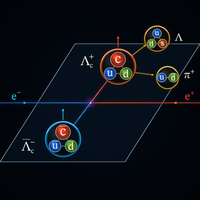
The study of the charmed baryons is crucial for investigating the strong and weak interactions in the standard model and for gaining insights into the internal structure of baryons. In an experiment, the lightest charmed baryon, , can be produced in pairs through the single-photon annihilation process. This process can be described by two complex electromagnetic form factors. The presence of a nonzero relative phase between these form factors gives rise to a transverse polarization of the charmed baryon and provides additional constraints on the dynamic parameters in the decays. In this article, we present the first observation of the transverse polarization of in the reaction , based on of annihilation data collected at center-of-mass energies between 4600 MeV and 4951 MeV with the BESIII detector. The decay asymmetry parameters in the decays , , , and are simultaneously extracted from the joint angular distributions. By independently extracting the above parameters for the process and its -conjugate counterpart, we derive both the strong and weak phase differences between different partial waves and test several observables. The obtained results fully demonstrate the feasibility of exploiting transverse polarization at electron-positron colliders to search for -violating effects, opening up a new avenue for exploring violation in the charmed baryon sector.
Physics Subject Headings (PhySH)
Popular Summary
Protons and neutrons are the fundamental constituents of nuclei and the most familiar baryons, each made of three quarks. Charmed baryons, which contain a charm quark, remain far less well understood. Because the charm quark is much heavier than the quarks inside protons and neutrons, charmed baryons offer a distinctive way to test how the strong force binds quarks together. Using the BESIII detector, we studied the lightest charmed baryon, the , and its antimatter partner at 13 collision energies. We found that their spin orientations are not completely random: They exhibit a measurable polarization perpendicular to the production plane of the pairs. This polarization reaches about 18% at its largest value and varies with collision energy. These results provide the most finely resolved measurement to date of the electromagnetic phase for any baryon and establish a route for searches for matter-antimatter differences in charmed-baryon decays.
Article Text
References (102)
- G. S. Abrams et al., Observation of charmed baryon production in annihilation, Phys. Rev. Lett. 44, 10 (1980).
- K. Schönning, V. Batozskaya, P. Adlarson, and X. Zhou, Production and decay of polarized hyperon-antihyperon pairs, Chin. Phys. C 47, 052002 (2023).
- G. Huang and R. B. Ferroli (BESIII Collaboration), Probing the internal structure of baryons, Natl. Sci. Rev. 8, nwab187 (2021).
- S. Pacetti, R. Baldini Ferroli, and E. Tomasi-Gustafsson, Proton electromagnetic form factors: Basic notions, present achievements and future perspectives, Phys. Rep. 550–551, 1 (2015).
- V. Punjabi, C. F. Perdrisat, M. K. Jones, E. J. Brash, and C. E. Carlson, The structure of the nucleon: Elastic electromagnetic form factors, Eur. Phys. J. A 51, 79 (2015).
- H. Atac, M. Constantinou, Z. E. Meziani, M. Paolone, and N. Sparveris, Measurement of the neutron charge radius and the role of its constituents, Nat. Commun. 12, 1759 (2021).
- M. Ablikim et al. (BESIII Collaboration), Determination of the timelike electromagnetic form factors, Phys. Rev. Lett. 132, 081904 (2024).
- M. Ablikim et al. (BESIII Collaboration), Unraveling the structure of hyperons with polarized pairs, Phys. Rev. Lett. 135, 191902 (2025).
- A. Mangoni, S. Pacetti, and E. Tomasi-Gustafsson, The first exploration of the physical Riemann surfaces of the ratio , Phys. Rev. D 104, 116016 (2021).
- H. Chen and R.-G. Ping, transverse polarization and decay asymmetry parameters, Phys. Rev. D 99, 114027 (2019).
- M. Ablikim et al. (BESIII Collaboration), Polarization and entanglement in baryon-antibaryon pair production in electron-positron annihilation, Nat. Phys. 15, 631 (2019).
- M. Ablikim et al. (BESIII Collaboration), Complete measurement of the electromagnetic form factors, Phys. Rev. Lett. 123, 122003 (2019).
- M. Ablikim et al. (BESIII Collaboration), Precise measurements of decay parameters and asymmetry with entangled pairs pairs, Phys. Rev. Lett. 129, 131801 (2022).
- M. Ablikim et al. (BESIII Collaboration), Measurement of transverse polarization in collisions at , J. High Energy Phys. 10 (2023) 081; 12 (2023) 80.
- M. Ablikim et al. (BESIII Collaboration), Extracting the femtometer structure of strange baryons using the vacuum polarization effect, Nat. Commun. 15, 8812 (2024).
- M. Ablikim et al. (BESIII Collaboration), Strong and weak tests in sequential decays of polarized hyperons, Phys. Rev. Lett. 133, 101902 (2024).
- M. Ablikim et al. (BESIII Collaboration), Probing symmetry and weak phases with entangled double-strange baryons, Nature (London) 606, 64 (2022).
- M. Ablikim et al. (BESIII Collaboration), Observation of hyperon transverse polarization in , Phys. Rev. D 106, L091101 (2022).
- M. Ablikim et al. (BESIII Collaboration), Tests of symmetry in entangled pairs, Phys. Rev. D 108, L031106 (2023).
- T. D. Lee and C.-N. Yang, General partial wave analysis of the decay of a hyperon of spin , Phys. Rev. 108, 1645 (1957).
- M. Ablikim et al. (BESIII Collaboration), Measurements of weak decay asymmetries of , , , and , Phys. Rev. D 100, 072004 (2019).
- H.-J. Wang, P.-R. Li, X.-R. Lyu, J. Tandean, and H.-B. Li, Remarks on strong phase shifts in weak nonleptonic baryon decays, Sci. Bull. 70, 1189 (2025).
- P. Avery et al. (CLEO Collaboration), Measurement of the decay asymmetry parameter, Phys. Rev. Lett. 65, 2842 (1990).
- J. G. Korner and M. Kramer, Exclusive nonleptonic charm baryon decays, Z. Phys. C 55, 659 (1992).
- M. A. Ivanov, J. G. Korner, V. E. Lyubovitskij, and A. G. Rusetsky, Exclusive nonleptonic decays of bottom and charm baryons in a relativistic three quark model: Evaluation of nonfactorizing diagrams, Phys. Rev. D 57, 5632 (1998).
- Q. P. Xu and A. N. Kamal, Cabibbo favored nonleptonic decays of charmed baryons, Phys. Rev. D 46, 270 (1992).
- H.-Y. Cheng and B. Tseng, Nonleptonic weak decays of charmed baryons, Phys. Rev. D 46, 1042 (1992); 55, 1697(E) (1997).
- H.-Y. Cheng and B. Tseng, Cabibbo allowed nonleptonic weak decays of charmed baryons, Phys. Rev. D 48, 4188 (1993).
- P. Zenczykowski, Nonleptonic charmed baryon decays: Symmetry properties of parity violating amplitudes, Phys. Rev. D 50, 5787 (1994).
- P. Zenczykowski, Quark and pole models of nonleptonic decays of charmed baryons, Phys. Rev. D 50, 402 (1994).
- A. Datta, Nonleptonic two-body decays of charmed and baryons, arXiv:hep-ph/9504428.
- K. K. Sharma and R. C. Verma, A Study of weak mesonic decays of and baryons on the basis of HQET results, Eur. Phys. J. C 7, 217 (1999).
- L. K. Li et al. (Belle Collaboration), Search for violation and measurement of branching fractions and decay asymmetry parameters for and , Sci. Bull. 68, 583 (2023).
- S. X. Li et al. (Belle Collaboration), Measurements of branching fractions of and and asymmetry parameters of , , and , Phys. Rev. D 107, 032003 (2023).
- M. Ablikim et al. (BESIII Collaboration), First measurement of the decay asymmetry in the pure -boson-exchange decay , Phys. Rev. Lett. 132, 031801 (2024).
- C. Yang, X.-G. He, and C.-W. Liu, Charmed baryon decays: breaking and violation, J. High Energy Phys. 09 (2025) 193.
- C.-Q. Geng, X.-G. He, X.-N. Jin, C.-W. Liu, and C. Yang, Complete determination of amplitudes and strong phase in , Phys. Rev. D 109, L071302 (2024).
- H. Zhong, F. Xu, and H.-Y. Cheng, Topological diagrams and hadronic weak decays of charmed baryons, arXiv:2401.15926.
- H. Zhong, F. Xu, and H.-Y. Cheng, Analysis of hadronic weak decays of charmed baryons in the topological diagrammatic approach, Phys. Rev. D 109, 114027 (2024).
- C. Q. Geng, C.-W. Liu, and T.-H. Tsai, Asymmetries of anti-triplet charmed baryon decays, Phys. Lett. B 794, 19 (2019).
- J. Zou, F. Xu, G. Meng, and H.-Y. Cheng, Two-body hadronic weak decays of antitriplet charmed baryons, Phys. Rev. D 101, 014011 (2020).
- H. Zhong, F. Xu, Q. Wen, and Y. Gu, Weak decays of antitriplet charmed baryons from the perspective of flavor symmetry, J. High Energy Phys. 02 (2023) 235.
- C.-W. Liu, Nonleptonic two-body weak decays of charmed baryons, Phys. Rev. D 109, 033004 (2024).
- H.-Y. Cheng, F. Xu, and H. Zhong, Hadronic weak decays of charmed baryons in the topological diagrammatic approach: An update, Phys. Rev. D 111, 034011 (2025).
- H. Albrecht et al. (ARGUS Collaboration), A measurement of asymmetry in the decay , Phys. Lett. B 274, 239 (1992).
- M. Bishai et al. (CLEO Collaboration), Measurement of the decay asymmetry parameters in and , Phys. Lett. B 350, 256 (1995).
- J. M. Link et al. (FOCUS Collaboration), Study of the decay asymmetry parameter and violation parameter in the decay, Phys. Lett. B 634, 165 (2006).
- R. Aaij et al. (LHCb Collaboration), Measurement of , , and decay parameters using decays, Phys. Rev. Lett. 133, 261804 (2024).
- S. Navas et al. (Particle Data Group), Review of particle physics, Phys. Rev. D 110, 030001 (2024).
- A. Alavi-Harati et al. (KTeV Collaboration), Observation of direct violation in decays, Phys. Rev. Lett. 83, 22 (1999).
- V. Fanti et al. (NA48 Collaboration), A new measurement of direct violation in two pion decays of the neutral kaon, Phys. Lett. B 465, 335 (1999).
- R. Aaij et al. (LHCb Collaboration), Observation of violation in charm decays, Phys. Rev. Lett. 122, 211803 (2019).
- B. Aubert et al. (BABAR Collaboration), Observation of direct violation in decays, Phys. Rev. Lett. 93, 131801 (2004).
- Y. Chao et al. (Belle Collaboration), Evidence for direct violation in decays, Phys. Rev. Lett. 93, 191802 (2004).
- R. Aaij et al. (LHCb Collaboration), Observation of charge-parity symmetry breaking in baryon decays, Nature (London) 643, 1223 (2025).
- R. Aaij et al. (LHCb Collaboration), Measurement of matter-antimatter differences in beauty baryon decays, Nat. Phys. 13, 391 (2017).
- R. Aaij et al. (LHCb Collaboration), Study of and decays to and evidence for violation in decays, Phys. Rev. Lett. 134, 101802 (2025).
- M. Ablikim et al. (BESIII Collaboration), Precision studies and searches for asymmetries in the inclusive decay , arXiv:2602.24089.
- M. Ablikim et al. (BESIII Collaboration), Investigation of the rule and test of symmetry through the measurement of decay asymmetry parameters in decays, Phys. Rev. Lett. 132, 101801 (2024).
- M. Ablikim et al. (BESIII Collaboration), Design and construction of the BESIII detector, Nucl. Instrum. Methods Phys. Res., Sect. A 614, 345 (2010).
- C. Yu et al., BEPCII performance and beam dynamics studies on luminosity, in 7th International Particle Accelerator Conference (JACoW Publishing, Geneva, Switzerland, 2016), p. TUYA01, 10.18429/JACoW-IPAC2016-TUYA01.
- M. Ablikim et al. (BESIII Collaboration), Future physics programme of BESIII, Chin. Phys. C 44, 040001 (2020).
- J. Lu, Y. Xiao, and X. Ji, Online monitoring of the center-of-mass energy from real data at BESIII, Radiat. Detect. Technol. Methods 4, 337 (2020).
- J.-W. Zhang et al., Suppression of top-up injection backgrounds with offline event filter in the BESIII experiment, Radiat. Detect. Technol. Methods 6, 289 (2022).
- Y.-X. Guo et al., The study of time calibration for upgraded end cap TOF of BESIII, Radiat. Detect. Technol. Methods 1, 15 (2017).
- X. Li et al., Study of MRPC technology for BESIII endcap-tof upgrade, Radiat. Detect. Technol. Methods 1, 13 (2017).
- C. Cao, P et al., Design and construction of the new BESIII endcap time-of-flight system with MRPC technology, Nucl. Instrum. Methods Phys. Res., Sect. A 953, 163053 (2020).
- M. Ablikim et al. (BESIII Collaboration), Measurement of integrated luminosities at BESIII for data samples at center-of-mass energies between 4.0 and 4.6 GeV, Chin. Phys. C 46, 113002 (2022).
- M. Ablikim et al. (BESIII Collaboration), Luminosities and energies of collision data taken between 4.61 GeV and 4.95 GeV at BESIII, Chin. Phys. C 46, 113003 (2022).
- S. Agostinelli et al. (GEANT4 Collaboration), GEANT4–a simulation toolkit, Nucl. Instrum. Methods Phys. Res., Sect. A 506, 250 (2003).
- S. Jadach, B. F. L. Ward, and Z. Was, Coherent exclusive exponentiation for precision Monte Carlo calculations, Phys. Rev. D 63, 113009 (2001).
- S. Jadach, B. F. L. Ward, and Z. Was, The precision Monte Carlo event generator for two fermion final states in collisions, Comput. Phys. Commun. 130, 260 (2000).
- D. J. Lange, The EvtGen particle decay simulation package, Nucl. Instrum. Methods Phys. Res., Sect. A 462, 152 (2001).
- R.-G. Ping, Event generators at BESIII, Chin. Phys. C 32, 599 (2008).
- J. C. Chen, G. S. Huang, X. R. Qi, D. H. Zhang, and Y. S. Zhu, Event generator for and decay, Phys. Rev. D 62, 034003 (2000).
- R.-L. Yang, R.-G. Ping, and H. Chen, Tuning and validation of the Lundcharm model with decays, Chin. Phys. Lett. 31, 061301 (2014).
- E. Barberio, B. van Eijk, and Z. Was, PHOTOS: A universal Monte Carlo for QED radiative corrections in decays, Comput. Phys. Commun. 66, 115 (1991).
- M. Ablikim et al. (BESIII Collaboration), Precision measurement of the cross section near threshold, Phys. Rev. Lett. 120, 132001 (2018).
- M. Ablikim et al. (BESIII Collaboration), Observations of the Cabibbo-suppressed decays , and the Cabibbo-favored decay , Chin. Phys. C 47, 023001 (2023).
- R. Aaij et al. (LHCb Collaboration), Evidence for a new structure in the and systems in decays, Phys. Rev. Lett. 128, 062001 (2022).
- R. Aaij et al. (LHCb Collaboration), Observation of a resonance consistent with a strange pentaquark candidate in decays, Phys. Rev. Lett. 131, 031901 (2023).
- H. Albrecht et al. (ARGUS Collaboration), Search for hadronic decays, Phys. Lett. B 241, 278 (1990).
- E. Perotti, G. Fäldt, A. Kupsc, S. Leupold, and J. J. Song, Polarization observables in annihilation to a baryon-antibaryon pair, Phys. Rev. D 99, 056008 (2019).
- R. Aaij et al. (LHCb Collaboration), polarimetry using the dominant hadronic mode, J. High Energy Phys. 07 (2023) 228.
- R. Aaij et al. (LHCb Collaboration), Amplitude analysis of the decay and baryon polarization measurement in semileptonic beauty hadron decays, Phys. Rev. D 108, 012023 (2023).
- M. Ablikim et al. (BESIII Collaboration), Partial wave analysis of the charmed baryon hadronic decay , J. High Energy Phys. 12 (2022) 033.
- C. Langenbruch, Parameter uncertainties in weighted unbinned maximum likelihood fits, Eur. Phys. J. C 82, 393 (2022).
- F. James and M. Roos, Minuit: A system for function minimization and analysis of the parameter errors and correlations, Comput. Phys. Commun. 10, 343 (1975).
- M. Ablikim et al. (BESIII Collaboration), Measurement of absolute branching fraction of the inclusive decay , Phys. Rev. Lett. 121, 062003 (2018).
- N. Salone, P. Adlarson, V. Batozskaya, A. Kupsc, S. Leupold, and J. Tandean, Study of violation in hyperon decays at super-charm-tau factories with a polarized electron beam, Phys. Rev. D 105, 116022 (2022).
- C. Chen, B. Yan, and J.-J. Xie, Cross sections and the electromagnetic form factors within the extended vector meson dominance model, Chin. Phys. Lett. 41, 021302 (2024).
- J. Wan, Y. Yang, and Z. Lu, The electromagnetic form factors of hyperon in the vector meson dominance model, Eur. Phys. J. Plus 136, 949 (2021).
- M. Ablikim et al. (BESIII Collaboration), Measurement of energy-dependent pair-production cross section and electromagnetic form factors of a charmed baryon, Phys. Rev. Lett. 131, 191901 (2023).
- Z.-Y. Li, A.-X. Dai, and J.-J. Xie, Electromagnetic form factors of hyperon in the vector meson dominance model and a possible explanation of the near-threshold enhancement of the reaction, Chin. Phys. Lett. 39, 011201 (2022).
- C. Chen, B. Yan, and J.-J. Xie, The electromagnetic form factors and spin polarization of in the process , Chin. Phys. C 49, 023102 (2025).
- Y. Yang, D.-Y. Chen, and Z. Lu, Electromagnetic form factors of hyperon in the vector meson dominance model, Phys. Rev. D 100, 073007 (2019).
- G. Pakhlova et al. (Belle Collaboration), Observation of a near-threshold enhancement in the cross section using initial-state radiation, Phys. Rev. Lett. 101, 172001 (2008).
- P.-R. Li, X.-R. Lyu, and Y. Zheng, Experimental overview on the charmed baryon decays, Chin. Phys. C 50, 022002 (2026).
- C.-P. Jia, H.-Y. Jiang, J.-P. Wang, and F.-S. Yu, Final-state rescattering mechanism of charmed baryon decays, J. High Energy Phys. 11 (2024) 072.
- X.-G. He and C.-W. Liu, Large violation in charmed baryon decays, Sci. Bull. 70, 2598 (2025).
- H.-J. Wang, C. Wang, H. Sun, P.-R. Li, X.-R. Lyu, and R.-G. Ping, Prospects for and violation in decays with a polarized beam at the Super Tau-Charm Facility, Phys. Rev. D 112, 112002 (2025).
- https://cstr.cn/31109.02.BEPC

