

- Open Access
Ionization and Dissociation Energies of Molecular Hydrogen
Phys. Rev. X 16, 041032 – Published 5 November, 2026
DOI: https://doi.org/10.1103/42c4-pc1s
Abstract
Molecular hydrogen () is the simplest neutral molecule, and its ionization and dissociation energies are key benchmarks for testing first-principles calculations of nonadiabatic, relativistic, quantum-electrodynamic, and finite-nuclear-size effects in molecules. To obtain improved ionization and dissociation energies, we performed precision measurements of 15 transition frequencies in para-. They connect the X ground state, the long-lived excited state, and several high members of the and Rydberg series with principal quantum number in the range between 48 and 70. These data lead to a 5 times more accurate value of the ionization energy of the ground state of para-, equivalent to a relative frequency accuracy of . Combined with a global network analysis of 45 energy intervals in para- and ortho- that have been measured in the past three decades, we obtain statistically robust values for the ionization energy [] and the dissociation energy [] of . These values have an unprecedented accuracy equivalent to 175 kHz. The network analysis also leads to improved term values and dissociation energies of the excited states involved in the analysis. By comparing the results with first-principles calculations of the level structures of and , a significantly reduced upper bound of 540 kHz is derived for putative beyond-the-standard-model contributions to the energy difference between para- and ortho-.
Physics Subject Headings (PhySH)
- Atomic & molecular structure
- Chemical binding
- Electronic excitation & ionization
- Molecular dissociation
- Molecular spectra
- Relativistic & quantum electrodynamic effects in atoms, molecules,& ions
- Single- and few-photon ionization & excitation
- Molecules
- Rydberg atoms & molecules
- Optical spectroscopy
- Photoexcitation
- Photoionization
- Spectroscopy
Popular Summary
The ionization and dissociation energies of molecular hydrogen act as essential benchmarks for testing fundamental first-principles calculations of complex molecular structure. We determined these energies to a relative accuracy of for the ionization frequency by performing precision measurements of fifteen transition frequencies in para- using deep-ultraviolet, ultraviolet, and millimeter-wave spectroscopy. Combined with a global network analysis of forty-five energy intervals measured over three decades, we obtained statistically robust values for the ionization and dissociation energies of molecular hydrogen with an accuracy of 175 kHz. Furthermore, we established a substantially reduced upper bound for putative beyond-the-standard-model contributions to the energy difference between para- and ortho-. Our results provide stringent benchmarks for calculations in two-electron systems and might eventually help resolve a persisting discrepancy between the experimental and theoretical ionization energies of metastable helium.
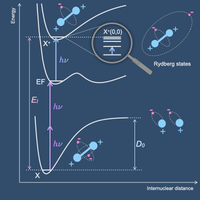
Article Text
Supplemental Material
References (87)
- I. Langmuir, The dissociation of hydrogen into atoms, J. Am. Chem. Soc. 34, 860 (1912).
- K. F. Herzfeld, Zur Theorie der Reaktionsgeschwindigkeiten in Gasen, Ann. Phys. (N.Y.) 59, 635 (1919).
- K. Wohl, Zur Dissoziation von Chlor und Wasserstoff in die Atome, Z. Elektrochem. Angew. Phys. Chem. 30, 49 (1924).
- M. Bodenstein and G. Jung, Die Dissoziation der Wasserstoffmolekel, Z. Phys. Chem. 121, 127 (1926).
- F. R. Bichowski and L. C. Copeland, The heat of formation of molecular hydrogen, J. Am. Chem. Soc. 50, 1315 (1928).
- N. Bohr, On the constitution of atoms and molecules. Part III.—Systems containing several nuclei, Philos. Mag. 26, 857 (1913).
- E. Schrödinger, Quantisierung als Eigenwertproblem (Erste Mitteilung), Ann. Phys. (Berlin) 384, 361 (1926).
- E. Schrödinger, Quantisierung als Eigenwertproblem (Zweite Mitteilung), Ann. Phys. (N.Y.) 384, 489 (1926).
- E. Schrödinger, Quantisierung als Eigenwertproblem (Dritte Mitteilung: Störungstheorie, mit Anwendung auf den Starkeffekt der Balmerlinien), Ann. Phys. (N.Y.) 385, 437 (1926).
- E. Schrödinger, Quantisierung als Eigenwertproblem (Vierte Mitteilung), Ann. Phys. (N.Y.) 386, 109 (1926).
- E. Schrödinger, Über das Verhältnis der Heisenberg-Born-Jordanschen Quantenmechanik zu der meinen, Ann. Phys. (N.Y.) 384, 734 (1926).
- W. Heitler and F. London, Wechselwirkung neutraler Atome und homöopolare Bindung nach der Quantenmechanik, Z. Phys. 44, 455 (1927).
- E. E. Witmer, Critical potentials and the heat of dissociation of hydrogen as determined from its ultra-violet band spectrum, Phys. Rev. 28, 1223 (1926).
- G. H. Dieke and J. J. Hopfield, The structure of the ultra-violet spectrum of the hydrogen molecule, Phys. Rev. 30, 400 (1927).
- H. M. James and A. S. Coolidge, The ground state of the hydrogen molecule, J. Chem. Phys. 1, 825 (1933).
- H. M. James and A. S. Coolidge, A correction and addition to the discussion of the ground state of , J. Chem. Phys. 3, 129 (1935).
- H. Beutler, Die Dissoziationswärme des Wasserstoffmoleküls , aus der Rotationsstruktur an der langwelligen Grenze des Absorptionskontinuums bei 850 Å bestimmt, Z. Phys. Chem., Abt. B 29B, 315 (1935).
- W. Kołos and C. C. J. Roothaan, Accurate electronic wave functions for the molecule, Rev. Mod. Phys. 32, 219 (1960).
- W. Kołos and C. C. J. Roothaan, Correlated orbitals for the ground state of the hydrogen molecule, Rev. Mod. Phys. 32, 205 (1960).
- G. Herzberg and A. Monfils, The dissociation energies of the , , and molecules, J. Mol. Spectrosc. 5, 482 (1961).
- W. Kołos and L. Wolniewicz, Improved theoretical ground-state energy of the hydrogen molecule, J. Chem. Phys. 49, 404 (1968).
- W. Kołos and L. Wolniewicz, Confirmation of the discrepancy between the theoretical and experimental ground-state energies of , Phys. Rev. Lett. 20, 243 (1968).
- G. Herzberg, The dissociation energy of the hydrogen molecule, J. Mol. Spectrosc. 33, 147 (1970).
- G. Herzberg and Ch. Jungen, Rydberg series and ionization potential of the molecule, J. Mol. Spectrosc. 41, 425 (1972).
- Ch. Jungen, I. Dabrowski, G. Herzberg, and M. Vervloet, High orbital angular momentum states in and . III. Singlet-triplet splittings, energy levels, and ionization potentials, J. Chem. Phys. 93, 2289 (1990).
- J. M. Gilligan and E. E. Eyler, Precise determinations of ionization potentials and -state energy levels of , , and , Phys. Rev. A 46, 3676 (1992).
- D. Shiner, J. M. Gilligan, B. M. Cook, and W. Lichten, , , and ionization potentials by accurate calibration of several iodine lines, Phys. Rev. A 47, 4042 (1993).
- A. de Lange, E. Reinhold, and W. Ubachs, Spectroscopy on some symmetry states in and determination of the ionization potential, Phys. Rev. A 65, 064501 (2002).
- D. M. Bishop and L. M. Cheung, Rigorous theoretical investigation of the ground state of , Phys. Rev. A 18, 1846 (1978).
- L. Wolniewicz, Nonadiabatic energies of the ground state of the hydrogen molecule, J. Chem. Phys. 103, 1792 (1995).
- Y. P. Zhang, C. H. Cheng, J. T. Kim, J. Stanojevic, and E. E. Eyler, Dissociation energies of molecular hydrogen and the hydrogen molecular ion, Phys. Rev. Lett. 92, 203003 (2004).
- K. P. Huber and G. Herzberg, Molecular Spectra and Molecular Structure Constants of Diatomic Molecules (Van Nostrand Reinhold Company, New York, 1979), Vol. IV.
- B. Simmen, E. Mátyus, and M. Reiher, Elimination of the translational kinetic energy contamination in pre-Born–Oppenheimer calculations, Mol. Phys. 111, 2086 (2013).
- M. Puchalski, J. Komasa, P. Czachorowski, and K. Pachucki, Nonadiabatic QED correction to the dissociation energy of the hydrogen molecule, Phys. Rev. Lett. 122, 103003 (2019).
- A. Muolo, A. Baiardi, R. Feldmann, and M. Reiher, Nuclear-electronic all-particle density matrix renormalization group, J. Chem. Phys. 152, 204103 (2020).
- L. M. Wang and Z.-C. Yan, Relativistic corrections to the ground state of calculated without using the Born-Oppenheimer approximation, Phys. Rev. A 97, 060501(R) (2018).
- M. Puchalski, J. Komasa, A. Spyszkiewicz, and K. Pachucki, Dissociation energy of molecular hydrogen isotopologues, Phys. Rev. A 100, 020503(R) (2019).
- K. Piszczatowski, G. Łach, M. Przybytek, J. Komasa, K. Pachucki, and B. Jeziorski, Theoretical determination of the dissociation energy of molecular hydrogen, J. Chem. Theory Comput. 5, 3039 (2009).
- M. Puchalski, A. Spyszkiewicz, J. Komasa, and K. Pachucki, Nonadiabatic relativistic correction to the dissociation energy of , , and , Phys. Rev. Lett. 121, 073001 (2018).
- K. Pachucki and J. Komasa, From first-principles to quantum electrodynamics: Pushing the limits of theory with the hydrogen molecule, J. Chem. Theory Comput. 21, 12664 (2025).
- J. Komasa, Electron-nucleus Araki-Sucher correction in the hydrogen molecule isotopologues, Phys. Rev. A 113, 012802 (2026).
- A. Osterwalder, A. Wüest, F. Merkt, and Ch. Jungen, High-resolution millimeter wave spectroscopy and multichannel quantum defect theory of the hyperfine structure in high Rydberg states of molecular hydrogen , J. Chem. Phys. 121, 11810 (2004).
- J. Liu, E. J. Salumbides, U. Hollenstein, J. C. J. Koelemeij, K. S. E. Eikema, W. Ubachs, and F. Merkt, Determination of the ionization and dissociation energies of the hydrogen molecule, J. Chem. Phys. 130, 174306 (2009).
- D. Sprecher, Ch. Jungen, and F. Merkt, Determination of the binding energies of the Rydberg states of , , and from high-resolution spectroscopic data by multichannel quantum-defect theory, J. Chem. Phys. 140, 104303 (2014).
- D. Sprecher, Ch. Jungen, W. Ubachs, and F. Merkt, Towards measuring the ionisation and dissociation energies of molecular hydrogen with sub-MHz accuracy, Faraday Discuss. 150, 51 (2011).
- C.-F. Cheng, J. Hussels, M. Niu, H. L. Bethlem, K. S. E. Eikema, E. J. Salumbides, W. Ubachs, M. Beyer, N. Hölsch, J. A. Agner, F. Merkt, L.-G. Tao, S.-M. Hu, and C. Jungen, Dissociation energy of the hydrogen molecule at accuracy, Phys. Rev. Lett. 121, 013001 (2018).
- N. Hölsch, M. Beyer, E. J. Salumbides, Kjeld S. E. Eikema, W. Ubachs, C. Jungen, and F. Merkt, Benchmarking theory with an improved measurement of the ionization and dissociation energies of , Phys. Rev. Lett. 122, 103002 (2019).
- M. Beyer, N. Hölsch, J. Hussels, C.-F. Cheng, E. J. Salumbides, K. S. E. Eikema, W. Ubachs, C. Jungen, and F. Merkt, Determination of the interval between the ground states of para- and ortho-, Phys. Rev. Lett. 123, 163002 (2019).
- N. Hölsch, I. Doran, M. Beyer, and F. Merkt, Precision millimetre-wave spectroscopy and calculation of the Stark manifolds in high Rydberg states of para-, J. Mol. Spectrosc. 387, 111648 (2022).
- V. Patkóš, V. A. Yerokhin, and K. Pachucki, Complete Lamb shift of helium triplet states, Phys. Rev. A 103, 042809 (2021).
- G. Clausen, P. Jansen, S. Scheidegger, J. A. Agner, H. Schmutz, and F. Merkt, Ionization energy of the metastable 2 state of from Rydberg-series extrapolation, Phys. Rev. Lett. 127, 093001 (2021).
- G. Clausen, K. Gamlin, J. A. Agner, H. Schmutz, and F. Merkt, Metrology in a two-electron atom: The ionization energy of metastable triplet helium (2 ), Phys. Rev. A 111, 012817 (2025).
- G. Clausen and F. Merkt, Ionization energy of metastable (2 ) and the alpha- and helion-particle charge-radius difference from precision spectroscopy of the Rydberg series, Phys. Rev. Lett. 134, 223001 (2025).
- J. Morgenweg and Kjeld S. E. Eikema, Ramsey-comb spectroscopy: Theory and signal analysis, Phys. Rev. A 89, 052510 (2014).
- N. F. Ramsey, A new molecular beam resonance method, Phys. Rev. 76, 996 (1949).
- N. F. Ramsey, A molecular beam resonance method with separated oscillating fields, Phys. Rev. 78, 695 (1950).
- D. W. Chandler and L. R. Thorne, Measured radiative lifetimes for and in the , electronic state, J. Chem. Phys. 85, 1733 (1986).
- M. Glass-Maujean, P. Quadrelli, K. Dressler, and L. Wolniewicz, Transition probabilities for spontaneous emission in the adiabatic and nonadiabatic approximations for all bound vibrational levels of the , , , , and states of , Phys. Rev. A 28, 2868 (1983).
- C. Roth, A. M. de Velasco, E. L. Gründeman, M. Collombon, M. Beyer, V. Barbé, and K. S. E. Eikema, High-precision Ramsey-comb spectroscopy on molecular deuterium for tests of molecular quantum theory, Mol. Phys. 121, e2211405 (2023).
- S. Hannemann, E. J. Salumbides, and W. Ubachs, Reducing the first-order Doppler shift in a Sagnac interferometer, Opt. Lett. 32, 1381 (2007).
- F. Biraben, B. Cagnac, and G. Grynberg, Experimental evidence of two-photon transition without Doppler broadening, Phys. Rev. Lett. 32, 643 (1974).
- S. Hannemann, E. J. Salumbides, S. Witte, R. T. Zinkstok, E.-J. van Duijn, K. S. E. Eikema, and W. Ubachs, Frequency metrology on the transition in , , and , Phys. Rev. A 74, 062514 (2006).
- D. Sun, Y. P. Zhang, X. J. Wei, L. M. Wang, and Z.-C. Yan, Polarizabilities of hydrogen molecules calculated without using the Born-Oppenheimer approximation, Phys. Rev. 103, 062813 (2021).
- N. F. Ramsey, Theory of molecular hydrogen and deuterium in magnetic fields, Phys. Rev. 85, 60 (1952).
- A. Misra and A. Panda, Variation of bond length with magnetic field, J. Mol. Spectrosc. 252, 98 (2008).
- N. Hölsch, M. Beyer, and F. Merkt, Nonadiabatic effects on the positions and lifetimes of the low-lying rovibrational levels of the and states of , Phys. Chem. Chem. Phys. 20, 26837 (2018).
- M. Beyer, N. Hölsch, J. A. Agner, J. Deiglmayr, H. Schmutz, and F. Merkt, Metrology of high- Rydberg states of molecular hydrogen with accuracy, Phys. Rev. A 97, 012501 (2018).
- L. Essen, R. W. Donaldson, M. J. Bangham, and E. G. Hope, Frequency of the hydrogen maser, Nature (London) 229, 110 (1971).
- S. G. Karshenboim, Precision physics of simple atoms: QED tests, nuclear structure and fundamental constants, Phys. Rep. 422, 1 (2005).
- U. D. Jentschura and V. A. Yerokhin, Quantum electrodynamic corrections to the hyperfine structure of excited s states, Phys. Rev. A 73, 062503 (2006).
- K.-F. Lai, W. Ubachs, and M. Beyer, Precision measurement of the last bound states in and determination of the scattering length, Phys. Rev. A 111, 022803 (2025).
- I. Doran, N. Hölsch, M. Beyer, and F. Merkt, Zero-quantum-defect method and the fundamental vibrational interval of , Phys. Rev. Lett. 132, 073001 (2024).
- M. Beyer, N. Hölsch, and F. Merkt (unpublished).
- R. K. Altmann, L. S. Dreissen, E. J. Salumbides, W. Ubachs, and K. S. E. Eikema, Deep-ultraviolet frequency metrology of for tests of molecular quantum theory, Phys. Rev. Lett. 120, 043204 (2018).
- J.-M. Flaud, C. Camy-Peyret, and J. Maillard, Higher ro-vibrational levels of deduced from high resolution oxygen-hydrogen flame spectra between , Mol. Phys. 32, 499 (1976).
- D. L. Albritton, A. L. Schmeltekopf, and R. N. Zare, An introduction to the least-squares fitting of spectroscopic data, in Molecular Spectroscopy: Modern Research, Vol. II, edited by K. N. Rao (Academic Press, New York, 1976), Chap. 1, pp. 1–67.
- T. Furtenbacher, A. G. Császár, and J. Tennyson, Marvel: Measured active rotational-vibrational energy levels, J. Mol. Spectrosc. 245, 115 (2007).
- A. G. Császár and T. Furtenbacher, Spectroscopic networks, J. Mol. Spectrosc. 266, 99 (2011).
- See Supplemental Material at http://link.aps.org/supplemental/10.1103/42c4-pc1s for the covariance matrices of the fitted energy levels (in units of ) obtained in the combination-difference analyses of the four sets of measured transitions.
- N. Hölsch, Precision Measurements of Rydberg States in Molecular Hydrogen, Doctoral thesis, Eidgenössische Technische Hochschule, Zürich, Switzerland, 2022, Diss. ETH No. 28802.
- V. I. Korobov, private communication, based on the work reported in Ref. [82].
- V. I. Korobov, L. Hilico, and J.-P. Karr, Fundamental transitions and ionization energies of the hydrogen molecular ions with few ppt uncertainty, Phys. Rev. Lett. 118, 233001 (2017).
- S. Scheidegger and F. Merkt, Precision-spectroscopic determination of the binding energy of a two-body quantum system: The hydrogen atom and the proton-size puzzle, Phys. Rev. Lett. 132, 113001 (2024).
- V. Patkóš, V. A. Yerokhin, and K. Pachucki, Nonradiative QED effects in the Lamb shift of helium triplet states, Phys. Rev. A 101, 062516 (2020).
- V. Patkóš, V. A. Yerokhin, and K. Pachucki, Radiative QED contribution to the helium Lamb shift, Phys. Rev. A 103, 012803 (2021).
- Y. van der Werf, K. Steinebach, R. Jannin, H. L. Bethlem, and K. S. E. Eikema, Alpha and helion particle charge radius difference determined from quantum-degenerate helium, Science 388, 850 (2025).
- K. Schuhmann et al., The helion charge radius from laser spectroscopy of muonic helium-3 ions, Science 388, 854 (2025).

