

- Open Access
Large Language Model-Type Architecture for High-Dimensional Molecular Potential Energy Surfaces
Phys. Rev. X 16, 011012 – Published 22 January, 2026
DOI: https://doi.org/10.1103/2qcy-8n8g
Abstract
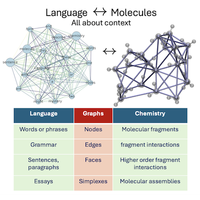
Computing high-dimensional potential energy surfaces for molecular systems and materials is considered to be a great challenge in computational chemistry with potential impact in a range of areas including the fundamental prediction of reaction rates. In this paper, we design and discuss an algorithm that has similarities to large language models in generative AI and natural language processing. Specifically, we represent a molecular system as a graph which contains a set of nodes, edges, faces, etc. Interactions between these sets, which represent molecular subsystems in our case, are used to construct the potential energy surface for a reasonably sized chemical system with 51 nuclear dimensions. For this purpose, a family of neural networks that pertain to the graph-theoretically obtained subsystems get the job done for this 51 nuclear dimensional system. We then ask if this same family of lower-dimensional graph-based neural networks can be transformed to provide accurate predictions for a 186-dimensional potential energy surface. We find that our algorithm does provide accurate results for this larger-dimensional problem with sub-kcal/mol accuracy for the higher-dimensional potential energy surface problem. Indeed, as a result of these developments, here we produce efforts toward a full-dimensional potential energy surface for the protonated 21-water cluster (186 nuclear dimensions) at coupled-cluster single and double level accuracy.
Physics Subject Headings (PhySH)
Popular Summary
Computing accurate, high-dimensional molecular potential energy surfaces is a foundational challenge in computational chemistry, essential for predicting reaction rates and designing new materials. We developed an algorithm that represents molecular systems as graphs, creating a family of decoupled neural networks to reduce the exponential complexity typical of post-Hartree-Fock calculations. Our approach shares deep architectural similarities with the attention mechanism in large language models, using geometric and topological weights rather than learnable parameters to project importance onto value. By implementing an incremental transfer learning protocol, we successfully adapted models from a 51-dimensional solvated Zundel system to provide sub-kcal/mol accuracy for a 186-dimensional protonated 21-water cluster. This framework establishes a scalable paradigm for computing accurate potential surfaces of large clusters, offering a new perspective on the interplay between molecular information and generative artificial intelligence.
Article Text
References (120)
- J. Murrell, S. Carter, S. Farantos, P. Huxley, and A. Varandas, Molecular Potential Energy Functions (Wiley, New York, 1984).
- B. J. Braams and J. M. Bowman, Permutationally invariant potential energy surfaces in high dimensionality, Int. Rev. Phys. Chem. 28, 577 (2009).
- Z. Xie and J. M. Bowman, Permutationally invariant polynomial basis for molecular energy surface fitting via monomial symmetrization, J. Chem. Theory Comput. 6, 26 (2010).
- Ö. F. Al𝚤ş and H. Rabitz, Efficient implementation of high dimensional model representations, J. Math. Chem. 29, 127 (2001).
- A. Jäckle and H.-D. Meyer, Product representation of potential energy surfaces, J. Chem. Phys. 104, 7974 (1996).
- D. Peláez and H.-D. Meyer, The multigrid POTFIT (MGPF) method: Grid representations of potentials for quantum dynamics of large systems, J. Chem. Phys. 138, 014108 (2013).
- A. Leclerc and T. Carrington, Calculating vibrational spectra with sum of product basis functions without storing full-dimensional vectors or matrices, J. Chem. Phys. 140, 174111 (2014).
- C. Qu, R. Conte, P. L. Houston, and J. M. Bowman, Full-dimensional potential energy surface for acetylacetone and tunneling splittings, Phys. Chem. Chem. Phys. 23, 7758 (2021).
- W. Grossmann, S. Eilermann, T. Rensmeyer, A. Liebert, M. Hohmann, C. Wittke, and O. Niggemann, Position paper on materials design—A modern approach, arXiv:2312.10996.
- R. Vasudevan, G. Pilania, and P. V. Balachandran, Machine learning for materials design and discovery, J. Appl. Phys. 129, 070401 (2021).
- S. Axelrod, D. Schwalbe-Koda, S. Mohapatra, J. Damewood, K. P. Greenman, and R. Gómez-Bombarelli, Learning matter: Materials design with machine learning and atomistic simulations, Acc. Mater. Res. 3, 343 (2022).
- K. Persson, Y. Hinuma, Y. S. Meng, A. Van der Ven, and G. Ceder, Thermodynamic and kinetic properties of the li-graphite system from first-principles calculations, Phys. Rev. B 82, 125416 (2010).
- D. Flam-Shepherd, A. Zhigalin, and A. Aspuru-Guzik, Scalable fragment-based 3D molecular design with reinforcement learning, arXiv:2202.00658.
- R. P. Feynman, Simulating physics with computers, Int. J. Theor. Phys. 21, 467 (1982).
- R. P. Feynman, J. Hey, and R. W. Allen, Feynman Lectures on Computation (Addison-Wesley Longman Publishing Co., Boston, MA, 1998).
- R. P. Feynman and A. R. Hibbs, Quantum Mechanics and Path Integrals (McGraw-Hill, New York, 1965).
- H.-D. Meyer, U. Manthe, and L. S. Cederbaum, The multi-configurational time-dependent Hartree approach, Chem. Phys. Lett. 165, 73 (1990).
- M. A. Nielsen and I. L. Chuang, Quantum Computation and Quantum Information (Cambridge University Press, Cambridge, England, 2000).
- H. Rabitz and Ö. F. Al𝚤ş, General foundations of high dimensional model representations, J. Math. Chem. 25, 197 (1999).
- S. Manzhos and T. Carrington Jr, Using neural networks, optimized coordinates, and high-dimensional model representations to obtain a vinyl bromide potential surface, J. Chem. Phys. 129, 224104 (2008).
- F. Otto, Multi-layer POTFIT: An accurate potential representation for efficient high-dimensional quantum dynamics, J. Chem. Phys. 140, 014106 (2014).
- I. Sumner and S. S. Iyengar, Quantum wavepacket ab initio molecular dynamics: An approach for computing dynamically averaged vibrational spectra including critical nuclear quantum effects, J. Phys. Chem. A 111, 10313 (2007).
- N. DeGregorio and S. S. Iyengar, Efficient and adaptive methods for computing accurate potential surfaces for quantum nuclear effects: Applications to hydrogen- transfer reactions, J. Chem. Theory Comput. 14, 30 (2018).
- H. B. Schlegel and M. J. Frisch, Computational bottlenecks in molecular orbital calculations, in Theoretical and Computational Models for Organic Chemistry (Springer, New York, 1991), pp. 5–33.
- C. Schran, F. Brieuc, and D. Marx, Transferability of machine learning potentials: Protonated water neural network potential applied to the protonated water hexamer, J. Chem. Phys. 154, 050001 (2021).
- T. T. Nguyen, E. Szekely, G. Imbalzano, J. Behler, G. Csanyi, M. Ceriotti, A. W. Goetz, and F. Paesani, Comparison of permutationally invariant polynomials, neural networks, and Gaussian approximation potentials in representing water interactions through many-body expansions, J. Chem. Phys. 148, 241726 (2018).
- C. Schran, J. Behler, and D. Marx, Automated fitting of neural network potentials at coupled cluster accuracy: Protonated water clusters as testing ground, J. Chem. Theory Comput. 16, 88 (2020).
- D. Lu, J. Behler, and J. Li, Accurate global potential energy surfaces for the reaction by neural network fitting with permutation invariance, J. Phys. Chem. A 124, 5737 (2020).
- D. Lu, J. Qi, M. Yang, J. Behler, H. Song, and J. Li, Mode specific dynamics in the reaction, Phys. Chem. Chem. Phys. 18, 29113 (2016).
- J. Li, K. Song, and J. Behler, A critical comparison of neural network potentials for molecular reaction dynamics with exact permutation symmetry, Phys. Chem. Chem. Phys. 21, 9672 (2019).
- J. S. Smith, B. T. Nebgen, R. Zubatyuk, N. Lubbers, C. Devereux, K. Barros, S. Tretiak, O. Isayev, and A. E. Roitberg, Approaching coupled cluster accuracy with a general-purpose neural network potential through transfer learning, Nat. Commun. 10, 2903 (2019).
- A. Li and H. Guo, A nine-dimensional ab initio global potential energy surface for the reaction, J. Chem. Phys. 140, 224313 (2014).
- F. Lu, L. Cheng, R. J. DiRisio, J. M. Finney, M. A. Boyer, P. Moonkaen, J. Sun, S. J. R. Lee, J. E. Deustua, T. F. Miller, III, and A. B. McCoy, Fast near ab initio potential energy surfaces using machine learning, J. Phys. Chem. A 126, 4013 (2022).
- A. Aldossary, J. A. Campos-Gonzalez-Angulo, S. Pablo-García, S. X. Leong, E. M. Rajaonson, L. Thiede, G. Tom, A. Wang, D. Avagliano, and A. Aspuru-Guzik, In silico chemical experiments in the age of AI: From quantum chemistry to machine learning and back, Adv. Mater. 36, 2402369 (2024).
- J. Behler and M. Parrinello, Generalized neural-network representation of high-dimensional potential-energy surfaces, Phys. Rev. Lett. 98, 146401 (2007).
- J. Behler, Four generations of high-dimensional neural network potentials, Chem. Rev. 121, 10037 (2021).
- A. Vaswani, N. Shazeer, N. Parmar, J. Uszkoreit, L. Jones, A. N. Gomez, L. u. Kaiser, and I. Polosukhin, Attention is all you need, in Proceedings of the 31st Conference on Neural Information Processing Systems (NIPS 2017), Long Beach, CA, edited by I. Guyon, U. V. Luxburg, S. Bengio, H. Wallach, R. Fergus, S. Vishwanathan, and R. Garnett (Curran Associates, Inc., 2017), Vol. 30.
- J. Li and S. S. Iyengar, Ab initio molecular dynamics using recursive, spatially separated, overlapping model subsystems mixed within an oniom based fragmentation energy extrapolation technique, J. Chem. Theory Comput. 11, 3978 (2015).
- J. Li, C. Haycraft, and S. S. Iyengar, Hybrid, extended lagrangian—Born-Oppenheimer ab initio molecular dynamics using fragment-based electronic structure, J. Chem. Theory Comput. 12, 2493 (2016).
- C. Haycraft, J. Li, and S. S. Iyengar, Efficient, “on-the-fly” Born–Oppenheimer and Car–Parrinello–type dynamics with coupled cluster accuracy through fragment based electronic structure, J. Chem. Theory Comput. 13, 1887 (2017).
- T. C. Ricard, C. Haycraft, and S. S. Iyengar, Adaptive, geometric networks for efficient coarse-grained ab initio molecular dynamics with Post-Hartree-Fock accuracy, J. Chem. Theory Comput. 14, 2852 (2018).
- T. C. Ricard and S. S. Iyengar, Efficiently capturing weak interactions in ab initio molecular dynamics through “on-the-fly” basis set extrapolation, J. Chem. Theory Comput. 14, 5535 (2018).
- A. Kumar and S. S. Iyengar, Fragment-based electronic structure for potential energy surfaces using a superposition of fragmentation topologies, J. Chem. Theory Comput. 15, 5769 (2019).
- T. C. Ricard and S. S. Iyengar, An efficient and accurate approach to estimate hybrid functional and large basis set contributions to condensed phase systems and molecule-surface interactions, J. Chem. Theory Comput. 16, 4790 (2020).
- T. C. Ricard, A. Kumar, and S. S. Iyengar, Embedded, graph-theoretically defined many-body approximations for wavefunction-in-DFT and DFT-in-DFT: Applications to gas- and condensed-phase ab initio molecular dynamics, and potential surfaces for quantum nuclear effects, Int. J. Quantum Chem. 120, e26244 (2020).
- T. C. Ricard, X. Zhu, and S. S. Iyengar, Capturing weak interactions in surface adsorbate systems at coupled cluster accuracy: A graph-theoretic molecular fragmentation approach improved through machine learning, J. Chem. Theory Comput. 19, 8541 (2023).
- A. Kumar, N. DeGregorio, and S. S. Iyengar, Graph-theory-based molecular fragmentation for efficient and accurate potential surface calculations in multiple dimensions, J. Chem. Theory Comput. 17, 6671 (2021).
- J. H. Zhang, T. C. Ricard, C. Haycraft, and S. S. Iyengar, Weighted-graph-theoretic methods for many-body corrections within oniom: Smooth aimd and the role of high-order many-body terms, J. Chem. Theory Comput. 17, 2672 (2021).
- X. Zhu and S. S. Iyengar, Graph theoretic molecular fragmentation for multidimensional potential energy surfaces yield an adaptive and general transfer machine learning protocol, J. Chem. Theory Comput. 18, 5125 (2022).
- J. H. Zhang and S. S. Iyengar, Graph-: A graph-based quantum-classical algorithm for efficient electronic structure on hybrid quantum/classical hardware systems: Improved quantum circuit depth performance, J. Chem. Theory Comput. 18, 2885 (2022).
- A. Kumar, N. DeGregorio, T. Ricard, and S. S. Iyengar, Graph-theoretic molecular fragmentation for potential surfaces leads naturally to a tensor network form and allows accurate and efficient quantum nuclear dynamics, J. Chem. Theory Comput. 18, 7243 (2022).
- S. S. Iyengar, D. Saha, A. Dwivedi, M. A. Lopez-Ruiz, A. Kumar, J. H. Zhang, T. C. Ricard, P. Richerme, and A. Sabry, Quantum algorithms for the study of electronic structure and molecular dynamics: Novel computational protocols, in Comprehensive Computational Chemistry (Elsevier, New York, 2023).
- S. S. Iyengar, J. H. Zhang, D. Saha, and T. C. Ricard, Graph-: A quantum algorithm with reduced quantum circuit depth for electronic structure, J. Phys. Chem. A 127, 9334 (2023).
- S. S. Iyengar, T. C. Ricard, and X. Zhu, A reformulation of all oniom-type molecular fragmentation approaches using graph theory-based projection operators: Applications to dynamics, molecular potential surfaces, and machine learning and quantum computing, J. Phys. Chem. A 128, 466 (2024).
- W. Zhang, K. Itoh, J. Tanida, and Y. Ichioka, Parallel distributed processing model with local space-invariant interconnections and its optical architecture, Appl. Opt. 29, 4790 (1990).
- D. K. Duvenaud, D. Maclaurin, J. Iparraguirre, R. Bombarell, T. Hirzel, A. Aspuru-Guzik, and R. P. Adams, Convolutional networks on graphs for learning molecular fingerprints, in Proceedings of the 29th International Conference on Neural Information Processing Systems, NIPS’15 (MIT Press, Cambridge, MA, 2015), pp. 2224–2232.
- P. Veličković, G. Cucurull, A. Casanova, A. Romero, P. Liò, and Y. Bengio, Graph attention networks, arXiv:1710.10903.
- J. A. Fournier, C. T. Wolke, M. A. Johnson, T. T. Odbadrakh, K. D. Jordan, S. M. Kathmann, and S. S. Xantheas, Snapshots of proton accommodation at a microscopic water surface: Understanding the vibrational spectral signatures of the charge defect in cryogenically cooled clusters, J. Phys. Chem. A 119, 37 (2015).
- J.-W. Shin, N. I. Hammer, E. G. Diken, M. A. Johnson, R. S. Walters, T. D. Jaeger, M. A. Duncan, R. A. Christie, and K. D. Jordan, Infrared signature of structures associated with the ( to 27) clusters, Science 304, 1137 (2004).
- S. S. Iyengar, M. K. Petersen, T. J. F. Day, C. J. Burnham, V. E. Teige, and G. A. Voth, The properties of ion-water clusters. I. The protonated 21-water cluster, J. Chem. Phys. 123, 084309 (2005).
- S. S. Iyengar, Further analysis of the dynamically averaged vibrational spectrum for the “magic” protonated 21-water cluster, J. Chem. Phys. 126, 216101 (2007).
- N. I. Hammer, E. G. Diken, J. R. Roscioli, M. A. Johnson, E. M. Myshakin, K. D. Jordan, A. B. McCoy, X. Huang, J. M. Bowman, and S. Carter, The vibrational predissociation spectra of the (, Ne) clusters: Correlation of the solvent perturbations in the free oh and shared proton transitions of the Zundel ion, J. Chem. Phys. 122, 244301 (2005).
- J. M. Headrick, E. G. Diken, R. S. Walters, N. I. Hammer, R. A. Christie, J. Cui, E. M. Myshakin, M. A. Duncan, M. A. Johnson, and K. Jordan, Spectral signatures of hydrated proton vibrations in water clusters, Science 308, 1765 (2005).
- S. M. Dietrick and S. S. Iyengar, Constructing periodic phase space orbits from ab initio molecular dynamics trajectories to analyze vibrational spectra: Case study of the Zundel () cation, J. Chem. Theory Comput. 8, 4876 (2012).
- K. R. Asmis, N. L. Pivonka, G. Santambrogio, M. Brümmer, C. Kaposta, D. M. Neumark, and L. Wöste, Gas-phase infrared spectrum of the protonated water dimer, Science 299, 1375 (2003).
- O. Vendrell, F. Gatti, and H.-D. Meyer, Dynamics and infrared spectroscopy of the protonated water dimer, Angew. Chem., Int. Ed. 46, 6918 (2007).
- E. G. Diken, J. M. Headrick, J. R. Roscioli, J. C. Bopp, M. A. Johnson, and A. B. McCoy, Fundamental excitations of the shared proton in the and complexes, J. Phys. Chem. A 109, 1487 (2005).
- W. H. Robertson, E. G. Diken, E. A. Price, J.-W. Shin, and M. A. Johnson, Spectroscopic determination of the oh- solvation shell in the clusters, Science 299, 1367 (2003).
- G. Lorentz, M. Golitschek, and Y. Makovoz, Constructive Approximation (Springer, New York, 1996).
- F. Girosi and T. Poggio, Representation properties of networks: Kolmogorov’s theorem is irrelevant, Neural Comput. 1, 465 (1989).
- I. M. Sobol, On the distribution of points in a cube and the approximate evaluation of integrals, USSR Comput. Math. Math. Phys. 7, 86 (1967).
- B. Roux, Computational studies of the gramicidin channel, Acc. Chem. Res. 35, 366 (2002).
- T. W. Allen, T. Baştuğ, S. Kuyucak, and S.-H. Chung, Gramicidin A channel as a test ground for molecular dynamics force fields, Biophys. J. 84, 2159 (2003).
- A. Pullman and C. Etchebest, The gramicidin A channel: The energy profile for single and double occupancy in a head-to-head . 33, 3-helical dimer backbone, FEBS Lett. 163, 199 (1983).
- A. Björklund, T. Husfeldt, and M. Koivisto, Set partitioning via inclusion exclusion, SIAM J. Comput. 39, 546 (2009).
- T. K. Dey and N. R. Shah, On the number of simplicial complexes in Rd, Comput. Geom. 8, 267 (1997).
- C. C. Adams and R. D. Franzosa, Introduction to Topology: Pure and Applied (Pearson Prentice Hall, Harlow, UK, 2008).
- M. Berger, P. Pansu, J.-P. Berry, and X. Saint-Raymond, Affine spaces, in Problems in Geometry (Springer, New York, 1984), p. 11.
- A. Bowyer, Computing Dirichlet tessellations, Comput. J. 24, 162 (1981).
- D. Watson, Computing the n-dimensional Delaunay tessellation with applications to Voronoi polytopes, Comput. J. 24, 167 (1981).
- F. Aurenhammer, Voronoi diagrams—A survey of a fundamental geometric data structure, ACM Comput. Surv. 23, 345 (1991).
- A. Okabe, B. Boots, K. Sugihara, and S. N. Chiu, Spatial Tessellations—Concepts and Applications of Voronoi Diagrams (John Wiley and Sons, New York, 2000).
- S. Hert and M. Seel, CGAL User and Reference Manual, 4th ed. (CGAL Editorial Board, 2018), Chap. dD Convex Hulls and Delaunay Triangulations.
- G. Farin, Surfaces over Dirichlet tessellations, Comput. Aided Geom. Des. 7, 281 (1990).
- F. Maseras and K. Morokuma, Imomm: A new integrated ab initio + molecular mechanics geometry optimization scheme of equilibrium structures and transition states, J. Comput. Chem. 16, 1170 (1995).
- A. Nandi, C. Qu, P. L. Houston, R. Conte, and J. M. Bowman, -machine learning for potential energy surfaces: A PIP approach to bring a DFT-based PES to CCSD(T) level of theory, J. Chem. Phys. 154, 051102 (2021).
- R. Ramakrishnan, P. O. Dral, M. Rupp, and O. A. von Lilienfeld, Big data meets quantum chemistry approximations: The -machine learning approach, J. Chem. Theory Comput. 11, 2087 (2015).
- J. Chen, W. Xu, and R. Zhang, -machine learning-driven discovery of double hybrid organic–inorganic perovskites, J. Mater. Chem. A 10, 1402 (2022).
- P. A. Unzueta, C. S. Greenwell, and G. J. O. Beran, Predicting density functional theory-quality nuclear magnetic resonance chemical shifts via -machine learning, J. Chem. Theory Comput. 17, 826 (2021).
- A. Nandi, P. Pandey, P. L. Houston, C. Qu, Q. Yu, R. Conte, A. Tkatchenko, and J. M. Bowman, -machine learning to elevate DFT-based potentials and a force field to the CCSD(T) level illustrated for ethanol, J. Chem. Theory Comput. 20, 8807 (2024).
- F. Riesz and B. Sz.-Nagy, Functional Analysis (Dover, New York, 1990).
- D. Bahdanau, K. Cho, and Y. Bengio, Neural machine translation by jointly learning to align and translate, arXiv:1409.0473.
- G. Zundel, Hydration and Intermolecular Interaction: Infrared Investigations with Polyelectrolyte Membranes (Academic Press, New York, 2012).
- M. E. Tuckerman, P. J. Ungar, T. Vonrosenvinge, and M. L. Klein, Ab initio molecular dynamics simulations, J. Phys. Chem. 100, 12878 (1996).
- M. Tuckerman, K. Laasonen, M. Sprik, and M. Parrinello, J. Phys. Chem. 99, 5749 (1995).
- U. W. Schmitt and G. A. Voth, The computer simulation of proton transport in water, J. Chem. Phys. 111, 9361 (1999).
- U. W. Schmitt and G. A. Voth, Multistate empirical valence bond model for proton transport in water, J. Phys. Chem. B 102, 5547 (1998).
- R. Pomes and B. Roux, Structure and dynamics of a proton wire: A theoretical study of translocation along the single-file water chain in the gramicidin a channel, Biophys. J. 71, 19 (1996).
- M. J. McEwan and L. F. Phillips, Chemistry of the Atmosphere (Eward Arnold, London, 1975).
- R. P. Wayne, Chemistry of the Atmosphere (Clarendon Press, Oxford, 1994).
- R. Pomes and B. Roux, Theoretical study of translocation along a model proton wire, J. Phys. Chem. 100, 2519 (1996).
- H. Decornez, K. Drukker, and S. Hammes-Schiffer, Solvation and hydrogen-bonding effects on proton wires, J. Phys. Chem. A 103, 2891 (1999).
- M. L. Brewer, U. W. Schmitt, and G. A. Voth, The formation and dynamics of proton wires in channel environments, Biophys. J. 80, 1691 (2001).
- M. Teeter, Water structure of a hydrophobic protein at atomic resolution: Pentagon rings of water molecules in crystals of crambin, Proc. Natl. Acad. Sci. U.S.A. 81, 6014 (1984).
- S. Neidle, H. M. Berman, and H. S. Shieh, Highly structured water network in crystals of a deoxydinucleoside-drug complex, Nature (London) 288, 129 (1980).
- L. A. Lipscomb, M. E. Peek, F. X. Zhou, J. A. Bertrand, D. VanDerveer, and L. D. Williams, Water ring structure at DNA interfaces: Hydration and dynamics of DNA-anthracycline complexes, Biochemistry 33, 3649 (1994).
- C. Tu, R. S. Rowlett, B. C. Tripp, J. G. Ferry, and D. N. Silverman, Chemical rescue of proton transfer in catalysis by carbonic anhydrases in the -and -class, Biochemistry 41, 15429 (2002).
- S. M. Dietrick and S. S. Iyengar, Constructing periodic phase space orbits from ab initio molecular dynamics trajectories to analyze vibrational spectra: Case study of the Zundel () cation, J. Chem. Theory Comput. 8, 4876 (2012).
- S. Sadhukhan, D. Munoz, C. Adamo, and G. E. Scuseria, Predicting proton transfer barriers with density functional methods, Chem. Phys. Lett. 306, 83 (1999).
- Y. Xie, R. B. Remington, and H. F. Schaefer, III, The protonated water dimer: Extensive theoretical studies of , J. Chem. Phys. 101, 4878 (1994).
- J. Klimes and A. Michaelides, Perspective: Advances and challenges in treating van der Waals dispersion forces in density functional theory, J. Chem. Phys. 137, 120901 (2012).
- R. Peverati and D. Truhlar, The quest for a universal density functional: The accuracy of density functionals across a broad spectrum of databases in chemistry and physics, Phil. Trans. R. Soc. A 372, 20120476 (2014).
- A. J. Cohen, P. Mori-Sánchez, and W. Yang, Challenges for density functional theory, Chem. Rev. 112, 289 (2012).
- J. A. Hartigan and M. A. Wong, Algorithm as 136: A k-means clustering algorithm, J. R. Stat. Soc. C 28, 100 (1979).
- Microsoft, Copilot (July 10 version) (2025), large language model.
- Google Gemini, Gemini AI Chatbot (2025) (accessed: 2025-07-10). Version [Gemini Advanced].
- H. B. Schlegel and M. J. Frisch, Computational bottlenecks in molecular orbital calculations, in Theoretical and Computational Models for Organic Chemistry, edited by S. J. Formosinho, I. G. Csizmadia, and L. G. Arnaut (Springer, Netherlands, Dordrecht, 1991), pp. 5–33.
- L.-H. Lim and B. J. Nelson, What is an equivariant neural network?, arXiv:2205.07362.
- R. Kondor, The principles behind equivariant neural networks for physics and chemistry, Proc. Natl. Acad. Sci. U.S.A. 122, e2415656122 (2025).
- G. Zundel, Hydration and Intermolecular Interaction (Academic Press, New York, 1969).

