

- Open Access
Quantum Coherent Transport of 1D Ballistic States in Second-Order Topological Insulator
Phys. Rev. X 16, 011031 – Published 20 February, 2026
DOI: https://doi.org/10.1103/2bqq-t7ml
Abstract
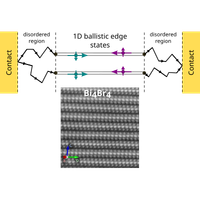
We investigate quantum transport in micrometer-sized single crystals of , a material predicted to be a second-order topological insulator. 1D topological states with long phase coherence times are revealed via the modulation of quantum interference with magnetic field and gate voltage. In particular, we demonstrate the existence of Aharonov-Bohm interference between 1D ballistic states several micrometers long, that we identify as phase-coherent hinge modes on neighboring step edges at the crystal surface. These Aharonov-Bohm oscillations are made possible by a disordered phase-coherent contact region, the existence of which is confirmed by scanning transmission electron microscopy combined with energy-dispersive x-ray spectroscopy (STEM-EDX) of FIB lamellae. Their coherent nature modulates the transmission of the 1D edge states, leading to weak antilocalization and universal conductance fluctuations with surprisingly large characteristic fields and a strongly anisotropic behavior. These complementary experimental results provide a comprehensive, coherent description of quantum transport in and establish the material as a second-order topological insulator with topologically protected 1D ballistic states.
Physics Subject Headings (PhySH)
Popular Summary
Ballistic conduction in one dimension is excessively rare in nature, yet it is a predicted feature of second-order topological insulators which host conducting channels along the physical hinges of 3D crystals. We investigated quantum transport in micrometer-size single crystals of . Ballistic topological states with long phase coherence times are revealed by quantum interference modulated by magnetic field and gate voltage. This is confirmed by the absence of Hall resistance and the presence of highly nonlocal conduction. These results provide a comprehensive description of transport in and establish that its hinges act as perfectly protected one-dimensional wires. Our work demonstrates the potential of this material for low-power electronic devices and provides a robust platform for further exploring the unique properties of high-order topological phases.
Article Text
Supplemental Material
References (86)
- M. Z. Hasan and C. L. Kane, Colloquium: Topological insulators, Rev. Mod. Phys. 82, 3045 (2010).
- X.-L. Qi and S.-C. Zhang, Topological insulators and superconductors, Rev. Mod. Phys. 83, 1057 (2011).
- Y. Ando, Topological insulator materials, J. Phys. Soc. Jpn. 82, 102001 (2013).
- C. L. Kane and E. J. Mele, topological order and the quantum spin Hall effect, Phys. Rev. Lett. 95, 146802 (2005).
- B. A. Bernevig and S.-C. Zhang, Quantum spin Hall effect, Phys. Rev. Lett. 96, 106802 (2006).
- F. Schindler, A. M. Cook, M. G. Vergniory, Z. Wang, S. S. P. Parkin, B. A. Bernevig, and T. Neupert, Higher-order topological insulators, Sci. Adv. 4, eaat0346 (2018).
- B. Xie, H.-X. Wang, X. Zhang, P. Zhan, J.-H. Jiang, M. Lu, and Y. Chen, Higher-order band topology, Nat. Rev. Phys. 3, 520 (2021).
- M. König, S. Wiedmann, C. Brüne, A. Roth, H. Buhmann, L. W. Molenkamp, X.-L. Qi, and S.-C. Zhang, Quantum spin Hall insulator state in quantum wells, Science 318, 766 (2007).
- Z. Fei, T. Palomaki, S. Wu, W. Zhao, X. Cai, B. Sun, P. Nguyen, J. Finney, X. Xu, and D. H. Cobden, Edge conduction in monolayer , Nat. Phys. 13, 677 (2017).
- S. Wu, V. Fatemi, Q. D. Gibson, K. Watanabe, T. Taniguchi, R. J. Cava, and P. Jarillo-Herrero, Observation of the quantum spin Hall effect up to 100 kelvin in a monolayer crystal, Science 359, 76 (2018).
- J. Tang et al., Dual quantum spin Hall insulator by density-tuned correlations in , Nature (London) 628, 515 (2024).
- A. Murani et al., Ballistic edge states in Bismuth nanowires revealed by SQUID interferometry, Nat. Commun. 8, 15941 (2017).
- F. Schindler et al., Higher-order topology in bismuth, Nat. Phys. 14, 918 (2018).
- B. Weber et al., 2024 roadmap on 2D topological insulators, J. Phys. Mater. 7, 022501 (2024).
- J.-J. Zhou, W. Feng, C.-C. Liu, S. Guan, and Y. Yao, Large-gap quantum spin Hall insulator in single layer bismuth monobromide , Nano Lett. 14, 4767 (2014).
- J.-J. Zhou, W. Feng, G.-B. Liu, and Y. Yao, Topological edge states in single- and multi-layer , New J. Phys. 17, 015004 (2015).
- C.-H. Hsu, X. Zhou, Q. Ma, N. Gedik, A. Bansil, V. M. Pereira, H. Lin, L. Fu, S.-Y. Xu, and T.-R. Chang, Purely rotational symmetry-protected topological crystalline insulator , 2D Mater. 6, 031004 (2019).
- F. Tang, H. C. Po, A. Vishwanath, and X. Wan, Efficient topological materials discovery using symmetry indicators, Nat. Phys. 15, 470 (2019).
- C. Yoon, C.-C. Liu, H. Min, and F. Zhang, Quasi-one-dimensional higher-order topological insulators, arXiv:2005.14710.
- K.-S. Lin, G. Palumbo, Z. Guo, Y. Hwang, J. Blackburn, D. P. Shoemaker, F. Mahmood, Z. Wang, G. A. Fiete, B. J. Wieder, and B. Bradlyn, Spin-resolved topology and partial axion angles in three-dimensional insulators, Nat. Commun. 15, 550 (2024).
- J. Han, W. Xiao, and Y. Yao, Quasi-one-dimensional topological material , Adv. Phys. X 7, 2057234 (2022).
- R. Noguchi et al., Evidence for a higher-order topological insulator in a three-dimensional material built from van der Waals stacking of bismuth-halide chains, Nat. Mater. 20, 473 (2021).
- M. Yang et al., Large-gap quantum spin Hall state and temperature-induced Lifshitz transition in , ACS Nano 16, 3036 (2022).
- J. Zhong et al., Coalescence of multiple topological orders in quasi-one-dimensional bismuth halide chains, Nat. Commun. 16, 1163 (2025).
- W. Zhao et al., Topological electronic structure and spin texture of quasi-one-dimensional higher-order topological insulator , Nat. Commun. 14, 8089 (2023).
- J. Han et al., Optical bulk-boundary dichotomy in a quantum spin Hall insulator, Sci. Bull. 68, 417 (2023).
- N. Shumiya et al., Evidence of a room-temperature quantum spin Hall edge state in a higher-order topological insulator, Nat. Mater. 21, 1111 (2022).
- J. K. Hofmann et al., Shear-resistant topology in quasi one-dimensional van Der Waals material , Phys. Rev. B 111, 245415 (2025).
- X. Peng et al., Observation of topological edge states on nanowires grown on substrates, J. Phys. Chem. Lett. 12, 10465 (2021).
- D.-Y. Chen, D. Ma, J. Duan, D. Chen, H. Liu, J. Han, and Y. Yao, Quantum transport evidence of boundary states and Lifshitz transition in , Phys. Rev. B 106, 075206 (2022).
- H. von Benda, A. Simon, and W. Bauhofer, Zur Kenntnis von BiBr und , 167, Z. Anorg. Allg. Chem. 438, 53 (1978).
- T. G. Filatova, P. V. Gurin, L. Kloo, V. A. Kulbachinskii, A. N. Kuznetsov, V. G. Kytin, M. Lindsjo, and B. A. Popovkin, Electronic structure, galvanomagnetic and magnetic properties of the bismuth subhalides and , J. Solid State Chem. 180, 1103 (2007).
- X. Li et al., Pressure-induced phase transitions and superconductivity in a quasi–1-dimensional topological crystalline insulator , Proc. Natl. Acad. Sci. U.S.A. 116, 17696 (2019).
- Z. Gong, X. Lai, W. Miao, J. Zhong, Z. Shi, H. Shen, X. Liu, Q. Li, M. Yang, J. Zhuang, and Yi Du, Br-Vacancies induced variable ranging hopping conduction in high-order topological insulator , Small Methods 8, 2400517 (2024).
- J. Zhong, M. Yang, F. Ye, C. Liu, J. Wang, J. Wang, W. Hao, J. Zhuang, and Y. Du, Facet-dependent electronic quantum diffusion in the high-order topological insulator , Phys. Rev. Appl. 17, 064017 (2022).
- J. Zhong et al., Observation of anomalous Planar Hall effect induced by one-dimensional weak antilocalization, ACS Nano 18, 4343 (2024).
- L. Qiao, X. Xiong, H. Yang, D. Chen, Y. Li, J. Li, X. Peng, Z.I Xu, J. Han, W. Xiao, and Y. Yao, Ultralong single-crystal nanobelts with a high current carrying capacity by mechanical exfoliation, J. Phys. Chem. C 125, 22312 (2021).
- S.-L. Wu, Z.-H. Ren, Y.-Q. Zhang, Y.-K. Li, J.-F. Han, J.-X. Duan, Z.-W. Wang, C.-Z. Li, and Y.-G. Yao, Gate-tunable transport in van der Waals topological insulator nanobelts, J. Phys. Condens. Matter 35, 234001 (2023).
- M. S. Hossain et al., Quantum transport response of topological hinge modes, Nat. Phys. 20, 776 (2024).
- R. Noguchi et al., A weak topological insulator state in quasi-one-dimensional bismuth iodide, Nature (London) 566, 518 (2019).
- See Supplemental Material at http://link.aps.org/supplemental/10.1103/2bqq-t7ml for a discussion of the crystalline quality of flakes, resistance networks of two other samples at different temperatures, the length dependence of resistance for samples and , extended data and analysis on the temperature dependence of the Aharonov-Bohm effect, details of the numerical simulations presented in the main text, the fitting of the magnetoconductance using the formula for 1D weak antilocalization, a presentation of zero-bias anomaly data and comparison with theoretical predictions, and, finally, extended data on the absence of Hall effect and Shubnikov–de Haas oscillations. Supplemental Material includes Refs. [42–62].
- G.-L. Ingold and Y. V. Nazarov, Charge tunneling rates in ultrasmall junctions, in Single Charge Tunneling, edited by H. Grabert and M. H. Devoret, NATO ASI Series B Vol. 294 (Plenum Press, New York, 1992), pp. 21–107.
- M. H. Devoret, D. Esteve, H. Grabert, G.-L. Ingold, H. Pothier, and C. Urbina, Effect of the electromagnetic environment on the Coulomb blockade in ultrasmall tunnel junctions, Phys. Rev. Lett. 64, 1824 (1990).
- F. D. Parmentier, A. Anthore, S. Jezouin, H. le Sueur, U. Gennser, A. Cavanna, D. Mailly, and F. Pierre, Strong back-action of a linear circuit on a single electronic quantum channel, Nat. Phys. 7, 935 (2011).
- M. Bockrath, D. H. Cobden, J. Liu, A. G. Rinzler, R. E. S. L. Balents, and P. L. McEuen, Luttinger-liquid behaviour in carbon nanotubes, Nature (London) 397, 598 (1999).
- B. Gao, A. Komnik, R. Egger, D. C. Glattli, and A. Bachtold, Evidence for Luttinger-liquid behavior in crossed metallic single-wall nanotubes, Phys. Rev. Lett. 92, 216804 (2004).
- C. L. Kane and M. P. A. Fisher, Transport in a one-channel Luttinger liquid, Phys. Rev. Lett. 68, 1220 (1992).
- C.-H. Hsu, P. Stano, J. Klinovaja, and D. Loss, Helical liquids in semiconductors, Semicond. Sci. Technol. 36, 123003 (2021).
- T. Li, P. Wang, H. Fu, L. Du, K. A. Schreiber, X. Mu, X. Liu, G. Sullivan, G. A. Csáthy, X. Lin, and R.-R. Du, Observation of a helical Luttinger liquid in quantum spin Hall edges, Phys. Rev. Lett. 115, 136804 (2015).
- R. Stühler, F. Reis, T. Müller, T. Helbig, T. Schwemmer, R. Thomale, J. Schäfer, and R. Claessen, Tomonaga–Luttinger liquid in the edge channels of a quantum spin Hall insulator, Nat. Phys. 16, 47 (2020).
- A. Q. Wang et al., A robust and tunable Luttinger liquid in correlated edge of transition-metal second-order topological insulator , Nat. Commun. 14, 7647 (2023).
- D. S. Golubev and A. D. Zaikin, Coulomb interaction and quantum transport through a coherent scatterer, Phys. Rev. Lett. 86, 4887 (2001).
- A. L. Yeyati, A. Martin-Rodero, D. Esteve, and C. Urbina, Direct link between Coulomb blockade and shot noise in a quantum-coherent structure, Phys. Rev. Lett. 87, 046802 (2001).
- M. Kindermann and Yu. V. Nazarov, Interaction effects on counting statistics and the transmission distribution, Phys. Rev. Lett. 91, 136802 (2003).
- I. Safi and H. Saleur, One-channel conductor in an ohmic environment: Mapping to a Tomonaga-Luttinger liquid and full counting statistics, Phys. Rev. Lett. 93, 126602 (2004).
- D. S. Golubev, A. V. Galaktionov, and A. D. Zaikin, Electron transport and current fluctuations in short coherent conductors, Phys. Rev. B 72, 205417 (2005).
- B. L. Al’tshuler and D. E. Khmel’nitskii, Fluctuation properties of small conductors, Pis’ma Zh. Eksp. Tear. Fiz. 42, 291 (1985) [JETP Lett. 42, 359 (1985)].
- D. E. Khmel’nitskii and A. I. Larkin, Nonlinear conductance in the mesoscopic regime, Phys. Scr. T14, 4 (1986).
- R. A. Webb, S. Washburn, and C. P. Umbach, Experimental study of nonlinear conductance in small metallic samples, Phys. Rev. B 37, 8455 (1988).
- H. Tang and Y. Fu, Intrinsic nonlinear conductance of mesoscopic conductors, Phys. Rev. Lett. 67, 485 (1991).
- W. G. van der Wiel, Yu. V. Nazarov, S. De Franceschi, T. Fujisawa, J. M. Elzerman, E. W. G. M. Huizeling, S. Tarucha, and L. P. Kouwenhoven, Electromagnetic Aharonov-Bohm effect in a two-dimensional electron gas ring, Phys. Rev. B 67, 033307 (2003).
- Y. Yamauchi, M. Hashisaka, S. Nakamura, K. Chida, S. Kasai, T. Ono, R. Leturcq, K. Ensslin, D. C. Driscoll, A. C. Gossard, and K. Kobayashi, Universality of bias- and temperature-induced dephasing in ballistic electronic interferometers, Phys. Rev. B 79, 161306 (2009).
- R. B. Bapat, Resistance matrix of a weighted graph, MATCH Commun. Math. Comput. Chem. 50, 73 (2004), https://match.pmf.kg.ac.rs/electronic_versions/Match50/match50_73-82.pdf.
- Devriendt Karel, Graph geometry from effective resistances, PhD thesis, Trinity College, 2022.
- S. Datta, Electronic Transport in Mesoscopic Systems (Cambridge University Press, Cambridge, England, 2009).
This method of finding the conductance matrix can be applied only if describing the sample as a network of resistors is adequate, meaning that the transport between nodes is reciprocal.
- E. Akkermans and G. Montambaux, Mesoscopic Physics of Electrons and Photons (Cambridge University Press, Cambridge, England, 2007).
- S. Hikami, A. I. Larkin, and Y. Nagaoka, Spin-orbit interaction and magnetoresistance in the two dimensional random system, Prog. Theor. Phys. 63, 707 (1980).
- H. Steinberg, J.-B. Laloë, V. Fatemi, J. S. Moodera, and P. Jarillo-Herrero, Electrically tunable surface-to-bulk coherent coupling in topological insulator thin films, Phys. Rev. B 84, 233101 (2011).
- J. Chen, X. Y. He, K. H. Wu, Z. Q. Ji, L. Lu, J. R. Shi, J. H. Smet, and Y. Q. Li, Tunable surface conductivity in revealed in diffusive electron transport, Phys. Rev. B 83, 241304 (2011).
- P. A. Lee, A. D. Stone, and H. Fukuyama, Universal conductance fluctuations in metals: Effects of finite temperature, interactions, and magnetic field, Phys. Rev. B 35, 1039 (1987).
- P. Mohanty and R. A. Webb, High-field measurements of electron decoherence time in metallic nanowires: Switching off magnetic impurity spins, Phys. Rev. Lett. 91, 066604 (2003).
- C. W. J. Beenakker and H. Van Houten, Flux-cancellation effect on narrow-channel magnetoresistance fluctuations, Phys. Rev. B 37, 6544 (1988).
- M. Büttiker, Absence of backscattering in the quantum Hall effect in multiprobe conductors, Phys. Rev. B 38, 9375 (1988).
- M. Büttiker, Symmetry of electrical conduction, IBM J. Res. Dev. 32, 317 (1988).
- B. Gao, Y. F. Chen, M. S. Fuhrer, D. C. Glattli, and A. Bachtold, Four-point resistance of individual single-wall carbon nanotubes, Phys. Rev. Lett. 95, 196802 (2005).
- G. Timp, A. M. Chang, P. Mankiewich, R. Behringer, J. E. Cunningham, T. Y. Chang, and R. E. Howard, Quantum transport in an electron-wave guide, Phys. Rev. Lett. 59, 732 (1987).
- R. de Picciotto, H. L. Stormer, N. Pfeiffer, K. W. Baldwin, and K. W. West, Four-terminal resistance of a ballistic quantum wire, Nature (London) 411, 51 (2001).
- S. Washburn and R. A. Webb, Aharonov-Bohm effect in normal metal quantum coherence and transport, Adv. Phys. 35, 375 (1986).
- A. E. Hansen, A. Kristensen, S. Pedersen, C. B. Sørensen, and P. E. Lindelof, Mesoscopic decoherence in Aharonov-Bohm rings, Phys. Rev. B 64, 045327 (2001).
- J. Dufouleur et al., Quasiballistic transport of Dirac fermions in a nanowire, Phys. Rev. Lett. 110, 186806 (2013).
- L. A. Jauregui, M. T. Pettes, L. P. Rokhinson, L. Shi, and Y. P. Chen, Magnetic field-induced helical mode and topological transitions in a topological insulator nanoribbon, Nat. Nanotechnol. 11, 345 (2016).
- G. Behner et al., Aharonov-Bohm interference and phase-coherent surface-state transport in topological insulator rings, Nano Lett. 23, 6347 (2023).
- Z.-C. Pan, C.-G. Chu, J.-J. Chen, A.-Q. Wang, Z.-B. Tan, W.-Z. Xu, J. Xu, X.-M. Ma, D.-P. Yu, and Z.-M. Liao, Altshuler-Aronov-Spivak interference of one-dimensional helical edge states in , Phys. Rev. B 107, 045411 (2023).
- C. W. Groth, M. Wimmer, A. R. Akhmerov, and X. Waintal, kwant: A software package for quantum transport. New J. Phys. 16, 063065 (2014).
- J. Lefeuvre et al., Quantum coherent transport of 1D ballistic states in second order topological insulator , Zenodo (2025), 10.5281/zenodo.17953562.

