Browse by Subject

Linear-response time-dependent density functional theory approach to warm dense matter with adiabatic exchange-correlation kernels

Zhandos A. Moldabekov, Michele Pavanello, Maximilian P. Böhme, Jan Vorberger, and Tobias Dornheim

Phys. Rev. Research 5, 023089 (2023) - Published 11 May, 2023

Subspace variational quantum simulator

Kentaro Heya, Ken M. Nakanishi, Kosuke Mitarai, Zhiguang Yan, Kun Zuo, Yasunari Suzuki, Takanori Sugiyama, Shuhei Tamate, Yutaka Tabuchi, Keisuke Fujii, and Yasunobu Nakamura

Phys. Rev. Research 5, 023078 (2023) - Published 1 May, 2023

Experimental critical dynamics of 3-methyl pyridine/D2O mixtures without and with antagonistic salt

Henrich Frielinghaus, Purushottam S. Dubey, Baohu Wu, Mary Odom, Feifei Zheng, Eunjoo Shin, Piotr Zolnierczuk, Olaf Holderer, Stephan Förster, and Theresia Heiden-Hecht

Phys. Rev. Research 5, 023053 (2023) - Published 25 April, 2023

Understanding the wetting of transition metal dichalcogenides from an ab initio perspective

Siheng Li, Keyang Liu, Jiří Klimeš, and Ji Chen

Phys. Rev. Research 5, 023018 (2023) - Published 12 April, 2023

Using parity-nonconserving spin-spin coupling to measure the Tl nuclear anapole moment in a TlF molecular beam

John W. Blanchard, Dmitry Budker, David DeMille, Mikhail G. Kozlov, and Leonid V. Skripnikov

Phys. Rev. Research 5, 013191 (2023) - Published 20 March, 2023

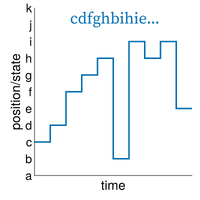
Compression algorithms reveal memory effects and static disorder in single-molecule trajectories

Kevin Song, Dmitrii E. Makarov, and Etienne Vouga

Phys. Rev. Research 5, L012026 (2023) - Published 27 February, 2023

Information-theory-based analysis of single-molecule time series, inspired by Shannon’s studies of the information content of printed English, can differentiate between Markov (memoryless) and non-Markov single-molecule signals and between static and dynamic disorder.

Dissipative stabilization of dark quantum dimers via squeezed vacuum

R. Gutiérrez-Jáuregui, A. Asenjo-Garcia, and G. S. Agarwal

Phys. Rev. Research 5, 013127 (2023) - Published 17 February, 2023

Experimental observation of mesoscopic fluctuations to identify origin of thermodynamic anomalies of ambient liquid water

Yukio Kajihara, Masanori Inui, Kazuhiro Matsuda, Daisuke Ishikawa, Satoshi Tsutsui, and Alfred Q. R. Baron

Phys. Rev. Research 5, 013120 (2023) - Published 16 February, 2023

Vibronic interactions in trilobite and butterfly Rydberg molecules

Frederic Hummel, Peter Schmelcher, and Matthew T. Eiles

Phys. Rev. Research 5, 013114 (2023) - Published 14 February, 2023

Housekeeping and excess entropy production for general nonlinear dynamics

Kohei Yoshimura, Artemy Kolchinsky, Andreas Dechant, and Sosuke Ito

Phys. Rev. Research 5, 013017 (2023) - Published 17 January, 2023

Geometric potential of the exact electron factorization: Meaning, significance, and application

Jakub Kocák, Eli Kraisler, and Axel Schild

Phys. Rev. Research 5, 013016 (2023) - Published 17 January, 2023

Enhanced potency of aggregation inhibitors mediated by liquid condensates

Thomas C. T. Michaels, L. Mahadevan, and Christoph A. Weber

Phys. Rev. Research 4, 043173 (2022) - Published 8 December, 2022

Mapping renormalized coupled cluster methods to quantum computers through a compact unitary representation of nonunitary operators

Bo Peng and Karol Kowalski

Phys. Rev. Research 4, 043172 (2022) - Published 8 December, 2022

Riemannian geometry of optimal driving and thermodynamic length and its application to chemical reaction networks

Dimitri Loutchko, Yuki Sughiyama, and Tetsuya J. Kobayashi

Phys. Rev. Research 4, 043049 (2022) - Published 20 October, 2022

High-pressure II-III phase transition in solid hydrogen: Insights from state-of-the-art ab initio calculations

Maria Hellgren, Damian Contant, Thomas Pitts, and Michele Casula

Phys. Rev. Research 4, L042009 (2022) - Published 17 October, 2022

The II-III phase transition in solid hydrogen using advanced computational methods comprising RPA and QMC many-body approaches is studied. A competitive phase II structure, driven by an out-of-plane rotation of the H2 molecules, is discovered and shown to accurately account for the experimental signatures of the transition.

Photodissociation spectroscopy via a rovibrational resonance in intense UV pulses

Yan Rong Liu, Victor Kimberg, Yong Wu, Jian Guo Wang, Oriol Vendrell, and Song Bin Zhang

Phys. Rev. Research 4, 043001 (2022) - Published 3 October, 2022

Covariant nonequilibrium thermodynamics from Ito-Langevin dynamics

Mingnan Ding and Xiangjun Xing

Phys. Rev. Research 4, 033247 (2022) - Published 29 September, 2022

Influence of an atomic resonance on the coherent control of the photoionization process

E. V. Gryzlova et al.

Phys. Rev. Research 4, 033231 (2022) - Published 23 September, 2022

Hessian geometry of nonequilibrium chemical reaction networks and entropy production decompositions

Tetsuya J. Kobayashi, Dimitri Loutchko, Atsushi Kamimura, and Yuki Sughiyama

Phys. Rev. Research 4, 033208 (2022) - Published 15 September, 2022

Chemical thermodynamics for growing systems

Yuki Sughiyama, Atsushi Kamimura, Dimitri Loutchko, and Tetsuya J. Kobayashi

Phys. Rev. Research 4, 033191 (2022) - Published 9 September, 2022

Sign In to Your Journals Account

Filter

Filter

Article Lookup

Enter a citation