Recent Articles

Time-adaptive phase estimation

Brennan de Neeve, Andrey V. Lebedev, Vlad Negnevitsky, and Jonathan P. Home

Phys. Rev. Research 7, 023070 (2025) - Published 21 April, 2025

Accelerated first detection in discrete-time quantum walks using sharp restarts

Kunal Shukla, Riddhi Chatterjee, and C. M. Chandrashekar

Phys. Rev. Research 7, 023069 (2025) - Published 21 April, 2025

Asymmetric simple exclusion process with concerted hopping

Takahiro Ezaki, Kai Kihara, Katsuhiro Nishinari, and Yasunobu Ando

Phys. Rev. Research 7, 023068 (2025) - Published 21 April, 2025

Interference and switching effect of topological interfacial modes with geometric phase

Xing-Xiang Wang, Sho Okada, Towa Maekawa, Liyan Hu, Tomohiro Amemiya, and Xiao Hu

Phys. Rev. Research 7, 023067 (2025) - Published 18 April, 2025

Role of sample thickness and self-absorption effects in simultaneous XEOL-XAS measurements on single crystalline ZnO and GaN

Sergiu Levcenko, Konrad Ritter, Hans H. Falk, Timo Pfeiffelmann, Lukas Trefflich, Edmund Welter, Marius Grundmann, and Claudia S. Schnohr

Phys. Rev. Research 7, 023066 (2025) - Published 18 April, 2025

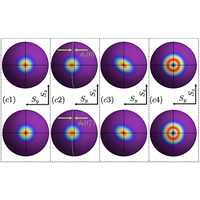
Generating Einstein-Podolsky-Rosen correlations for teleporting collective spin states in a two-dimensional trapped ion crystal

Muhammad Miskeen Khan, Edwin Chaparro, Bhuvanesh Sundar, Allison Carter, John Bollinger, Klaus Molmer, and Ana Maria Rey

Phys. Rev. Research 7, L022019 (2025) - Published 17 April, 2025

A proposed protocol allows for the teleportation of collective spin-coherent states, as well as entangled spin-squeezed and Dicke states, between nuclear spin degrees of freedom in a two-dimensional trapped-ion crystal. Beyond teleportation, generalizations of the protocol could be used for retroactive squeezing generation and enhanced displacement sensing in a Penning trap, as well as in other systems featuring collective spin-spin interactions within synthetic dimensions or spatially separated arrays.

Frequency-resolved cross-correlation between XUV high harmonics and IR fundamental laser pulses by transient multiphoton absorption spectroscopy in gases

Juliette Dubois, Adrien Leblanc, Julien Gautier, Fabien Tissandier, Léonardo Rico, Boris Vodungbo, Jérémie Caillat, Camille Lévêque, Richard Taïeb, and Guillaume Lambert

Phys. Rev. Research 7, 023065 (2025) - Published 17 April, 2025

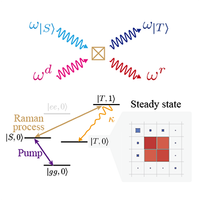
Hardware-efficient stabilization of entanglement via engineered dissipation in superconducting circuits

Changling Chen, Kai Tang, Yuxuan Zhou, KangYuan Yi, Xuan Zhang, Xu Zhang, Haosheng Guo, Song Liu, Yuanzhen Chen, Tongxing Yan, and Dapeng Yu

Phys. Rev. Research 7, L022018 (2025) - Published 16 April, 2025

A hardware-efficient protocol is demonstrated for stabilizing entangled quantum states in cQED using a four-wave mixing process, where “hardware efficient” refers to the absence of any need for specialized quantum hardware. Steady entangled states with the highest reported fidelity for both two-qubit and three-qubit systems are experimentally achieved in cQED through an autonomous process.

How to use the dispersion in the χ(3) tensor for broadband generation of polarization-entangled photons

Valeria Vento, Francesco Ciccarello, Sakthi Priya Amirtharaj, and Christophe Galland

Phys. Rev. Research 7, L022017 (2025) - Published 16 April, 2025

Motivated by measurements in diamond, this work presents general principles for using phonon resonances to tailor the polarization quantum states produced via spontaneous four-wave mixing. The approach exploits the interplay of electronic and vibrational contributions to the nonlinear response to generate broadband polarization-entangled photon pairs.

Resonant propagation of extreme-ultraviolet pulses through strongly driven high-density media

Yu He, Shuyuan Hu, Gergana D. Borisova, Yizhu Zhang, Marc Rebholz, Zuoye Liu, Mette B. Gaarde, Christian Ott, and Thomas Pfeifer

Phys. Rev. Research 7, 023064 (2025) - Published 16 April, 2025

Qubit fidelity distribution under stochastic Schrödinger equations driven by classical noise

R. J. P. T. de Keijzer, L. Y. Visser, O. Tse, and S. J. J. M. F. Kokkelmans

Phys. Rev. Research 7, 023063 (2025) - Published 16 April, 2025

Uniform response theory of non-Hermitian systems: Non-Hermitian physics beyond the exceptional point

Subhajyoti Bid and Henning Schomerus

Phys. Rev. Research 7, 023062 (2025) - Published 16 April, 2025

Spatiospectral properties of redshifted free electron laser radiation

Marie Labat, Rui Prazeres, Eléonore Roussel, Yen-Yu Chang, Amin Ghaith, Maxwell LaBerge, Susanne Schöbel, Ulrich Schramm, Patrick Ufer, Marie-Emmanuelle Couprie, and Arie Irman

Phys. Rev. Research 7, 023061 (2025) - Published 16 April, 2025

Existence of unbiased estimators in discrete quantum systems

Javier Navarro, Ricard Ravell Rodríguez, and Mikel Sanz

Phys. Rev. Research 7, 023060 (2025) - Published 16 April, 2025

Nonequilibrium dynamics and thermodynamics provide the underlying physical mechanism of the perceptual rivalry

Yuxuan Wu, Liufang Xu, and Jin Wang

Phys. Rev. Research 7, 023059 (2025) - Published 16 April, 2025

Stabilizing steady-state properties of open quantum systems with parameter engineering

Koray Aydoğan, Anthony W. Schlimgen, and Kade Head-Marsden

Phys. Rev. Research 7, 023057 (2025) - Published 15 April, 2025

Sturdy spin-momentum locking in a chiral organic superconductor

Takuro Sato, Hiroshi Goto, and Hiroshi M. Yamamoto

Phys. Rev. Research 7, 023056 (2025) - Published 15 April, 2025

Breaking of Lorentz invariance caused by the interplay between spin-orbit interaction and transverse phonon modes in quantum wires

D. V. Efremov, Weyner Ccuiro, Luis E. F. Foa Torres, and M. N. Kiselev

Phys. Rev. Research 7, L022016 (2025) - Published 14 April, 2025

A nanomechanical device using a suspended quantum wire with strong spin-orbit interaction is proposed for detecting quantum phase transitions. The work explores the interplay between electron orbital degrees of freedom and bending elastic modes, providing a framework for detecting quantum critical points.

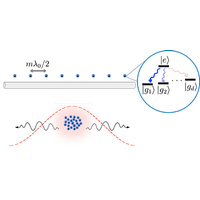
Ground-state selection via many-body superradiant decay

Wai-Keong Mok, Stuart J. Masson, Dan M. Stamper-Kurn, Tanya Zelevinsky, and Ana Asenjo-Garcia

Phys. Rev. Research 7, L022015 (2025) - Published 14 April, 2025

An analytical framework for the collective decay of many-body quantum systems with competing decay channels is presented. The study proves the emergence of a “winner takes all” dynamic, where interactions suppress all but the dominant decay transition, drastically amplifying the occupation of the dominant ground state beyond the constraints imposed by the system’s natural branching ratios.

Harris dispersion relation and Bernstein modes in dense magnetized quantum plasmas

Tian-Xing Hu, Dong Wu, and Jie Zhang

Phys. Rev. Research 7, 023055 (2025) - Published 14 April, 2025

Sign In to Your Journals Account

Filter

Recent Issues

Vol. 8, Iss. 4
October - December 2026
Vol. 8, Iss. 3
July - September 2026
Vol. 8, Iss. 2
April - June 2026
Vol. 8, Iss. 1
January - March 2026
Category
Article Type

Filter

Article Lookup

Enter a citation