Recent Articles

Finding the time: Exploring a new perspective on students’ perceptions of cosmological time and efforts to improve temporal frameworks in astronomy

Laci Shea Brock, Edward Prather, and Chris Impey

Phys. Rev. Phys. Educ. Res. 14, 010138 (2018) - Published 15 June, 2018

Past research on students’ understanding of cosmological time informs a proposed research and instructional agenda.

Editorial: Focused Collection: Astronomy Education Research

Janelle M. Bailey and Julia D. Plummer

Phys. Rev. Phys. Educ. Res. 14, 010004 (2018) - Published 15 June, 2018

Multidimensional item response theory and the Force Concept Inventory

John Stewart, Cabot Zabriskie, Seth DeVore, and Gay Stewart

Phys. Rev. Phys. Educ. Res. 14, 010137 (2018) - Published 13 June, 2018

Multidimensional Item Response Theory is a powerful tool for improving understanding of student knowledge by providing a fine-grained analysis of constructs measured by conceptual inventories.

Hidden factors that influence success in the optics workforce

Anne E. Leak, Zackary Santos, Erik Reiter, Benjamin M. Zwickl, and Kelly Norris Martin

Phys. Rev. Phys. Educ. Res. 14, 010136 (2018) - Published 12 June, 2018

Successful employees in the optics industry have characteristics that are not frequently emphasized in undergraduate physics programs.

Epistemic belief structures within introductory astronomy

Keith Johnson and Shannon D. Willoughby

Phys. Rev. Phys. Educ. Res. 14, 010135 (2018) - Published 7 June, 2018

Using factor analysis to explore the structure of the epistemological beliefs about the physical science survey in the context of introductory astronomy.

Activation of a critical attitude in prospective teachers: From research investigations to guidelines for teacher education

Laurence Viennot and Nicolas Décamp

Phys. Rev. Phys. Educ. Res. 14, 010133 (2018) - Published 7 June, 2018

Developing critical thinking in prospective physics teachers.

Editorial: Call for Papers Focused Collection of Physical Review Physics Education Research Curriculum Development: Theory into Design

Charles Henderson

Phys. Rev. Phys. Educ. Res. 14, 010003 (2018) - Published 5 June, 2018

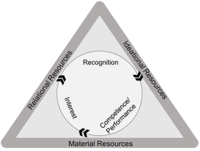
Critical look at physics identity: An operationalized framework for examining race and physics identity

Simone Hyater-Adams, Claudia Fracchiolla, Noah Finkelstein, and Kathleen Hinko

Phys. Rev. Phys. Educ. Res. 14, 010132 (2018) - Published 1 June, 2018

A tool is presented to critically examine physics identity with special attention to the impacts of structural and systemic racism.

Educational commitment and social networking: The power of informal networks

Justyna P. Zwolak, Michael Zwolak, and Eric Brewe

Phys. Rev. Phys. Educ. Res. 14, 010131 (2018) - Published 29 May, 2018

Average students are more likely to persist in a physics course if they are well immersed into the out-of-class social system of the university and are successfully reaching out to others.

General relativity in upper secondary school: Design and evaluation of an online learning environment using the model of educational reconstruction

Magdalena Kersting, Ellen Karoline Henriksen, Maria Vetleseter Bøe, and Carl Angell

Phys. Rev. Phys. Educ. Res. 14, 010130 (2018) - Published 25 May, 2018

Upper secondary students can obtain a qualitative understanding of general relativity when provided with appropriately designed learning resources and sufficient scaffolding.

Exploring the entanglement of personal epistemologies and emotions in students’ thinking

Ayush Gupta, Andrew Elby, and Brian A. Danielak

Phys. Rev. Phys. Educ. Res. 14, 010129 (2018) - Published 25 May, 2018

Anticipating, attending, and responding to students’ unsettled and/or negative emotions is an important and undervalued design consideration for research-based instructional strategies.

Mastery-style homework exercises in introductory physics courses: Implementation matters

Brianne Gutmann, Gary Gladding, Morten Lundsgaard, and Timothy Stelzer

Phys. Rev. Phys. Educ. Res. 14, 010128 (2018) - Published 18 May, 2018

When implementing mastery-style homework, it is crucial to consider the class context and the affective characteristics of the students.

Design of an assessment to probe teachers’ content knowledge for teaching: An example from energy in high school physics

Eugenia Etkina, Drew Gitomer, Charles Iaconangelo, Geoffrey Phelps, Lane Seeley, and Stamatis Vokos

Phys. Rev. Phys. Educ. Res. 14, 010127 (2018) - Published 11 May, 2018

Content knowledge for teaching can be measured on a written assessment based on two main components: tasks of teaching and student content targets.

Analysis of Praxis physics subject assessment examinees and performance: Who are our prospective physics teachers?

Lisa Shah, Jie Hao, Christian A. Rodriguez, Rebekah Fallin, Kimberly Linenberger-Cortes, Herman E. Ray, and Gregory T. Rushton

Phys. Rev. Phys. Educ. Res. 14, 010126 (2018) - Published 10 May, 2018

States have different minimum cutoff scores on the Praxis Physics Subject Assessment for prospective physics teachers to demonstrate their physics proficiency.

Consideration of learning orientations as an application of achievement goals in evaluating life science majors in introductory physics

Andrew J. Mason and Charles A. Bertram

Phys. Rev. Phys. Educ. Res. 14, 010125 (2018) - Published 3 May, 2018

A proposed method for measuring students’ learning orientations through a short self-report instrument.

Confirmatory factor analysis applied to the Force Concept Inventory

Philip Eaton and Shannon D. Willoughby

Phys. Rev. Phys. Educ. Res. 14, 010124 (2018) - Published 19 April, 2018

Contrary to much concern about the underlying structure of the Force Concept Inventory, confirmatory factor analysis on a large data set supports the original factor structure proposed by the developers.

Analysis of the most common concept inventories in physics: What are we assessing?

James T. Laverty and Marcos D. Caballero

Phys. Rev. Phys. Educ. Res. 14, 010123 (2018) - Published 12 April, 2018

Existing physics concept inventories are not suitable for gathering evidence of the important student learning goals of scientific practices and crosscutting concepts.

Students’ flexible use of ontologies and the value of tentative reasoning: Examples of conceptual understanding in three canonical topics of quantum mechanics

Jessica R. Hoehn and Noah D. Finkelstein

Phys. Rev. Phys. Educ. Res. 14, 010122 (2018) - Published 11 April, 2018

During interviews about quantum mechanics, students flexibly switch back and forth between parallel stable ontologies, as well as constructing and negotiating new ontologies in-the-moment.

Examining students’ views about validity of experiments: From introductory to Ph.D. students

Dehui Hu and Benjamin M. Zwickl

Phys. Rev. Phys. Educ. Res. 14, 010121 (2018) - Published 11 April, 2018

Introductory physics students and PhD students justify the validity of experimental results differently, suggesting that lab courses should emphasize a variety of approaches for establishing validity.

Reasoning with alternative explanations in physics: The cognitive accessibility rule

Andrew F. Heckler and Abigail M. Bogdan

Phys. Rev. Phys. Educ. Res. 14, 010120 (2018) - Published 9 April, 2018

Introductory physics students consider alternative explanations less frequently when an explanation with high cognitive accessibility is offered.

Sign In to Your Journals Account

Filter

Recent Issues

Vol. 22, Iss. 2
July - December 2026
Vol. 22, Iss. 1
January - June 2026
Vol. 21, Iss. 2
July - December 2025
Vol. 21, Iss. 1
January - June 2025
Category
Article Type

Filter

Article Lookup

Enter a citation