Highlights

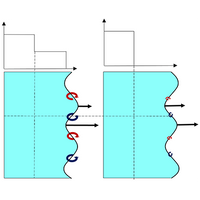
Suppression of Richtmyer-Meshkov Instability via Special Pairs of Shocks and Phase Transitions

W. J. Schill, M. R. Armstrong, J. H. Nguyen, D. M. Sterbentz, D. A. White, L. X. Benedict, R. N. Rieben, A. Hoff, H. E. Lorenzana, J. L. Belof, B. M. La Lone, and M. D. Staska

Phys. Rev. Lett. 132, 024001 (2024) - Published 9 January, 2024

Neutralization of a shock-generated Richtmyer-Meshkov instability at the interface between heavy and light materials using timed double-shock wave fronts is demonstrated experimentally and verified numerically.

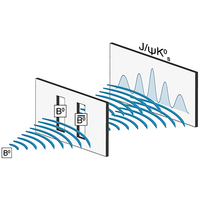
Measurement of CP Violation in B0→ψ(→ℓ+ℓ−)KS0(→π+π−) Decays

R. Aaij et al. (LHCb Collaboration)

Phys. Rev. Lett. 132, 021801 (2024) - Published 8 January, 2024

The quark-mixing CP-violation angle β is measured with the greatest precision to date.

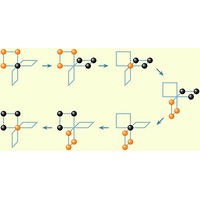
Fracton Self-Statistics

Hao Song, Nathanan Tantivasadakarn, Wilbur Shirley, and Michael Hermele

Phys. Rev. Lett. 132, 016604 (2024) - Published 5 January, 2024

By way of an algebraic basis for their computation, fracton self-statistics is shown to be a key factor in the characterization of fracton order.

d-Mon: A Transmon with Strong Anharmonicity Based on Planar c-Axis Tunneling Junction between d-Wave and s-Wave Superconductors

Hrishikesh Patel, Vedangi Pathak, Oguzhan Can, Andrew C. Potter, and Marcel Franz

Phys. Rev. Lett. 132, 017002 (2024) - Published 5 January, 2024

A proposed new design of superconducting qubits uses Josephson junctions made with a high-Tc d-wave superconductor overlaying a conventional s-wave superconductor to increase their coherence time and stability in the presence of noise.

Superconducting Qubit Based on Twisted Cuprate Van der Waals Heterostructures

Valentina Brosco, Giuseppe Serpico, Valerii Vinokur, Nicola Poccia, and Uri Vool

Phys. Rev. Lett. 132, 017003 (2024) - Published 5 January, 2024

A proposed new design of superconducting qubits uses Josephson junctions made with a high-Tc d-wave superconductor overlaying a conventional s-wave superconductor to increase their coherence time and stability in the presence of noise.

Nonlinear and Negative Effective Diffusivity of Interlayer Excitons in Moiré-Free Heterobilayers

Edith Wietek, Matthias Florian, Jonas Göser, Takashi Taniguchi, Kenji Watanabe, Alexander Högele, Mikhail M. Glazov, Alexander Steinhoff, and Alexey Chernikov

Phys. Rev. Lett. 132, 016202 (2024) - Published 4 January, 2024

Interlayer excitons in van der Waals heterostructures diffuse rapidly, with diffusion coefficients about 1000 times larger than previously seen, in the absence of moiré- and disorder-induced localization.

Observation of Terahertz Spin Hall Conductivity Spectrum in GaAs with Optical Spin Injection

Tomohiro Fujimoto, Takayuki Kurihara, Yuta Murotani, Tomohiro Tamaya, Natsuki Kanda, Changsu Kim, Jun Yoshinobu, Hidefumi Akiyama, Takeo Kato, and Ryusuke Matsunaga

Phys. Rev. Lett. 132, 016301 (2024) - Published 4 January, 2024

Spin Hall conductivity is observed in GaAs at room temperature via a circularly polarized terahertz pump-probe setup.

Fully Ab Initio Approach to Inelastic Atom-Surface Scattering

Michelle M. Kelley, Ravishankar Sundararaman, and Tomás A. Arias

Phys. Rev. Lett. 132, 016203 (2024) - Published 3 January, 2024

The interactions of helium atoms with crystalline surfaces are so gentle and subtle that it has been challenging to describe them from first principles.

Light-Induced Ideal Weyl Semimetal in HgTe via Nonlinear Phononics

Dongbin Shin, Angel Rubio, and Peizhe Tang

Phys. Rev. Lett. 132, 016603 (2024) - Published 3 January, 2024

Calculations show that light-matter interactions via nonlinear phononics can lead to long-lived non-equilibrium lattice distortion in bulk HgTe, demonstrating a possible microscopic mechanism to control the material topology with light.

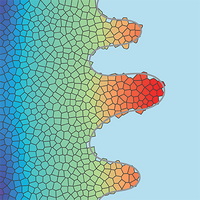
Fingering Instability Accelerates Population Growth of a Proliferating Cell Collective

Yiyang Ye (叶毅扬) and Jie Lin (林杰)

Phys. Rev. Lett. 132, 018402 (2024) - Published 3 January, 2024

A continuum model predicts a fingering instability at the leading front of a growing cell collective due to the feedback between pressure and growth rate, which could provide an evolutionary advantage.

Generalized Scaling and Model for Friction in Wall Turbulence

Shivsai Ajit Dixit, Abhishek Gupta, Harish Choudhary, and Thara Prabhakaran

Phys. Rev. Lett. 132, 014001 (2024) - Published 2 January, 2024

A new theoretical framework allows scientists to accurately estimate the friction a surface experiences in a turbulent flow, such as an airplane wing flying through the sky.

Schramm-Loewner Evolution in 2D Rigidity Percolation

Nina Javerzat

Phys. Rev. Lett. 132, 018201 (2024) - Published 2 January, 2024

New theoretical work explores the onset of rigidity in granular materials and other disordered systems by mapping out the edges of rigid regions.

Conformal Invariance and Multifractality at Anderson Transitions in Arbitrary Dimensions

Jaychandran Padayasi and Ilya Gruzberg

Phys. Rev. Lett. 131, 266401 (2023) - Published 26 December, 2023

Conformal invariance and Abelian fusion constrain the spectrum of multifractal exponents to be quadratic in its arguments in any dimension greater than two.

Combined Measurement of the Higgs Boson Mass from the H→γγ and H→ZZ*→4ℓ Decay Channels with the ATLAS Detector Using s=7, 8, and 13 TeV pp Collision Data

G. Aad et al. (ATLAS Collaboration)

Phys. Rev. Lett. 131, 251802 (2023) - Published 21 December, 2023

The mass of the Higgs boson is measured with a precision of less than a tenth of a percent.

Continuous Phase Transitions between Fractional Quantum Hall States and Symmetry-Protected Topological States

Ying-Hai Wu, Hong-Hao Tu, and Meng Cheng

Phys. Rev. Lett. 131, 256502 (2023) - Published 21 December, 2023

In Bose-Fermi mixtures under particular conditions, a symmetry-protected topological state goes through a continuous transition to two decoupled fractional quantum Hall states.

Rationalizing Euclidean Assemblies of Hard Polyhedra from Tessellations in Curved Space

Philipp W. A. Schönhöfer, Kai Sun, Xiaoming Mao, and Sharon C. Glotzer

Phys. Rev. Lett. 131, 258201 (2023) - Published 21 December, 2023

Though geometrically forbidden from doing so in flat space, some hard Platonic solids can entropically self-assemble into space-filling crystals with sufficient spatial curvature.

Extreme Domain Wall Speeds under Ultrafast Optical Excitation

Rahul Jangid, Nanna Zhou Hagström, Meera Madhavi, Kyle Rockwell, Justin M. Shaw, Jeffrey A. Brock, Matteo Pancaldi, Dario De Angelis, Flavio Capotondi, Emanuele Pedersoli, Hans T. Nembach, Mark W. Keller, Stefano Bonetti, Eric E. Fullerton, Ezio Iacocca, Roopali Kukreja, and Thomas J. Silva

Phys. Rev. Lett. 131, 256702 (2023) - Published 19 December, 2023

Experiments reveal that the boundaries between magnetic domains in a multilayered magnetic metal can move faster than sound, confirming a previous prediction.

Sampling Efficiency of Transverse Forces in Dense Liquids

Federico Ghimenti, Ludovic Berthier, Grzegorz Szamel, and Frédéric van Wijland

Phys. Rev. Lett. 131, 257101 (2023) - Published 18 December, 2023

Transverse forces that break detailed balance accelerate the dynamics of an overdamped many-body system while preserving the Boltzmann distribution.

Evaporation of Concentrated Polymer Solutions Is Insensitive to Relative Humidity

Max Huisman, Paul Digard, Wilson C. K. Poon, and Simon Titmuss

Phys. Rev. Lett. 131, 248102 (2023) - Published 15 December, 2023

Experiments verify a theory that explains why paint doesn’t dry any faster on a dry day than on a wet day.

Artificial Atoms, Wigner Molecules, and an Emergent Kagome Lattice in Semiconductor Moiré Superlattices

Aidan P. Reddy, Trithep Devakul, and Liang Fu

Phys. Rev. Lett. 131, 246501 (2023) - Published 14 December, 2023

The superlattice constant, the quantum confinement length, and the Wigner molecule size are three key length scales that control the properties of moiré materials at filling factors greater than one.

Sign In to Your Journals Account

Filter

Section

Filter

Article Lookup

Enter a citation