Highlights

Current-Induced Creation of Topological Vortex Rings in a Magnetic Nanocylinder

Yizhou Liu and Naoto Nagaosa

Phys. Rev. Lett. 132, 126701 (2024) - Published 19 March, 2024

Scientists have devised a promising method for generating and manipulating exotic spin patterns called magnetic vortex rings, which could have applications in energy-efficient data storage and processing.

Topological Flat Bands in Graphene Super-Moiré Lattices

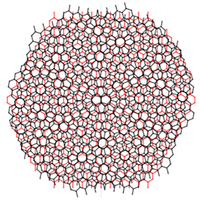
Mohammed M. Al Ezzi, Junxiong Hu, Ariando Ariando, Francisco Guinea, and Shaffique Adam

Phys. Rev. Lett. 132, 126401 (2024) - Published 18 March, 2024

A super-moiré lattice in monolayer graphene generates flat bands, providing a viable platform to engineer its correlated states.

New Structures in the J/ψJ/ψ Mass Spectrum in Proton-Proton Collisions at s=13  TeV

A. Hayrapetyan et al. (CMS Collaboration)

Phys. Rev. Lett. 132, 111901 (2024) - Published 15 March, 2024

Three structures, X(6900) and two new ones around 6.64 and 7.13 GeV, are seen in the J/ψJ/ψ mass spectrum that are consistent with being part of a family of radial excitations.

Direct Observation of Sub-Poissonian Temporal Statistics in a Continuous Free-Electron Beam with Subpicosecond Resolution

S. Borrelli, T. C. H. de Raadt, S. B. van der Geer, P. H. A. Mutsaers, K. A. H. van Leeuwen, and O. J. Luiten

Phys. Rev. Lett. 132, 115001 (2024) - Published 15 March, 2024

A new method to measure the arrival times of electrons could aid in the design of future electron microscopes.

Shortcuts of Freely Relaxing Systems Using Equilibrium Physical Observables

Isidoro González-Adalid Pemartín, Emanuel Mompó, Antonio Lasanta, Víctor Martín-Mayor, and Jesús Salas

Phys. Rev. Lett. 132, 117102 (2024) - Published 15 March, 2024

Equilibrium observables can control nonequilibrium dynamics such as anomalous heating and cooling effects.

Tensor Network Message Passing

Yijia Wang, Yuwen Ebony Zhang, Feng Pan, and Pan Zhang

Phys. Rev. Lett. 132, 117401 (2024) - Published 15 March, 2024

The tensor network message passing method reduces the error in the calculation of local observables by several orders of magnitude compared with state-of-the-art techniques.

Multispecies Ion Acceleration in 3D Magnetic Reconnection with Hybrid-Kinetic Simulations

Qile Zhang, Fan Guo, William Daughton, Hui Li, Ari Le, Tai Phan, and Mihir Desai

Phys. Rev. Lett. 132, 115201 (2024) - Published 14 March, 2024

Computationally challenging 3D hybrid simulations of magnetic reconnection for multiple ion species give insights into the acceleration process for heavy ions and energy spectra compatible with in-situ spacecraft observations.

Spin-Orbit Excitons in a Correlated Metal: Raman Scattering Study of Sr2RhO4

Lichen Wang, Huimei Liu, Valentin Zimmermann, Arvind Kumar Yogi, Masahiko Isobe, Matteo Minola, Matthias Hepting, Giniyat Khaliullin, and Bernhard Keimer

Phys. Rev. Lett. 132, 116502 (2024) - Published 14 March, 2024

A combined Raman scattering and theoretical study of spin-orbit excitations in Sr2RhO4 reveals unusual but well-defined excitations around 230 meV that are excitonic transitions between the spin-orbit multiplets of the Rh ions, excitations analogous to those recently observed in the Mott insulators Sr2IrO4 and RuCl3.

Hydrodynamic Mechanism for Clumping along the Equatorial Rings of SN1987A and Other Stars

Michael J. Wadas, William J. White, Heath J. LeFevre, Carolyn C. Kuranz, Aaron Towne, and Eric Johnsen

Phys. Rev. Lett. 132, 111201 (2024) - Published 13 March, 2024

The clumpy structure of a ring of gas ejected by the progenitor star of the supernova 1987A could have formed when vortices in the gas interacted.

Precision-Spectroscopic Determination of the Binding Energy of a Two-Body Quantum System: The Hydrogen Atom and the Proton-Size Puzzle

Simon Scheidegger and Frédéric Merkt

Phys. Rev. Lett. 132, 113001 (2024) - Published 11 March, 2024

Researchers have measured the transition energy of several highly excited states, which could help resolve a discrepancy about the size of the proton.

Orbital Magneto-Nonlinear Anomalous Hall Effect in Kagome Magnet Fe3Sn2

Lujunyu Wang, Jiaojiao Zhu, Haiyun Chen, Hui Wang, Jinjin Liu, Yue-Xin Huang, Bingyan Jiang, Jiaji Zhao, Hengjie Shi, Guang Tian, Haoyu Wang, Yugui Yao, Dapeng Yu, Zhiwei Wang, Cong Xiao, Shengyuan A. Yang, and Xiaosong Wu

Phys. Rev. Lett. 132, 106601 (2024) - Published 6 March, 2024

Researchers have observed a new class of nonlinear Hall effect that can be understood through a geometric description of the electronic wave function.

Ultrahigh Critical Current Density across Sliding Electrical Contacts in Structural Superlubric State

Tielin Wu, Weipeng Chen, Lingyi Wangye, Yiran Wang, Zhanghui Wu, Ming Ma, and Quanshui Zheng

Phys. Rev. Lett. 132, 096201 (2024) - Published 1 March, 2024

An experimental study of sliding electrical graphite contacts demonstrates simultaneous superlubricity and extremely high electrical conductivity.

Exploration-Exploitation Paradigm for Networked Biological Systems

Vito Dichio and Fabrizio De Vico Fallani

Phys. Rev. Lett. 132, 098402 (2024) - Published 1 March, 2024

In the context of the brain wiring problem, development of the nematode, C. elegans, follows an exploration-exploitation paradigm.

Polar Self-Organization of Ferroelectric Nematic-Liquid-Crystal Molecules on Atomically Flat Au(111) Surface

Alexandr A. Marchenko, Oleksiy L. Kapitanchuk, Yaroslava Yu. Lopatina, Kostiantyn G. Nazarenko, Anton I. Senenko, Nathalie Katsonis, Vassili G. Nazarenko, and Oleg D. Lavrentovich

Phys. Rev. Lett. 132, 098101 (2024) - Published 29 February, 2024

Using a scanning tunneling microscope polar molecular ordering in a monolayer of ferroelectric nematic liquid crystal has been directly observed for the first time.

Conformal Invariance in Water-Wave Turbulence

M. Noseda and P. J. Cobelli

Phys. Rev. Lett. 132, 094001 (2024) - Published 28 February, 2024

Experiments on gravity-capillary waves and analysis techniques drawn from stochastic partial differential equation theory establish a connection between zero-height isolines and the critical 2D Ising model’s domain walls, revealing a novel link between water-wave turbulence and critical systems.

Deep-Learning Density Functional Perturbation Theory

He Li, Zechen Tang, Jingheng Fu, Wen-Han Dong, Nianlong Zou, Xiaoxun Gong, Wenhui Duan, and Yong Xu

Phys. Rev. Lett. 132, 096401 (2024) - Published 28 February, 2024

A framework leveraging deep learning and automatic differentiation circumvents the computational bottleneck associated with density functional perturbation theory calculations.

Mass, Spectroscopy, and Two-Neutron Decay of Be16

B. Monteagudo et al.

Phys. Rev. Lett. 132, 082501 (2024) - Published 23 February, 2024

Identification of both the ground and first excited states of 16Be allows for a precise determination of its mass.

Avalanches and Extreme Value Statistics of a Mesoscale Moving Contact Line

Caishan Yan, Dongshi Guan, Yin Wang, Pik-Yin Lai, Hsuan-Yi Chen, and Penger Tong

Phys. Rev. Lett. 132, 084003 (2024) - Published 23 February, 2024

The pinning-depinning dynamics of a circular moving contact line are studied at the single-slip resolution using a mesoscale experimental framework.

Exact Solution of the Bose-Hubbard Model with Unidirectional Hopping

Mingchen Zheng, Yi Qiao, Yupeng Wang, Junpeng Cao, and Shu Chen

Phys. Rev. Lett. 132, 086502 (2024) - Published 23 February, 2024

Using a quantum inverse scattering framework, it is shown that the non-Hermitian one-dimensional Bose-Hubbard model is integrable.

Non-Gaussian Displacements in Active Transport on a Carpet of Motile Cells

Robert Großmann, Lara S. Bort, Ted Moldenhawer, Maike Stange, Setareh Sharifi Panah, Ralf Metzler, and Carsten Beta

Phys. Rev. Lett. 132, 088301 (2024) - Published 23 February, 2024
A carpet of active cells functions as an active bath for passive tracer particles, inducing non-Gaussian displacement and a crossover from superdiffusive to normal diffusive behavior.

Sign In to Your Journals Account

Filter

Section

Filter

Article Lookup

Enter a citation