Highlights

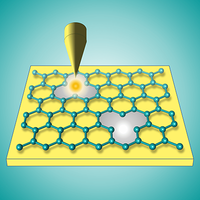
Direct Evidence of Klein and Anti-Klein Tunneling of Graphitic Electrons in a Corbino Geometry

Mirza M. Elahi, Hamed Vakili, Yihang Zeng, Cory R. Dean, and Avik W. Ghosh

Phys. Rev. Lett. 132, 146302 (2024) - Published 2 April, 2024

Graphene is the setting for the first demonstration of relativistic electrons’ paradoxical ability to whiz through a barrier, provided the barrier is high enough.

Microscopic Origin of the Entropy of Astrophysical Black Holes

Vijay Balasubramanian, Albion Lawrence, Javier M. Magán, and Martin Sasieta

Phys. Rev. Lett. 132, 141501 (2024) - Published 1 April, 2024

A theoretical proposal presents a framework for microscopic explanation of the entropy of astrophysical black holes.

Effects of Linking Topology on the Shear Response of Connected Ring Polymers: Catenanes and Bonded Rings Flow Differently

Reyhaneh A. Farimani, Zahra Ahmadian Dehaghani, Christos N. Likos, and Mohammad Reza Ejtehadi

Phys. Rev. Lett. 132, 148101 (2024) - Published 1 April, 2024

The dynamics of ring polymers under shear is strongly dependent on whether they are chemically bonded or mechanically linked

Quantum Light Generation Based on GaN Microring toward Fully On-Chip Source

Hong Zeng, Zhao-Qin He, Yun-Ru Fan, Yue Luo, Chen Lyu, Jin-Peng Wu, Yun-Bo Li, Sheng Liu, Dong Wang, De-Chao Zhang, Juan-Juan Zeng, Guang-Wei Deng, You Wang, Hai-Zhi Song, Zhen Wang, Li-Xing You, Kai Guo, Chang-Zheng Sun, Yi Luo, Guang-Can Guo, and Qiang Zhou

Phys. Rev. Lett. 132, 133603 (2024) - Published 29 March, 2024

A new device consisting of a semiconductor ring produces pairs of entangled photons that could be used in a photonic quantum processor.

Vacancy Spectroscopy of Non-Abelian Kitaev Spin Liquids

Wen-Han Kao, Natalia B. Perkins, and Gábor B. Halász

Phys. Rev. Lett. 132, 136503 (2024) - Published 29 March, 2024

A proposed approach to detect Majorana fermions in Kitaev spin liquids by using scanning tunneling microscopy could lead to the unambiguous confirmation of both the spin-liquid state and its Majorana zero modes.

Heralded Three-Photon Entanglement from a Single-Photon Source on a Photonic Chip

Si Chen, Li-Chao Peng, Y.-P. Guo, X.-M. Gu, X. Ding, R.-Z. Liu, J.-Y. Zhao, X. You, J. Qin, Y.-F. Wang, Yu-Ming He, Jelmer J. Renema, Yong-Heng Huo, Hui Wang, Chao-Yang Lu, and Jian-Wei Pan

Phys. Rev. Lett. 132, 130603 (2024) - Published 28 March, 2024

A heralded three-photon GHZ entangled state is generated based on the interference of six single photons from a quantum dot source.

Photonic Source of Heralded Greenberger-Horne-Zeilinger States

H. Cao, L. M. Hansen, F. Giorgino, L. Carosini, P. Zahálka, F. Zilk, J. C. Loredo, and P. Walther

Phys. Rev. Lett. 132, 130604 (2024) - Published 28 March, 2024

First Results from a Broadband Search for Dark Photon Dark Matter in the 44 to 52  μeV Range with a Coaxial Dish Antenna

Stefan Knirck et al. (BREAD Collaboration)

Phys. Rev. Lett. 132, 131004 (2024) - Published 28 March, 2024

A proof-of-principle search for dark-photon dark-matter particles surpasses existing constraints for a mass ~50 μeV by about two orders of magnitude.

Gravitational Raman Scattering in Effective Field Theory: A Scalar Tidal Matching at O(G3)

Mikhail M. Ivanov, Yue-Zhou Li, Julio Parra-Martinez, and Zihan Zhou

Phys. Rev. Lett. 132, 131401 (2024) - Published 28 March, 2024

A theoretical framework is presented for the computation of the gravitational analog of the Raman effect.

Scaling and Localization in Multipole-Conserving Diffusion

Jung Hoon Han, Ethan Lake, and Sunghan Ro

Phys. Rev. Lett. 132, 137102 (2024) - Published 28 March, 2024

Systems that conserve both total particle number and total dipole moment display unique dynamical exponents and nonuniform particle distributions in their steady state.

Ultrahigh Quality Factor of a Levitated Nanomechanical Oscillator

Lorenzo Dania, Dmitry S. Bykov, Florian Goschin, Markus Teller, Abderrahmane Kassid, and Tracy E. Northup

Phys. Rev. Lett. 132, 133602 (2024) - Published 27 March, 2024

A nanoresonator trapped in ultrahigh vacuum features an exceptionally high quality factor, showing promise for applications in force sensors and macroscopic tests of quantum mechanics.

Transport and Nonreciprocity in Monitored Quantum Devices: An Exact Study

João Ferreira, Tony Jin, Jochen Mannhart, Thierry Giamarchi, and Michele Filippone

Phys. Rev. Lett. 132, 136301 (2024) - Published 27 March, 2024

Exact formulas to describe particle and heat transport in generic noninteracting fermionic systems undergoing continuous monitoring and driven by biased reservoirs show the possibility to achieve measurement-induced power or cooling.

Full Classification of Transport on an Equilibrated 5/2 Edge via Shot Noise

Sourav Manna, Ankur Das, Moshe Goldstein, and Yuval Gefen

Phys. Rev. Lett. 132, 136502 (2024) - Published 27 March, 2024

A new protocol shows promise for classifying non-Abelian fractional quantum Hall states–being explored for quantum computation–using experimental shot-noise techniques.

Measurements of All-Particle Energy Spectrum and Mean Logarithmic Mass of Cosmic Rays from 0.3 to 30 PeV with LHAASO-KM2A

Zhen Cao et al. (LHAASO Collaboration)

Phys. Rev. Lett. 132, 131002 (2024) - Published 26 March, 2024

Using observations made with an array of thousands of particle detectors, researchers have uncovered an important clue about cosmic rays that originate from outside of our Galaxy.

Dark Matter Induced Power in Quantum Devices

Anirban Das, Noah Kurinsky, and Rebecca K. Leane

Phys. Rev. Lett. 132, 121801 (2024) - Published 22 March, 2024

Sub-GeV dark matter particles can be probed via power measurements in quantum devices.

Measurement of the Earth Tides with a Diamagnetic-Levitated Micro-Oscillator at Room Temperature

Yingchun Leng, Yiming Chen, Rui Li, Lihua Wang, Hao Wang, Lei Wang, Han Xie, Chang-Kui Duan, Pu Huang, and Jiangfeng Du

Phys. Rev. Lett. 132, 123601 (2024) - Published 22 March, 2024

A new gravimeter is compact and stable and can detect the daily solar and lunar gravitational oscillations that are responsible for the tides.

Measurement of the Ce140(n,γ) Cross Section at n_TOF and Its Astrophysical Implications for the Chemical Evolution of the Universe

S. Amaducci et al. (n_TOF Collaboration)

Phys. Rev. Lett. 132, 122701 (2024) - Published 21 March, 2024

A widening gap between the cerium-140 abundance predicted by theories and that measured in observations of certain stars indicates a potential need for updated models of element formation.

Efficient Full-Frequency GW Calculations Using a Lanczos Method

Weiwei Gao, Zhao Tang, Jijun Zhao, and James R. Chelikowsky

Phys. Rev. Lett. 132, 126402 (2024) - Published 21 March, 2024

The spectroscopic data of hundreds of atoms can now be computed on a single workstation using the new Lanczos method in full-frequency GW calculations.

Phase Transition to Chaos in Complex Ecosystems with Nonreciprocal Species-Resource Interactions

Emmy Blumenthal, Jason W. Rocks, and Pankaj Mehta

Phys. Rev. Lett. 132, 127401 (2024) - Published 21 March, 2024

Nonreciprocal interactions in large ecosystems can give rise to a transition to chaos controlled by the ratio of surviving species to surviving resources.

Observation of WWγ Production and Search for Hγ Production in Proton-Proton Collisions at s=13  TeV

A. Hayrapetyan et al. (CMS Collaboration)

Phys. Rev. Lett. 132, 121901 (2024) - Published 19 March, 2024

The production of two W bosons and a photon—a standard-model process—is observed for the first time.

Sign In to Your Journals Account

Filter

Section

Filter

Article Lookup

Enter a citation