Highlights

Crystal Nucleation in Supercooled Atomic Liquids

Johannes Möller et al.

Phys. Rev. Lett. 132, 206102 (2024) - Published 17 May, 2024

A new liquid-jet technology enabled researchers to test the theory for liquid freezing more stringently than was possible in previous experiments, but uncertainties remain.

Measuring the Boundary Gapless State and Criticality via Disorder Operator

Zenan Liu, Rui-Zhen Huang, Yan-Cheng Wang, Zheng Yan, and Dao-Xin Yao

Phys. Rev. Lett. 132, 206502 (2024) - Published 17 May, 2024

A disorder operator defined on the boundary of a two-dimensional Affleck-Kennedy-Lieb-Tasaki model reveals the connection between the gapless boundary mode and bulk criticality in the surface critical behavior.

Quantum Slush State in Rydberg Atom Arrays

Tengzhou Zhang and Zi Cai

Phys. Rev. Lett. 132, 206503 (2024) - Published 17 May, 2024

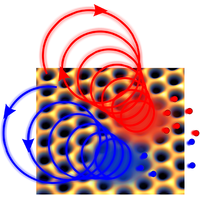
Quantum Monte Carlo simulations of Rydberg atom arrays with kinetic constraints reveal a quantum slush state: a heterogeneous liquid and glass mixture with quasi-long-range order.

Engineering the Impact of Phonon Dephasing on the Coherence of a WSe2 Single-Photon Source via Cavity Quantum Electrodynamics

Victor N. Mitryakhin, Alexander Steinhoff, Jens-Christian Drawer, Hangyong Shan, Matthias Florian, Lukas Lackner, Bo Han, Falk Eilenberger, Seth Ariel Tongay, Kenji Watanabe, Takashi Taniguchi, Carlos Antón-Solanas, Ana Predojević, Christopher Gies, Martin Esmann, and Christian Schneider

Phys. Rev. Lett. 132, 206903 (2024) - Published 16 May, 2024

The coherence of single-photon emissions is controlled by coupling to optical cavities.

Kinetic Theory of Motility Induced Phase Separation for Active Brownian Particles

Rodrigo Soto, Martín Pinto, and Ricardo Brito

Phys. Rev. Lett. 132, 208301 (2024) - Published 16 May, 2024

Active Brownian particles can be described by a Boltzmann–Enskog-like kinetic theory in which a motility-induced phase separation could arise from a reduced effective velocity of particles.

Adapting to the Abyss: Passive Ventilation in the Deep-Sea Glass Sponge Euplectella aspergillum

Giacomo Falcucci, Giorgio Amati, Gino Bella, Andrea Luigi Facci, Vesselin K. Krastev, Giovanni Polverino, Sauro Succi, and Maurizio Porfiri

Phys. Rev. Lett. 132, 208402 (2024) - Published 16 May, 2024

A deep-sea sponge’s intricate skeleton converts the horizontal flow of ocean currents into a vertical flow through the sponge’s body—a mechanism that helps with the sponge’s filter feeding.

Phase Separation in Cold Para-H2 D2 Clusters

Russell Sliter, Kim Hyeon-Deuk, and Andrey F. Vilesov

Phys. Rev. Lett. 132, 206001 (2024) - Published 15 May, 2024

Clusters containing a mixture of the hydrogen isotopes para-H2 and D2 remain liquid at a temperature of 2 K and exhibit phase separation, a hallmark of quantum fluids.

Gate-Controlled Anyon Generation and Detection in Kitaev Spin Liquids

Gábor B. Halász

Phys. Rev. Lett. 132, 206501 (2024) - Published 15 May, 2024

A scheme utilizing tunable gate voltages in a Kitaev spin liquid and a monolayer semiconductor is proposed as a method for both generating and detecting individual Ising anyons.

Structural Relaxation Time of a Polymer Glass during Deformation

Pradip K. Bera, Grigori A. Medvedev, James M. Caruthers, and Mark D. Ediger

Phys. Rev. Lett. 132, 208101 (2024) - Published 15 May, 2024

The structural and segmental relaxation times in a deformed polymer glass are similar, indicating a connection between segmental mobility and structural relaxation.

Experimental Quantum Homomorphic Encryption Using a Quantum Photonic Chip

Yuan Li, Lin Cao, Wei Luo, Hui Zhang, Hong Cai, Muhammad Faeyz Karim, Feng Gao, Joseph Fitzsimons, Qinghua Song, and Ai-Qun Liu

Phys. Rev. Lett. 132, 200801 (2024) - Published 14 May, 2024

Quantum fully homomorphic encryption is shown to be feasible on a compact silicon photonic chip, improving the prospects of a scalable, programmable, and stable quantum network infrastructure.

Experimental Demonstration of a Large Transverse Emittance Ratio 11∶1 in the Relativistic Heavy Ion Collider for the Electron-Ion Collider

Y. Luo, D. Xu, M. Blaskiewicz, and C. Montag

Phys. Rev. Lett. 132, 205001 (2024) - Published 13 May, 2024

As a crucial validation for the forthcoming electron-ion collider (EIC), an experiment at the RHIC demonstrates the ability to prepare and collide ion beams with emittance ratio of 11:1.

Chirality-Driven Orbital Angular Momentum and Circular Dichroism in CoSi

Stefanie Suzanne Brinkman, Xin Liang Tan, Bjørnulf Brekke, Anders Christian Mathisen, Øyvind Finnseth, Richard Justin Schenk, Kenta Hagiwara, Meng-Jie Huang, Jens Buck, Matthias Kalläne, Moritz Hoesch, Kai Rossnagel, Kui-Hon Ou Yang, Minn-Tsong Lin, Guo-Jiun Shu, Ying-Jiun Chen, Christian Tusche, and Hendrik Bentmann

Phys. Rev. Lett. 132, 196402 (2024) - Published 10 May, 2024

X-ray experiments reveal that a semimetal exhibits “orbital texture”—an exotic electronic structure resulting in spin-dependent electron transport.

Quantum-Geometric Origin of Out-of-Plane Stacking Ferroelectricity

Benjamin T. Zhou, Vedangi Pathak, and Marcel Franz

Phys. Rev. Lett. 132, 196801 (2024) - Published 10 May, 2024

The quantum-geometric origin of out-of-plane stacking ferroelectric polarization is elucidated and shown to be compatible with the modern theory of polarization.

Machine-Learning Optimized Measurements of Chaotic Dynamical Systems via the Information Bottleneck

Kieran A. Murphy and Dani S. Bassett

Phys. Rev. Lett. 132, 197201 (2024) - Published 10 May, 2024

Machine learning can be employed to optimize extraction of information from trajectory data in deterministic chaos.

Production of p Nuclei from r-Process Seeds: The νr Process

Zewei Xiong, Gabriel Martínez-Pinedo, Oliver Just, and Andre Sieverding

Phys. Rev. Lett. 132, 192701 (2024) - Published 9 May, 2024

Adding neutrinos to an existing nucleosynthesis recipe can account for the puzzling existence of neutron-deficient heavy nuclei.

Optical Kinetic Theory of Nonlinear Multimode Photonic Networks

Arkady Kurnosov, Lucas J. Fernández-Alcázar, Alba Ramos, Boris Shapiro, and Tsampikos Kottos

Phys. Rev. Lett. 132, 193802 (2024) - Published 8 May, 2024

A universal, one-parameter scaling theory is developed that describes transport behavior from the ballistic to the diffusive regime in multimode nonlinear photonic circuits.

Strong-Coupling Phases of Trions and Excitons in Electron-Hole Bilayers at Commensurate Densities

David D. Dai and Liang Fu

Phys. Rev. Lett. 132, 196202 (2024) - Published 8 May, 2024

Researchers predict that several exotic states of matter can exist in semiconductor structures hosting electrons in one layer and holes in another.

Bell Nonlocality in Classical Systems Coexisting with Other System Types

Giulio Chiribella, Lorenzo Giannelli, and Carlo Maria Scandolo

Phys. Rev. Lett. 132, 190201 (2024) - Published 7 May, 2024

If classical systems were to coexist with “anticlassical” systems (coined here) then an observer with access to both systems could measure Bell nonlocality and other nonclassical features.

Combining Reinforcement Learning and Tensor Networks, with an Application to Dynamical Large Deviations

Edward Gillman, Dominic C. Rose, and Juan P. Garrahan

Phys. Rev. Lett. 132, 197301 (2024) - Published 7 May, 2024

Tensor network methods and reinforcement learning are combined to solve dynamical optimization tasks relevant to both nonequilibrium physics and machine learning.

Bias-Free Access to Orbital Angular Momentum in Two-Dimensional Quantum Materials

Jonas Erhardt, Cedric Schmitt, Philipp Eck, Matthias Schmitt, Philipp Keßler, Kyungchan Lee, Timur Kim, Cephise Cacho, Iulia Cojocariu, Daniel Baranowski, Vitaliy Feyer, Louis Veyrat, Giorgio Sangiovanni, Ralph Claessen, and Simon Moser

Phys. Rev. Lett. 132, 196401 (2024) - Published 6 May, 2024

A universal and fully experimental algorithm allows for extraction of orbital angular momentum from 2D quantum materials.

Sign In to Your Journals Account

Filter

Section

Filter

Article Lookup

Enter a citation