Highlights

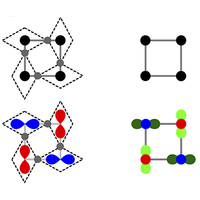
Spontaneous Formation of Altermagnetism from Orbital Ordering

Valentin Leeb, Alexander Mook, Libor Šmejkal, and Johannes Knolle

Phys. Rev. Lett. 132, 236701 (2024) - Published 3 June, 2024

In a system where a standard antiferromagnet coexists with a second, ordered phase, which breaks the sublattice rotational symmetry spontaneously, altermagnetism may emerge as an electronic instability.

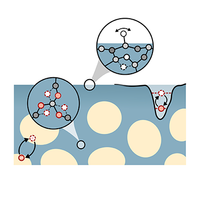
How Charges Separate when Surfaces Are Dewetted

Aaron D. Ratschow, Lisa S. Bauer, Pravash Bista, Stefan A. L. Weber, Hans-Jürgen Butt, and Steffen Hardt

Phys. Rev. Lett. 132, 224002 (2024) - Published 31 May, 2024

Experiments and theory explain how charge builds up in a moving water drop and why the effect requires a water-repelling surface.

Quantum Bipolaron Superconductivity from Quadratic Electron-Phonon Coupling

Zhaoyu Han, Steven A. Kivelson, and Pavel A. Volkov

Phys. Rev. Lett. 132, 226001 (2024) - Published 31 May, 2024

A mechanism for strong-coupling superconductivity based on the electron-phonon interaction, quadratic in phonon displacements suggests a new route to high-temperature superconductivity.

Timing Correlated-Electron Emission from Strong Field Atomic Double Ionization with Polarization-Gated Attoclock

YanLan Wang, ShaoGang Yu, RenPing Sun, HuiPeng Kang, SongPo Xu, XuanYang Lai, Wei Quan, and XiaoJun Liu

Phys. Rev. Lett. 132, 223202 (2024) - Published 30 May, 2024

Polarization-gated attoclock technique allows the observation of electron-electron interaction in nonsequential photoionization events.

Topological Photonic Alloy

Tiantao Qu, Mudi Wang, Xiaoyu Cheng, Xiaohan Cui, Ruo-Yang Zhang, Zhao-Qing Zhang, Lei Zhang, Jun Chen, and C. T. Chan

Phys. Rev. Lett. 132, 223802 (2024) - Published 30 May, 2024

Experiments and numerical simulations indicate that randomly replacing a few nonmagnetic components with magnetic ones in a photonic alloy induces backscattering-free light propagation along its edge.

Excited-State Half-Lives in Cd130 and the Isospin Dependence of Effective Charges

A. Jungclaus et al.

Phys. Rev. Lett. 132, 222501 (2024) - Published 29 May, 2024

Experiments comparing neutron-rich cadmium with previous data on a neutron-poor version prove that a key parameter in nuclear calculations depends on the neutron-to-proton ratio.

Transition between Heavy-Fermion-Strange-Metal and Quantum Spin Liquid in a 4d-Electron Trimer Lattice

Hengdi Zhao, Yu Zhang, Pedro Schlottmann, Rahul Nandkishore, Lance E. DeLong, and Gang Cao

Phys. Rev. Lett. 132, 226503 (2024) - Published 29 May, 2024

Observation of a heavy Fermi surface of charge-neutral spinons in Ba4Nb1−xRu3+xO12 provides experimental evidence for a robust quantum spin liquid that features an extraordinarily large entropy and a linear heat capacity extending into the milli-Kelvin regime.

Surface-Symmetry-Driven Dzyaloshinskii-Moriya Interaction and Canted Ferrimagnetism in Collinear Magnetoelectric Antiferromagnet Cr2O3

Oleksandr V. Pylypovskyi, Sophie F. Weber, Pavlo Makushko, Igor Veremchuk, Nicola A. Spaldin, and Denys Makarov

Phys. Rev. Lett. 132, 226702 (2024) - Published 28 May, 2024

Group theory and first-principles calculations combine to predict which antiferromagnets have potentially useful net surface magnetization.

Controlling Chaos: Periodic Defect Braiding in Active Nematics Confined to a Cardioid

Fereshteh L. Memarian, Derek Hammar, Md Mainul Hasan Sabbir, Mark Elias, Kevin A. Mitchell, and Linda S. Hirst

Phys. Rev. Lett. 132, 228301 (2024) - Published 28 May, 2024

Confining active nematics in cardioid-shaped wells leads to realization of the golden braid, a maximally efficient mixing state of exactly three defects with no defect creation or annihilation.

Pseudomagic Quantum States

Andi Gu, Lorenzo Leone, Soumik Ghosh, Jens Eisert, Susanne F. Yelin, and Yihui Quek

Phys. Rev. Lett. 132, 210602 (2024) - Published 24 May, 2024

The newly constructed pseudomagic ensembles possess low nonstabilizerness but are computationally indistinguishable from those with high nonstabilizerness, having implications for quantum scramblers, quantum cryptography, and magic state distillation.

First Measurement of R(Xτ/ℓ) as an Inclusive Test of the b→cτν Anomaly

I. Adachi et al. (Belle II Collaboration)

Phys. Rev. Lett. 132, 211804 (2024) - Published 23 May, 2024

The ratio of inclusive semileptonic B meson decays into τ versus other leptons is in agreement with lepton universality.

Tracer Diffusion beyond Gaussian Behavior: Explicit Results for General Single-File Systems

Aurélien Grabsch and Olivier Bénichou

Phys. Rev. Lett. 132, 217101 (2024) - Published 23 May, 2024

An explicit formula is provided for the fourth cumulant of an arbitrary single-file system.

Thermalization of Two- and Three-Dimensional Classical Lattices

Zhen Wang, Weicheng Fu, Yong Zhang, and Hong Zhao

Phys. Rev. Lett. 132, 217102 (2024) - Published 23 May, 2024

A universal scaling law shows that thermalization can be universally achieved in sufficiently large two- and three-dimensional lattices via weak nonlinear interactions.

Nonreciprocal Quantum Batteries

B. Ahmadi, P. Mazurek, P. Horodecki, and S. Barzanjeh

Phys. Rev. Lett. 132, 210402 (2024) - Published 22 May, 2024

Coupling the charger and battery to a common reservoir induces a direct flow of energy into the battery.

Observation of Alfvén Wave Reflection in the Solar Chromosphere: Ponderomotive Force and First Ionization Potential Effect

Mariarita Murabito, Marco Stangalini, J. Martin Laming, Deborah Baker, Andy S. H. To, David M. Long, David H. Brooks, Shahin Jafarzadeh, David B. Jess, and Gherardo Valori

Phys. Rev. Lett. 132, 215201 (2024) - Published 22 May, 2024

New solar observations indicate that plasma waves are responsible for the Sun’s outer atmosphere having different abundances of chemical elements than the Sun’s other layers.

Giant Two-Level Systems in a Granular Superconductor

M. Kristen, J. N. Voss, M. Wildermuth, A. Bilmes, J. Lisenfeld, H. Rotzinger, and A. V. Ustinov

Phys. Rev. Lett. 132, 217002 (2024) - Published 22 May, 2024

A class of strongly coupled two-level systems is revealed in experiments with compact microwave resonators fabricated from granular aluminum thin films.

Emerging Mesoscale Flows and Chaotic Advection in Dense Active Matter

Yann-Edwin Keta, Juliane U. Klamser, Robert L. Jack, and Ludovic Berthier

Phys. Rev. Lett. 132, 218301 (2024) - Published 22 May, 2024

Reminiscent of multiscale flow patterns in turbulence, mesoscale flows and chaotic advection can develop in dense active suspensions resulting from a competition between crowding effects and propulsion.

First Results in the Search for Dark Sectors at NA64 with the CERN SPS High Energy Muon Beam

Yu. M. Andreev et al.

Phys. Rev. Lett. 132, 211803 (2024) - Published 21 May, 2024

An experiment at CERN seeks signs of dark matter by looking for missing energy and momentum in the debris of particle collisions.

Coexistence of Nonequilibrium Density and Equilibrium Energy Distribution of Quasiparticles in a Superconducting Qubit

Thomas Connolly, Pavel D. Kurilovich, Spencer Diamond, Heekun Nho, Charlotte G. L. Bøttcher, Leonid I. Glazman, Valla Fatemi, and Michel H. Devoret

Phys. Rev. Lett. 132, 217001 (2024) - Published 20 May, 2024

Measurements of the temperature distribution of quasiparticles in superconducting circuits reveal behavior that could inform strategies for mitigating quasiparticle-induced errors in superconducting qubits.

First Study of the Ba139(n,γ)Ba140 Reaction to Constrain the Conditions for the Astrophysical i Process

A. Spyrou et al.

Phys. Rev. Lett. 132, 202701 (2024) - Published 17 May, 2024

Measurements related to the production of lanthanum in stars where elements are thought to form via the “i process” indicate that less of the element is produced than models predict.

Sign In to Your Journals Account

Filter

Section

Filter

Article Lookup

Enter a citation