Highlights

Conformational Selection of Polymer Chains upon π−π Interactions with Small Molecules

Weirui Zeng, Lei Liu, Yingzhou Shen, Zhefu Wu, Yuanming Zhai, Dong Liu, Hongyu Chen, Kai Zhang, Bo Yin, Wei Yang, and Mingbo Yang

Phys. Rev. Lett. 133, 178101 (2024) - Published 25 October, 2024

Synthetic polymers exhibit conformational selection behavior in melt processing, adapting to small molecules through noncovalent interactions.

Critical Spontaneous Breaking of U(1) Symmetry at Zero Temperature in One Dimension

Haruki Watanabe, Hosho Katsura, and Jong Yeon Lee

Phys. Rev. Lett. 133, 176001 (2024) - Published 24 October, 2024

There is an infinite family of one-dimensional models exhibiting spontaneous breaking of a U(1) symmetry at zero temperature whose order parameter does not commute with the Hamiltonian.

Absence of Altermagnetic Spin Splitting Character in Rutile Oxide RuO2

Jiayu Liu, Jie Zhan, Tongrui Li, Jishan Liu, Shufan Cheng, Yuming Shi, Liwei Deng, Meng Zhang, Chihao Li, Jianyang Ding, Qi Jiang, Mao Ye, Zhengtai Liu, Zhicheng Jiang, Siyu Wang, Qian Li, Yanwu Xie, Yilin Wang, Shan Qiao, Jinsheng Wen, Yan Sun, and Dawei Shen

Phys. Rev. Lett. 133, 176401 (2024) - Published 24 October, 2024

Measurement of momentum-dependent band splitting and spin polarization provides direct spectral evidence that RuO2 is unlikely to be an altermagnet.

Individual-Ion Addressing and Readout in a Penning Trap

Brian J. McMahon, Kenton R. Brown, Creston D. Herold, and Brian C. Sawyer

Phys. Rev. Lett. 133, 173201 (2024) - Published 23 October, 2024

A way to address the individual ions of a rotating ion crystal could allow scientists to perform quantum simulations in which each qubit can be carefully controlled.

Optimization Methodology of Polar Direct-Drive Illumination for the National Ignition Facility

D. E. M. Barlow, A. Colaïtis, D. Viala, M. J. Rosenberg, I. Igumenshchev, V. Goncharov, L. Ceurvorst, P. B. Radha, W. Theobald, R. S. Craxton, M. J. V. Streeter, R. H. H. Scott, K. Glize, T. Chapman, and J. Mathiaud

Phys. Rev. Lett. 133, 175101 (2024) - Published 23 October, 2024

An automatic, algorithmic technique can find optimal laser configurations for inertial-confinement fusion—one of two main fusion approaches.

Pair-Density-Wave Superconductivity: A Microscopic Model on the 2D Honeycomb Lattice

Yi-Fan Jiang and Hong Yao

Phys. Rev. Lett. 133, 176501 (2024) - Published 22 October, 2024

A pair density wave state can be realized in a minimal model of spinless fermions on a honeycomb lattice with nearest-neighbor and next-nearest-neighbor interaction.

Toward the Discovery of New Elements: Production of Livermorium (Z=116) with Ti50

J. M. Gates et al.

Phys. Rev. Lett. 133, 172502 (2024) - Published 21 October, 2024

Scientists have synthesized an isotope of the superheavy element livermorium using a novel fusion reaction. The result paves the way for the discovery of new chemical elements.

Interaction-Induced Crystalline Topology of Excitons

Henry Davenport, Johannes Knolle, and Frank Schindler

Phys. Rev. Lett. 133, 176601 (2024) - Published 21 October, 2024

An interacting centrosymmetric semiconductor displays topologically nontrivial excitons even when the underlying noninteracting electron and hole bands have a trivial atomic limit.

Search for Light Long-Lived Particles in pp Collisions at s=13  TeV Using Displaced Vertices in the ATLAS Inner Detector

G. Aad et al. (ATLAS Collaboration)

Phys. Rev. Lett. 133, 161803 (2024) - Published 17 October, 2024

A search for long-lived particles at the LHC with a new scheme for reconstructing particle-tracks with significantly displaced vertices results in an order-of-magnitude improvement in constraints.

Non-Abelian Fractionalization in Topological Minibands

Aidan P. Reddy, Nisarga Paul, Ahmed Abouelkomsan, and Liang Fu

Phys. Rev. Lett. 133, 166503 (2024) - Published 17 October, 2024

The prediction that twisted semiconductor bilayers can host so-called non-Abelian states without a magnetic field holds promise for fault-tolerant quantum computing.

Visualization of Skyrmion-Superconducting Vortex Pairs in a Chiral-Magnet–Superconductor Heterostructure

Yong-Jie Xie, Ang Qian, Bin He, Yu-Biao Wu, Sheng Wang, Bing Xu, Guoqiang Yu, Xiufeng Han, and X. G. Qiu

Phys. Rev. Lett. 133, 166706 (2024) - Published 17 October, 2024

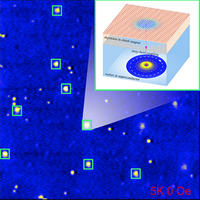
Skyrmion-superconducting vortex pairs in chiral magnet-superconductor heterostructures have been directly observed.

Nonmonotonic Hall Effect of Weyl Semimetals under a Magnetic Field

Xiao-Xiao Zhang and Naoto Nagaosa

Phys. Rev. Lett. 133, 166301 (2024) - Published 16 October, 2024

Global topological properties of three-dimensional Weyl semimetals lead to a nonmonotonic Hall effect as a function of an external magnetic field.

Fermi and Luttinger Arcs: Two Concepts, Realized on One Surface

Paul Worm, Matthias Reitner, Karsten Held, and Alessandro Toschi

Phys. Rev. Lett. 133, 166501 (2024) - Published 16 October, 2024

An analytical model providing an exact single-particle Green’s function in a material with strong antiferromagnetic fluctuations explains the emergence of Fermi arcs and pseudogaps in superconducting cuprates.

Three-Dimensional Moiré Crystal in Ultracold Atomic Gases

Ce Wang, Chao Gao, Jing Zhang, Hui Zhai, and Zhe-Yu Shi

Phys. Rev. Lett. 133, 163401 (2024) - Published 15 October, 2024

Overlapping two 3D lattices with a relative twist opens the door to synthesizing crystals with diverse symmetries that showcase nontrivial band structures and novel properties.

General Stacking Theory for Altermagnetism in Bilayer Systems

Baoru Pan, Pan Zhou, Pengbo Lyu, Huaping Xiao, Xuejuan Yang, and Lizhong Sun

Phys. Rev. Lett. 133, 166701 (2024) - Published 15 October, 2024

General stacking theory provides a straightforward criteria to predict whether a bilayer can demonstrate altermagnetic spin splitting solely based on the layer group of the composing monolayers.

Long-Lived Magnetization in an Atomic Spin Chain Tuned to a Diabolic Point

R. J. G. Elbertse, D. Borodin, J. Oh, T. Ahn, J. Hwang, J. C. Rietveld, A. J. Heinrich, F. Delgado, S. Otte, and Y. Bae

Phys. Rev. Lett. 133, 166703 (2024) - Published 15 October, 2024

A quantum degeneracy named after a Chinese yo-yo boosts the magnetization lifetime of a short chain of magnetic iron atoms by a factor of 1000.

Rift Gaps in Chemical-Wave Network Systems

Tamar Kanimian, Lara Haroun, and Rabih Sultan

Phys. Rev. Lett. 133, 168001 (2024) - Published 15 October, 2024

Patterns formed in chemical waves in precipitation reactions and electroless metal-deposition media are shown to be chemical analogs of Voronoi diagrams.

Highly Nonlinear Light-Nucleus Interaction

Hanxu Zhang, Tao Li, and Xu Wang

Phys. Rev. Lett. 133, 152503 (2024) - Published 11 October, 2024

Hydrogenlike thorium-229 ions interacting with intense lasers could unlock a highly nonlinear and nonperturbative regime of light-nucleus interaction.

Ballistic Electron Source with Magnetically Controlled Valley Polarization in Bilayer Graphene

Josep Ingla-Aynés, Antonio L. R. Manesco, Talieh S. Ghiasi, Kenji Watanabe, Takashi Taniguchi, and Herre S. J. van der Zant

Phys. Rev. Lett. 133, 156301 (2024) - Published 11 October, 2024

A valley-polarized current source in bilayer graphene has been made by electrostatically defining quantum point contact pairs that work as a coherent valley-polarized current splitter and collector.

Predictive Framework for Flow Reversals and Excursions in Turbulence

Balachandra Suri

Phys. Rev. Lett. 133, 154002 (2024) - Published 10 October, 2024

A new framework shows that the occurrence of reversals and excursions of large-scale circulations in turbulent geophysical, fluid, and thermal systems can be predicted and averted via feedback control.

Sign In to Your Journals Account

Filter

Section

Filter

Article Lookup

Enter a citation