Highlights

ω Meson from Lattice QCD

Haobo Yan (燕浩波), Maxim Mai, Marco Garofalo, Ulf-G. Meißner, Chuan Liu, Liuming Liu, and Carsten Urbach

Phys. Rev. Lett. 133, 211906 (2024) - Published 22 November, 2024

For the first time, a lattice QCD computation is able to determine the mass and width of the ω meson, which is the lightest hadron resonance dominantly decaying into three particles.

Anomalies in Hadronic B Decays

Raphaël Berthiaume, Bhubanjyoti Bhattacharya, Rida Boumris, Alexandre Jean, Suman Kumbhakar, and David London

Phys. Rev. Lett. 133, 211802 (2024) - Published 21 November, 2024

A new analysis of B-meson decays strongly hints that they harbor physics beyond the standard model.

Nuclear Magnetic Resonance with a Levitating Microparticle

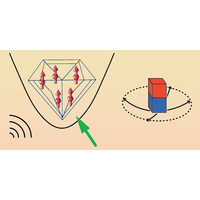
J. Voisin, A. Durand, T. Copie, M. Perdriat, and G. Hétet

Phys. Rev. Lett. 133, 213602 (2024) - Published 21 November, 2024

By manipulating and detecting nuclear spins in a tiny floating diamond, scientists have reported a record-long spin coherence time for a levitated system.

Deforming Ice with Drops

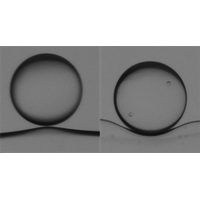
Duco van Buuren, Pallav Kant, Jochem G. Meijer, Christian Diddens, and Detlef Lohse

Phys. Rev. Lett. 133, 214002 (2024) - Published 21 November, 2024

When approaching a bubble or droplet, a solidifying front of water ice behaves differently than when interacting with solid particles.

Control of Chemical Waves by Fluid Stretching and Compression

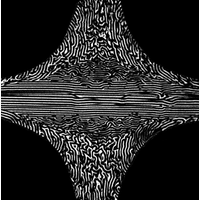
S. Izumoto, D. M. Escala, J. Heyman, T. Le Borgne, and A. De Wit

Phys. Rev. Lett. 133, 218001 (2024) - Published 21 November, 2024

The properties of reaction-diffusion waves can be controlled by fluid stretching and compression in a hyperbolic flow.

Interacting-Bath Dynamical Embedding for Capturing Nonlocal Electron Correlation in Solids

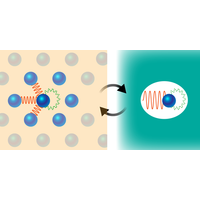
Jiachen Li and Tianyu Zhu

Phys. Rev. Lett. 133, 216402 (2024) - Published 20 November, 2024

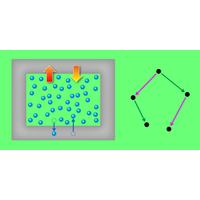
A new framework that embeds electrons in a surrounding bath captures nonlocal correlation effects that are relevant to metals, semiconductors, and correlated insulators.

Chiral Dichroism in Resonant Metasurfaces with Monoclinic Lattices

Ivan Toftul, Pavel Tonkaev, Kirill Koshelev, Fangxing Lai, Qinghai Song, Maxim Gorkunov, and Yuri Kivshar

Phys. Rev. Lett. 133, 216901 (2024) - Published 20 November, 2024

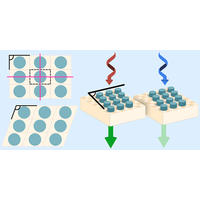
Contrary to conventional wisdom, a lattice of engineered nanoparticles called meta-atoms can have a chiral optical response even when each meta-atom is not chiral.

Duality Constraints on Thermal Spectra of 3D Conformal Field Theories and 4D Quasinormal Modes

Sašo Grozdanov and Mile Vrbica

Phys. Rev. Lett. 133, 211601 (2024) - Published 19 November, 2024

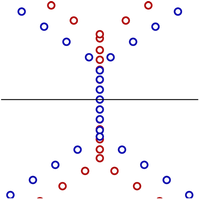
New universal duality relations constrain the thermal spectra of 3D conformal field theories and the quasinormal spectra of their black hole duals.

Nonrelativistic Spin Splitting at the Brillouin Zone Center in Compensated Magnets

Lin-Ding Yuan, Alexandru B. Georgescu, and James M. Rondinelli

Phys. Rev. Lett. 133, 216701 (2024) - Published 18 November, 2024

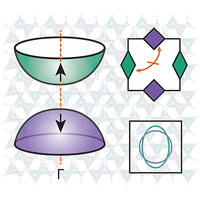
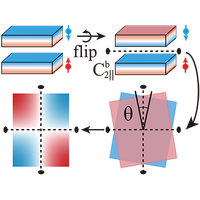
A predicted new group of compensated collinear magnets that falls outside the altermagnetism definition exhibits a similar and perhaps superior nonrelativistic spin-splitting effect.

Gauge Invariance of Equilibrium Statistical Mechanics

Johanna Müller, Sophie Hermann, Florian Sammüller, and Matthias Schmidt

Phys. Rev. Lett. 133, 217101 (2024) - Published 18 November, 2024

The identification of a new type of symmetry in statistical mechanics could help scientists derive and interpret fundamental relationships in this branch of physics.

Origin of Spectral Bands in the Crab Pulsar Radio Emission

Mikhail V. Medvedev

Phys. Rev. Lett. 133, 205201 (2024) - Published 15 November, 2024

A new model explains the peculiar spectral band structure of the high-frequency interpulse of the Crab pulsar radio emission as diffraction fringes created by the pulsar’s plasma-filled magnetosphere, acting as a frequency-dependent diffraction screen.

Twisted Magnetic Van der Waals Bilayers: An Ideal Platform for Altermagnetism

Yichen Liu, Junxi Yu, and Cheng-Cheng Liu

Phys. Rev. Lett. 133, 206702 (2024) - Published 15 November, 2024

By choosing a constituent monolayer with specific symmetry, the properties of twisted altermagnets, like spin Hall effect, can be flexibly engineered.

Search for an eV-Scale Sterile Neutrino Using Improved High-Energy νμ Event Reconstruction in IceCube

R. Abbasi et al. (IceCube Collaboration)

Phys. Rev. Lett. 133, 201804 (2024) - Published 14 November, 2024

Using a decade of data, the IceCube collaboration places strong new constraints on sterile neutrinos.

Gain-Induced Group Delay in Spontaneous Parametric Down-Conversion

Guillaume Thekkadath, Martin Houde, Duncan England, Philip Bustard, Frédéric Bouchard, Nicolás Quesada, and Ben Sussman

Phys. Rev. Lett. 133, 203601 (2024) - Published 14 November, 2024

The observation of a previously unseen photon delay in the production of quantum light has implications for the development of quantum technologies.

Quantum Advantage: A Single Qubit’s Experimental Edge in Classical Data Storage

Chen Ding, Edwin Peter Lobo, Mir Alimuddin, Xiao-Yue Xu, Shuo Zhang, Manik Banik, Wan-Su Bao, and He-Liang Huang

Phys. Rev. Lett. 133, 200201 (2024) - Published 13 November, 2024

A new quantum communication protocol allows a qubit to outperform a classical bit in storing capacity for classical data.

Frequency-Dependent Covariance Reveals Critical Spatiotemporal Patterns of Synchronized Activity in the Human Brain

Rubén Calvo, Carles Martorell, Guillermo B. Morales, Serena Di Santo, and Miguel A. Muñoz

Phys. Rev. Lett. 133, 208401 (2024) - Published 13 November, 2024

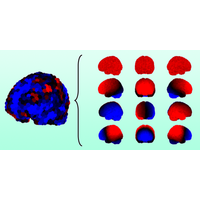
A new frequency-based analysis of recordings from neurons in the brain may give insight into brain pathologies such as Parkinson’s disease.

Experimental Demonstration of Mode-Coupled and High-Brightness Self-Amplified Spontaneous Emission in an X-Ray Free-Electron Laser

Eduard Prat, Wenxiang Hu, Christopher Arrell, Marco Calvi, Philipp Dijkstal, Rolf Follath, and Sven Reiche

Phys. Rev. Lett. 133, 205001 (2024) - Published 12 November, 2024

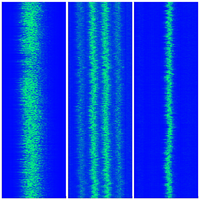
The first experimental demonstration of two schemes to enhance the longitudinal coherence of SASE-XFEL pulses shows that the SASE pulse bandwidth can be reduced by up to a factor of three.

Theory of Quantum Anomalous Hall Phases in Pentalayer Rhombohedral Graphene Moiré Structures

Zhihuan Dong, Adarsh S. Patri, and T. Senthil

Phys. Rev. Lett. 133, 206502 (2024) - Published 12 November, 2024

Fractional quantum anomalous Hall phases in rhombohedral multilayer graphene.

Anomalous Hall Crystals in Rhombohedral Multilayer Graphene. I. Interaction-Driven Chern Bands and Fractional Quantum Hall States at Zero Magnetic Field

Junkai Dong (董焌锴), Taige Wang, Tianle Wang, Tomohiro Soejima (副島智大), Michael P. Zaletel, Ashvin Vishwanath, and Daniel E. Parker

Phys. Rev. Lett. 133, 206503 (2024) - Published 12 November, 2024

Fractional Quantum Anomalous Hall Effect in Rhombohedral Multilayer Graphene in the Moiréless Limit

Boran Zhou, Hui Yang, and Ya-Hui Zhang

Phys. Rev. Lett. 133, 206504 (2024) - Published 12 November, 2024
Sign In to Your Journals Account

Filter

Section

Filter

Article Lookup

Enter a citation