Highlights

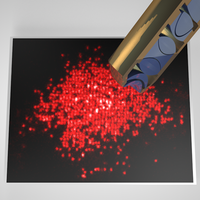
Microscopic Observation of Pauli Blocking in Degenerate Fermionic Lattice Gases

Ahmed Omran, Martin Boll, Timon A. Hilker, Katharina Kleinlein, Guillaume Salomon, Immanuel Bloch, and Christian Gross

Phys. Rev. Lett. 115, 263001 (2015) - Published 23 December, 2015

A fermion quantum gas microscope that operates in the quantum degenerate regime is used to directly measure local atom number fluctuations showing a strong suppression in the band-insulating region.

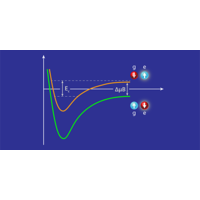
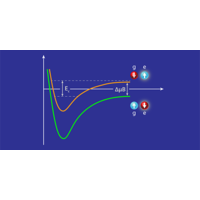
Strongly Interacting Gas of Two-Electron Fermions at an Orbital Feshbach Resonance

G. Pagano, M. Mancini, G. Cappellini, L. Livi, C. Sias, J. Catani, M. Inguscio, and L. Fallani

Phys. Rev. Lett. 115, 265301 (2015) - Published 21 December, 2015

Two separate groups have managed to control the interactions in a cold atomic gas in which each atom has two valence electrons.

Observation of an Orbital Interaction-Induced Feshbach Resonance in Yb173

M. Höfer, L. Riegger, F. Scazza, C. Hofrichter, D. R. Fernandes, M. M. Parish, J. Levinsen, I. Bloch, and S. Fölling

Phys. Rev. Lett. 115, 265302 (2015) - Published 21 December, 2015

Two separate groups have managed to control the interactions in a cold atomic gas in which each atom has two valence electrons.

Magnetic Alignment of Block Copolymer Microdomains by Intrinsic Chain Anisotropy

Yekaterina Rokhlenko, Manesh Gopinadhan, Chinedum O. Osuji, Kai Zhang, Corey S. O’Hern, Steven R. Larson, Padma Gopalan, Paweł W. Majewski, and Kevin G. Yager

Phys. Rev. Lett. 115, 258302 (2015) - Published 18 December, 2015

Experiments demonstrate that a magnetic field can cause polymers to organize into arrangements that are potentially useful for clean energy products.

Significant-Loophole-Free Test of Bell’s Theorem with Entangled Photons

Marissa Giustina, Marijn A. M. Versteegh, Sören Wengerowsky, Johannes Handsteiner, Armin Hochrainer, Kevin Phelan, Fabian Steinlechner, Johannes Kofler, Jan-Åke Larsson, Carlos Abellán, Waldimar Amaya, Valerio Pruneri, Morgan W. Mitchell, Jörn Beyer, Thomas Gerrits, Adriana E. Lita, Lynden K. Shalm, Sae Woo Nam, Thomas Scheidl, Rupert Ursin, Bernhard Wittmann, and Anton Zeilinger

Phys. Rev. Lett. 115, 250401 (2015) - Published 16 December, 2015

By closing two loopholes at once, three experimental tests of Bell’s inequalities remove the last doubts that we should renounce local realism. They also open the door to new quantum information technologies.

Strong Loophole-Free Test of Local Realism

Lynden K. Shalm et al.

Phys. Rev. Lett. 115, 250402 (2015) - Published 16 December, 2015

By closing two loopholes at once, three experimental tests of Bell’s inequalities remove the last doubts that we should renounce local realism. They also open the door to new quantum information technologies.

Generation of Fresh and Pure Random Numbers for Loophole-Free Bell Tests

Carlos Abellán, Waldimar Amaya, Daniel Mitrani, Valerio Pruneri, and Morgan W. Mitchell

Phys. Rev. Lett. 115, 250403 (2015) - Published 16 December, 2015

A fast random number generator based on laser dynamics helps test the foundations of quantum physics.

Cosmological Higgs-Axion Interplay for a Naturally Small Electroweak Scale

J. R. Espinosa, C. Grojean, G. Panico, A. Pomarol, O. Pujolàs, and G. Servant

Phys. Rev. Lett. 115, 251803 (2015) - Published 16 December, 2015

Weak coupling of the Higgs boson to two axionlike states could lead to a naturally small electroweak scale, which could be detected via their astrophysical and cosmological effects.

Broadband Acoustic Hyperbolic Metamaterial

Chen Shen, Yangbo Xie, Ni Sui, Wenqi Wang, Steven A. Cummer, and Yun Jing

Phys. Rev. Lett. 115, 254301 (2015) - Published 16 December, 2015

An array of rigid paper squares contained in aluminum frames is used to create a hyperbolic acoustic metamaterial.

Three New Low-Energy Resonances in the Ne22(p,γ)Na23 Reaction

F. Cavanna et al. (The LUNA Collaboration)

Phys. Rev. Lett. 115, 252501 (2015) - Published 15 December, 2015

New resonances are observed in 22Ne(p,γ)23Na reactions at energies relevant to element production in stars and novae. The resulting reaction rates are five times higher than previous measurements indicating a higher abundance of sodium and neon in these systems.

Experimental Evidence for Dark Excitons in Monolayer WSe2

Xiao-Xiao Zhang, Yumeng You, Shu Yang Frank Zhao, and Tony F. Heinz

Phys. Rev. Lett. 115, 257403 (2015) - Published 15 December, 2015

Photoluminescence measurements of WSe2, a 2D semiconductor, reveal optically forbidden excitations in the material.

Experimental Observation of Large Chern Numbers in Photonic Crystals

Scott A. Skirlo, Ling Lu, Yuichi Igarashi, Qinghui Yan, John Joannopoulos, and Marin Soljačić

Phys. Rev. Lett. 115, 253901 (2015) - Published 14 December, 2015

A two-dimensional photonic crystal has multiple topologically protected channels, which can be used to transmit and reroute light without scattering losses.

Neutral Hydrogen Structures Trace Dust Polarization Angle: Implications for Cosmic Microwave Background Foregrounds

S. E. Clark, J. Colin Hill, J. E. G. Peek, M. E. Putman, and B. L. Babler

Phys. Rev. Lett. 115, 241302 (2015) - Published 11 December, 2015

The morphology of diffuse neutral hydrogen structures can provide information about the orientation of polarized dust emission, a significant source of foreground contamination to the B-mode polarization of the cosmic microwave background.

Out-of-Contact Elastohydrodynamic Deformation due to Lubrication Forces

Yumo Wang, Charles Dhong, and Joelle Frechette

Phys. Rev. Lett. 115, 248302 (2015) - Published 10 December, 2015

A dimple forms at the surface of a soft material when it is lowered into contact with a hard surface. This dimple stops the two surfaces coming into direct contact with each other.

Programmable Extreme Pseudomagnetic Fields in Graphene by a Uniaxial Stretch

Shuze Zhu, Joseph A. Stroscio, and Teng Li

Phys. Rev. Lett. 115, 245501 (2015) - Published 8 December, 2015

A specially shaped ribbon of single-layer carbon can produce a strong magnetic-like effect within the material when it is pulled on its ends.

Squeezing of Quantum Noise of Motion in a Micromechanical Resonator

J.-M. Pirkkalainen, E. Damskägg, M. Brandt, F. Massel, and M. A. Sillanpää

Phys. Rev. Lett. 115, 243601 (2015) - Published 7 December, 2015

The act of a quantum measurement reduces the uncertainty in the motion of a vibrating membrane below the fundamental quantum limit.

Electron Spin Coherence of Shallow Donors in Natural and Isotopically Enriched Germanium

A. J. Sigillito, R. M. Jock, A. M. Tyryshkin, J. W. Beeman, E. E. Haller, K. M. Itoh, and S. A. Lyon

Phys. Rev. Lett. 115, 247601 (2015) - Published 7 December, 2015

Measurements of the donor electron spin in germanium show coherence times that are long enough for the electrons to be used as qubits.

Heavy Tails in the Distribution of Time to Solution for Classical and Quantum Annealing

Damian S. Steiger, Troels F. Rønnow, and Matthias Troyer

Phys. Rev. Lett. 115, 230501 (2015) - Published 4 December, 2015

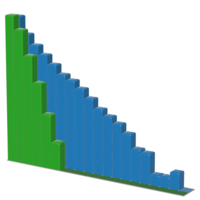
Simulated quantum annealing, used in D-Wave systems, does not perform as well as classical annealing for computationally hard instances of the Ising spin glass problem, implying that median ‘time-to-solution’ is a poor measure of annealing algorithms.

Nuclear Recoil Effect in the Lamb Shift of Light Hydrogenlike Atoms

V. A. Yerokhin and V. M. Shabaev

Phys. Rev. Lett. 115, 233002 (2015) - Published 4 December, 2015

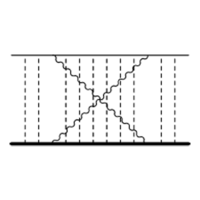
The nuclear recoil correction in hydrogen-like atoms has been calculated nonperturbatively in the nuclear binding strength, Zα, improving the numerical accuracy by more than two orders of magnitude.

Test of Electric Charge Conservation with Borexino

M. Agostini et al. (Borexino Collaboration)

Phys. Rev. Lett. 115, 231802 (2015) - Published 3 December, 2015

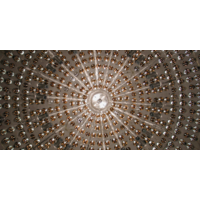
Scientists have placed new limits on how often electrons decay into neutrinos and photons, a reaction that—if it occurred—would violate the law of charge conservation.

Sign In to Your Journals Account

Filter

Section

Filter

Article Lookup

Enter a citation