Highlights

Direct Evidence of Octupole Deformation in Neutron-Rich Ba144

B. Bucher et al.

Phys. Rev. Lett. 116, 112503 (2016) - Published 17 March, 2016

Experiments confirm that the barium-144 nucleus is pear shaped and hint that this asymmetry is more pronounced than previously thought.

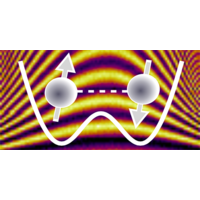
Reduced Sensitivity to Charge Noise in Semiconductor Spin Qubits via Symmetric Operation

M. D. Reed, B. M. Maune, R. W. Andrews, M. G. Borselli, K. Eng, M. P. Jura, A. A. Kiselev, T. D. Ladd, S. T. Merkel, I. Milosavljevic, E. J. Pritchett, M. T. Rakher, R. S. Ross, A. E. Schmitz, A. Smith, J. A. Wright, M. F. Gyure, and A. T. Hunter

Phys. Rev. Lett. 116, 110402 (2016) - Published 16 March, 2016

A new way to control the coupling of spins between adjacent quantum dots produces qubits that are less susceptible to electronic noise.

Noise Suppression Using Symmetric Exchange Gates in Spin Qubits

Frederico Martins, Filip K. Malinowski, Peter D. Nissen, Edwin Barnes, Saeed Fallahi, Geoffrey C. Gardner, Michael J. Manfra, Charles M. Marcus, and Ferdinand Kuemmeth

Phys. Rev. Lett. 116, 116801 (2016) - Published 16 March, 2016

A new way to control the coupling of spins between adjacent quantum dots produces qubits that are less susceptible to electronic noise.

Optical Conductivity of Topological Surface States with Emergent Supersymmetry

William Witczak-Krempa and Joseph Maciejko

Phys. Rev. Lett. 116, 100402 (2016) - Published 11 March, 2016

Theoretical predictions suggest that experiments on topological insulators could provide the first evidence of supersymmetry.

Spatial Search by Quantum Walk is Optimal for Almost all Graphs

Shantanav Chakraborty, Leonardo Novo, Andris Ambainis, and Yasser Omar

Phys. Rev. Lett. 116, 100501 (2016) - Published 11 March, 2016

The continuous time quantum walk algorithm for searching a network is optimal for nearly all graphs.

Sudden Viscous Dissipation of Compressing Turbulence

Seth Davidovits and Nathaniel J. Fisch

Phys. Rev. Lett. 116, 105004 (2016) - Published 11 March, 2016

Turbulent kinetic energy, amplified by compression, can be rapidly converted to thermal energy enabling fast plasma ignition, according to theoretical predictions.

Planckian Interacting Massive Particles as Dark Matter

Mathias Garny, McCullen Sandora, and Martin S. Sloth

Phys. Rev. Lett. 116, 101302 (2016) - Published 10 March, 2016

A theoretical investigation of super-heavy dark matter particles finds that their existence might be discerned in the cosmic microwave background.

Spectroscopic Evidence of the Aharonov-Casher Effect in a Cooper Pair Box

M. T. Bell, W. Zhang, L. B. Ioffe, and M. E. Gershenson

Phys. Rev. Lett. 116, 107002 (2016) - Published 10 March, 2016

Direct evidence of the Aharonov–Casher effect, in which a magnetic dipole acquires a phase in an electric field, has been observed in a superconducting circuit.

Integrable Turbulence and Rogue Waves: Breathers or Solitons?

J. M. Soto-Crespo, N. Devine, and N. Akhmediev

Phys. Rev. Lett. 116, 103901 (2016) - Published 9 March, 2016

Numerical simulations of the nonlinear Schrödinger equation demonstrate how rogue waves form for different levels of initial random noise.

Shape-Shifting Droplet Networks

T. Zhang, Duanduan Wan, J. M. Schwarz, and M. J. Bowick

Phys. Rev. Lett. 116, 108301 (2016) - Published 9 March, 2016

Sheets of liquid droplets can spontaneously and reversibly change their shape.

Isospin Mixing Reveals P30(p,γ)S31 Resonance Influencing Nova Nucleosynthesis

M. B. Bennett, C. Wrede, B. A. Brown, S. N. Liddick, D. Pérez-Loureiro, D. W. Bardayan, A. A. Chen, K. A. Chipps, C. Fry, B. E. Glassman, C. Langer, N. R. Larson, E. I. McNeice, Z. Meisel, W. Ong, P. D. O’Malley, S. D. Pain, C. J. Prokop, H. Schatz, S. B. Schwartz, S. Suchyta, P. Thompson, M. Walters, and X. Xu

Phys. Rev. Lett. 116, 102502 (2016) - Published 8 March, 2016

A short-lived nuclear state that boosts the destruction rate of phosphorus-30 via proton capture has been discovered. This nuclear reaction is critical to determining the origins of microscopic rocks found inside of meteorites that predate our solar system.

Modeling Repeatedly Flaring δ Sunspots

Piyali Chatterjee, Viggo Hansteen, and Mats Carlsson

Phys. Rev. Lett. 116, 101101 (2016) - Published 7 March, 2016

Simulations show for the first time how the magnetic fields that produce solar flares can extend out of the Sun by acquiring a twist.

Automated Search for new Quantum Experiments

Mario Krenn, Mehul Malik, Robert Fickler, Radek Lapkiewicz, and Anton Zeilinger

Phys. Rev. Lett. 116, 090405 (2016) - Published 4 March, 2016

Quantum weirdness is hard for humans to grasp, so researchers wrote a program to suggest experimental setups.

Emergent Collective Chemotaxis without Single-Cell Gradient Sensing

Brian A. Camley, Juliane Zimmermann, Herbert Levine, and Wouter-Jan Rappel

Phys. Rev. Lett. 116, 098101 (2016) - Published 3 March, 2016

A simple model suggests a way in which clusters of cells could follow concentration gradients in cases where individual cells cannot.

Structures and Dynamics of Glass-Forming Colloidal Liquids under Spherical Confinement

Bo Zhang and Xiang Cheng

Phys. Rev. Lett. 116, 098302 (2016) - Published 2 March, 2016

Correlated patterns of particles form in colloidal liquids as they approach the glass transition.

Observation of Thermoelectric Currents in High-Field Superconductor-Ferromagnet Tunnel Junctions

S. Kolenda, M. J. Wolf, and D. Beckmann

Phys. Rev. Lett. 116, 097001 (2016) - Published 1 March, 2016

Researchers have observed spin-dependent thermoelectric currents in superconductors—a finding that could lead to precise cryogenic thermometers.

Realization of the Contextuality-Nonlocality Tradeoff with a Qubit-Qutrit Photon Pair

Xiang Zhan, Xin Zhang, Jian Li, Yongsheng Zhang, Barry C. Sanders, and Peng Xue

Phys. Rev. Lett. 116, 090401 (2016) - Published 29 February, 2016

A quantum optics experiment verifies theoretical work showing that there is a trade-off between local contextual correlations and spatially separated correlations.

Observation and Calculation of the Quasibound Rovibrational Levels of the Electronic Ground State of H2+

Maximilian Beyer and Frédéric Merkt

Phys. Rev. Lett. 116, 093001 (2016) - Published 29 February, 2016

Orbiting resonances (quasi-bound states) of H2+ have been experimentally observed.

Valley Vortex States in Sonic Crystals

Jiuyang Lu, Chunyin Qiu, Manzhu Ke, and Zhengyou Liu

Phys. Rev. Lett. 116, 093901 (2016) - Published 29 February, 2016

A sonic crystal consisting of a hexagonal array of triangular steel rods in water provides a new degree of freedom to manipulate acoustic waves.

How Water Advances on Superhydrophobic Surfaces

Frank Schellenberger, Noemí Encinas, Doris Vollmer, and Hans-Jürgen Butt

Phys. Rev. Lett. 116, 096101 (2016) - Published 29 February, 2016

High-resolution imaging of a drop moving on an ultra-water-repellent surface spurs researchers to propose a new definition for superhydrophobicity.

Sign In to Your Journals Account

Filter

Section

Filter

Article Lookup

Enter a citation