Highlights

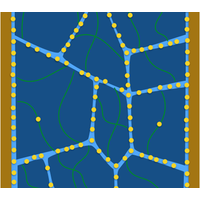
Compression-Driven Mass Flow in Bulk Solid He4

Zhi Gang Cheng and John Beamish

Phys. Rev. Lett. 117, 025301 (2016) - Published 6 July, 2016

Mass flow in solid helium can be generated directly by mechanical compression and does not require superfluid conduits.

Elimination of X-Ray Diffraction through Stimulated X-Ray Transmission

B. Wu, T. Wang, C. E. Graves, D. Zhu, W. F. Schlotter, J. J. Turner, O. Hellwig, Z. Chen, H. A. Dürr, A. Scherz, and J. Stöhr

Phys. Rev. Lett. 117, 027401 (2016) - Published 6 July, 2016

The absorption and diffraction of an x-ray pulse transmitted through a magnetic cobalt-palladium multilayer decrease with increasing x-ray intensity.

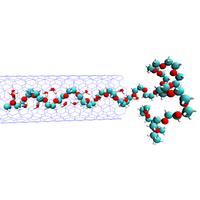
Spontaneous Insertion, Helix Formation, and Hydration of Polyethylene Oxide in Carbon Nanotubes

Udaya R. Dahal and Elena E. Dormidontova

Phys. Rev. Lett. 117, 027801 (2016) - Published 6 July, 2016

Molecular dynamics simulations predict that a polyethylene oxide chain can spontaneously enter a carbon nanotube from a water-based solution, where it then forms a helical conformation stabilized by hydrogen bonding.

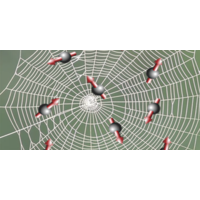
Kinetic Transition Networks for the Thomson Problem and Smale’s Seventh Problem

Dhagash Mehta, Jianxu Chen, Danny Z. Chen, Halim Kusumaatmaja, and David J. Wales

Phys. Rev. Lett. 117, 028301 (2016) - Published 6 July, 2016

Network theory is used to find the minimum energy of N identical charges constrained on a sphere. Solutions are found relatively easily for N≤150 due to the easily accessible global minimum of the energy landscape.

Diagonalization and Many-Body Localization for a Disordered Quantum Spin Chain

John Z. Imbrie

Phys. Rev. Lett. 117, 027201 (2016) - Published 5 July, 2016

Theoretical work proves that interacting quantum systems can enter a many-body localized phase in which they cannot reach thermal equilibrium without an external bath.

Measuring the Second Chern Number from Nonadiabatic Effects

Michael Kolodrubetz

Phys. Rev. Lett. 117, 015301 (2016) - Published 30 June, 2016

Proposals are laid out for measuring the non-Abelian Berry curvature and the second Chern number of quantum systems including trapped ions, cold atoms, and superconducting qubits.

Hybrid Quantum Device with Nitrogen-Vacancy Centers in Diamond Coupled to Carbon Nanotubes

Peng-Bo Li, Ze-Liang Xiang, Peter Rabl, and Franco Nori

Phys. Rev. Lett. 117, 015502 (2016) - Published 30 June, 2016

The spin of the NV center in diamond and the vibrational mode of a carbon nanotube suspended above the NV center could be coupled by passing a current through the nanotube. This system could be used to mechanically address quantum logic gates.

Evidence of Topological Nodal-Line Fermions in ZrSiSe and ZrSiTe

Jin Hu, Zhijie Tang, Jinyu Liu, Xue Liu, Yanglin Zhu, David Graf, Kevin Myhro, Son Tran, Chun Ning Lau, Jiang Wei, and Zhiqiang Mao

Phys. Rev. Lett. 117, 016602 (2016) - Published 30 June, 2016

Quantum oscillation experiments on two node-line semimetals raises the possibility of realizing a two-dimensional topological insulator state in monolayers of ZrSiSe and ZrSiTe.

Black Hole Kicks as New Gravitational Wave Observables

Davide Gerosa and Christopher J. Moore

Phys. Rev. Lett. 117, 011101 (2016) - Published 29 June, 2016

The gravitational waves produced by the merging of two black holes are predicted to cause a recoil (or kick) velocity to the remnant black hole. This effect could be seen in the waveforms measured by gravitational wave observatories.

Higgs Boson Pair Production in Gluon Fusion at Next-to-Leading Order with Full Top-Quark Mass Dependence

S. Borowka, N. Greiner, G. Heinrich, S. P. Jones, M. Kerner, J. Schlenk, U. Schubert, and T. Zirke

Phys. Rev. Lett. 117, 012001 (2016) - Published 29 June, 2016

The production rate of a pair of Higgs bosons has been calculated with higher precision than before by using the exact value of the top quark mass in the calculation.

Anomalous Topological Phases and Unpaired Dirac Cones in Photonic Floquet Topological Insulators

Daniel Leykam, M. C. Rechtsman, and Y. D. Chong

Phys. Rev. Lett. 117, 013902 (2016) - Published 29 June, 2016

The design for a photonic lattice that can realize a previously unobserved anomalous Floquet phase is proposed.

High Antiferromagnetic Domain Wall Velocity Induced by Néel Spin-Orbit Torques

O. Gomonay, T. Jungwirth, and J. Sinova

Phys. Rev. Lett. 117, 017202 (2016) - Published 29 June, 2016

The Néel spin orbit torque — a current-induced generation of an effective staggered magnetic field in antiferromagnets — could be used to move a magnetic domain wall at high velocities, according to theoretical predictions.

Suppressed Magnetic Circular Dichroism and Valley-Selective Magnetoabsorption due to the Effective Mass Anisotropy in Bismuth

Pieter J. de Visser, Julien Levallois, Michaël K. Tran, Jean-Marie Poumirol, Ievgeniia O. Nedoliuk, Jérémie Teyssier, Ctirad Uher, Dirk van der Marel, and Alexey B. Kuzmenko

Phys. Rev. Lett. 117, 017402 (2016) - Published 29 June, 2016

Elliptically polarized infrared light in an external magnetic field is used in a new technique to measure the anisotropic effective mass of electrons in semi-metals.

Mechanical Autonomous Stochastic Heat Engine

Marc Serra-Garcia, André Foehr, Miguel Molerón, Joseph Lydon, Christopher Chong, and Chiara Daraio

Phys. Rev. Lett. 117, 010602 (2016) - Published 28 June, 2016

Researchers propose a stochastic heat engine that runs without an external control system.

Quantum-Enhanced Sensing Based on Time Reversal of Nonlinear Dynamics

D. Linnemann, H. Strobel, W. Muessel, J. Schulz, R. J. Lewis-Swan, K. V. Kheruntsyan, and M. K. Oberthaler

Phys. Rev. Lett. 117, 013001 (2016) - Published 28 June, 2016

Spin-changing collisions between atoms in a Bose-Einstein condensate are used experimentally to implement a non-linear interferometer for quantum-enhanced phase measurements with sensitivity better than the standard quantum limit.

Explicit Derivation of Duality between a Free Dirac Cone and Quantum Electrodynamics in (2+1) Dimensions

David F. Mross, Jason Alicea, and Olexei I. Motrunich

Phys. Rev. Lett. 117, 016802 (2016) - Published 27 June, 2016

Theoretical work reveals a surprising relationship between the physics of fermionic vortices and quantum electrodynamics.

Departures from the Friedmann-Lemaitre-Robertston-Walker Cosmological Model in an Inhomogeneous Universe: A Numerical Examination

John T. Giblin, Jr., James B. Mertens, and Glenn D. Starkman

Phys. Rev. Lett. 116, 251301 (2016) - Published 24 June, 2016

Cosmologists have begun using fully relativistic models to understand the effects of inhomogeneous matter distribution on the evolution of the Universe.

Effects of Nonlinear Inhomogeneity on the Cosmic Expansion with Numerical Relativity

Eloisa Bentivegna and Marco Bruni

Phys. Rev. Lett. 116, 251302 (2016) - Published 24 June, 2016

Cosmologists have begun using fully relativistic models to understand the effects of inhomogeneous matter distribution on the evolution of the Universe.

Prediction and Control of Slip-Free Rotation States in Sphere Assemblies

D. V. Stäger, N. A. M. Araújo, and H. J. Herrmann

Phys. Rev. Lett. 116, 254301 (2016) - Published 24 June, 2016

Spinning a few spheres among a large collection of them can lead to a predictable state where each sphere rotates in synch with the others.

Surface Temperature Dependence of Hydrogen Ortho-Para Conversion on Amorphous Solid Water

Hirokazu Ueta, Naoki Watanabe, Tetsuya Hama, and Akira Kouchi

Phys. Rev. Lett. 116, 253201 (2016) - Published 22 June, 2016
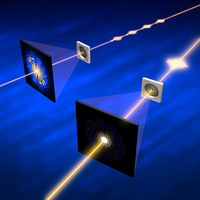
The reaction that transforms ortho hydrogen molecules (parallel spins) into para hydrogen (anti-parallel spins) accelerates at low temperatures. This finding may be relevant to the ortho-para ratio in low temperature cosmic dust.

Sign In to Your Journals Account

Filter

Section

Filter

Article Lookup

Enter a citation