Highlights

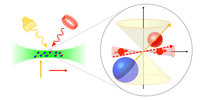
Precision Measurement of the Electron’s Electric Dipole Moment Using Trapped Molecular Ions

William B. Cairncross, Daniel N. Gresh, Matt Grau, Kevin C. Cossel, Tanya S. Roussy, Yiqi Ni, Yan Zhou, Jun Ye, and Eric A. Cornell

Phys. Rev. Lett. 119, 153001 (2017) - Published 9 October, 2017

New precision experiments using trapped molecular ions provide an alternative method for determining if the electron has an electric dipole moment.

Long-Lived Ultracold Molecules with Electric and Magnetic Dipole Moments

Timur M. Rvachov, Hyungmok Son, Ariel T. Sommer, Sepehr Ebadi, Juliana J. Park, Martin W. Zwierlein, Wolfgang Ketterle, and Alan O. Jamison

Phys. Rev. Lett. 119, 143001 (2017) - Published 2 October, 2017

The creation of ultracold molecules that have both an electric and a magnetic dipole moment offers new ways to explore physics in the many-body quantum regime.

Interatomic Coulombic Decay: The Mechanism for Rapid Deexcitation of Hollow Atoms

Richard A. Wilhelm, Elisabeth Gruber, Janine Schwestka, Roland Kozubek, Teresa I. Madeira, José P. Marques, Jacek Kobus, Arkady V. Krasheninnikov, Marika Schleberger, and Friedrich Aumayr

Phys. Rev. Lett. 119, 103401 (2017) - Published 8 September, 2017

Interatomic Coulomb decay is shown to cause the ultrafast neutralization and de-excitation of atoms after they impact a surface.

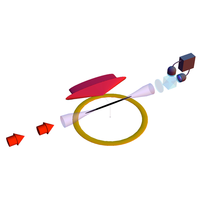
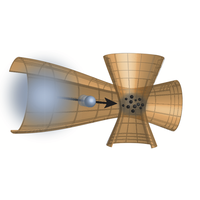
Radio Frequency Magneto-Optical Trapping of CaF with High Density

Loïc Anderegg, Benjamin L. Augenbraun, Eunmi Chae, Boerge Hemmerling, Nicholas R. Hutzler, Aakash Ravi, Alejandra Collopy, Jun Ye, Wolfgang Ketterle, and John M. Doyle

Phys. Rev. Lett. 119, 103201 (2017) - Published 6 September, 2017

Significant improvements in molecular trapping techniques increase the trappable molecular density by an order of magnitude, furthering the quest for directly loading optical tweezers and lattices, and for generating a Bose-Einstein condensate of CaF.

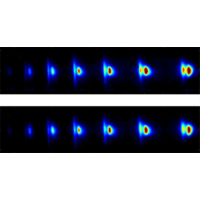
Rotationally Cold OH− Ions in the Cryogenic Electrostatic Ion-Beam Storage Ring DESIREE

H. T. Schmidt, G. Eklund, K. C. Chartkunchand, E. K. Anderson, M. Kamińska, N. de Ruette, R. D. Thomas, M. K. Kristiansson, M. Gatchell, P. Reinhed, S. Rosén, A. Simonsson, A. Källberg, P. Löfgren, S. Mannervik, H. Zettergren, and H. Cederquist

Phys. Rev. Lett. 119, 073001 (2017) - Published 14 August, 2017

Two research teams have created the coldest molecular beams ever, putting molecules in their ground states of rotation and providing improved experimental stand-ins for interstellar gas clouds.

Oscillation of Branching Ratios Between the D(2s)+D(1s) and the D(2p)+D(1s) Channels in Direct Photodissociation of D2

Jie Wang, Qingnan Meng, and Yuxiang Mo

Phys. Rev. Lett. 119, 053002 (2017) - Published 4 August, 2017

Previously predicted oscillations in the electronic states of atoms after the dissociation of a hydrogen molecule are observed experimentally.

Optical Control of the Resonant Dipole-Dipole Interaction between Rydberg Atoms

Sylvain de Léséleuc, Daniel Barredo, Vincent Lienhard, Antoine Browaeys, and Thierry Lahaye

Phys. Rev. Lett. 119, 053202 (2017) - Published 2 August, 2017

The interaction between two Rydberg atoms is modified experimentally by addressing one of the two atoms with a laser beam.

Entanglement-Enhanced Radio-Frequency Field Detection and Waveform Sensing

F. Martin Ciurana, G. Colangelo, L. Slodička, R. J. Sewell, and M. W. Mitchell

Phys. Rev. Lett. 119, 043603 (2017) - Published 25 July, 2017

A new design for an atomic magnetometer utilizes so-called quantum nondemolition measurements to detect very weak magnetic-field signals.

Attosecond Probing of Nuclear Dynamics with Trajectory-Resolved High-Harmonic Spectroscopy

Pengfei Lan, Marc Ruhmann, Lixin He, Chunyang Zhai, Feng Wang, Xiaosong Zhu, Qingbin Zhang, Yueming Zhou, Min Li, Manfred Lein, and Peixiang Lu

Phys. Rev. Lett. 119, 033201 (2017) - Published 21 July, 2017

Laser-induced proton dynamics of molecular hydrogen are probed with attosecond precision using a trajectory-resolved high-harmonic spectroscopy scheme.

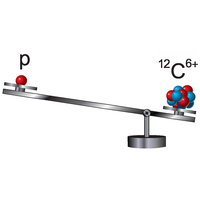
High-Precision Measurement of the Proton’s Atomic Mass

F. Heiße, F. Köhler-Langes, S. Rau, J. Hou, S. Junck, A. Kracke, A. Mooser, W. Quint, S. Ulmer, G. Werth, K. Blaum, and S. Sturm

Phys. Rev. Lett. 119, 033001 (2017) - Published 18 July, 2017

The most precise measurement to date of the proton mass finds a value that is 3 standard deviations lower than previous estimates.

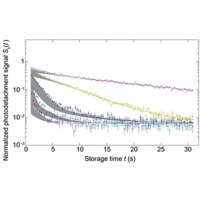
Radiative Rotational Lifetimes and State-Resolved Relative Detachment Cross Sections from Photodetachment Thermometry of Molecular Anions in a Cryogenic Storage Ring

C. Meyer et al.

Phys. Rev. Lett. 119, 023202 (2017) - Published 14 July, 2017

A beam of molecules is cooled through radiative rotation using a cryogenic storage ring without buffer gas, enabling natural lifetime measurements of lowest rotational levels in the molecules.

Topological Quantum Optics in Two-Dimensional Atomic Arrays

J. Perczel, J. Borregaard, D. E. Chang, H. Pichler, S. F. Yelin, P. Zoller, and M. D. Lukin

Phys. Rev. Lett. 119, 023603 (2017) - Published 14 July, 2017

A proposed platform for studying topological effects in quantum optical systems involves 2D atomic emitter arrays in optical lattices.

Individual Tracer Atoms in an Ultracold Dilute Gas

Michael Hohmann, Farina Kindermann, Tobias Lausch, Daniel Mayer, Felix Schmidt, Eric Lutz, and Artur Widera

Phys. Rev. Lett. 118, 263401 (2017) - Published 30 June, 2017

The tracking of individual atoms diffusing in a cold, rarefied gas reveals the influence that a single impact has on randomizing the motion.

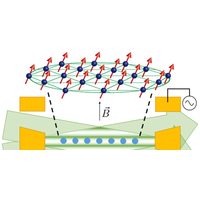
Amplitude Sensing below the Zero-Point Fluctuations with a Two-Dimensional Trapped-Ion Mechanical Oscillator

K. A. Gilmore, J. G. Bohnet, B. C. Sawyer, J. W. Britton, and J. J. Bollinger

Phys. Rev. Lett. 118, 263602 (2017) - Published 29 June, 2017

A spin-based technique is able to measure the center-of-mass motion of a 2D crystal of trapped ions to a precision 40 times below the object’s zero-point energy.

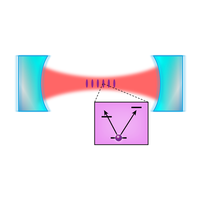
Magnetically Induced Optical Transparency on a Forbidden Transition in Strontium for Cavity-Enhanced Spectroscopy

Matthew N. Winchester, Matthew A. Norcia, Julia R. K. Cline, and James K. Thompson

Phys. Rev. Lett. 118, 263601 (2017) - Published 26 June, 2017

A magnetic field applied to an atomic sample in an optical cavity generates optical transparency that could be used to enhance the frequency stability of lasers.

Ultrafast Magnetization of a Dense Molecular Gas with an Optical Centrifuge

A. A. Milner, A. Korobenko, and V. Milner

Phys. Rev. Lett. 118, 243201 (2017) - Published 16 June, 2017

The electronic spin of paramagnetic molecules is controlled by manipulating their rotation, polarizing them. This technique should be applicable to many other paramagnetic molecules.

Recoil-Sensitive Lithium Interferometer without a Subrecoil Sample

Kayleigh Cassella, Eric Copenhaver, Brian Estey, Yanying Feng, Chen Lai, and Holger Müller

Phys. Rev. Lett. 118, 233201 (2017) - Published 9 June, 2017

A new atom interferometer works at less extreme temperatures and with lighter atoms than previous designs, opening up a new route to precision measurements of fundamental constants.

Quantum Nonlinear Optics with a Germanium-Vacancy Color Center in a Nanoscale Diamond Waveguide

M. K. Bhaskar, D. D. Sukachev, A. Sipahigil, R. E. Evans, M. J. Burek, C. T. Nguyen, L. J. Rogers, P. Siyushev, M. H. Metsch, H. Park, F. Jelezko, M. Lončar, and M. D. Lukin

Phys. Rev. Lett. 118, 223603 (2017) - Published 31 May, 2017

A diamond color center with a germanium defect has superior optical coherence properties over other color centers, with implications for application.

Dark Vibronic Polaritons and the Spectroscopy of Organic Microcavities

Felipe Herrera and Frank C. Spano

Phys. Rev. Lett. 118, 223601 (2017) - Published 30 May, 2017

A new class of collective excitation is predicted to explain the puzzling difference in magnitude between emission lines and absorption in organic microcavities.

Self-Similar Nanocavity Design with Ultrasmall Mode Volume for Single-Photon Nonlinearities

Hyeongrak Choi, Mikkel Heuck, and Dirk Englund

Phys. Rev. Lett. 118, 223605 (2017) - Published 30 May, 2017

A carefully shaped air gap in a silicon block would concentrate laser light enough to produce photons that interact with one another, even using a weak laser beam, according to theory.

Sign In to Your Journals Account

Filter

Section

Filter

Article Lookup

Enter a citation