Highlights

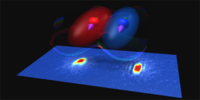
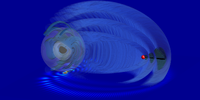
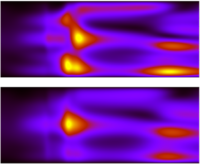
Density Waves and Jet Emission Asymmetry in Bose Fireworks

Han Fu, Lei Feng, Brandon M. Anderson, Logan W. Clark, Jiazhong Hu, Jeffery W. Andrade, Cheng Chin, and K. Levin

Phys. Rev. Lett. 121, 243001 (2018) - Published 11 December, 2018

By switching a magnetic field’s direction up and down, researchers interfered matter waves to produce density ripples that led to firework-like jets.

Mapping Twisted Light into and out of a Photonic Chip

Yuan Chen, Jun Gao, Zhi-Qiang Jiao, Ke Sun, Wei-Guan Shen, Lu-Feng Qiao, Hao Tang, Xiao-Feng Lin, and Xian-Min Jin

Phys. Rev. Lett. 121, 233602 (2018) - Published 7 December, 2018

Light waves capable of storing fragile quantum information can propagate through a photonic chip waveguide and potentially be used for on-chip computation.

Dipolar Quantum Mixtures of Erbium and Dysprosium Atoms

A. Trautmann, P. Ilzhöfer, G. Durastante, C. Politi, M. Sohmen, M. J. Mark, and F. Ferlaino

Phys. Rev. Lett. 121, 213601 (2018) - Published 21 November, 2018

A condensate mixing two species of strongly magnetic atoms provides a new experimental window into many-body phenomena.

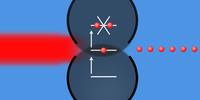
Observation of Rydberg Blockade Induced by a Single Ion

F. Engel, T. Dieterle, T. Schmid, C. Tomschitz, C. Veit, N. Zuber, R. Löw, T. Pfau, and F. Meinert

Phys. Rev. Lett. 121, 193401 (2018) - Published 8 November, 2018

Forming an ion in an ultracold atomic cloud delays the subsequent creation of a Rydberg atom until the ion wanders away.

Observation of the Bogoliubov Dispersion in a Fluid of Light

Q. Fontaine, T. Bienaimé, S. Pigeon, E. Giacobino, A. Bramati, and Q. Glorieux

Phys. Rev. Lett. 121, 183604 (2018) - Published 31 October, 2018

At room temperature light propagates like a superfluid through an atomic vapor.

Phonon-Number-Sensitive Electromechanics

J. J. Viennot, X. Ma, and K. W. Lehnert

Phys. Rev. Lett. 121, 183601 (2018) - Published 29 October, 2018

Two teams demonstrate that they can count the number of quantized vibrations, or phonons, in cold mechanical oscillators by measuring the energy in the vibrations.

Coherent Control of Penning and Associative Ionization: Insights from Symmetries

Juan J. Omiste, Johannes Floß, and Paul Brumer

Phys. Rev. Lett. 121, 163405 (2018) - Published 17 October, 2018

By taking into account formerly-neglected symmetry conditions, coherent control in atomic collision processes, such as control of Penning and Associative ionization, may be possible.

Ultrahigh-Precision Measurement of the n=2 Triplet P Fine Structure of Atomic Helium Using Frequency-Offset Separated Oscillatory Fields

K. Kato, T. D. G. Skinner, and E. A. Hessels

Phys. Rev. Lett. 121, 143002 (2018) - Published 4 October, 2018

Use of a new frequency-offset separated-oscillatory-fields technique to measure the 23P2→23P1 interval in helium allows greatly increased precision of fine-structure measurements.

Crossover from the Ultracold to the Quasiclassical Regime in State-Selected Photodissociation

S. S. Kondov, C.-H. Lee, M. McDonald, B. H. McGuyer, I. Majewska, R. Moszynski, and T. Zelevinsky

Phys. Rev. Lett. 121, 143401 (2018) - Published 2 October, 2018

Experiments track a simple molecule dissociating to find when the reaction can be described with a quantum model and when a semiclassical one will do.

Keldysh-Rutherford Model for the Attoclock

Alexander W. Bray, Sebastian Eckart, and Anatoli S. Kheifets

Phys. Rev. Lett. 121, 123201 (2018) - Published 20 September, 2018

Results from a controversial photoelectron tunneling-time experiment in an attosecond clock are explained by the Keldysh-Rutherford model.

Theoretical Prediction of the Creation and Observation of a Ghost Trilobite Chemical Bond

Matthew T. Eiles, Zhengjia Tong, and Chris H. Greene

Phys. Rev. Lett. 121, 113203 (2018) - Published 12 September, 2018

A series of electric and magnetic pulses applied to an atom could cause one of its electrons to behave as if “bonded” to an empty point in space.

Unraveling the Stereodynamics of Cold Controlled HD−H2 Collisions

James F. E. Croft, Naduvalath Balakrishnan, Meng Huang, and Hua Guo

Phys. Rev. Lett. 121, 113401 (2018) - Published 11 September, 2018

First principles simulations of the HD-H2 collisions show that a single scattering resonance controls the stereochemistry of bimolecular collisions near 1 K.

Measurement of the Dynamical Structure Factor of a 1D Interacting Fermi Gas

T. L. Yang, P. Grišins, Y. T. Chang, Z. H. Zhao, C. Y. Shih, T. Giamarchi, and R. G. Hulet

Phys. Rev. Lett. 121, 103001 (2018) - Published 4 September, 2018

Bragg spectroscopy on a one-dimensional interacting Fermi gas reveals a dynamic response in good agreement with Tomonaga-Luttinger liquid theory.

Λ-Enhanced Imaging of Molecules in an Optical Trap

Lawrence W. Cheuk, Loïc Anderegg, Benjamin L. Augenbraun, Yicheng Bao, Sean Burchesky, Wolfgang Ketterle, and John M. Doyle

Phys. Rev. Lett. 121, 083201 (2018) - Published 23 August, 2018

Researchers demonstrate a method for ultracold cooling and imaging of a dense cloud of molecules.

Hexapartite Entanglement in an above-Threshold Optical Parametric Oscillator

F. A. S. Barbosa, A. S. Coelho, L. F. Muñoz-Martínez, L. Ortiz-Gutiérrez, A. S. Villar, P. Nussenzveig, and M. Martinelli

Phys. Rev. Lett. 121, 073601 (2018) - Published 13 August, 2018

Researchers have entangled six modes of a laser cavity—a record number for such a device.

Synchronizing the Smallest Possible System

Alexandre Roulet and Christoph Bruder

Phys. Rev. Lett. 121, 053601 (2018) - Published 30 July, 2018

Theorists have determined that a quantum oscillator needs at least three energy levels in order to sync up with another oscillator.

Observation of the Unconventional Photon Blockade

H. J. Snijders, J. A. Frey, J. Norman, H. Flayac, V. Savona, A. C. Gossard, J. E. Bowers, M. P. van Exter, D. Bouwmeester, and W. Löffler

Phys. Rev. Lett. 121, 043601 (2018) - Published 23 July, 2018

Two separate groups have demonstrated a photon blockade effect that could be used to make practical single-photon emitters.

Observation of the Unconventional Photon Blockade in the Microwave Domain

Cyril Vaneph, Alexis Morvan, Gianluca Aiello, Mathieu Féchant, Marco Aprili, Julien Gabelli, and Jérôme Estève

Phys. Rev. Lett. 121, 043602 (2018) - Published 23 July, 2018

Two separate groups have demonstrated a photon blockade effect that could be used to make practical single-photon emitters.

GHz Rotation of an Optically Trapped Nanoparticle in Vacuum

René Reimann, Michael Doderer, Erik Hebestreit, Rozenn Diehl, Martin Frimmer, Dominik Windey, Felix Tebbenjohanns, and Lukas Novotny

Phys. Rev. Lett. 121, 033602 (2018) - Published 20 July, 2018

Two teams report spinning nanoscale particles at more than 60 billion rpm, the fastest rotation of any object, with the potential to probe the quantum vacuum.

Optically Levitated Nanodumbbell Torsion Balance and GHz Nanomechanical Rotor

Jonghoon Ahn, Zhujing Xu, Jaehoon Bang, Yu-Hao Deng, Thai M. Hoang, Qinkai Han, Ren-Min Ma, and Tongcang Li

Phys. Rev. Lett. 121, 033603 (2018) - Published 20 July, 2018

Two teams report spinning nanoscale particles at more than 60 billion rpm, the fastest rotation of any object, with the potential to probe the quantum vacuum.

Sign In to Your Journals Account

Filter

Section

Filter

Article Lookup

Enter a citation