Highlights

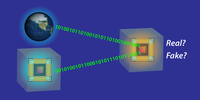
Synchronizing the Smallest Possible System

Alexandre Roulet and Christoph Bruder

Phys. Rev. Lett. 121, 053601 (2018) - Published 30 July, 2018

Theorists have determined that a quantum oscillator needs at least three energy levels in order to sync up with another oscillator.

Plastic Deformation in a Quantum Solid: Dislocation Avalanches and Creep in Helium

Zhi Gang Cheng and John Beamish

Phys. Rev. Lett. 121, 055301 (2018) - Published 30 July, 2018

The first measurement of plastic deformation of solid helium will likely lead to discovery of unusual properties of dislocations.

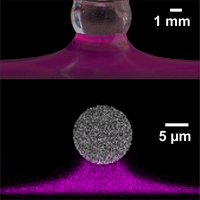
Detaching Microparticles from a Liquid Surface

Frank Schellenberger, Periklis Papadopoulos, Michael Kappl, Stefan A. L. Weber, Doris Vollmer, and Hans-Jürgen Butt

Phys. Rev. Lett. 121, 048002 (2018) - Published 27 July, 2018

The force required to detach a colloidal particle from a liquid film is accurately described when taking the receding contact angle of the liquid on the particle’s surface into account.

Generalized Gelation Theory Describes Onset of Online Extremist Support

Pedro D. Manrique, Minzhang Zheng, Zhenfeng Cao, Elvira Maria Restrepo, and Neil F. Johnson

Phys. Rev. Lett. 121, 048301 (2018) - Published 27 July, 2018

An analogy between the growth of online networks and the formation of gels suggests ways to detect extremist groups before they become influential.

Quantum Generative Adversarial Learning

Seth Lloyd and Christian Weedbrook

Phys. Rev. Lett. 121, 040502 (2018) - Published 26 July, 2018

Researchers have mathematically proven that a powerful classical machine learning algorithm should work on quantum computers.

Photon-Number-Resolved Measurement of an Exciton-Polariton Condensate

M. Klaas, E. Schlottmann, H. Flayac, F. P. Laussy, F. Gericke, M. Schmidt, M. v. Helversen, J. Beyer, S. Brodbeck, H. Suchomel, S. Höfling, S. Reitzenstein, and C. Schneider

Phys. Rev. Lett. 121, 047401 (2018) - Published 25 July, 2018

By counting the photons emitted from a microcavity, researchers shed light on the nature of an exotic condensate of quasiparticles contained in the cavity.

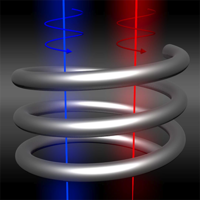
Optical Chirality in Dispersive and Lossy Media

J. Enrique Vázquez-Lozano and Alejandro Martínez

Phys. Rev. Lett. 121, 043901 (2018) - Published 24 July, 2018

A new general expression for the optical chirality density in lossless and lossy dispersive media is applicable to many material systems including among others dielectrics, plasmonic nanostructures, and left-handed metamaterials.

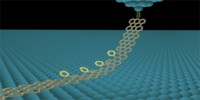
How Structural Defects Affect the Mechanical and Electrical Properties of Single Molecular Wires

Matthias Koch, Zhi Li, Christophe Nacci, Takashi Kumagai, Ignacio Franco, and Leonhard Grill

Phys. Rev. Lett. 121, 047701 (2018) - Published 24 July, 2018

Molecular defects can improve the mechanical flexibility of graphene nanoribbons without affecting their electrical properties, new experiments show.

Observation of the Unconventional Photon Blockade

H. J. Snijders, J. A. Frey, J. Norman, H. Flayac, V. Savona, A. C. Gossard, J. E. Bowers, M. P. van Exter, D. Bouwmeester, and W. Löffler

Phys. Rev. Lett. 121, 043601 (2018) - Published 23 July, 2018

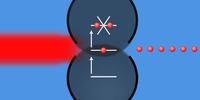
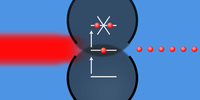
Two separate groups have demonstrated a photon blockade effect that could be used to make practical single-photon emitters.

Observation of the Unconventional Photon Blockade in the Microwave Domain

Cyril Vaneph, Alexis Morvan, Gianluca Aiello, Mathieu Féchant, Marco Aprili, Julien Gabelli, and Jérôme Estève

Phys. Rev. Lett. 121, 043602 (2018) - Published 23 July, 2018

Two separate groups have demonstrated a photon blockade effect that could be used to make practical single-photon emitters.

Room for New Physics in the Rayleigh-Jeans Tail of the Cosmic Microwave Background

Maxim Pospelov, Josef Pradler, Joshua T. Ruderman, and Alfredo Urbano

Phys. Rev. Lett. 121, 031103 (2018) - Published 20 July, 2018

New physics models that produce abundant low-energy photons could explain the EDGES observation by positing that CMB photons are warmer than expected.

GHz Rotation of an Optically Trapped Nanoparticle in Vacuum

René Reimann, Michael Doderer, Erik Hebestreit, Rozenn Diehl, Martin Frimmer, Dominik Windey, Felix Tebbenjohanns, and Lukas Novotny

Phys. Rev. Lett. 121, 033602 (2018) - Published 20 July, 2018

Two teams report spinning nanoscale particles at more than 60 billion rpm, the fastest rotation of any object, with the potential to probe the quantum vacuum.

Optically Levitated Nanodumbbell Torsion Balance and GHz Nanomechanical Rotor

Jonghoon Ahn, Zhujing Xu, Jaehoon Bang, Yu-Hao Deng, Thai M. Hoang, Qinkai Han, Ren-Min Ma, and Tongcang Li

Phys. Rev. Lett. 121, 033603 (2018) - Published 20 July, 2018

Two teams report spinning nanoscale particles at more than 60 billion rpm, the fastest rotation of any object, with the potential to probe the quantum vacuum.

Strain-Tunable GaAs Quantum Dot: A Nearly Dephasing-Free Source of Entangled Photon Pairs on Demand

Daniel Huber, Marcus Reindl, Saimon Filipe Covre da Silva, Christian Schimpf, Javier Martín-Sánchez, Huiying Huang, Giovanni Piredda, Johannes Edlinger, Armando Rastelli, and Rinaldo Trotta

Phys. Rev. Lett. 121, 033902 (2018) - Published 18 July, 2018

Quantum dots that emit entangled photon pairs on demand could be used in quantum communication networks.

Quantum Holography in a Graphene Flake with an Irregular Boundary

Anffany Chen, R. Ilan, F. de Juan, D. I. Pikulin, and M. Franz

Phys. Rev. Lett. 121, 036403 (2018) - Published 18 July, 2018

Under a strong magnetic field, a holographic image of a black hole may be realized in a flake of graphene.

Eigenvector Continuation with Subspace Learning

Dillon Frame, Rongzheng He, Ilse Ipsen, Daniel Lee, Dean Lee, and Ermal Rrapaj

Phys. Rev. Lett. 121, 032501 (2018) - Published 17 July, 2018

A new computational method tackles many-body quantum calculations that have defied a suite of existing approaches.

Tunable High-Resolution Macroscopic Self-Engineered Geometric Phase Optical Elements

Etienne Brasselet

Phys. Rev. Lett. 121, 033901 (2018) - Published 17 July, 2018

A q-plate, which converts spin angular momentum of light to orbital angular moment, is tuned via a combination of static magnetic field and a quasistatic electric field.

Realization of a Valley Superlattice

M. A. Mueed, Md. Shafayat Hossain, I. Jo, L. N. Pfeiffer, K. W. West, K. W. Baldwin, and M. Shayegan

Phys. Rev. Lett. 121, 036802 (2018) - Published 16 July, 2018

Strain in a semiconductor quantum well spatially modulates the electron population, leading to a valley superlattice.

Topologically Protected Landau Level in the Vortex Lattice of a Weyl Superconductor

M. J. Pacholski, C. W. J. Beenakker, and İ. Adagideli

Phys. Rev. Lett. 121, 037701 (2018) - Published 16 July, 2018

In a Weyl superconductor, Landau levels and a vortex lattice may coexist.

Water-Mediated Protein-Protein Interactions at High Pressures are Controlled by a Deep-Sea Osmolyte

Karin Julius, Jonathan Weine, Melanie Berghaus, Nico König, Mimi Gao, Jan Latarius, Michael Paulus, Martin A. Schroer, Metin Tolan, and Roland Winter

Phys. Rev. Lett. 121, 038101 (2018) - Published 16 July, 2018

The osmolyte compound TMAO keeps proteins from clumping and unfolding at high pressures, allowing creatures to live in a deep-sea environment.

Sign In to Your Journals Account

Filter

Section

Filter

Article Lookup

Enter a citation