Highlights

Thermalization and Sub-Poissonian Density Fluctuations in a Degenerate Molecular Fermi Gas

William G. Tobias, Kyle Matsuda, Giacomo Valtolina, Luigi De Marco, Jun-Ru Li, and Jun Ye

Phys. Rev. Lett. 124, 033401 (2020) - Published 22 January, 2020

Collisions between molecules and free atoms determine the final temperature of a dilute molecular Fermi gas.

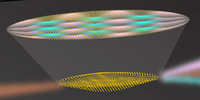
Three-Dimensional Trapping of Individual Rydberg Atoms in Ponderomotive Bottle Beam Traps

D. Barredo, V. Lienhard, P. Scholl, S. de Léséleuc, T. Boulier, A. Browaeys, and T. Lahaye

Phys. Rev. Lett. 124, 023201 (2020) - Published 16 January, 2020

A holographic technique confines excited Rydberg atoms in the central dark region of a 3D light-intensity pattern.

Low-Energy Electron Escape from Liquid Interfaces: Charge and Quantum Effects

Loren Ban, Thomas E. Gartmann, Bruce L. Yoder, and R. Signorell

Phys. Rev. Lett. 124, 013402 (2020) - Published 10 January, 2020

A new technique allows accurate measurements of electrons that escape a liquid surface—information that is essential for understanding chemical reactions in water droplets in the atmosphere.

Motional Sideband Asymmetry of a Nanoparticle Optically Levitated in Free Space

Felix Tebbenjohanns, Martin Frimmer, Vijay Jain, Dominik Windey, and Lukas Novotny

Phys. Rev. Lett. 124, 013603 (2020) - Published 8 January, 2020

Optically levitated nanosphere shows definitive signature of its quantum ground state of motion.

Absolute Measurement of Laser Ionization Yield in Atmospheric Pressure Range Gases over 14 Decades

D. Woodbury, R. M. Schwartz, E. Rockafellow, J. K. Wahlstrand, and H. M. Milchberg

Phys. Rev. Lett. 124, 013201 (2020) - Published 6 January, 2020

Laser ionization yield of dense gases confirms the model of isolated molecules and the importance of contaminants, but not of many-body effects under those conditions.

Deuteron-to-Proton Mass Ratio from the Cyclotron Frequency Ratio of H2+ to D+ with H2+ in a Resolved Vibrational State

David J. Fink and Edmund G. Myers

Phys. Rev. Lett. 124, 013001 (2020) - Published 2 January, 2020

An improved measurement of ratio of cyclotron frequencies of H2+ and D2+ leads to the most precise determination of the deuteron-to-proton mass to date.

Strong Coupling of a Single Ion to an Optical Cavity

Hiroki Takahashi, Ezra Kassa, Costas Christoforou, and Matthias Keller

Phys. Rev. Lett. 124, 013602 (2020) - Published 2 January, 2020

Cavity assisted Raman spectroscopy demonstrates vacuum Rabi splitting for an ion-cavity system, thereby showing that this system reaches the strong coupling regime.

Spin-Wave Multiplexed Atom-Cavity Electrodynamics

Kevin C. Cox, David H. Meyer, Zachary A. Castillo, Fredrik K. Fatemi, and Paul D. Kunz

Phys. Rev. Lett. 123, 263601 (2019) - Published 24 December, 2019

Researchers demonstrate a method for storing quantum information by “painting” spin-wave patterns onto an ensemble of atoms.

Subfemtosecond Tracing of Molecular Dynamics during Strong-Field Interaction

Václav Hanus, Sarayoo Kangaparambil, Seyedreza Larimian, Martin Dorner-Kirchner, Xinhua Xie (谢新华), Markus S. Schöffler, Gerhard G. Paulus, Andrius Baltuška, André Staudte, and Markus Kitzler-Zeiler

Phys. Rev. Lett. 123, 263201 (2019) - Published 23 December, 2019

Experiments capture the motion of an ionized molecule with an unprecedented combination of spatial and temporal resolution.

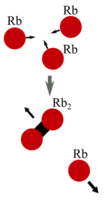
Hyperfine Magnetic Substate Resolved State-to-State Chemistry

Joschka Wolf, Markus Deiß, and Johannes Hecker Denschlag

Phys. Rev. Lett. 123, 253401 (2019) - Published 19 December, 2019

Magnetic quantum states of ultracold molecular reactions are spectroscopically resolved for three-body recombination of weakly interacting ultracold rubidium atoms.

Quasisimultons in Thermal Atomic Vapors

Thomas P. Ogden, K. A. Whittaker, J. Keaveney, S. A. Wrathmall, C. S. Adams, and R. M. Potvliege

Phys. Rev. Lett. 123, 243604 (2019) - Published 12 December, 2019

By combining two frequencies of light into a pulse called a simulton, a weak signal can travel through a dense atomic vapor as though the medium were nearly transparent.

Precision Test of the Limits to Universality in Few-Body Physics

Roman Chapurin, Xin Xie, Michael J. Van de Graaff, Jared S. Popowski, José P. D’Incao, Paul S. Julienne, Jun Ye, and Eric A. Cornell

Phys. Rev. Lett. 123, 233402 (2019) - Published 2 December, 2019

Precision measurements with ultracold gases provide evidence that three-body bound states depend on atom-specific two-body interactions.

Hanbury Brown–Twiss Correlations for a Driven Superatom

J. Lampen, A. Duspayev, H. Nguyen, H. Tamura, P. R. Berman, and A. Kuzmich

Phys. Rev. Lett. 123, 203603 (2019) - Published 15 November, 2019

An experiment involving a gas of two-level atoms distinguishes between two mechanisms of light-matter interaction: stimulated emission and Hanbury Brown and Twiss interference.

Candidate for Laser Cooling of a Negative Ion: High-Resolution Photoelectron Imaging of Th−

Rulin Tang, Ran Si, Zejie Fei, Xiaoxi Fu, Yuzhu Lu, Tomas Brage, Hongtao Liu, Chongyang Chen, and Chuangang Ning

Phys. Rev. Lett. 123, 203002 (2019) - Published 12 November, 2019

Measurements of the electron binding energy in the negative thorium ion suggest that it may be a good candidate for laser cooling.

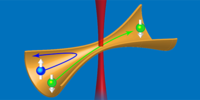
Quantized Conductance through a Spin-Selective Atomic Point Contact

Martin Lebrat, Samuel Häusler, Philipp Fabritius, Dominik Husmann, Laura Corman, and Tilman Esslinger

Phys. Rev. Lett. 123, 193605 (2019) - Published 8 November, 2019

A spin filter for cold atoms might be used as a testbed for spintronic devices and for searches for Majorana fermions.

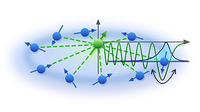
Quantum Rydberg Central Spin Model

Yuto Ashida, Tao Shi, Richard Schmidt, H. R. Sadeghpour, J. Ignacio Cirac, and Eugene Demler

Phys. Rev. Lett. 123, 183001 (2019) - Published 31 October, 2019

Rydberg excitations in ultracold atoms provide a new type of quantum impurity system unifying key features of three fundamental models: the Kondo model, the Bose polaron model, and the central spin model.

Quantum Network Nodes Based on Diamond Qubits with an Efficient Nanophotonic Interface

C. T. Nguyen, D. D. Sukachev, M. K. Bhaskar, B. Machielse, D. S. Levonian, E. N. Knall, P. Stroganov, R. Riedinger, H. Park, M. Lončar, and M. D. Lukin

Phys. Rev. Lett. 123, 183602 (2019) - Published 30 October, 2019

A solid-state qubit satisfies three key requirements of a building block for a quantum network.

Measurement of Motion beyond the Quantum Limit by Transient Amplification

R. D. Delaney, A. P. Reed, R. W. Andrews, and K. W. Lehnert

Phys. Rev. Lett. 123, 183603 (2019) - Published 30 October, 2019

A new technique allows for more precise measurements of a quantum oscillator’s time-varying displacement, with potential applications in quantum information.

Demonstration of a Timescale Based on a Stable Optical Carrier

William R. Milner, John M. Robinson, Colin J. Kennedy, Tobias Bothwell, Dhruv Kedar, Dan G. Matei, Thomas Legero, Uwe Sterr, Fritz Riehle, Holly Leopardi, Tara M. Fortier, Jeffrey A. Sherman, Judah Levine, Jian Yao, Jun Ye, and Eric Oelker

Phys. Rev. Lett. 123, 173201 (2019) - Published 21 October, 2019

An all-optical clock scheme could improve time metrology standards, taking an important step toward the redefinition of the second.

Determination of the Interval between the Ground States of Para- and Ortho-H2

M. Beyer, N. Hölsch, J. Hussels, C.-F. Cheng, E. J. Salumbides, K. S. E. Eikema, W. Ubachs, Ch. Jungen, and F. Merkt

Phys. Rev. Lett. 123, 163002 (2019) - Published 16 October, 2019

High-precision measurement of the energy shift between the ground states of ortho- and para-hydrogen yields a new fundamental physical quantity for ultraprecise quantum chemistry.

Sign In to Your Journals Account

Filter

Section

Filter

Article Lookup

Enter a citation