Highlights

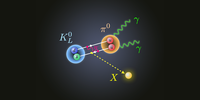
New Physics Implications of Recent Search for KL→π0νν¯ at KOTO

Teppei Kitahara, Takemichi Okui, Gilad Perez, Yotam Soreq, and Kohsaku Tobioka

Phys. Rev. Lett. 124, 071801 (2020) - Published 19 February, 2020

Previously unpredicted particles or a new type of particle interaction could explain the unexpected rare kaon decay events reported by the KOTO experiment in Japan.

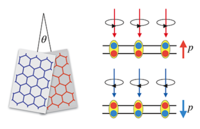
Tunable Layer Circular Photogalvanic Effect in Twisted Bilayers

Yang Gao, Yinhan Zhang, and Di Xiao

Phys. Rev. Lett. 124, 077401 (2020) - Published 19 February, 2020

Circularly polarized light at normal incidence is predicted to induce a static out-of-plane dipole moment in twisted bilayer structures.

Direct Measurements of Collisional Dynamics in Cold Atom Triads

L. A. Reynolds, E. Schwartz, U. Ebling, M. Weyland, J. Brand, and M. F. Andersen

Phys. Rev. Lett. 124, 073401 (2020) - Published 18 February, 2020

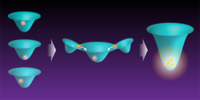
Using optical tweezers, researchers bring together three atoms in a controlled manner, allowing them to observe three-body collisions.

Strange Metal in Magic-Angle Graphene with near Planckian Dissipation

Yuan Cao, Debanjan Chowdhury, Daniel Rodan-Legrain, Oriol Rubies-Bigorda, Kenji Watanabe, Takashi Taniguchi, T. Senthil, and Pablo Jarillo-Herrero

Phys. Rev. Lett. 124, 076801 (2020) - Published 18 February, 2020

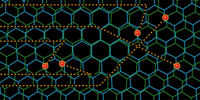
Experiments on magic-angle graphene reveal a “strange metal” phase and transport behavior consistent with so-called Planckian dissipation.

Learning the Physics of Pattern Formation from Images

Hongbo Zhao, Brian D. Storey, Richard D. Braatz, and Martin Z. Bazant

Phys. Rev. Lett. 124, 060201 (2020) - Published 14 February, 2020

Pixels in 2D video data provide information regarding the physics of pattern formation via an extension of the inversion problem applied to still images.

Tuning Contact Line Dynamics and Deposition Patterns in Volatile Liquid Mixtures

Asher P. Mouat, Clay E. Wood, Justin E. Pye, and Justin C. Burton

Phys. Rev. Lett. 124, 064502 (2020) - Published 14 February, 2020

A spreading drop containing a mixture of two liquids breaks into fingers or spherical droplets, depending on the fluids.

Free-Electron–Bound-Electron Resonant Interaction

Avraham Gover and Amnon Yariv

Phys. Rev. Lett. 124, 064801 (2020) - Published 13 February, 2020

Electrons with a modulated wave function might enable improvements in electron microscopy and quantum computing.

Electric-Field-Induced Pattern Formation in Layers of DNA Molecules at the Interface between Two Immiscible Liquids

Steffen Hardt, Johannes Hartmann, Sicheng Zhao, and Aditya Bandopadhyay

Phys. Rev. Lett. 124, 064501 (2020) - Published 12 February, 2020

A novel 2D cellular structure is formed by DNA at the interface of two immiscible liquids in a perpendicular electric field.

Predicting the Speed of Epidemics Spreading in Networks

Sam Moore and Tim Rogers

Phys. Rev. Lett. 124, 068301 (2020) - Published 12 February, 2020

A new analysis predicts the speed at which an infectious disease spreads to specific individuals in a network.

Lighting the Dark: Evolution of the Postinflationary Universe

Nathan Musoke, Shaun Hotchkiss, and Richard Easther

Phys. Rev. Lett. 124, 061301 (2020) - Published 10 February, 2020

Numerical calculations explain how density fluctuations in the Universe grew by orders of magnitude during the “primordial dark ages.”

Gravimeter Search for Compact Dark Matter Objects Moving in the Earth

C. J. Horowitz and R. Widmer-Schnidrig

Phys. Rev. Lett. 124, 051102 (2020) - Published 7 February, 2020

Using ten years of data from gravimeters placed around the globe, mountain-sized bounds are placed on the mass of hypothetical compact dark objects moving inside the Earth.

Time-Integrated Neutrino Source Searches with 10 Years of IceCube Data

M. G. Aartsen et al.

Phys. Rev. Lett. 124, 051103 (2020) - Published 6 February, 2020

Ten years of observations from the IceCube detector show that researchers are closing in on identifying the astrophysical sources of high-energy neutrinos.

Longitudinal Wobbling Motion in Au187

N. Sensharma, U. Garg, Q. B. Chen, S. Frauendorf, D. P. Burdette, J. L. Cozzi, K. B. Howard, S. Zhu, M. P. Carpenter, P. Copp, F. G. Kondev, T. Lauritsen, J. Li, D. Seweryniak, J. Wu, A. D. Ayangeakaa, D. J. Hartley, R. V. F. Janssens, A. M. Forney, W. B. Walters, S. S. Ghugre, and R. Palit

Phys. Rev. Lett. 124, 052501 (2020) - Published 5 February, 2020

A rare kind of nuclear spinning motion has been detected in an isotope of gold.

Self-Organized Synchronization of Phonon Lasers

Jiteng Sheng, Xinrui Wei, Cheng Yang, and Haibin Wu

Phys. Rev. Lett. 124, 053604 (2020) - Published 5 February, 2020

The demonstration of synchronization of two mechanical membranes leads to the first experimental optomechanics-based observation of mechanical phase locking, and the realization of a phononic memory.

Wake Induced Long Range Repulsion of Aqueous Dunes

Karol A. Bacik, Sean Lovett, Colm-cille P. Caulfield, and Nathalie M. Vriend

Phys. Rev. Lett. 124, 054501 (2020) - Published 4 February, 2020

Underwater dunes repel each other due to turbulent flow structures produced by the upstream dune.

Femtosecond Compression Dynamics and Timing Jitter Suppression in a THz-driven Electron Bunch Compressor

E. C. Snively, M. A. K. Othman, M. Kozina, B. K. Ofori-Okai, S. P. Weathersby, S. Park, X. Shen, X. J. Wang, M. C. Hoffmann, R. K. Li, and E. A. Nanni

Phys. Rev. Lett. 124, 054801 (2020) - Published 4 February, 2020

Terahertz radiation can be used to produce short and well-timed pulses of electrons—which could benefit electron diffraction schemes used to image ultrafast atomic and molecular dynamics.

Femtosecond Relativistic Electron Beam with Reduced Timing Jitter from THz Driven Beam Compression

Lingrong Zhao, Heng Tang, Chao Lu, Tao Jiang, Pengfei Zhu, Long Hu, Wei Song, Huida Wang, Jiaqi Qiu, Chunguang Jing, Sergey Antipov, Dao Xiang, and Jie Zhang

Phys. Rev. Lett. 124, 054802 (2020) - Published 4 February, 2020

Terahertz radiation can be used to produce short and well-timed pulses of electrons—which could benefit electron diffraction schemes used to image ultrafast atomic and molecular dynamics.

Universal Spectral Features of Ultrastrongly Coupled Systems

Simone Felicetti and Alexandre Le Boité

Phys. Rev. Lett. 124, 040404 (2020) - Published 31 January, 2020

Superradiant phases, previously known in the context of critical phenomena, are shown to be an intrinsic property of the ultrastrong coupling limit.

Full Electrostatic Control of Nanomechanical Buckling

Selcuk Oguz Erbil, Utku Hatipoglu, Cenk Yanik, Mahyar Ghavami, Atakan B. Ari, Mert Yuksel, and M. Selim Hanay

Phys. Rev. Lett. 124, 046101 (2020) - Published 31 January, 2020

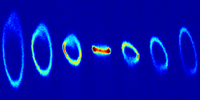
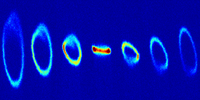
An electromechanical device allows researchers to control and study how a nanoscale beam buckles when compressed.

Electronic Griffiths Phase in Disordered Mott-Transition Systems

Riku Yamamoto, Tetsuya Furukawa, Kazuya Miyagawa, Takahiko Sasaki, Kazushi Kanoda, and Tetsuaki Itou

Phys. Rev. Lett. 124, 046404 (2020) - Published 31 January, 2020
In an organic disordered Mott-transition system a combination of randomness and correlation results in soft-matter behavior, producing a phenomenon which could be called an ”electronic Griffiths phase.”

Sign In to Your Journals Account

Filter

Section

Filter

Article Lookup

Enter a citation