Highlights

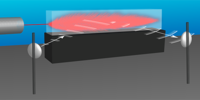
Observation of Radar Echoes from High-Energy Particle Cascades

S. Prohira, K. D. de Vries, P. Allison, J. Beatty, D. Besson, A. Connolly, N. van Eijndhoven, C. Hast, C.-Y. Kuo, U. A. Latif, T. Meures, J. Nam, A. Nozdrina, J. P. Ralston, Z. Riesen, C. Sbrocco, J. Torres, and S. Wissel

Phys. Rev. Lett. 124, 091101 (2020) - Published 6 March, 2020

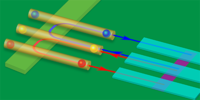
Radar could detect ultrahigh-energy neutrinos from space, according to experiments using electrons as neutrino stand-ins.

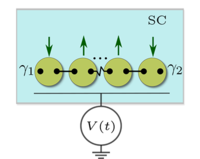
Time-Crystalline Topological Superconductors

Aaron Chew, David F. Mross, and Jason Alicea

Phys. Rev. Lett. 124, 096802 (2020) - Published 5 March, 2020

Proposed one-dimensional time-crystalline topological superconductors are predicted to yield anomalous Floquet Majorana modes that are not possible in free-fermion systems.

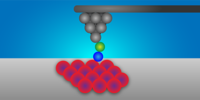
Atomically Resolved Chemical Reactivity of Small Fe Clusters

Julian Berwanger, Svitlana Polesya, Sergiy Mankovsky, Hubert Ebert, and Franz J. Giessibl

Phys. Rev. Lett. 124, 096001 (2020) - Published 4 March, 2020

Using a scanning probe microscope, researchers measure the dependence of an atom’s chemical reactivity on the number of chemical bonds it forms.

Unusual Avian Vocal Mechanism Facilitates Encoding of Body Size

Gonzalo Uribarri, María José Rodríguez-Cajarville, Pablo Luis Tubaro, Franz Goller, and Gabriel B. Mindlin

Phys. Rev. Lett. 124, 098101 (2020) - Published 4 March, 2020

The physics of how the white-tipped plantcutter creates its raspy cry reveals how a bird’s physical characteristics can link to its song.

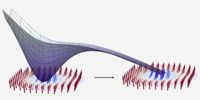
Quantum Depinning of a Magnetic Skyrmion

Christina Psaroudaki and Daniel Loss

Phys. Rev. Lett. 124, 097202 (2020) - Published 3 March, 2020

Sufficiently small magnetic skyrmions consisting of some thousands of spins can behave as quantum objects at low temperatures in the mK regime, and may demonstrate macroscopic quantum tunneling.

Weak Measurement Protocols for Majorana Bound State Identification

J. Manousakis, C. Wille, A. Altland, R. Egger, K. Flensberg, and F. Hassler

Phys. Rev. Lett. 124, 096801 (2020) - Published 2 March, 2020

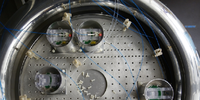
A proposed measurement technique could overcome lingering uncertainties over whether Majorana bound states have been observed in previous experiments.

Measurement of the Permanent Electric Dipole Moment of the Neutron

C. Abel et al.

Phys. Rev. Lett. 124, 081803 (2020) - Published 28 February, 2020

A new attempt to detect the neutron’s electric dipole moment tightens the constraints on theories of symmetry breaking in the early Universe.

Multiple Photodetachment of Carbon Anions via Single and Double Core-Hole Creation

A. Perry-Sassmannshausen, T. Buhr, A. Borovik, Jr., M. Martins, S. Reinwardt, S. Ricz, S. O. Stock, F. Trinter, A. Müller, S. Fritzsche, and S. Schippers

Phys. Rev. Lett. 124, 083203 (2020) - Published 27 February, 2020

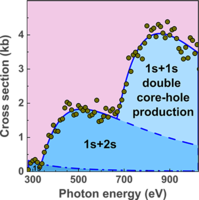
New measurements of multiple photodetachment of carbon anions via K-shell excitation and ionization yields unambiguous evidence for fivefold detachment via double K-hole production.

Acoustic Sensing of Forces Driving Fast Capillary Flows

Adrien Bussonnière, Arnaud Antkowiak, François Ollivier, Michaël Baudoin, and Régis Wunenburger

Phys. Rev. Lett. 124, 084502 (2020) - Published 27 February, 2020

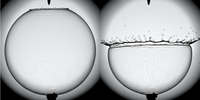
Acoustic emission from a ruptured liquid film reveals the forces that drive the liquid’s flow.

Possible Kitaev Quantum Spin Liquid State in 2D Materials with S=3/2

Changsong Xu, Junsheng Feng, Mitsuaki Kawamura, Youhei Yamaji, Yousra Nahas, Sergei Prokhorenko, Yang Qi, Hongjun Xiang, and L. Bellaiche

Phys. Rev. Lett. 124, 087205 (2020) - Published 27 February, 2020

A strong Kitaev term predicted to be found in a series of Cr-based 2D magnets indicates possible quantum spin liquid states in those materials when subjected to epitaxial strain.

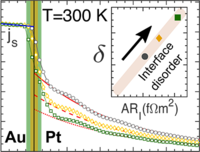
Disorder Dependence of Interface Spin Memory Loss

Kriti Gupta, Rien J. H. Wesselink, Ruixi Liu, Zhe Yuan, and Paul J. Kelly

Phys. Rev. Lett. 124, 087702 (2020) - Published 27 February, 2020

A combination of first-principles relativistic quantum transport calculations and realistic modeling of thermal spin and lattice disorder allows the calculation of current profiles through a number of relevant interfaces.

Search for a Variation of the Fine Structure Constant around the Supermassive Black Hole in Our Galactic Center

A. Hees, T. Do, B. M. Roberts, A. M. Ghez, S. Nishiyama, R. O. Bentley, A. K. Gautam, S. Jia, T. Kara, J. R. Lu, H. Saida, S. Sakai, M. Takahashi, and Y. Takamori

Phys. Rev. Lett. 124, 081101 (2020) - Published 26 February, 2020

A spectral analysis of stars at our Galaxy’s center sets the first constraints on how much the fine-structure constant varies in the vicinity of a supermassive black hole.

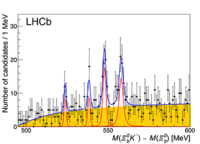
First Observation of Excited Ωb− States

R. Aaij et al. (LHCb Collaboration)

Phys. Rev. Lett. 124, 082002 (2020) - Published 25 February, 2020

Excited Ωb− baryons are seen as narrow peaks in the Ξb0K− mass spectra for the first time.

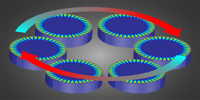
Permanent Directional Heat Currents in Lattices of Optomechanical Resonators

Zakari Denis, Alberto Biella, Ivan Favero, and Cristiano Ciuti

Phys. Rev. Lett. 124, 083601 (2020) - Published 25 February, 2020

A ring of resonators could support a persistent heat flow despite having a uniform temperature, new calculations show.

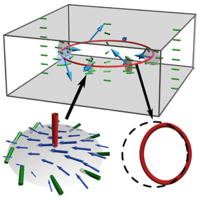
Three-Dimensional Active Defect Loops

Jack Binysh, Žiga Kos, Simon Čopar, Miha Ravnik, and Gareth P. Alexander

Phys. Rev. Lett. 124, 088001 (2020) - Published 25 February, 2020

Three-dimensional defect loops in active nematics self-propel and distort by driving flows along the defect line.

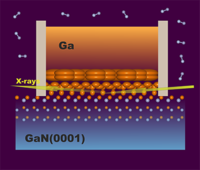
Complex Geometric Structure of a Simple Solid-Liquid Interface: GaN(0001)-Ga

A. E. F. de Jong, V. Vonk, M. Boćkowski, I. Grzegory, V. Honkimäki, and E. Vlieg

Phys. Rev. Lett. 124, 086101 (2020) - Published 24 February, 2020

The structure of the solid-liquid interface between Ga and GaN(0001) is studied with unprecedented detail and found to be surprisingly complex and have a connection to Friedel oscillations.

Photonic Refrigeration from Time-Modulated Thermal Emission

Siddharth Buddhiraju, Wei Li, and Shanhui Fan

Phys. Rev. Lett. 124, 077402 (2020) - Published 21 February, 2020

A device described in a new proposal would cool an object by causing it to radiate extra heat.

Quantum Rifling: Protecting a Qubit from Measurement Back Action

Daniel Szombati, Alejandro Gomez Frieiro, Clemens Müller, Tyler Jones, Markus Jerger, and Arkady Fedorov

Phys. Rev. Lett. 124, 070401 (2020) - Published 20 February, 2020

The state of a superconducting qubit can be preserved by increasing the drive strength, thus introducing further control over decoherence processes.

Sending-or-Not-Sending with Independent Lasers: Secure Twin-Field Quantum Key Distribution over 509 km

Jiu-Peng Chen, Chi Zhang, Yang Liu, Cong Jiang, Weijun Zhang, Xiao-Long Hu, Jian-Yu Guan, Zong-Wen Yu, Hai Xu, Jin Lin, Ming-Jun Li, Hao Chen, Hao Li, Lixing You, Zhen Wang, Xiang-Bin Wang, Qiang Zhang, and Jian-Wei Pan

Phys. Rev. Lett. 124, 070501 (2020) - Published 20 February, 2020

Secure twin-field quantum key distribution over 509 km in optical fiber has been achieved, using independent lasers with a remote frequency-locking technique.

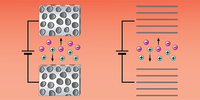
Blessing and Curse: How a Supercapacitor’s Large Capacitance Causes its Slow Charging

Cheng Lian, Mathijs Janssen, Honglai Liu, and René van Roij

Phys. Rev. Lett. 124, 076001 (2020) - Published 20 February, 2020

A new model more accurately predicts the charging time of real supercapacitors by better accounting for the structure of the device’s porous electrodes.

Sign In to Your Journals Account

Filter

Section

Filter

Article Lookup

Enter a citation