Highlights

Has NANOGrav Found First Evidence for Cosmic Strings?

Simone Blasi, Vedran Brdar, and Kai Schmitz

Phys. Rev. Lett. 126, 041305 (2021) - Published 28 January, 2021

A pulsar survey has detected a potential signal from low-frequency gravitational waves, which theorists are eager to explain.

Topological Metric Detects Hidden Order in Disordered Media

Dominic J. Skinner, Boya Song, Hannah Jeckel, Eric Jelli, Knut Drescher, and Jörn Dunkel

Phys. Rev. Lett. 126, 048101 (2021) - Published 27 January, 2021

Eighteenth century mathematics of soil transport helps uncover hidden order in disordered systems, such as tissues and glasses.

Certifying the Adiabatic Preparation of Ultracold Lattice Bosons in the Vicinity of the Mott Transition

Cécile Carcy, Gaétan Hercé, Antoine Tenart, Tommaso Roscilde, and David Clément

Phys. Rev. Lett. 126, 045301 (2021) - Published 26 January, 2021

Thermometry of ultracold bosons in an optical lattice shows adiabatic preparation of finite-entropy states across the superfluid—Mott-insulator quantum critical point.

Twist Angle-Dependent Interlayer Exciton Lifetimes in van der Waals Heterostructures

Junho Choi, Matthias Florian, Alexander Steinhoff, Daniel Erben, Kha Tran, Dong Seob Kim, Liuyang Sun, Jiamin Quan, Robert Claassen, Somak Majumder, Jennifer A. Hollingsworth, Takashi Taniguchi, Kenji Watanabe, Keiji Ueno, Akshay Singh, Galan Moody, Frank Jahnke, and Xiaoqin Li

Phys. Rev. Lett. 126, 047401 (2021) - Published 26 January, 2021

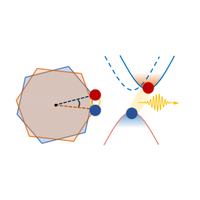
Varying the twist angle between layers of a 2D semiconductor can prolong the duration of resonances that give the material its unique optoelectronic properties.

Skyrmion Spin Ice in Liquid Crystals

Ayhan Duzgun and Cristiano Nisoli

Phys. Rev. Lett. 126, 047801 (2021) - Published 26 January, 2021

Artificial spin ice can be realized and controlled in a skyrmion liquid crystal.

Spectroscopy along Flerovium Decay Chains: Discovery of Ds280 and an Excited State in Cn282

A. Såmark-Roth et al.

Phys. Rev. Lett. 126, 032503 (2021) - Published 22 January, 2021

The discovery that copernicium can decay into a new isotope of darmstadtium and the observation of a previously unseen excited state of copernicium provide clues to the location of the “island of stability.”

Scalar Signatures of Chaotic Mixing in Porous Media

J. Heyman, D. R. Lester, and T. Le Borgne

Phys. Rev. Lett. 126, 034505 (2021) - Published 22 January, 2021

Video from a new technique reveals the chaotic motion of a fluid flowing through a pile of gravel.

Faceting and Flattening of Emulsion Droplets: A Mechanical Model

Ireth García-Aguilar, Piermarco Fonda, Eli Sloutskin, and Luca Giomi

Phys. Rev. Lett. 126, 038001 (2021) - Published 21 January, 2021

Researchers uncover the mechanism that makes some oil droplets change shape from spheres to icosahedrons to flattened plates.

Many-Body Chaos in the Sachdev-Ye-Kitaev Model

Bryce Kobrin, Zhenbin Yang, Gregory D. Kahanamoku-Meyer, Christopher T. Olund, Joel E. Moore, Douglas Stanford, and Norman Y. Yao

Phys. Rev. Lett. 126, 030602 (2021) - Published 20 January, 2021

A numerical technique allows the verification of analytical bounds for the SYK model and the investigation of chaotic behavior in generic quantum many-body systems of high dimensions.

Transport of a Single Cold Ion Immersed in a Bose-Einstein Condensate

T. Dieterle, M. Berngruber, C. Hölzl, R. Löw, K. Jachymski, T. Pfau, and F. Meinert

Phys. Rev. Lett. 126, 033401 (2021) - Published 19 January, 2021

Direct observation of an ion moving through a Bose-Einstein condensate identifies the effect of ion-atom collisions on charge transport in an ultracold gas.

High-Frequency Acoustic Droplet Vaporization is Initiated by Resonance

Guillaume Lajoinie, Tim Segers, and Michel Versluis

Phys. Rev. Lett. 126, 034501 (2021) - Published 19 January, 2021

Resonant ultrasonic vaporization of droplets can be important in applications ranging from cancer therapy to combustion efficiency.

Optical-Relayed Entanglement Distribution Using Drones as Mobile Nodes

Hua-Ying Liu, Xiao-Hui Tian, Changsheng Gu, Pengfei Fan, Xin Ni, Ran Yang, Ji-Ning Zhang, Mingzhe Hu, Jian Guo, Xun Cao, Xiaopeng Hu, Gang Zhao, Yan-Qing Lu, Yan-Xiao Gong, Zhenda Xie, and Shi-Ning Zhu

Phys. Rev. Lett. 126, 020503 (2021) - Published 15 January, 2021

A small prototype of a drone-based quantum network has successfully relayed a quantum signal over a kilometer of free space.

Desynchronization Transitions in Adaptive Networks

Rico Berner, Simon Vock, Eckehard Schöll, and Serhiy Yanchuk

Phys. Rev. Lett. 126, 028301 (2021) - Published 15 January, 2021

A master stability approach for a general class of adaptive networks provides a powerful tool to study collective effects by decoupling topological and dynamical properties of the network.

Fracture Diodes: Directional Asymmetry of Fracture Toughness

N. R. Brodnik, S. Brach, C. M. Long, G. Ravichandran, B. Bourdin, K. T. Faber, and K. Bhattacharya

Phys. Rev. Lett. 126, 025503 (2021) - Published 14 January, 2021

Researchers have designed a metamaterial that is nearly twice as resistant to cracking in one direction versus the other—what they call a fracture diode.

Observation of Pauli Crystals

Marvin Holten, Luca Bayha, Keerthan Subramanian, Carl Heintze, Philipp M. Preiss, and Selim Jochim

Phys. Rev. Lett. 126, 020401 (2021) - Published 13 January, 2021

A novel, high-resolution fluorescence imaging technique reveals a pattern, known as a Pauli crystal, that can emerge in a cloud of trapped, noninteracting fermions.

Swirling Instability of the Microtubule Cytoskeleton

David B. Stein, Gabriele De Canio, Eric Lauga, Michael J. Shelley, and Raymond E. Goldstein

Phys. Rev. Lett. 126, 028103 (2021) - Published 13 January, 2021

During a fruit-fly egg cell’s early development, its internal fluid begins to swirl in a vortex—a transition caused by the coordinated behavior of elastic filaments in the cell.

Ab Initio Limits of Atomic Nuclei

S. R. Stroberg, J. D. Holt, A. Schwenk, and J. Simonis

Phys. Rev. Lett. 126, 022501 (2021) - Published 12 January, 2021

First-principles calculations predict the properties of nearly 700 isotopes between helium and iron, showing which nuclides can exist and which cannot.

Evidence of Three-Dimensional Asymmetries Seeded by High-Density Carbon-Ablator Nonuniformity in Experiments at the National Ignition Facility

D. T. Casey et al.

Phys. Rev. Lett. 126, 025002 (2021) - Published 12 January, 2021

Novel fusion experiments indicate that nonuniformity in the ablator shell thickness hinders implosion performance significantly.

Optical Mass Spectrometry of Cold RaOH+ and RaOCH3+

M. Fan, C. A. Holliman, X. Shi, H. Zhang, M. W. Straus, X. Li, S. W. Buechele, and A. M. Jayich

Phys. Rev. Lett. 126, 023002 (2021) - Published 11 January, 2021

Researchers design radioactive molecules that might have exceptional sensitivity to the symmetry violations explaining the matter-antimatter imbalance of the Universe.

Probing Fundamental Symmetries of Deformed Nuclei in Symmetric Top Molecules

Phelan Yu and Nicholas R. Hutzler

Phys. Rev. Lett. 126, 023003 (2021) - Published 11 January, 2021

Researchers design radioactive molecules that might have exceptional sensitivity to the symmetry violations explaining the matter-antimatter imbalance of the Universe.

Sign In to Your Journals Account

Filter

Section

Filter

Article Lookup

Enter a citation