Highlights

Spin-Conservation Propensity Rule for Three-Body Recombination of Ultracold Rb Atoms

Shinsuke Haze, José P. D’Incao, Dominik Dorer, Markus Deiß, Eberhard Tiemann, Paul S. Julienne, and Johannes Hecker Denschlag

Phys. Rev. Lett. 128, 133401 (2022) - Published 1 April, 2022

The propensity rule for the total spin conservation of many-body ultracold collisions is confirmed experimentally.

Magnetic-Field Effect as a Tool to Investigate Electron Correlation in Strong-Field Ionization

Kang Lin, Xiang Chen, Sebastian Eckart, Hui Jiang, Alexander Hartung, Daniel Trabert, Kilian Fehre, Jonas Rist, Lothar Ph. H. Schmidt, Markus S. Schöffler, Till Jahnke, Maksim Kunitski, Feng He, and Reinhard Dörner

Phys. Rev. Lett. 128, 113201 (2022) - Published 16 March, 2022

The role of the magnetic field of light in double ionization explains the lack of nondipole contributions from initial tunneling to recollision.

Observation of Chemical Reactions between a Trapped Ion and Ultracold Feshbach Dimers

H. Hirzler, R. S. Lous, E. Trimby, J. Pérez-Ríos, A. Safavi-Naini, and R. Gerritsma

Phys. Rev. Lett. 128, 103401 (2022) - Published 10 March, 2022

Researchers demonstrate that they can create molecules from lithium dimers and ytterbium ions, paving the way for quantum chemistry studies in a new type of system.

Defect-Free Arbitrary-Geometry Assembly of Mixed-Species Atom Arrays

Cheng Sheng, Jiayi Hou, Xiaodong He, Kunpeng Wang, Ruijun Guo, Jun Zhuang, Bahtiyar Mamat, Peng Xu, Min Liu, Jin Wang, and Mingsheng Zhan

Phys. Rev. Lett. 128, 083202 (2022) - Published 24 February, 2022

Two research teams have created arrays containing two different neutral atoms, a promising platform for quantum computing.

Superresolution Microscopy of Optical Fields Using Tweezer-Trapped Single Atoms

Emma Deist, Justin A. Gerber, Yue-Hui Lu, Johannes Zeiher, and Dan M. Stamper-Kurn

Phys. Rev. Lett. 128, 083201 (2022) - Published 22 February, 2022

A one-dimensional array of atoms has been used to make superresolution measurements of the electromagnetic field distribution within an optical cavity.

Nonlocal Scatterer for Compact Wave-Based Analog Computing

Heedong Goh and Andrea Alù

Phys. Rev. Lett. 128, 073201 (2022) - Published 18 February, 2022

Predictions indicate that a nanometer-sized wave-based computer could solve equations in a fraction of the time of their larger, electronic counterparts.

Collective Radiative Dynamics of an Ensemble of Cold Atoms Coupled to an Optical Waveguide

Riccardo Pennetta, Martin Blaha, Aisling Johnson, Daniel Lechner, Philipp Schneeweiss, Jürgen Volz, and Arno Rauschenbeutel

Phys. Rev. Lett. 128, 073601 (2022) - Published 16 February, 2022

An ensemble of cold atoms is coherently coupled in a controlled way to a tapered optical fiber, demonstrating collective effects in this system.

Coupling Two Laser-Cooled Ions via a Room-Temperature Conductor

Da An, Alberto M. Alonso, Clemens Matthiesen, and Hartmut Häffner

Phys. Rev. Lett. 128, 063201 (2022) - Published 7 February, 2022

Two separate teams have demonstrated a way to couple two ions through a metal wire, offering a way to remotely cool ions.

Self-Pinning Transition of a Tonks-Girardeau Gas in a Bose-Einstein Condensate

Tim Keller, Thomás Fogarty, and Thomas Busch

Phys. Rev. Lett. 128, 053401 (2022) - Published 31 January, 2022

A mixture of ultracold bosons may undergo 1D crystallization due to interspecies interaction.

Magnetic-Field Effect in High-Order Above-Threshold Ionization

Kang Lin, Simon Brennecke, Hongcheng Ni, Xiang Chen, Alexander Hartung, Daniel Trabert, Kilian Fehre, Jonas Rist, Xiao-Min Tong, Joachim Burgdörfer, Lothar Ph. H. Schmidt, Markus S. Schöffler, Till Jahnke, Maksim Kunitski, Feng He, Manfred Lein, Sebastian Eckart, and Reinhard Dörner

Phys. Rev. Lett. 128, 023201 (2022) - Published 14 January, 2022

A target-sensitive nondipole effect is experimentally observed for the first time in strong-field ionization.

Self-Consistent-Field Method for Correlated Many-Electron Systems with an Entropic Cumulant Energy

Jian Wang and Evert Jan Baerends

Phys. Rev. Lett. 128, 013001 (2022) - Published 3 January, 2022

A self-consistent method based on density matrix functional theory delivers accurate and computationally efficient calculation of many-electron correlations.

Picometer-Resolved Photoemission Position within the Molecule by Strong-Field Photoelectron Holography

Wenhai Xie, Jiaqing Yan, Min Li, Chuanpeng Cao, Keyu Guo, Yueming Zhou, and Peixiang Lu

Phys. Rev. Lett. 127, 263202 (2021) - Published 22 December, 2021

A new technique pinpoints, with picometer resolution, the location from which an emitted electron originates within a molecule.

High Phase-Space Density of Laser-Cooled Molecules in an Optical Lattice

Yewei Wu, Justin J. Burau, Kameron Mehling, Jun Ye, and Shiqian Ding

Phys. Rev. Lett. 127, 263201 (2021) - Published 21 December, 2021

Researchers achieve the lowest temperature yet for laser-cooled molecules trapped in an optical lattice.

Zeeman-Sisyphus Deceleration of Molecular Beams

Benjamin L. Augenbraun, Alexander Frenett, Hiromitsu Sawaoka, Christian Hallas, Nathaniel B. Vilas, Abdullah Nasir, Zack D. Lasner, and John M. Doyle

Phys. Rev. Lett. 127, 263002 (2021) - Published 20 December, 2021

A magnetic-field based method can slow molecular beams that cannot be slowed using other techniques, unlocking the door to ultracold polyatomic molecular physics.

Deuteron-to-Proton Mass Ratio from Simultaneous Measurement of the Cyclotron Frequencies of H2+ and D+

David J. Fink and Edmund G. Myers

Phys. Rev. Lett. 127, 243001 (2021) - Published 7 December, 2021

Coupled ion measurement yields a deuteron to proton mass ratio with a fractional uncertainty of 4.5 parts per trillion.

Atomic Compass: Detecting 3D Magnetic Field Alignment with Vector Vortex Light

Francesco Castellucci, Thomas W. Clark, Adam Selyem, Jinwen Wang, and Sonja Franke-Arnold

Phys. Rev. Lett. 127, 233202 (2021) - Published 30 November, 2021

An update to the polarization of the laser light used in an atom-based compass allows the technology to reveal the 3D alignment of a magnetic field in one snapshot, rather than many.

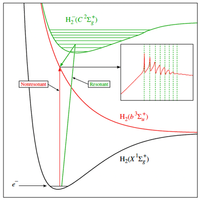
Electronic and Vibrational Close-Coupling Method for Resonant Electron-Molecule Scattering

Liam H. Scarlett, Igor Bray, and Dmitry V. Fursa

Phys. Rev. Lett. 127, 223401 (2021) - Published 24 November, 2021

Incorporation of resonant phenomena into a molecular close-coupling method allows calculation of electron-molecule scattering and interference effects in a single theoretical framework.

Deceleration and Trapping of SrF Molecules

P. Aggarwal, Y. Yin, K. Esajas, H. L. Bethlem, A. Boeschoten, A. Borschevsky, S. Hoekstra, K. Jungmann, V. R. Marshall, T. B. Meijknecht, M. C. Mooij, R. G. E. Timmermans, A. Touwen, W. Ubachs, and L. Willmann (NL−eEDM Collaboration)

Phys. Rev. Lett. 127, 173201 (2021) - Published 21 October, 2021

Electric deceleration brings a beam of the largest molecules yet to a standstill.

Single-Molecule Vacuum Rabi Splitting: Four-Wave Mixing and Optical Switching at the Single-Photon Level

André Pscherer, Manuel Meierhofer, Daqing Wang, Hrishikesh Kelkar, Diego Martín-Cano, Tobias Utikal, Stephan Götzinger, and Vahid Sandoghdar

Phys. Rev. Lett. 127, 133603 (2021) - Published 24 September, 2021

A single molecule can turn a beam of photons on or off, a potentially useful function for a quantum computer.

Fourfold Differential Photoelectron Circular Dichroism

K. Fehre et al.

Phys. Rev. Lett. 127, 103201 (2021) - Published 2 September, 2021

Photoelectron circular dichroism is used to develop a sensitive tool to detect chirality in randomly oriented molecules.

Sign In to Your Journals Account

Filter

Section

Filter

Article Lookup

Enter a citation