Highlights

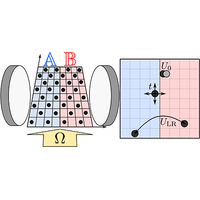
Quantum Critical Behavior of Entanglement in Lattice Bosons with Cavity-Mediated Long-Range Interactions

Shraddha Sharma, Simon B. Jäger, Rebecca Kraus, Tommaso Roscilde, and Giovanna Morigi

Phys. Rev. Lett. 129, 143001 (2022) - Published 26 September, 2022

Scaling of entanglement entropy can signal the different phase transitions in a two-dimensional quantum many-body system with long-range interactions.

Engineering Symmetry-Selective Couplings of a Superconducting Artificial Molecule to Microwave Waveguides

Mohammed Ali Aamir, Claudia Castillo Moreno, Simon Sundelin, Janka Biznárová, Marco Scigliuzzo, Kowshik Erappaji Patel, Amr Osman, D. P. Lozano, Ingrid Strandberg, and Simone Gasparinetti

Phys. Rev. Lett. 129, 123604 (2022) - Published 15 September, 2022

Considering symmetry in waveguide couplings to transmon qubits, quasiselection rules are implemented in superconducting quantum optics.

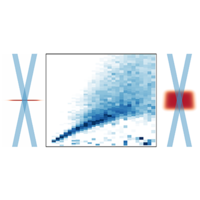
Two-Dimensional Programmable Tweezer Arrays of Fermions

Zoe Z. Yan, Benjamin M. Spar, Max L. Prichard, Sungjae Chi, Hao-Tian Wei, Eduardo Ibarra-García-Padilla, Kaden R. A. Hazzard, and Waseem S. Bakr

Phys. Rev. Lett. 129, 123201 (2022) - Published 14 September, 2022

An optical tweezer with a stroboscopic twist can trap cold atoms in lattices of all shapes.

Nanoscale Magnetism Probed in a Matter-Wave Interferometer

Yaakov Y. Fein, Sebastian Pedalino, Armin Shayeghi, Filip Kiałka, Stefan Gerlich, and Markus Arndt

Phys. Rev. Lett. 129, 123001 (2022) - Published 12 September, 2022

A matter-wave interferometer can probe the magnetism of a broad range of species, from single atoms to very large, weakly magnetic molecules.

Subrecoil Clock-Transition Laser Cooling Enabling Shallow Optical Lattice Clocks

X. Zhang, K. Beloy, Y. S. Hassan, W. F. McGrew, C.-C. Chen, J. L. Siegel, T. Grogan, and A. D. Ludlow

Phys. Rev. Lett. 129, 113202 (2022) - Published 8 September, 2022

Researchers have cooled ytterbium atoms to a few tens of nanokelvin, which might usher in the next generation of optical atomic clocks.

Observation of Interaction-Induced Mobility Edge in an Atomic Aubry-André Wire

Yunfei Wang, Jia-Hui Zhang, Yuqing Li, Jizhou Wu, Wenliang Liu, Feng Mei, Ying Hu, Liantuan Xiao, Jie Ma, Cheng Chin, and Suotang Jia

Phys. Rev. Lett. 129, 103401 (2022) - Published 1 September, 2022

A cold-atom experiment suggests that interactions between particles can induce the coexistence of localized and extended states in a quantum wire.

Observing the Influence of Reduced Dimensionality on Fermionic Superfluids

Lennart Sobirey, Hauke Biss, Niclas Luick, Markus Bohlen, Henning Moritz, and Thomas Lompe

Phys. Rev. Lett. 129, 083601 (2022) - Published 17 August, 2022

Measurements of the excitation spectrum and superfluid gap of quasi-2D Fermi gases indicate that there is no inherent difference in the stability of two-dimensional and three-dimensional fermionic superfluids.

All-Optical Synchronization of Remote Optomechanical Systems

Jin Li, Zhong-Hao Zhou, Shuai Wan, Yan-Lei Zhang, Zhen Shen, Ming Li, Chang-Ling Zou, Guang-Can Guo, and Chun-Hua Dong

Phys. Rev. Lett. 129, 063605 (2022) - Published 5 August, 2022

Researchers have optically synced the motion of two micrometer-sized objects separated by 5 km, a distance around a hundred million times longer than previous demonstrations.

Squeezed Light from a Levitated Nanoparticle at Room Temperature

Lorenzo Magrini, Victor A. Camarena-Chávez, Constanze Bach, Aisling Johnson, and Markus Aspelmeyer

Phys. Rev. Lett. 129, 053601 (2022) - Published 25 July, 2022

A trapped nanoparticle interacting with a laser provides a simple way to generate squeezed light, which has an unusually low level of fluctuations.

Ponderomotive Squeezing of Light by a Levitated Nanoparticle in Free Space

Andrei Militaru, Massimiliano Rossi, Felix Tebbenjohanns, Oriol Romero-Isart, Martin Frimmer, and Lukas Novotny

Phys. Rev. Lett. 129, 053602 (2022) - Published 25 July, 2022

A trapped nanoparticle interacting with a laser provides a simple way to generate squeezed light, which has an unusually low level of fluctuations.

Subpromille Measurements and Calculations of CO (3–0) Overtone Line Intensities

Katarzyna Bielska, Aleksandra A. Kyuberis, Zachary D. Reed, Gang Li, Agata Cygan, Roman Ciuryło, Erin M. Adkins, Lorenzo Lodi, Nikolay F. Zobov, Volker Ebert, Daniel Lisak, Joseph T. Hodges, Jonathan Tennyson, and Oleg L. Polyansky

Phys. Rev. Lett. 129, 043002 (2022) - Published 21 July, 2022

Two independent laboratories measure the intensity of spectral lines in the second overtone band of 12C16O to an unprecedented degree of precision and accuracy, thereby enabling the definition of new intensity standards and reducing the biases in future measurements of spectroscopic peak areas.

Position Measurement of a Levitated Nanoparticle via Interference with Its Mirror Image

Lorenzo Dania, Katharina Heidegger, Dmitry S. Bykov, Giovanni Cerchiari, Gabriel Araneda, and Tracy E. Northup

Phys. Rev. Lett. 129, 013601 (2022) - Published 28 June, 2022

A scattered laser beam’s interaction with itself creates a motion-detection method precise enough to determine whether a trapped particle is in its ground state.

Vibronic Coupling through the Continuum in the e+CO2 System

Jan Dvořák, Miloš Ranković, Karel Houfek, Pamir Nag, Roman Čurík, Juraj Fedor, and Martin Čížek

Phys. Rev. Lett. 129, 013401 (2022) - Published 27 June, 2022

High-resolution spectra of electron loss in CO2 reveal non-Born–Oppenheimer dynamics in the nuclear motion produced by vibrational coupling.

Femtosecond Rotational Dynamics of D2 Molecules in Superfluid Helium Nanodroplets

Junjie Qiang, Lianrong Zhou, Peifen Lu, Kang Lin, Yongzhe Ma, Shengzhe Pan, Chenxu Lu, Wenyu Jiang, Fenghao Sun, Wenbin Zhang, Hui Li, Xiaochun Gong, Ilya Sh. Averbukh, Yehiam Prior, Constant A. Schouder, Henrik Stapelfeldt, Igor N. Cherepanov, Mikhail Lemeshko, Wolfgang Jäger, and Jian Wu

Phys. Rev. Lett. 128, 243201 (2022) - Published 16 June, 2022

A laser nudges deuterium molecules into friction-free motion within a superfluid.

Floquet Spin Amplification

Min Jiang, Yushu Qin, Xin Wang, Yuanhong Wang, Haowen Su, Xinhua Peng, and Dmitry Budker

Phys. Rev. Lett. 128, 233201 (2022) - Published 9 June, 2022

Floquet amplifiers based on periodically-driven xenon spins provide femtotesla-level precision in magnetic field measurements and broad bandwidth.

Realization of a Fermi-Hubbard Optical Tweezer Array

Benjamin M. Spar, Elmer Guardado-Sanchez, Sungjae Chi, Zoe Z. Yan, and Waseem S. Bakr

Phys. Rev. Lett. 128, 223202 (2022) - Published 1 June, 2022

An eight-site Fermi-Hubbard chain is realized in an optical tweezer array of 6Li atoms, increasing the size of the Hilbert space by over three orders of magnitude over previous experiments.

Laser Probing of the Rotational Cooling of Molecular Ions by Electron Collisions

Ábel Kálosi, Manfred Grieser, Robert von Hahn, Ulrich Hechtfischer, Claude Krantz, Holger Kreckel, Damian Müll, Daniel Paul, Daniel W. Savin, Patrick Wilhelm, Andreas Wolf, and Oldřich Novotný

Phys. Rev. Lett. 128, 183402 (2022) - Published 4 May, 2022

Researchers use lasers and extreme cooling to monitor the rotational states of molecular ions after they collide with electrons, confirming predictions about the rates of these collisions.

Laughlin’s Topological Charge Pump in an Atomic Hall Cylinder

Aurélien Fabre, Jean-Baptiste Bouhiron, Tanish Satoor, Raphael Lopes, and Sylvain Nascimbene

Phys. Rev. Lett. 128, 173202 (2022) - Published 25 April, 2022

Using atomic spin to represent a synthetic dimension, researchers have experimentally verified the predictions of a long-unrealized thought experiment.

Evidence of Two-Source King Plot Nonlinearity in Spectroscopic Search for New Boson

Joonseok Hur, Diana P. L. Aude Craik, Ian Counts, Eugene Knyazev, Luke Caldwell, Calvin Leung, Swadha Pandey, Julian C. Berengut, Amy Geddes, Witold Nazarewicz, Paul-Gerhard Reinhard, Akio Kawasaki, Honggi Jeon, Wonho Jhe, and Vladan Vuletić

Phys. Rev. Lett. 128, 163201 (2022) - Published 22 April, 2022

Tests of the standard model of particle physics using nuclear isotopes are becoming increasingly precise but they have a way to go before they can confirm the existence of any new particles.

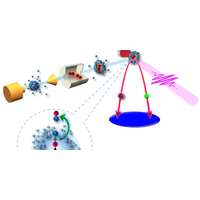
Intermolecular Coulombic Decay in Liquid Water

Pengju Zhang, Conaill Perry, Tran Trung Luu, Danylo Matselyukh, and Hans Jakob Wörner

Phys. Rev. Lett. 128, 133001 (2022) - Published 1 April, 2022

The first observation of intermolecular Coulombic decay following inner-valence ionization in liquid water is made in a tabletop experiment.

Sign In to Your Journals Account

Filter

Section

Filter

Article Lookup

Enter a citation