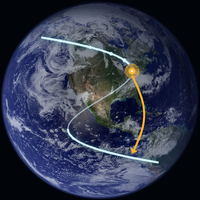
Earth’s climate and geophysical systems offer a natural frontier for interdisciplinary physics: they are driven far from equilibrium, internally active, heterogeneous across scales, and capable of yielding through abrupt reorganization. Under changing forcing and internal variability, gradual trends can trigger bifurcations and potentially irreversible shifts, from fault instability to reorganizations of atmospheric and oceanic circulation. Understanding these tipping points demands approaches that cross disciplinary boundaries. Inviting editors Valerio Lucarini and Tommaso Alberti solicitted a series of short Perspective articles connecting statistical physics, nonlinear dynamics, stochastic processes, data assimilation, and machine learning. Together, the contributions assess where the field stands, how critical transitions can be detected and attributed, and which theoretical, observational, and computational tools are needed to anticipate change at the edge of predictability.