

- Open Access
Accuracy comes at a cost: Optimal localization against a flow
Phys. Rev. E 113, 064142 – Published 22 June, 2026
DOI: https://doi.org/10.1103/z6b5-s3z2
Abstract
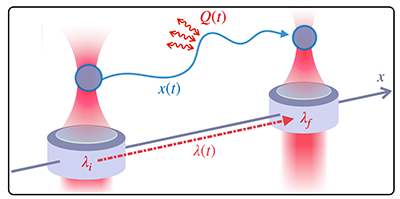
How much work does it cost for a propelled particle to stay localized near a stationary target, defying both thermal noise and a constant flow that would carry it away? We study the control of such a particle in finite time and find optimal protocols for time-dependent swim velocity and diffusivity, without feedback. Accuracy, quantified via the mean squared deviation from the target, and energetic cost turn out to be related by a tradeoff, which complements the one between precision and cost known in stochastic thermodynamics. We show that accuracy better than a certain threshold requires active driving, which comes at a cost that increases with accuracy. The optimal protocols have discontinuous swim velocity and diffusivity, switching between a passive drift state with vanishing diffusivity and an active propulsion state. If the initial position is fixed, an initial jump of the particle, enabled by a sudden burst of propulsion, can be optimal. This study highlights how a time-dependent diffusivity enhances optimal control and sets benchmarks for cost and accuracy of artificial self-propelled particles navigating noisy environments.
Physics Subject Headings (PhySH)
Collections
This article appears in the following collection:
Controlling Stochastic Dynamics Across Scales
We present a Collection of papers on Controlling Stochastic Dynamics Across Scales. It seeks to highlight novel studies on controlling the dynamics of complex stochastic systems with a rich phenomenology. Guest editors of the Collection are Étienne Fodor of the University of Luxembourg and Todd Gingrich of Northwestern University.
Article Text
References (53)
- U. Seifert, Stochastic thermodynamics, fluctuation theorems and molecular machines, Rep. Prog. Phys. 75, 126001 (2012).
- A. C. Barato and U. Seifert, Thermodynamic uncertainty relation for biomolecular processes, Phys. Rev. Lett. 114, 158101 (2015).
- T. R. Gingrich, J. M. Horowitz, N. Perunov, and J. L. England, Dissipation bounds all steady-state current fluctuations, Phys. Rev. Lett. 116, 120601 (2016).
- C. Hyeon and W. Hwang, Physical insight into the thermodynamic uncertainty relation using Brownian motion in tilted periodic potentials, Phys. Rev. E 96, 012156 (2017).
- J. M. Horowitz and T. R. Gingrich, Proof of the finite-time thermodynamic uncertainty relation for steady-state currents, Phys. Rev. E 96, 020103(R) (2017).
- J. M. Horowitz and T. R. Gingrich, Thermodynamic uncertainty relations constrain non-equilibrium fluctuations, Nat. Phys. 16, 15 (2020).
- Note that the word “accuracy” is sometimes used in the meaning of trueness, considering only the mean deviation from a target. We here follow the standard definition of accuracy (ISO 5725-1) requiring both trueness and precision.
- L. Cocconi, B. Mahault, and L. Piro, Dissipation-accuracy tradeoffs in autonomous control of smart active matter, New J. Phys. 27, 013002 (2025).
- L. Cocconi, B. Mahault, and L. Piro, Nonequilibrium energetics of sensing and actuation by a smart active particle, arXiv:2603.15602.
- T. Speck, J. Mehl, and U. Seifert, Role of external flow and frame invariance in stochastic thermodynamics, Phys. Rev. Lett. 100, 178302 (2008).
- A. Zöttl and H. Stark, Emergent behavior in active colloids, J. Phys.: Condens. Matter 28, 253001 (2016).
- G. Gompper, R. G. Winkler, T. Speck, A. Solon, C. Nardini, F. Peruani, H. Löwen, R. Golestanian, U. B. Kaupp, L. Alvarez, et al., The 2020 motile active matter roadmap, J. Phys.: Condens. Matter 32, 193001 (2020).
- L. Baraban, M. Tasinkevych, M. N. Popescu, S. Sanchez, S. Dietrich, and O. Schmidt, Transport of cargo by catalytic Janus micro-motors, Soft Matter 8, 48 (2012).
- M. Popescu, M. Tasinkevych, and S. Dietrich, Pulling and pushing a cargo with a catalytically active carrier, Europhys. Lett. 95, 28004 (2011).
- D. Patra, S. Sengupta, W. Duan, H. Zhang, R. Pavlick, and A. Sen, Intelligent, self-powered, drug delivery systems, Nanoscale 5, 1273 (2013).
- J. R. Baylis, K. Y. Chan, and C. J. Kastrup, Halting hemorrhage with self-propelling particles and local drug delivery, Thrombosis Res. 141, S36 (2016).
- B. Wang, Y. Zhang, and L. Zhang, Recent progress on micro-and nano-robots: Towards in vivo tracking and localization, Quant. Imaging Med. Surg. 8, 461 (2018).
- M. E. Cates and J. Tailleur, Motility-induced phase separation, Annu. Rev. Condens. Matter Phys. 6, 219 (2015).
- I. Buttinoni, J. Bialké, F. Kümmel, H. Löwen, C. Bechinger, and T. Speck, Dynamical clustering and phase separation in suspensions of self-propelled colloidal particles, Phys. Rev. Lett. 110, 238301 (2013).
- Y. Fily and M. C. Marchetti, Athermal phase separation of self-propelled particles with no alignment, Phys. Rev. Lett. 108, 235702 (2012).
- T. Vicsek, A. Czirók, E. Ben-Jacob, I. Cohen, and O. Shochet, Novel type of phase transition in a system of self-driven particles, Phys. Rev. Lett. 75, 1226 (1995).
- J. Toner and Y. Tu, Flocks, herds, and schools: A quantitative theory of flocking, Phys. Rev. E 58, 4828 (1998).
- M. J. Falk, V. Alizadehyazdi, H. Jaeger, and A. Murugan, Learning to control active matter, Phys. Rev. Res. 3, 033291 (2021).
- H. Reinken, D. Nishiguchi, S. Heidenreich, A. Sokolov, M. Bär, S. H. Klapp, and I. S. Aranson, Organizing bacterial vortex lattices by periodic obstacle arrays, Commun. Phys. 3, 76 (2020).
- J. F. Schubert, S. F. Navas, and S. H. Klapp, Self-assembly and time-dependent control of active and passive triblock Janus colloids, J. Chem. Phys. 163, 044904 (2025).
- S. Blaber and D. A. Sivak, Optimal control in stochastic thermodynamics, J. Phys. Commun. 7, 033001 (2023).
- J. Alvarado, E. G. Teich, D. A. Sivak, and J. Bechhoefer, Optimal control in soft and active matter, Annu. Rev. Condens. Matter Phys. 17, 327 (2026).
- U. Seifert, Stochastic Thermodynamics (Cambridge University Press, Cambridge, 2025).
- T. Schmiedl and U. Seifert, Optimal finite-time processes in stochastic thermodynamics, Phys. Rev. Lett. 98, 108301 (2007).
- S. Blaber, M. D. Louwerse, and D. A. Sivak, Steps minimize dissipation in rapidly driven stochastic systems, Phys. Rev. E 104, L022101 (2021).
- M. Baldovin, I. Ben Yedder, C. A. Plata, D. Raynal, L. Rondin, E. Trizac, and A. Prados, Optimal control of levitated nanoparticles through finite-stiffness confinement, Phys. Rev. Lett. 135, 097102 (2025).
- S. A. M. Loos, S. Monter, F. Ginot, and C. Bechinger, Universal symmetry of optimal control at the microscale, Phys. Rev. X 14, 021032 (2024).
- H. J. Kappen, Linear theory for control of nonlinear stochastic systems, Phys. Rev. Lett. 95, 200201 (2005).
- R. Garcia-Millan, J. Schüttler, M. E. Cates, and S. A. M. Loos, Optimal closed-loop control of active particles and a minimal information engine, Phys. Rev. Lett. 135, 088301 (2025).
- K. S. Olsen, R. Goerlich, Y. Roichman, and H. Löwen, Harnessing non-equilibrium forces to optimize work extraction, Nat. Commun. 16, 11031 (2025).
- S. Shankar, V. Raju, and L. Mahadevan, Optimal transport and control of active drops, Proc. Natl. Acad. Sci. USA 119, e2121985119 (2022).
- D. Gupta, S. H. L. Klapp, and D. A. Sivak, Efficient control protocols for an active Ornstein-Uhlenbeck particle, Phys. Rev. E 108, 024117 (2023).
- M. Baldovin, D. Guéry-Odelin, and E. Trizac, Control of active Brownian particles: An exact solution, Phys. Rev. Lett. 131, 118302 (2023).
- L. K. Davis, K. Proesmans, and É. Fodor, Active matter under control: Insights from response theory, Phys. Rev. X 14, 011012 (2024).
- B. Liebchen and H. Löwen, Optimal navigation strategies for active particles, Europhys. Lett. 127, 34003 (2019).
- L. G. Nava, R. Großmann, and F. Peruani, Markovian robots: Minimal navigation strategies for active particles, Phys. Rev. E 97, 042604 (2018).
- C. Calascibetta, L. Biferale, F. Borra, A. Celani, and M. Cencini, Optimal tracking strategies in a turbulent flow, Commun. Phys. 6, 256 (2023).
- L. Piro, A. Vilfan, R. Golestanian, and B. Mahault, Energetic cost of microswimmer navigation: The role of body shape, Phys. Rev. Res. 6, 013274 (2024).
- E. Schneider and H. Stark, Optimal steering of a smart active particle, Europhys. Lett. 127, 64003 (2019).
- S. Muiños-Landin, A. Fischer, V. Holubec, and F. Cichos, Reinforcement learning with artificial microswimmers, Sci. Rob. 6, eabd9285 (2021).
- A. C. Barato and U. Seifert, Thermodynamic cost of external control, New J. Phys. 19, 073021 (2017).
- P. Ngatchou, A. Zarei, and A. El-Sharkawi, Pareto multi objective optimization, in Proceedings of the 13th International Conference on Intelligent Systems Application to Power Systems (IEEE, Piscataway, NJ, 2005), p. 84.
- L. F. Seoane and R. Solé, Multiobjective optimization and phase transitions, in Proceedings of ECCS 2014: European Conference on Complex Systems (Springer, Berlin, 2016), p. 259.
- J. C. Sunil, R. A. Blythe, M. R. Evans, and S. N. Majumdar, Minimizing the profligacy of searches with reset, Phys. Rev. E 110, 054122 (2024).
- X. Ma, K. Hahn, and S. Sanchez, Catalytic mesoporous Janus nanomotors for active cargo delivery, J. Am. Chem. Soc. 137, 4976 (2015).
- L. K. Davis, Optimal multi-parameter control of trapped active matter, arXiv:2603.16778.
- https://github.com/tillwelker/Accuracy-Comes-at-a-Cost-Optimal-Localisation-Against-a-Flow.
- C. Rackauckas and Q. Nie, DifferentialEquations.jl–A performant and feature-rich ecosystem for solving differential equations in Julia, J. Open Res. Software 5, 15 (2017).

