Recent Articles

Measurement of the nucleon spin structure functions for 0.01<Q2<1GeV2 using CLAS

A. Deur et al. (The CLAS Collaboration)

Phys. Rev. C 111, 035202 (2025) - Published 25 March, 2025

Lifetime measurements in Mo102 interpreted in the interacting boson model and the X(5) symmetry

C. E. Jones et al.

Phys. Rev. C 111, 034325 (2025) - Published 24 March, 2025

Competition between the neutron-proton pair break-ups delineating the level structure of Po202

Sahab Singh, D. Choudhury, B. Maheshwari, R. Roy, K. Yadav, R. Palit, B. Das, P. Dey, A. Kundu, Md. S. R. Laskar, D. Negi, V. Malik, S. Jadhav, B. S. Naidu, A. V. Thomas, D. L. Balabanski, A. Dhal, S. Bhattacharya, A. K. Singh, S. Bhattacharyya, and S. Nag

Phys. Rev. C 111, 034326 (2025) - Published 24 March, 2025

Nuclear fission in plasma

Péter Kálmán and Tamás Keszthelyi

Phys. Rev. C 111, 034618 (2025) - Published 24 March, 2025

Extraction of fission mode properties from fragment mass distributions

Patrick McGlynn and Cédric Simenel

Phys. Rev. C 111, 034619 (2025) - Published 24 March, 2025

Production of leptons from decay of heavy-flavor hadrons in high-energy nuclear collisions

Sa Wang, Yao Li, Shuwan Shen, Ben-Wei Zhang, and Enke Wang

Phys. Rev. C 111, 034912 (2025) - Published 24 March, 2025

Approximation of the S matrix for solving the Marchenko equation

N. A. Khokhlov

Phys. Rev. C 111, 034004 (2025) - Published 21 March, 2025

Significance of the noncoplanar degree of freedom in heavy-ion-induced fusion reactions

Harshit Sharma, Raj Kumar, and Manoj K. Sharma

Phys. Rev. C 111, 034617 (2025) - Published 21 March, 2025

Nuclear level density studied in odd-mass nuclei in the framework of the projected shell model

Jiaqi Wang, Saumi Dutta, Cui-Juan Lv, Long-Jun Wang, and Yang Sun

Phys. Rev. C 111, 034324 (2025) - Published 19 March, 2025

Two-cluster approach to the properties of one- and two-neutron-halo nuclei

H. M. Maridi, Jagjit Singh, N. R. Walet, and D. K. Sharp

Phys. Rev. C 111, 034616 (2025) - Published 19 March, 2025

Multicomponent Fermi systems at low densities

C. J. Pethick and A. Schwenk

Phys. Rev. C 111, 035808 (2025) - Published 19 March, 2025

First study of Zr88+n at DICER at LANSCE at energies up to 500 eV and relevance to explosive environments

Athanasios Stamatopoulos, Paul E. Koehler, Brad DiGiovine, Veronika Mocko, Artem Matyskin, Christiaan Vermeulen, Aaron Couture, Andrew Cooper, Jonathan Morrell, Ellen O'Brien, Dusan Kral, and John Ullmann

Phys. Rev. C 111, 034613 (2025) - Published 18 March, 2025

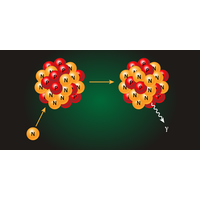
Measuring how efficiently an isotope captures neutrons of various energies both confirms and refutes some surprising recent results.

Comprehensive Bayesian machine learning approach to estimating the total nuclear capture rate of a negative muon

Hiroki Iwamoto, Megumi Niikura, and Rurie Mizuno

Phys. Rev. C 111, 034614 (2025) - Published 18 March, 2025

Nuclear reaction dynamics in C12+Sn119 collisions

L. M. Martinis, L. R. Gasques, J. P. Fernández-García, V. Scarduelli, M. A. G. Alvarez, L. C. Chamon, W. A. Y. Hatano, J. K. L. Chaves, G. P. Cessel, and L. Garrido-Gómez

Phys. Rev. C 111, 034615 (2025) - Published 18 March, 2025

Density curvature, skewness, and kurtosis of the nuclear symmetry energy and their impact on the compactness and tidal deformability of neutron stars

W. M. Seif, A. S. Hashem, and H. A. Abualhamd

Phys. Rev. C 111, 035806 (2025) - Published 18 March, 2025

Determining the minimal mass of a proto-neutron star with chirally constrained nuclear equations of state

Selina Kunkel, Stephan Wystub, and Jürgen Schaffner-Bielich

Phys. Rev. C 111, 035807 (2025) - Published 18 March, 2025

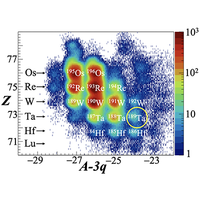
Reaching the prolate-oblate boundary at N=116 via first fragmentation of a Pt198 beam: Sharp transition to triaxiality in Ta189

K. Sharma et al.

Phys. Rev. C 111, L031301 (2025) - Published 18 March, 2025

How shapes of heavy nuclei evolve as their valence nucleon shells are filled continues to be a nuclear physics research frontier. The authors populated high-spin isomers in very-neutron-rich A≈190 Hf-Ta-W nuclei with the pioneering fragmentation of a 198Pt primary beam at the NSCL. The collective level structure deduced from the subsequent γ decay of stopped isomeric fragments using the A1900 spectrometer and GRETINA array points to a sudden transition from axially prolate shapes in the lighter Ta isotopes to a strong triaxial shape for the 189Ta nucleus (Z=73, N=116; 8 neutrons more than stable 181Ta). The results suggest that the prolate-oblate shape boundary has been reached in this previously inaccessible region of neutron-rich nuclei. They are also an important experimental benchmark for nuclear theory to describe nuclear structure and shape evolution far from stability.

X17 boson and the H2(p,e+e−)He3 and H2(n,e+e−)H3 processes: A theoretical analysis

M. Viviani, E. Filandri, L. Girlanda, C. Gustavino, A. Kievsky, and L. E. Marcucci

Phys. Rev. C 111, 034002 (2025) - Published 17 March, 2025

Level shifts of exotic deuterium atoms from effective range parameters

Pierre-Yves Duerinck, Rimantas Lazauskas, and Jérémy Dohet-Eraly

Phys. Rev. C 111, 034003 (2025) - Published 17 March, 2025

Anomalous B4/2 ratio in the yrast band of Os167

I. Zanon et al.

Phys. Rev. C 111, 034323 (2025) - Published 17 March, 2025

Sign In to Your Journals Account

Filter

Recent Issues

Vol. 114, Iss. 4
October 2026
Vol. 114, Iss. 3
September 2026
Vol. 114, Iss. 2
August 2026
Vol. 114, Iss. 1
July 2026
Category
Article Type
Section

Filter

Article Lookup

Enter a citation