Recent Articles

Fraunhofer oscillations of the critical current at a varying Zeeman field in a spin-orbit coupled Josephson junction

A. G. Mal'shukov

Phys. Rev. B 102, 134509 (2020) - Published 26 October, 2020

Superconductivity and equation of state of lanthanum at megabar pressures

Wuhao Chen, Dmitrii V. Semenok, Ivan A. Troyan, Anna G. Ivanova, Xiaoli Huang, Artem R. Oganov, and Tian Cui

Phys. Rev. B 102, 134510 (2020) - Published 26 October, 2020

Anomalous Kerr effect in SrRuO3 thin films

F. Michael Bartram, Sopheak Sorn, Zhuolu Li, Kyle Hwangbo, Shengchun Shen, Felix Frontini, Liqun He, Pu Yu, Arun Paramekanti, and Luyi Yang

Phys. Rev. B 102, 140408(R) (2020) - Published 26 October, 2020

Robust metastable skyrmions with tunable size in the chiral magnet FePtMo3N

A. S. Sukhanov, A. Heinemann, L. Kautzsch, J. D. Bocarsly, S. D. Wilson, C. Felser, and D. S. Inosov

Phys. Rev. B 102, 140409(R) (2020) - Published 26 October, 2020

Entanglement spectrum as a marker for phase transitions in the density embedding theory for interacting spinless fermionic models

Xavier Plat and Chisa Hotta

Phys. Rev. B 102, 140410(R) (2020) - Published 26 October, 2020

Here, the authors show that the entanglement spectrum – a fingerprint of the quantum many-body wave function – of strongly correlated fermionic systems can be evaluated almost exactly by density embedding theory. An accurate entanglement spectrum guarantees the accuracy of the local density matrix or the physical properties, and their anomalies generally serve as markers for phase transitions, including not only the Landau symmetry-breaking ones but also topological transitions.

Asymmetric magnetic relaxation behavior of domains and domain walls observed through the FeRh first-order metamagnetic phase transition

Jamie R. Massey, Rowan C. Temple, Trevor P. Almeida, Ray Lamb, Nicolas A. Peters, Richard P. Campion, Raymond Fan, Damien McGrouther, Stephen McVitie, Paul Steadman, and Christopher H. Marrows

Phys. Rev. B 102, 144304 (2020) - Published 26 October, 2020

Quasiballistic phonon transport from first principles

Pol Torres, Miquel Royo, Miquel López-Suárez, Junichiro Shiomi, and Riccardo Rurali

Phys. Rev. B 102, 144305 (2020) - Published 26 October, 2020

Magnon polaron formed by selectively coupled coherent magnon and phonon modes of a surface patterned ferromagnet

F. Godejohann, A. V. Scherbakov, S. M. Kukhtaruk, A. N. Poddubny, D. D. Yaremkevich, M. Wang, A. Nadzeyka, D. R. Yakovlev, A. W. Rushforth, A. V. Akimov, and M. Bayer

Phys. Rev. B 102, 144438 (2020) - Published 26 October, 2020

In a metallic ferromagnet, fast dephasing of phonons and magnons typically prevents their strong coupling. Here, the authors overcome this limitation and demonstrate a hybridized coherent state of phonon and magnon known as a “magnon polaron” in a metallic ferromagnetic film under femtosecond optical excitation. Surface patterning provides magnons and phonons with long lifetimes in the ferromagnetic film, while spatial matching of their wave distributions enhances their coupling strength and selects particular modes in the broad phonon and magnon spectra for hybridization.

Tensor-network strong-disorder renormalization groups for random quantum spin systems in two dimensions

Kouichi Seki, Toshiya Hikihara, and Kouichi Okunishi

Phys. Rev. B 102, 144439 (2020) - Published 26 October, 2020

Coexistence of type-I and type-II superconductivity signatures in ZrB12 probed by muon spin rotation measurements

P. K. Biswas, F. N. Rybakov, R. P. Singh, Saumya Mukherjee, N. Parzyk, G. Balakrishnan, M. R. Lees, C. D. Dewhurst, E. Babaev, A. D. Hillier, and D. Mc K. Paul

Phys. Rev. B 102, 144523 (2020) - Published 26 October, 2020

Role of f−d exchange interaction and Kondo scattering in the Nd-doped pyrochlore iridate (Eu1−xNdx)2Ir2O7

Sampad Mondal, M. Modak, B. Maji, Mayukh K. Ray, S. Mandal, Swapan K. Mandal, M. Sardar, and S. Banerjee

Phys. Rev. B 102, 155139 (2020) - Published 26 October, 2020

Protracted Kondo screening and kagome bands in the heavy-fermion metal Ce3Al

Li Huang and Haiyan Lu

Phys. Rev. B 102, 155140 (2020) - Published 26 October, 2020

Topological surface states in strained Dirac semimetal thin films

Pablo Villar Arribi, Jian-Xin Zhu, Timo Schumann, Susanne Stemmer, Anton A. Burkov, and Olle Heinonen

Phys. Rev. B 102, 155141 (2020) - Published 26 October, 2020

Remarkable low-energy properties of the pseudogapped semimetal Be5Pt

Laura Fanfarillo, J. J. Hamlin, R. G. Hennig, Ajinkya C. Hire, P. J. Hirschfeld, Jungsoo Kim, Jinhyuk Lim, Yundi Quan, G. R. Stewart, and Stephen R. Xie

Phys. Rev. B 102, 155206 (2020) - Published 26 October, 2020

Polaritonic cylinders as multifunctional metamaterials: Single scattering and effective medium description

Charalampos P. Mavidis, Anna C. Tasolamprou, Eleftherios N. Economou, Costas M. Soukoulis, and Maria Kafesaki

Phys. Rev. B 102, 155310 (2020) - Published 26 October, 2020

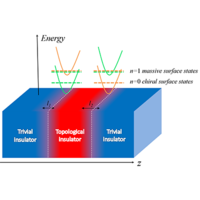
Dirac quantum well engineering on the surface of a topological insulator

X. Lu and M. O. Goerbig

Phys. Rev. B 102, 155311 (2020) - Published 26 October, 2020

Making topological insulators into thin films is a promising way to rule out the undesirable bulk contribution for applications, but one then needs to worry about coupling between surface states at opposite sides of the film. The understanding of this coupling is addressed here. The coupling and the resulting gap opening in the chiral states (n=0) turn out to be qualitatively different and quantitatively much smaller compared to those in massive Volkov-Pankratov surface states (n>0), which are not protected by chirality.

Twisted bilayer graphene as a linear nanoactuator

Zhisen Meng, Zhenyan Wu, Jesús Carrete, and Zhao Wang

Phys. Rev. B 102, 155424 (2020) - Published 26 October, 2020

Viscous Maxwell-Chern-Simons theory for topological electromagnetic phases of matter

Todd Van Mechelen and Zubin Jacob

Phys. Rev. B 102, 155425 (2020) - Published 26 October, 2020

Chern-Simons theories, initially developed for high-energy physics, have been very successful in explaining integer and fractional quantum Hall phases of matter, topological insulators, and Weyl semimetals. However, it was an open question as to whether Chern-Simons theories can be adapted to topological photonics. Here, the authors develop a viscous Maxwell-Chern-Simons theory to capture the fundamental physics of a topological electromagnetic phase of matter. The theory applies to viscous Hall fluids and predicts the existence of unique spin-1 photonic skyrmions in momentum space.

Simple mechanism that breaks the Hall-effect linearity at low temperatures

A. Yu. Kuntsevich, A. V. Shupletsov, and A. L. Rakhmanov

Phys. Rev. B 102, 155426 (2020) - Published 26 October, 2020

Scattering invariance for arbitrary polarizations protected by joint spatial-duality symmetries

Qingdong Yang, Weijin Chen, Yuntian Chen, and Wei Liu

Phys. Rev. B 102, 155427 (2020) - Published 26 October, 2020

Sign In to Your Journals Account

Filter

Recent Issues

Vol. 114, Iss. 30
15 November 2026
Vol. 114, Iss. 29
15 November 2026
Vol. 114, Iss. 28
15 November 2026
Vol. 114, Iss. 27
1 November 2026
Category
Article Type
Section

Filter

Article Lookup

Enter a citation