Recent Articles

Gaplessness from disorder and quantum geometry in gapped superconductors

Omri Lesser, Sagnik Banerjee, Xuepeng Wang, Jaewon Kim, Ehud Altman, and Debanjan Chowdhury

Phys. Rev. B 113, 035109 (2026) - Published 5 January, 2026

Few-meV resolution Floquet band-gap mapping via high-order sideband generation

Yu-Xuan Chen, Gan Wang, Mingjie Li, and Tao-Yuan Du

Phys. Rev. B 113, 035110 (2026) - Published 5 January, 2026

Polarons and bipolarons in the Rydberg-dressed extended Bose-Hubbard model

G. A. Domínguez-Castro, L. Santos, and L. A. Peña Ardila

Phys. Rev. B 113, 035111 (2026) - Published 5 January, 2026

The authors explore here how a single and a pair of impurities behave across the superfluid and insulating (charge density wave) phases of a hard-core bosonic bath. In the superfluid regime, an impurity becomes a polaron-like quasiparticle, while in the insulating phase it regains its particle-like nature, moving through a potential landscape shaped by the charge density wave order. Furthermore, the authors show that two impurities can bind into a stable pair even without direct mutual interactions.

Chiral anomaly-induced nonlinear Hall effect in spin-orbit coupled noncentrosymmetric metals

Gautham Varma K., Mohd. Hashim Raza, and Azaz Ahmad

Phys. Rev. B 113, 035112 (2026) - Published 5 January, 2026

Coupling-dependent electronic structure in InSe-based lateral heterostructures

Jiaming Lou, Bo Li, Shuangping Liao, Sahar Izadi Vishkayi, Li Zhang, Yuan Tian, Long-Jing Yin, Meysam Bagheri Tagani, Lijie Zhang, and Zhihui Qin

Phys. Rev. B 113, 035302 (2026) - Published 5 January, 2026

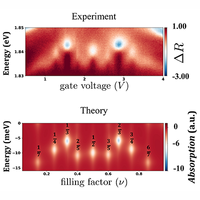
Excitons in moiré superlattices with disordered electrons

Junghwan Kim, Dinh Van Tuan, and Hanan Dery

Phys. Rev. B 113, 035303 (2026) - Published 5 January, 2026

How do excitons probe electron crystals in moiré superlattices? The authors investigate here how the absorption amplitude and energy of excitons are influenced by charge order at fractional fillings of moiré superlattices. In addition to the sensitivity from s-p orbital mixing of excitonic states that stems from the charge order, this study also demonstrates how the moiré physics is suppressed by atomic defects and thermal fluctuations. This work provides a comprehensive picture that bridges theory and recent experimental observations.

Hyperfine interaction of electrons confined in CsPbI3 nanocrystals with nuclear spin fluctuations

Sergey R. Meliakov, Evgeny A. Zhukov, Vasilii V. Belykh, Kirill V. Kavokin, Mikhail O. Nestoklon, Evgeniya V. Kulebyakina, Mikhail L. Skorikov, Elena V. Kolobkova, Maria S. Kuznetsova, Manfred Bayer, and Dmitri R. Yakovlev

Phys. Rev. B 113, 035304 (2026) - Published 5 January, 2026

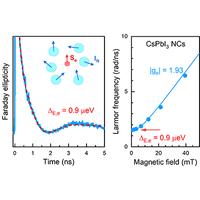
The authors measure coherent spin dynamics of electrons in CsPbI3 perovskite nanocrystals using time-resolved Faraday ellipticity. They find a finite Larmor precession frequency at zero magnetic field, corresponding to the electron spin splitting of 0.8 µeV induced by the hyperfine interaction of the electron with nuclear spin fluctuations. Using this experimental value and density functional calculations of the material band structure, the atomic hyperfine constant for the 5s orbital of iodine is evaluated as 190 µeV.

Specific heat and thermoelectric investigation of the charge density wave in single crystal Cu1.90Te

Ramesh Lalmani Yadav, Pallab Bag, Yung-Kang Kuo, Chia-Nung Kuo, and Chin Shan Lue

Phys. Rev. B 113, 035405 (2026) - Published 5 January, 2026

Theory of vibrational Stark effect for adsorbates and diatomic molecules

Sang Yang, Jun Cai, Yanxia Chen, and Ming Gong

Phys. Rev. B 113, 035406 (2026) - Published 5 January, 2026

Tunable hinge skin states in a hybrid skin-topological sonic crystal

Yu-Xin Fang, Wen-Hao Zhu, Yu-Ping Lai, Yongyao Li, and Shi-Qiao Wu

Phys. Rev. B 113, 035407 (2026) - Published 5 January, 2026

Defects potentials for two-dimensional topological materials

Yuval Abulafia, Amit Goft, Nadav Orion, and Eric Akkermans

Phys. Rev. B 113, 045102 (2026) - Published 5 January, 2026

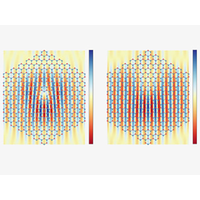
Topological materials exhibit distinct electronic characteristics that make them ideal candidates for rapid, reliable, and energy-saving technologies. However, the process of creating these materials is known to be particularly challenging. Here, the authors present a simpler approach to two-dimensional materials by starting with nontopological lattice structures and introducing properly crafted defects to modify their topological properties. These changes are demonstrated through observable electronic characteristics, such as local electron density, offering a clear and practical strategy for designing new topological materials and advancing the creation of more robust quantum and electronic devices.

Cavity quantum Hall hydrodynamics

Gabriel Cardoso, Liu Yang, Thors Hans Hansson, and Qing-Dong Jiang

Phys. Rev. B 113, 045108 (2026) - Published 5 January, 2026

Quantum Hall effect in a chiral cavity

Liu Yang, Gabriel Cardoso, Thors Hans Hansson, and Qing-Dong Jiang

Phys. Rev. B 113, 045109 (2026) - Published 5 January, 2026

Interaction-driven Chern insulator at zero electric field in ABCB-stacked tetralayer graphene

Yulu Ren, Yang Shen, Chengyang Xu, Wanfei Shan, and Weidong Luo

Phys. Rev. B 113, 045405 (2026) - Published 5 January, 2026

Excitons in two-dimensional inversion-symmetry-breaking tetragonal monolayers: The role of intrinsic built-in electric potential difference

Ziwei Zhao, Li Xiang, Yaqi Deng, Xu Li, Juexian Cao, and Wangping Xu

Phys. Rev. B 113, 045406 (2026) - Published 5 January, 2026

Strain-induced magnetism and half-metallicity in monolayer graphullerenes of the smallest fullerene C20

Jing Nie, Pei-Yi Liang, Jun-Xi Li, Wan-Xin Li, Du-Xin Liang, Fang Lin, and Shi-Zhang Chen

Phys. Rev. B 113, 045407 (2026) - Published 5 January, 2026

Gate voltage tunable second harmonic generation in monolayer and bilayer black phosphene

Kainan Chang, Yan Meng, Yanyan Qian, Yuwei Shan, Luxia Wang, and Jin Luo Cheng

Phys. Rev. B 113, 045408 (2026) - Published 5 January, 2026

Here, the authors explore giant and electrically tunable second-harmonic generation (SHG) in black phosphorene. Notably, its effective nonlinear susceptibility surpasses AgGaSe2 by orders of magnitude and is widely tunable via gate voltage and chemical potential. They clarify the link between conventional SHG and electric field induced SHG, showing that they coincide at low gate voltages. These nonlinear optical properties establish black phosphorene as a superior platform for active photonic devices.

Sliding ferroelectricity, second harmonic generation, and bulk photovoltaic effect induced by 60∘ twisting in bilayer PtSe2

Yiyang Du, Hongsheng Liu, Shi Qiu, Anbing Zhang, Luneng Zhao, Feng Ding, and Junfeng Gao

Phys. Rev. B 113, 045409 (2026) - Published 5 January, 2026

Loschmidt echo zeros in finite-size quantum systems with linear quench

Zhen-Yu Zheng, Xudong Liu, Siyan Lin, Yu Zhang, and Shu Chen

Phys. Rev. B 113, L020301 (2026) - Published 5 January, 2026

Plasmon-driven giant amplification of ultrashort spin current

H. Y. Yuan and Rembert A. Duine

Phys. Rev. B 113, L020401 (2026) - Published 5 January, 2026

Sign In to Your Journals Account

Filter

Recent Issues

Vol. 114, Iss. 30
15 November 2026
Vol. 114, Iss. 29
15 November 2026
Vol. 114, Iss. 28
15 November 2026
Vol. 114, Iss. 27
1 November 2026
Category
Article Type
Section

Filter

Article Lookup

Enter a citation