Browse by Subject

Limited Stochastic Current for Energy-Optimized Switching of Spin-Transfer-Torque Magnetic Random-Access Memory

Eunchong Baek, Indra Purnama, and Chun-Yeol You

Phys. Rev. Applied 12, 064004 (2019) - Published 3 December, 2019

Reducing the write-error rate (WER) is one of the main concerns for commercialization of spin-transfer-torque magnetic random-access memory (STT-MRAM). While most studies have been focused on finding proper material, this work discusses the use of limited stochastic (LS) current, for which WER is controlled. By solving the Fokker-Planck equation, an analytical expression for the LS current for a given WER is obtained. Most importantly, by using the LS current and optimizing it together with the related pulse duration, the authors find the optimum combination of current amplitude and pulse duration, which can reduce the energy consumption of STT-MRAM by up to 75%.

Electrical Néel-Order Switching in Magnetron-Sputtered CuMnAs Thin Films

T. Matalla-Wagner, M.-F. Rath, D. Graulich, J.-M. Schmalhorst, G. Reiss, and M. Meinert

Phys. Rev. Applied 12, 064003 (2019) - Published 2 December, 2019

Antiferromagnets are insensitive to external magnetic fields and exhibit ultrafast magnetization dynamics, which are desirable properties for advanced data storage. The Napos{e}el-order spin-orbit torque is a means to manipulate the antiferromagnetic state, and thus could serve as the writing mechanism in future spintronic memory cells. This study investigates in depth the switching characteristics of a sputtered antiferromagnetic alloy, and presents a general scheme for analyzing the switching of arbitrary antiferromagnets. The results highlight the significance of thermal activation in this switching mechanism, which is crucial for designing and optimizing devices.

Optical-Resonance-Enhanced Photoemission from Nanostructured GaAs Photocathodes

Xincun Peng, Zhidong Wang, Yun Liu, Dennis M. Manos, Matt Poelker, Marcy Stutzman, Bin Tang, Shukui Zhang, and Jijun Zou

Phys. Rev. Applied 12, 064002 (2019) - Published 2 December, 2019

A particular type of semiconductor photocathode with a nanostructured surface is shown to increase photoemission yield by more than a factor of three, compared to a flat photocathode. This improvement stems from the excitation of Mie resonances, which serve to reduce reflectivity and enhance light absorption near the surface, where electrons are more efficiently emitted. Nanostructured photocathodes, which can be described as “electrically bright” yet “optically dark”, could benefit many applications, including high-current electron cooling of hadron beams in particle accelerators.

Heat-Recovery Solar Cell

Kenji Kamide, Toshimitsu Mochizuki, Hidefumi Akiyama, and Hidetaka Takato

Phys. Rev. Applied 12, 064001 (2019) - Published 2 December, 2019

Using heat that otherwise would be lost is important for efficient use of solar energy, but continues to be held back for lack of an ultrathin photovoltaic absorber that permits both sufficient absorption of light and ultrafast extraction of “hot” carriers before they lose their kinetic energy. This article presents a concept to enable heat recovery in a solar cell without the need for ultrafast carrier extraction. This thermoelectric approach should impact engineering solutions for further improvement in silicon solar cells, beyond the Shockley-Queisser limit.

Reversible Control of Magnetic Anisotropy and Magnetization in Amorphous Co40Fe40B20 Thin Films via All-Solid-State Li-ion Redox Capacitor

Dhanapal Pravarthana, Baomin Wang, Zeeshan Mustafa, Sandeep Agarwal, Ke Pei, Huali Yang, and Run-Wei Li

Phys. Rev. Applied 12, 054065 (2019) - Published 27 November, 2019

Modulation of magnetism by electric-field-driven ion migration has huge potential for tuning of magnetic properties and inducing magnetic functionalities. This article reports the use of a solid-electrolyte Li+ redox capacitor for reversible modulation of magnetic anisotropy and magnetization in thin films of Co40Fe40B20, an alloy much studied for spintronics. The technique is a means to control the magnetic properties of metallic thin films via solid-state ionics, by marrying the physics of lithium-ion batteries and magnetic tunnel junctions. Strain engineering via the lithiation-delithiation cycle is also a possibility.

Active Acoustic Resonators with Reconfigurable Resonance Frequency, Absorption, and Bandwidth

Theodoros T. Koutserimpas, Etienne Rivet, Hervé Lissek, and Romain Fleury

Phys. Rev. Applied 12, 054064 (2019) - Published 27 November, 2019

This study demonstrates the relevance of active electroacoustic resonators to controlling the performance of subwavelength inclusions in an acoustic metamaterial, which is a major difficulty. A feedback control scheme for loudspeakers (used as acoustic scatterers) is proposed, involving passband-current control via real-time sensing and processing of the pressure signal by a field-programmable gate array. This allows external, independent tuning of the absorption (including levels near zero and near unity), bandwidth, and resonance frequency of subwavelength acoustic resonators. The work offers a viable way past the current limitations of metamaterials, to enable practical applications.

Dichroic Two-Photon Rubidium Frequency Standard

C. Perrella, P.S. Light, J.D. Anstie, F.N. Baynes, R.T. White, and A.N. Luiten

Phys. Rev. Applied 12, 054063 (2019) - Published 27 November, 2019

Frequency standards find wide use in navigation and timing for industry, civilian, and defense applications. Unfortunately, the very best frequency standards are bulky, power-hungry, and confined to well-controlled laboratory environments. Here the authors aim to deliver a compact, high-performance standard, the key challenge being the need to produce a strong, narrow atomic transition. They produce a superstrong signal by driving a two-photon transition in 87Rb vapor that exploits a fortuitous third atomic level to greatly enhance the effective strength of the atom-light interaction, allowing short-term clock performance comparable to today’s best commercial frequency standards.

Realization of Complete Boolean Logic Functions using a Single Memtranstor

Jianxin Shen, Peipei Lu, Dashan Shang, and Young Sun

Phys. Rev. Applied 12, 054062 (2019) - Published 27 November, 2019

The integration of memory and logic functions in a single device is required to develop advanced computing systems beyond the von Neumann architecture. The memtranstor, a two-terminal circuit element based on the relation between charge and magnetic flux via nonlinear magnetoelectric effects, provides an alternate path toward logic-in-memory devices. This work demonstrates that all 16 Boolean logic functions can be implemented in a single memtranstor, using a lock-in technique. This approach would greatly reduce computational complexity while retaining functional completeness.

Wide-Band Nonreciprocity of Surface Acoustic Waves Induced by Magnetoelastic Coupling with a Synthetic Antiferromagnet

Roman Verba, Vasil Tiberkevich, and Andrei Slavin

Phys. Rev. Applied 12, 054061 (2019) - Published 26 November, 2019

One of the major challenges in surface acoustic wave (SAW) technology, which is widely used in modern signal processing, is the absence of wave nonreciprocity (one-way propagation). To tackle this problem, the authors propose an approach based on magnetoelastic coupling of SAWs to spin waves possessing a suitable spectrum. This approach allows the creation of nonreciprocal SAW devices with almost no limitations on the working-frequency band (in contrast to the severe band limitations of traditional approaches), to realize the full potential of magnetoelastically induced SAW nonreciprocity. These results could become a breakthrough step toward nonreciprocal SAW signal processing.

Manipulating Spin Chirality of Magnetic Skyrmion Bubbles by In-Plane Reversed Magnetic Fields in (Mn1−xNix)65Ga35 (x = 0.45) Magnet

Bei Ding, Jie Cui, Guizhou Xu, Zhipeng Hou, Hang Li, Enke Liu, Guangheng Wu, Yuan Yao, and Wenhong Wang

Phys. Rev. Applied 12, 054060 (2019) - Published 26 November, 2019

Research on magnetic skyrmions (topologically protected spin textures) as potential information carriers in spintronics has steadily expanded in recent years. The authors report the control of skyrmion chirality at room temperature in Mn-Ni-Ga, a centrosymmetric alloy with uniaxial magnetic anisotropy. The ability to manipulate the collective behavior of spin-chirality reversal under small external fields is promising for applications in nonvolatile spintronic devices with reduced power dissipation.

Directional Acoustic Superscattering by Coupled Resonators

Taehwa Lee, Tsuyoshi Nomura, Paul Schmalenberg, Ercan M. Dede, and Hideo Iizuka

Phys. Rev. Applied 12, 054059 (2019) - Published 26 November, 2019

The phenomenon known as superscattering maximizes interaction between incident waves and subwavelength structures, enabling a myriad of applications, including sensing and energy harvesting. It is difficult to extend optical superscattering (based on core-shell multilayered structures) to its acoustic counterpart, though, due to limited material availability. This study demonstrates acoustic superscattering by means of subwavelength scatterers, each consisting of a rigid cylinder decorated with deeply subwavelength resonators. The results provide a critical understanding of superscattering, in both optics and acoustics, that could strongly boost sensing technology.

One-Way Reflection-Free Exciton-Polariton Spin-Filtering Channel

S. Mandal, R. Banerjee, and T. C. H. Liew

Phys. Rev. Applied 12, 054058 (2019) - Published 26 November, 2019

Topological band structures in exciton-polariton systems are of interest for realizing chiral edge states that offer robust transport in the presence of disorder. However, their application in polariton spintronics has been limited, as edge states appear in counterpropagating pairs and correspond to impure spin states. By considering a lattice with spatially modulated on-site energy, the authors design a scheme wherein a fully spin-polarized edge state undergoes unidirectional propagation, with no backscattering and no opposite edge state. Remarkably, such states can also exist in thin lattice strips.

Plasmonic Lenses for Tunable Ultrafast Electron Emitters at the Nanoscale

Daniel B. Durham, Fabrizio Riminucci, Filippo Ciabattini, Andrea Mostacci, Andrew M. Minor, Stefano Cabrini, and Daniele Filippetto

Phys. Rev. Applied 12, 054057 (2019) - Published 25 November, 2019

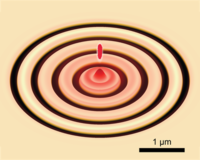
Femtosecond electron pulses are increasingly used as e.g. probes of ultrafast dynamics. The information obtained from these experiments currently is limited by the source’s brightness. This study explores the potential of bullseye plasmonic lenses as ultrafast nanoemitters. This design offers many promising qualities, including emission from a flat nanoscale region and tunability of pulse duration and charge via geometric parameters. Such structures could also be utilized in high-brightness rf guns to enable more signal-intensive experiments, such as detailed spatiotemporal mapping of dynamics in heterogeneous systems, or high-fidelity measurements of weakly scattering systems.

Subnanosecond Fluctuations in Low-Barrier Nanomagnets

J. Kaiser, A. Rustagi, K. Y. Camsari, J. Z. Sun, S. Datta, and P. Upadhyaya

Phys. Rev. Applied 12, 054056 (2019) - Published 25 November, 2019

Fluctuations in nanomagnets are interesting for application in areas such as probabilistic computing, stochastic optimization, statistical sampling, and cryptography, as these fields rely on random numbers. The authors show theoretically and numerically that superparamagnetic nanomagnets can be used to generate random numbers on a subnanosecond time scale. The order parameters of both thermally excited easy-plane and antiferromagnetically coupled nanomagnets are found to possess similar dynamics. This insight could have an impact on emerging devices such as stochastic magnetic tunnel junctions, where such magnets could be used in the free layer to speed operation by orders of magnitude.

Optical Smoothing with Reduced FM-to-AM Conversion in High-Power Lasers Using Spectral Distribution

M. Duluc, D. Penninckx, P. Loiseau, G. Riazuelo, and E. D’humières

Phys. Rev. Applied 12, 054055 (2019) - Published 25 November, 2019

Optical smoothing techniques are crucial for achieving well-controlled experiments at large-scale laser facilities dedicated to high-energy-density physics. Due to detrimental effects in the laser chain, however, those techniques can convert phase modulation into potentially large amplitude modulation, reducing laser performance at the target and causing laser damage. This study uses innovative smoothing paradigms to address this key issue. In particular, one simple solution is to distribute the laser bandwidth over the beams, a result that might have considerable impact on engineering solutions to such problems.

Tunable Quantum Beat of Single Photons Enabled by Nonlinear Nanophotonics

Qing Li, Anshuman Singh, Xiyuan Lu, John Lawall, Varun Verma, Richard Mirin, Sae Woo Nam, and Kartik Srinivasan

Phys. Rev. Applied 12, 054054 (2019) - Published 22 November, 2019

Manipulation of photonic quantum states in the frequency domain can be a valuable physical resource in quantum information processing. Here researchers demonstrate that two essential components for frequency-domain quantum photonics, quantum light generation and quantum frequency conversion, can be realized on a common platform based on integrated nonlinear nanophotonics. The authors realize the tunable quantum beat of single photons, a signature of controlled quantum interference in which single photons are precisely tuned into spectral alignment via quantum frequency conversion.

Geometric Phase and Intensity-Controlled Extrinsic Orbital Angular Momentum of Off-Axis Vortex Beams

Satyajit Maji, Philip Jacob, and Maruthi M. Brundavanam

Phys. Rev. Applied 12, 054053 (2019) - Published 22 November, 2019

Smooth control of the intrinsic orbital angular momentum (OAM) carried by a beam of light is important for e.g. optical tweezers, communication, and quantum information processing, while control of extrinsic OAM is useful for e.g. super-resolution microscopy and light-matter interaction with atoms, molecules, and condensates. This study presents a technique to control intrinsic and extrinsic OAM in a single-path configuration that is free from mechanical errors. By managing the relative intensity and Pancharatnam-Berry phase difference between two orthogonal spatial modes with orthogonal polarizations, one may tune the net transverse linear momentum to yield variable extrinsic OAM.

Time-varying Metasurfaces for Broadband Spectral Camouflage

Mingkai Liu, Alexander B. Kozyrev, and Ilya V. Shadrivov

Phys. Rev. Applied 12, 054052 (2019) - Published 22 November, 2019

There’s more than one way to do it: Concealing an object need not rely on transformation optics. If detection is based on the signature of reflected light, as in radar, then distorting that signature into something unrecognizable can be sufficient. Here the authors design a time-varying metasurface that can act as spectral camouflage, by converting an incident narrowband radar signal into broadband scattered waves that look like white noise. This study provides practical insight for the development of broadband time-varying metasurfaces, and their applications.

Experimental Implementation of a Raman-Assisted Eight-Wave Mixing Process

S.O. Mundhada, A. Grimm, J. Venkatraman, Z.K. Minev, S. Touzard, N.E. Frattini, V.V. Sivak, K. Sliwa, P. Reinhold, S. Shankar, M. Mirrahimi, and M.H. Devoret

Phys. Rev. Applied 12, 054051 (2019) - Published 21 November, 2019

Engineering higher-order nonlinear interactions is vital in autonomous protection of quantum systems against errors. Such interactions are often not directly available, though, or are slow compared to error rates of the system. The authors present a nonlinear eight-wave mixing process that exchanges four photons of a harmonic oscillator with two excitations of a transmon-qubit mode and two pump photons, by combining more accessible lower-order interactions via a sort of Raman transition. Surprisingly, this technique produces a stronger interaction than a six-wave mixing process in the same system. This eight-wave mixing process is expected to become a key component of autonomous continuous-variable quantum error correction.

Electronic Structure Shift of Deeply Nanoscale Silicon by SiO2 versus Si3N4 Embedding as an Alternative to Impurity Doping

Dirk König, Noël Wilck, Daniel Hiller, Birger Berghoff, Alexander Meledin, Giovanni Di Santo, Luca Petaccia, Joachim Mayer, Sean Smith, and Joachim Knoch

Phys. Rev. Applied 12, 054050 (2019) - Published 21 November, 2019

In semiconductor physics for electronics, conventional impurity doping presents a major obstacle to further miniaturization for ultralarge-scale integration. The authors discuss a phenomenon occurring at deep nanoscale Si volumes with a large surface-to-volume ratio: The electronic structure of Si in such nanocrystals is massively shifted by coating with a few monolayers of SiO2 or Si3N4, pushing the Si electronic structure toward or away from the vacuum level respectively. This energy offset of about 0.9 eV allows one to create n-type (SiO2-coated) or p-type (Si3N4-coated) in deep nanoscale Si, mimicking the familiar impurity doping of bulk Si.

Sign In to Your Journals Account

Filter

Subject

Filter

Article Lookup

Enter a citation