Browse by Subject

Scalable Squeezed-Light Source for Continuous-Variable Quantum Sampling

Z. Vernon, N. Quesada, M. Liscidini, B. Morrison, M. Menotti, K. Tan, and J.E. Sipe

Phys. Rev. Applied 12, 064024 (2019) - Published 10 December, 2019

Generation of “squeezed” light is a key technology for quantum information processing with continuous variables. In this field, continuous-variable quantum sampling is a promising candidate for near-term demonstration of quantum advantage. Despite many years of progress, though, a squeezed-light source suitable for quantum sampling has not been demonstrated. This work finally provides a blueprint for squeezed-light sources that can be used for large-scale quantum sampling applications, and thus will have an impact on advancing photonic quantum technology for practical deployment.

Comparative Study of Silicon Photonic Modulators based on Transparent Conducting Oxide and Graphene

Georgios Sinatkas, Thomas Christopoulos, Odysseas Tsilipakos, and Emmanouil E. Kriezis

Phys. Rev. Applied 12, 064023 (2019) - Published 10 December, 2019

Transparent conducting oxides and graphene have dominated research on optical modulation in recent years. Regrettably, studies are often unrealistic, which hinders a clear understanding of the state of the art. The authors revisit both material technologies to present an equitable, quantitative comparison on common grounds, rigorously modeling their shared physical principles. Both inline and resonant configurations are examined from the ground up, using a silicon photonic platform as underlying structure. The proposed modulators are thoroughly compared in terms of performance, demonstrating high-quality switching with rates exceeding 100 GHz.

Methods for Measuring Magnetic Flux Crosstalk between Tunable Transmons

Deanna M. Abrams, Nicolas Didier, Shane A. Caldwell, Blake R. Johnson, and Colm A. Ryan

Phys. Rev. Applied 12, 064022 (2019) - Published 9 December, 2019

To scale up the number of qubits in a quantum processor, it is important that each qubit, or pair of qubits, can be controlled individually. Flux crosstalk between frequency-tunable superconducting qubits means that assumptions about addressability may no longer be valid. In this study, the authors detail several methods for measuring flux crosstalk between transmon qubits. These crosstalk metrics can then be used to predict simultaneous performance of two-qubit gates, and thus employed as engineering milestones on the path to truly scalable quantum computers.

Quantitative Detection of Biological Nanoparticles in Solution via Their Mediation of Colocalization of Fluorescent Liposomes

Olov Wahlsten, Frida Ulander, Daniel Midtvedt, Måns Henningson, Vladimir P. Zhdanov, Björn Agnarsson, and Fredrik Höök

Phys. Rev. Applied 12, 064021 (2019) - Published 9 December, 2019

Measuring the concentration of low-abundance biological nanoparticles or biomolecules suspended in liquid is both important and challenging. The authors show how viruslike particles can be detected by using their ability to induce aggregation of fluorescently labeled lipid vesicles of two different colors. This approach allows a detection limit of a few picomolar in a mere 30 minutes, employing a simple videomicroscope for readout.

Omnidirectional Broadband Low-Frequency Elastic-Wave Concentrator

Hexuan Gao, Wei Liu, Yixiao Sun, Lei Xu, and Zhihai Xiang

Phys. Rev. Applied 12, 064020 (2019) - Published 9 December, 2019

What if we could use small devices to protect buildings from earthquakes? Unfortunately, it is very difficult to trap complex elastic waves over a broad band of low frequencies. This paper addresses the problem by using an omnidirectional concentrator designed via a special transformation method. Experimental results demonstrate that a prototype just 20 cm in diameter can absorb complex elastic waves efficiently in the range of 10–800 Hz. Thus the longstanding dream of seismic protection might be realized by using the “elastic black hole” presented here.

Inkjet Nozzle Failure by Heterogeneous Nucleation: Bubble Entrainment, Cavitation, and Diffusive Growth

Arjan Fraters, Marc van den Berg, Youri de Loore, Hans Reinten, Herman Wijshoff, Detlef Lohse, Michel Versluis, and Tim Segers

Phys. Rev. Applied 12, 064019 (2019) - Published 9 December, 2019

Piezoacoustic drop-on-demand inkjet printing is widely applied in high-end digital printing, due to its remarkable precision and reproducibility. The stability of such printing can be compromised, however, by stochastic entrainment of bubbles in the ink channel. Here bubble nucleation, translation, and growth in an experimental printhead are visualized at microsecond resolution, using high-speed imaging triggered by changes in the ink channel’s acoustics. Impurities in the ink are trapped in the vortical flow close to the nozzle, and can induce bubble nucleation at the oscillating meniscus. These insights should lead to better waveform and nozzle designs, for improved inkjet printing.

Fundamental Efficiency Bounds for the Conversion of a Radiative Heat Engine’s Own Emission into Work

Andreas Pusch, Jeffrey M. Gordon, Alex Mellor, Jacob J. Krich, and Nicholas J. Ekins-Daukes

Phys. Rev. Applied 12, 064018 (2019) - Published 6 December, 2019

Undergraduate coursework familiarizes us with heat engines—but not like these. This study identifies an innovative type of radiative heat engine and derives its fundamental efficiency and power bounds. The findings include the surprising possibility that certain classes of radiative heat engines, such as thermoradiative diodes, can exceed the Landsberg efficiency limit and approach the Carnot limit. Conventional radiative heat engines have a converter coupled to a cold reservoir and absorbing external hot (e.g. solar) radiation to produce work, but here the situation is flipped, with the converter on the hot side generating work from its own radiative emission to the cold side.

Fabrication and Characterization of Aluminum SQUID Transmission Lines

Luca Planat, Ekaterina Al-Tavil, Javier Puertas Martínez, Rémy Dassonneville, Farshad Foroughi, Sébastien Léger, Karthik Bharadwaj, Jovian Delaforce, Vladimir Milchakov, Cécile Naud, Olivier Buisson, Wiebke Hasch-Guichard, and Nicolas Roch

Phys. Rev. Applied 12, 064017 (2019) - Published 6 December, 2019

Highly nonlinear, low-loss, 50-Ω transmission lines are highly desirable for the development of microwave quantum optics, and could be used directly as ultralow-noise traveling-wave parametric amplifiers. Unfortunately, an accessible, widespread fabrication technique is lacking. This study shows that a simple, affordable process based on SQUID arrays is possible. The authors present detailed characterization of such transmission lines and demonstrate in situ tuning of the characteristic impedance. This result should promote research in microwave quantum optics worldwide by broadly increasing access to the necessary traveling-wave structures.

Angular-Asymmetric Transmitting Metasurface and Splitter for Acoustic Waves: Combining the Coherent Perfect Absorber and a Laser

Shuting Cao and Zhilin Hou

Phys. Rev. Applied 12, 064016 (2019) - Published 6 December, 2019

For simplicity and efficiency, metasurfaces need to be constructed of passive and lossless material. On the contrary, a coherent perfect absorber (CPA), and its time-reversal device the laser, require lossy active materials. Thus ideas from CPA design have seldom been extended to metasurfaces. This study shows that the combination of CPA and laser can also work as an efficient wavefront-manipulating device, if the wave energy absorbed by the CPA can be somehow recovered and then re-emitted by the L]laser. Not only could this approach greatly simplify metasurface design, but it could also bridge research efforts on metasurfaces and non-Hermitian systems.

Pump-Probe Study of Plasma Dynamics in Gas-Filled Photonic Crystal Fiber Using Counterpropagating Solitons

M. I. Suresh, F. Köttig, J. R. Koehler, F. Tani, and P. St.J. Russell

Phys. Rev. Applied 12, 064015 (2019) - Published 5 December, 2019

Transient changes in polarizability alter the phase-matching conditions in nonlinear optical processes in a gas-filled hollow-core photonic crystal fiber. Understanding these polarizability changes is crucial for describing light-matter interactions in e.g. high-field laser science. Although techniques to detect these changes exist, they are complex and have not been proven to work in confined geometries. In this study, the wavelength shift of the dispersive wave emitted by a soliton in a fiber is used to probe the plasma at the temporal focus of a counterpropagating pump soliton. By varying the delay between pump and probe, the buildup of plasma is monitored and its spatial profile reconstructed.

Multiple One-Way Edge States From Reciprocal Continuous Media

Jinying Xu, Yineng Liu, K. S. Chan, and Jensen Li

Phys. Rev. Applied 12, 064014 (2019) - Published 5 December, 2019

One-way edge states are emerging as a robust way to control light in topological photonics, in which a high gap Chern number is essential for generating multiple one-way edge states for multiplexing and demultiplexing circuits. Contrary to approaches using gyrotropic photonic crystals, this study shows how reciprocal continuous media with a gauge field and chirality can be used to generate a gap Chern number greater than 1, and to support a maximum of 4 one-way edge states. Such media can be further used to construct one-way signal combiners and splitters, in which branching and transmission efficiencies can be accurately controlled.

Calibration of a Cross-Resonance Two-Qubit Gate Between Directly Coupled Transmons

A.D. Patterson, J. Rahamim, T. Tsunoda, P.A. Spring, S. Jebari, K. Ratter, M. Mergenthaler, G. Tancredi, B. Vlastakis, M. Esposito, and P.J. Leek

Phys. Rev. Applied 12, 064013 (2019) - Published 5 December, 2019

Implementing high-fidelity entangling operations between qubits is a key challenge in quantum computing. Multiple sources of error and a large parameter space make optimization of control schemes for high-fidelity operations a complex technical challenge. This study presents a complete recipe for calibrating a high-fidelity cross-resonance gate implemented between two dispersively coupled transmon qubits, showing that even large amounts of crosstalk can be effectively canceled. This approach should be useful as a general tool for those working on experiments with coupled quantum systems, in particular for computing.

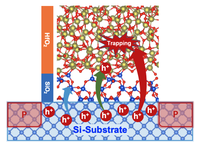
Characterizing the Charge Trapping across Crystalline and Amorphous Si/SiO2/HfO2 Stacks from First-Principle Calculations

Yue-Yang Liu, Feilong Liu, Runsheng Wang, Jun-Wei Luo, Xiangwei Jiang, Ru Huang, Shu-Shen Li, and Lin-Wang Wang

Phys. Rev. Applied 12, 064012 (2019) - Published 5 December, 2019

Charge trapping across multiple interfaces is a universal, important process in semiconductor devices such as high-κ MOSFETs and nonvolatile memory. However, a straightforward simulation framework for such complicated physical processes, and systematic studies of them, are lacking. The authors combine first-principles calculations and Marcus charge-transfer theory in an optimized simulation framework, and apply it to Si/SiO2/HfO2 gate stacks to characterize hole trapping in high-κ gate transistors. This insight and framework could be helpful for studying charge trapping in other semiconductor devices as well.

Near-Ideal Dechirper for Plasma-Based Electron and Positron Acceleration Using a Hollow Channel Plasma

Y.P. Wu, J.F. Hua, C.-H. Pai, W. An, Z. Zhou, J. Zhang, S. Liu, B. Peng, Y. Fang, S.Y. Zhou, X.L. Xu, C.J. Zhang, F. Li, Z. Nie, W. Lu, W.B. Mori, and C. Joshi

Phys. Rev. Applied 12, 064011 (2019) - Published 4 December, 2019

Plasma-based electron/positron wakefield acceleration has made great strides in the past decade. Currently, a major challenge to its application in coherent light sources and linear colliders is the relatively large beam-energy spread, dominated by the energy chirp. The authors propose a nearly ideal dechirper based on a low-density hollow channel plasma to reduce the beam energy spread down to the 0.1% level or even lower, while maintaining beam emittance. This approach may significantly improve the beam quality of plasma-based accelerators, paving the way for compact free-electron lasers and colliders.

Dual-Axis Hanle Magnetometer Based on Atomic Alignment with a Single Optical Access

Gwenael Le Gal, Gaëtan Lieb, François Beato, Thomas Jager, Hervé Gilles, and Agustin Palacios-Laloy

Phys. Rev. Applied 12, 064010 (2019) - Published 4 December, 2019

Optically pumped magnetometers are serious candidates to replace SQUIDs, and thus avoid the need for cryogenics, in applications like magnetoencephalography. In building magnetometer arrays for imaging, a compact yet multiaxis architecture is highly desirable. Here the authors present a scheme based on atomic alignment that only requires one optical access point, bearing both a pump beam and a probe beam at a small angle to it, and that allows measurement of two magnetic field components. Measuring the third component should be possible via partial depolarization of the pump beam. Such a compact scheme opens interesting perspectives for magnetometer arrays for medical imaging.

Omnidirectional Conformal Cloak Without Geometrical Dispersion

Yichao Liu, Fei Sun, and Sailing He

Phys. Rev. Applied 12, 064009 (2019) - Published 4 December, 2019

Invisibility cloaks designed by optical conformal mapping work only at some discrete frequencies, due to the phase-delay problem. The present work solves the phase-delay problem by using an optical null medium in the lower Riemann sheet. This approach has many advantages, such as a continuous working-frequency band (without geometrical dispersion), omnidirectionality, robustness under frequency shift, and no need for complex materials that are anisotropic and inhomogeneous. The technique offers a realistic means to an omnidirectional conformal cloak.

Waveform-Based Geometrical Inversion of Obstacles

Fan Shi and Peter Huthwaite

Phys. Rev. Applied 12, 064008 (2019) - Published 4 December, 2019

Full waveform inversion (FWI) of the shapes of impenetrable obstacles has broad value in e.g. ultrasonic characterization of cracks and voids, seismic-wave inversion of salt bodies, and sonar, as well as parallel topics for electromagnetic waves. The success of FWI for shape reconstruction has been rather limited, though, due to the difficulty of realizing target convergence. The authors propose an FWI scheme to directly invert the geometrical parameters of an impenetrable scatterer, using elastic-wave finite-element formulations. Their iterative approach provides a powerful means to reconstruct the shapes of impenetrable scatterers from full waveform measurements in an automated way.

Manipulation of Orbital-Angular-Momentum Spectrum Using Pinhole Plates

Yuanjie Yang, Qi Zhao, Linli Liu, Yidong Liu, Carmelo Rosales-Guzmán, and Cheng-wei Qiu

Phys. Rev. Applied 12, 064007 (2019) - Published 4 December, 2019

The orbital angular momentum (OAM) spectrum of light, produced by superposition of vortex beams, is important for applications in optical metrology and classical and quantum communication. Nonetheless, manipulation of the OAM spectrum remains challenging. The authors propose a technique for control of the OAM spectrum using structured pinhole plates, which can generate both wide and narrow OAM spectra. In particular, a rather simple pinhole plate can produce an interesting series of discrete, equally spaced OAM modes: an OAM comb, akin to a frequency comb. This approach could be extended beyond photonics to work with rf, acoustic, electron, or neutron composite vortices.

High-Threshold Code for Modular Hardware With Asymmetric Noise

Xiaosi Xu, Qi Zhao, Xiao Yuan, and Simon C. Benjamin

Phys. Rev. Applied 12, 064006 (2019) - Published 3 December, 2019

Practical, large-scale quantum computers require active error correction, but for this to work the components must attain fidelities that are very challenging. Here the authors customize the leading “surface code” approach, layering it on top of a second, simpler code to detect the most common type of noise. Information from the lower-level code is fed into a specialized, advanced controller for the higher-level code so that it can make smarter choices. Numerical simulations confirm that the authors’ code is superior over a wide range of parameters, in terms of noise and hardware connectivity. This work offers a potential path to scaling up quantum hardware under biased noise.

Deep Three-Dimensional Solid-State Qubit Arrays with Long-Lived Spin Coherence

C. J. Stephen, B. L. Green, Y. N. D. Lekhai, L. Weng, P. Hill, S. Johnson, A. C. Frangeskou, P. L. Diggle, Y.-C. Chen, M. J. Strain, E. Gu, M. E. Newton, J. M. Smith, P. S. Salter, and G. W. Morley

Phys. Rev. Applied 12, 064005 (2019) - Published 3 December, 2019

The nitrogen-vacancy center (NVC) in diamond is an exciting candidate system for building a quantum computer, because of its long coherence time at the relatively high temperature of 5 K. Scaling up to a useful quantum computer requires having an array of many individual NVCs in one diamond; such arrays can be created, but suffer from much shorter coherence times than in natural NVCs. This study uses laser writing to create arrays of single NVCs with “natural” spin coherence times, at the right depth for use with optical cavities, enabling arrays of 200,000 coherent NVCs per diamond.

Sign In to Your Journals Account

Filter

Subject

Filter

Article Lookup

Enter a citation