Browse by Subject

High-impedance resonators for strong coupling to an electron on helium

G. Koolstra, E.O. Glen, N.R. Beysengulov, H. Byeon, K.E. Castoria, M. Sammon, B. Dizdar, C.S. Wang, D.I. Schuster, S.A. Lyon, J. Pollanen, and D.G. Rees

Phys. Rev. Applied 23, 024001 (2025) - Published 3 February, 2025

Extendable optical phase synchronization of remote and independent quantum network nodes over deployed fibers

A.J. Stolk, J.J.B. Biemond, K.L. van der Enden, L. van Dooren, E.J. van Zwet, and R. Hanson

Phys. Rev. Applied 23, 014077 (2025) - Published 30 January, 2025

Entanglement generation using the single-photon protocol is of interest for quantum networks, for its reduced sensitivity to photon losses. This protocol requires a stable relative optical phase on the optical link between network nodes. The authors present a phase-synchronization scheme that enables scalable entanglement generation over metropolitan distances, in a robust and extendable infrastructure. Their results show the feasibility of the single-click heralding protocol at long distances, and the approach can also be used with other types of node hardware, for near-term exploration of large-scale quantum networks.

Experimental shadow tomography beyond single-copy measurements

Xu-Jie Peng, Qing Liu, Lu Liu, Ting Zhang, You Zhou, and He Lu

Phys. Rev. Applied 23, 014075 (2025) - Published 29 January, 2025

Autonomous bootstrapping of quantum dot devices

Anton Zubchenko, Danielle Middlebrooks, Torbjørn Rasmussen, Lara Lausen, Ferdinand Kuemmeth, Anasua Chatterjee, and Justyna P. Zwolak

Phys. Rev. Applied 23, 014072 (2025) - Published 28 January, 2025

Magnetic-field-tolerant superconducting spiral resonators for circuit quantum electrodynamics

Mihirangi Medahinne, Yadav P. Kandel, Suraj Thapa Magar, Elizabeth Champion, John M. Nichol, and Machiel S. Blok

Phys. Rev. Applied 23, 014070 (2025) - Published 28 January, 2025

Faster computation of nonstabilizerness

Hiroki Hamaguchi, Kou Hamada, Naoki Marumo, and Nobuyuki Yoshioka

Phys. Rev. Applied 23, 014069 (2025) - Published 28 January, 2025

Quantum gate teleportation with the superposition of causal order

Wen-Qiang Liu and Hai-Rui Wei

Phys. Rev. Applied 23, 014064 (2025) - Published 28 January, 2025

Quantum algorithm for partial differential equations of nonconservative systems with spatially varying parameters

Yuki Sato, Hiroyuki Tezuka, Ruho Kondo, and Naoki Yamamoto

Phys. Rev. Applied 23, 014063 (2025) - Published 28 January, 2025

Effective Hamiltonian and parametric tuning for the cross-cross-resonance gate in the transmon model

Yousung Kang and Kyungsun Moon

Phys. Rev. Applied 23, 014062 (2025) - Published 28 January, 2025

Robust suppression of high-frequency laser phase noise by adaptive Pound-Drever-Hall feedforward

Yu-Xin Chao, Zhen-Xing Hua, Xin-Hui Liang, Zong-Pei Yue, Chen Jia, Li You, and Meng Khoon Tey

Phys. Rev. Applied 23, L011005 (2025) - Published 27 January, 2025

As opposed to feedback, feedforward methods bring new opportunities to suppress high-frequency laser phase noise, but their performance is more susceptible to environmental perturbations, hindering broad application. Tackling the key factors for long-term stability of feedforward based on Pound-Drever-Hall (PDH) detection, the authors construct a compact circuit to adaptively control feedforward gain in response to power variations of cavity transmission. This design achieves robust suppression beyond 40 dB for megahertz noise frequencies. The compact scheme may promote the general use of reliable PDH feedforward in simple, inexpensive lasers for precision quantum control and metrology.

Teleporting two-qubit entanglement across 19 qubits on a superconducting quantum computer

Haiyue Kang, John F. Kam, Gary J. Mooney, and Lloyd C.L. Hollenberg

Phys. Rev. Applied 23, 014057 (2025) - Published 24 January, 2025

Analyzing the performance of CV-MDI QKD under continuous-mode scenarios

Yanhao Sun, Ziyang Chen, Xiangyu Wang, Song Yu, and Hong Guo

Phys. Rev. Applied 23, 014056 (2025) - Published 24 January, 2025

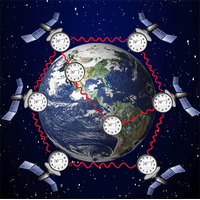
Quantum-assisted master clock in the sky: Global synchronization from satellites at subnanosecond precision

Sage Ducoing, Ivan Agullo, James E. Troupe, and Stav Haldar

Phys. Rev. Applied 23, 014052 (2025) - Published 23 January, 2025

The Global Positioning System (GPS) provides uninterrupted position and timing data across the globe with a precision of up to 40 ns, but is insufficient for advanced applications such as quantum communication, and is susceptible to jamming and spoofing attacks. This article introduces a protocol for synchronizing clocks using a constellation of satellites that relies on the exchange of entangled photons. Simulation shows that 50 low-Earth-orbit satellites bearing off-the-shelf atomic clocks can distribute time globally with a precision that is 2 to 4 orders of magnitude higher than that of GPS. Additionally, the use of entangled photons provides an extra layer of quantum security.

Benchmarking quantum optimization for the maximum-cut problem on a superconducting quantum computer

Maxime Dupont, Bhuvanesh Sundar, Bram Evert, David E. Bernal Neira, Zedong Peng, Stephen Jeffrey, and Mark J. Hodson

Phys. Rev. Applied 23, 014045 (2025) - Published 22 January, 2025

Robust gates inspired by stimulated Raman adiabatic passage for a superconducting dual-rail qubit

Ujjawal Singhal, Harsh Vardhan Upadhyay, Irshad Ahmad, and Vibhor Singh

Phys. Rev. Applied 23, 014044 (2025) - Published 22 January, 2025

Cavity-mode initialization via a Rabi-driven qubit

N. Karaev, E. Blumenthal, G. Moshel, A.A. Diringer, and S. Hacohen-Gourgy

Phys. Rev. Applied 23, 014043 (2025) - Published 21 January, 2025

Low-noise microwave parametric amplifier based on self-heated nonlinear impedance with subnanosecond thermal response

Marco Will, Mohammad Tasnimul Haque, Yuvraj Chaudhry, Dmitry Golubev, and Pertti Hakonen

Phys. Rev. Applied 23, 014037 (2025) - Published 17 January, 2025

Probing fast quantum circuit refrigeration in the quantum regime

Shuji Nakamura, Teruaki Yoshioka, Sergei Lemziakov, Dmitrii Lvov, Hiroto Mukai, Akiyoshi Tomonaga, Shintaro Takada, Yuma Okazaki, Nobu-Hisa Kaneko, Jukka Pekola, and Jaw-Shen Tsai

Phys. Rev. Applied 23, L011003 (2025) - Published 10 January, 2025

Photon-absorption-based quantum circuit refrigeration is crucial to developing superconducting quantum computers, particularly for initializing qubits. However, precise and rapid measurement of residual photons in the circuit immediately after absorption has been a significant technical challenge. This study employs the ac Stark shift of superconducting qubits to detect sub-photon-level energies in the circuit, confirming the effectiveness of the fast refrigeration even in the quantum regime. These results will facilitate the development of more efficient quantum refrigeration devices and faster, high-fidelity qubit initialization.

Circuit optimization of informationally complete positive operator–valued qubit measurements for shadow estimation

Zhou You, Qing Liu, and You Zhou

Phys. Rev. Applied 23, 014021 (2025) - Published 9 January, 2025

In quantum information processing, using positive operator–valued measurements (POVMs) enables the design of general measurement schemes and efficient estimation methods with fixed circuits, but the CNOT-gate count during compilation becomes a bottleneck. This study shows that any single-qubit minimal informationally complete POVM (IC POVM) can be realized with at most two CNOT gates—and a symmetric case (SIC POVM) requires only one. This is achieved by virtually inserting gates to adjust unrelated parameters in the compilation circuit. The authors also provide a concise compilation circuit for single-qubit SIC POVMs, paving the way for practical application.

Quantum neural compressive sensing for ghost imaging

Xinliang Zhai, Tailong Xiao, Jingzheng Huang, Jianping Fan, and Guihua Zeng

Phys. Rev. Applied 23, 014018 (2025) - Published 7 January, 2025

Sign In to Your Journals Account

Filter

Filter

Article Lookup

Enter a citation